
Description of the article « NuviaLab Flex »
Disclosure: This page contains an affiliate link. If you buy through it, we may earn a commission at no extra cost to you. It never changes our scores or conclusions.
Quick Answer
NuviaLab Flex prints its full eleven-ingredient panel, including two branded Sabinsa extracts — Boswellin® boswellia and Curcumin C3 Complex®, 200 mg each — and then undercuts its own headline: the glucosamine, chondroitin and MSM that joint shoppers look for first are present at fractions of the doses used in research. Glucosamine is 500 mg against a standard 1,500 mg trial dose; chondroitin is 100 mg against a typical 800–1,200 mg.
The maker publishes no money-back guarantee, while claiming the product "has no side effects" and works "regardless of the cause" of joint pain — neither claim is defensible. Best for: adults who mainly want boswellia and curcumin in one capsule and treat the rest as background support. Score: 5.2/10.
NuviaLab Flex at a glance
Single bottle$49.99
Best pack$149.97 — 6 bottles ($25.00 per bottle)
Cost per day$0.83–$1.67
FormatCapsules (60 per bottle)
Directions2 capsules a day with about 300 ml of water
Doses publishedFull
What we checked
- The full eleven-ingredient panel is published, with two branded Sabinsa extracts — Boswellin® boswellia and Curcumin C3 Complex® — at plausible doses.
- Glucosamine is 500 mg of the 2KCl salt — about 296 mg of base glucosamine — against the 1,500 mg a day used in trials; chondroitin and MSM sit at garnish levels.
- The capsule shell is gelatin — this product is not vegetarian.
- The maker tells users to have a 25-(OH)D vitamin D blood test before use — responsible advice, given the 2,000 IU dose.
- Glucosamine with chondroitin has case reports of increased INR in people taking warfarin — anyone on anticoagulants needs clinician clearance first.
- No money-back guarantee is published — and the maker claims the product “has no side effects” and works “regardless of the cause”, neither of which is defensible.
Our Score: 5.2/10
| Criterion | Weight | Score | Why |
|---|---|---|---|
| Ingredients | 30% | 5.5 | Full panel with standardisations and two branded extracts at plausible doses; but glucosamine at one-third of the trial dose, chondroitin and MSM at garnish levels, and a gelatin shell |
| Evidence | 25% | 4.5 | Boswellia and curcumin carry modest positive trial records; glucosamine and chondroitin's evidence is contested even at full dose and cannot be borrowed at one-third dose; no trial of this formula |
| Maker credibility | 20% | 5.0 | NuviaLab trademark and Sabinsa brands printed on the panel, FDA disclaimer present; against that, absolute sales claims, an unnamed seller in Hong Kong terms, and no guarantee |
| Safety | 15% | 6.0 | Full caution block plus a genuinely responsible instruction to get a 25-(OH)D blood test before use; against that, a "no side effects" claim the ingredients do not support, and 2,000 IU of vitamin D that stacks with other supplements |
| Value | 10% | 5.0 | $49.99 a month is mid-range and bundles fall to $25.00 a bottle; but several ingredients are part-dosed at full-formula prices, shipping adds $12, and no guarantee stands behind it |
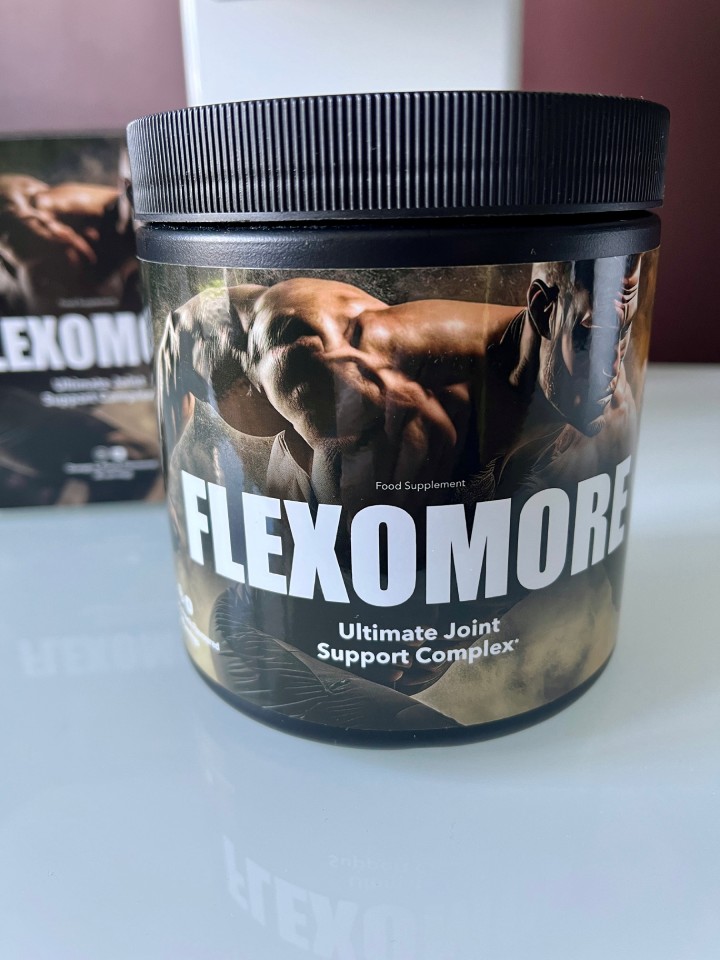
The stronger alternative: Flexomore · 6.8/10The joint formula we scored highest delivers glucosamine at the full trial dose this panel undercuts — 2 g of glucosamine sulfate per scoop, every amount published. It is a powder rather than a capsule, and it also publishes no guarantee.
What It Is
NuviaLab Flex is a 60-capsule bottle — one month at 2 capsules a day, washed down with about 300 ml of water, the directions printed on the panel and repeated in the maker's FAQ. The panel states that NuviaLab® is a registered trademark of NuviaLab Limited, and that Boswellin® and Curcumin C3 Complex® are registered trademarks of Sabinsa.
One detail the marketing does not highlight: the capsule shell is gelatin, so the product is not vegetarian.
Sold via the official website. The formula is a joint-stack in the familiar pattern: the glucosamine–chondroitin–MSM trio up front, boswellia and curcumin as the anti-inflammatory botanicals, then vitamin D, vitamin C, manganese, shilajit and two enzymes in support. The panel is fully disclosed — which is exactly what allows the dose audit that follows, and the audit is where this product gets interesting.
Ingredients (per daily serving of 2 capsules)
| Ingredient | Amount |
|---|---|
| Glucosamine Sulphate 2KCl | 500 mg |
| Boswellia Serrata Resin Extract (70% boswellic acid) — Boswellin® | 200 mg |
| Curcuma Longa Rhizomes Extract (85% curcuminoids) — Curcumin C3 Complex® | 200 mg |
| Chondroitin Sulfate (90% chondroitin) | 100 mg |
| Methylsulfonylmethane (MSM) | 100 mg |
| Shilajit Extract (20% fulvic acids) | 50 mg |
| Bromelain (from pineapple fruit extract) | 50 mg (125 GDU) |
| Papain (from papaya fruit extract) | 50 mg (4,800 MCU) |
| Vitamin C | 80 mg |
| Vitamin D | 50 µg (2,000 IU) |
| Manganese | 1.80 mg |
The dose audit starts with the trio on the front of the box. Glucosamine research — including the large GAIT trial and the European crystalline-sulfate studies — is built on 1,500 mg a day. NuviaLab Flex provides 500 mg, one-third of that. Chondroitin trials typically use 800–1,200 mg a day; this panel provides 100 mg. MSM studies generally run in grams; 100 mg is a token presence, not a dose.
The branded pair fares better. Boswellin® at 200 mg, standardised to 70% boswellic acids, sits within the range used in boswellia trials. Curcumin C3 Complex® at 200 mg delivers about 170 mg of curcuminoids — below the amounts in most knee-pain trials, but a real quantity rather than a dusting. If this formula does anything, the published evidence points to these two extracts doing it.
Vitamin D deserves its own note: 50 µg (2,000 IU) a day is a full maintenance-level dose, relevant because deficiency genuinely does affect bone and muscle. It is also why the maker's caution block — to its credit — tells users to have a 25-(OH)D blood test and discuss the result with a doctor or pharmacist before use. Vitamin C (80 mg, the full reference value) and manganese round out the collagen-support side.
What the Evidence Actually Supports
For glucosamine and chondroitin, the honest summary is "contested at full dose, unborrowable at this one". The largest trial, GAIT (Clegg and colleagues, New England Journal of Medicine, 2006), found the combination no better than placebo overall for knee osteoarthritis pain. Some European trials of prescription crystalline glucosamine sulfate at 1,500 mg a day report benefits, and the question remains debated.
All of that evidence, though, sits at three times the dose in this panel, in a specific preparation this product does not replicate.
Boswellia has the most encouraging file of the botanicals here: several trials and pooled analyses of enriched boswellia extracts report modest improvements in knee pain and stiffness over weeks. The effects are not dramatic and the trials are small, but the direction is consistent, and Boswellin®-type extracts at around this amount are what those trials used.
Curcumin follows close behind: trials in knee osteoarthritis, and meta-analyses pooling them, suggest a modest pain benefit over placebo in the short term. Again the caveats apply — small studies, short durations, and trial doses of curcuminoids usually higher than the roughly 170 mg a day delivered here.
Vitamin D is a correction nutrient, not a joint treatment: restoring a deficient level matters for bone and muscle, which is why the maker's blood-test advice is the most medically literate line on the page. In someone already replete, the extra 2,000 IU has no demonstrated joint benefit.
Shilajit at 50 mg, and bromelain and papain at 50 mg each, sit below the amounts their own literatures discuss; we count them as label decoration rather than active contributions.
Against that record, the maker's claims overshoot badly. The product is said to work "regardless of the cause" of joint pain and to be "helpful in every case"; joint pain has causes — inflammatory arthritis, injury, gout — that no supplement addresses and that worsen while being self-treated.
A claim to restore mobility "to Olympic athletes" and a "98% of customers recommend" figure with no published survey behind it belong in the same category: advertising language, not evidence. There is no trial of NuviaLab Flex itself.
Price and Packs (maker's prices, verified 2026-10-31)
Prices from the maker's order page (US), before shipping. Shipping is $12.00 on every package, with no free-shipping option published.
| Package | What you get | Total | Per bottle |
|---|---|---|---|
| Basic | 1 bottle (1-month supply) | $49.99 | $49.99 |
| Standard — Buy 2, Get 1 Free | 3 bottles (3-month supply) | $99.98 | $33.33 |
| Best Value — Buy 3, Get 3 Free | 6 bottles (6-month supply) | $149.97 | $25.00 |
With shipping, the totals are $61.99, $111.98 and $161.97. The maker publishes no list price and no money-back guarantee — the terms offer only a 10-day withdrawal for unused goods.
Safety Notes
The maker prints a proper caution block: do not exceed the daily dose; not suitable for children or for pregnant or lactating mothers; and — the standout line — before use, it is recommended to have a 25-(OH)D blood test and discuss the result with a doctor or pharmacist. Given the 2,000 IU vitamin D dose, that is responsible advice, and we repeat it rather than soften it. Our additions:
- The maker's "no side effects" claim is not accurate. In trials of its own ingredients, curcumin and boswellia commonly produce mild gastrointestinal effects, and glucosamine can cause digestive upset in some users. "Generally well tolerated" is the defensible statement.
- Vitamin D stacks. 50 µg a day is half the European tolerable upper intake level of 100 µg for adults. On its own that is within bounds, but it adds to any multivitamin, cod-liver oil or standalone D supplement in the same routine — count the total.
- Anticoagulant caution: glucosamine with chondroitin has case reports of increased INR in people taking warfarin. Anyone on anticoagulant medication should clear this product with their clinician first.
- Allergy and diet notes: the shell is gelatin (not vegetarian or vegan), and the panel does not state the glucosamine's source — most glucosamine is shellfish-derived, so anyone with a shellfish allergy should confirm the source before use.
- New, hot, swollen or injured joints need diagnosis, not supplements — and that applies double to a product marketed as working "regardless of the cause".
Frequently Asked Questions
How do I take NuviaLab Flex?
2 capsules a day with about 300 ml of water — the panel's directions, repeated in the maker's FAQ. One 60-capsule bottle lasts one month.
Why is the glucosamine dose lower than in studies?
Because that is what the maker formulated: 500 mg a day, against the 1,500 mg used in GAIT and in the European crystalline-sulfate trials. We flag it rather than explain it away — readers who want a trial-matched glucosamine dose will not find it in this product, and should weigh the boswellia and curcumin content as the real proposition.
Is NuviaLab Flex vegetarian?
No. The capsule shell printed on the panel is gelatin. Vegetarians and vegans should look elsewhere in the category.
Is there a money-back guarantee?
No. We checked the sales page, order page and terms: no money-back guarantee is published. The terms allow withdrawal within 10 days for unused goods only.
Does it have side effects?
The maker says it has none and "can be used by anyone". We do not accept that as written: trials of curcumin and boswellia report mild gastrointestinal effects, glucosamine can upset digestion, and the vitamin D dose interacts with the rest of a supplement routine. The panel's own caution block — blood test, dose limit, exclusions — is the more honest document.
Should I really get a vitamin D blood test first?
The maker recommends it, and on this point we agree with them. At 50 µg (2,000 IU) a day, the product meaningfully changes your vitamin D intake; knowing whether you are deficient turns a guess into a decision, and the result should be discussed with a doctor or pharmacist, as the panel says.
How long before I can judge it?
The boswellia and curcumin trials that report benefits ran for weeks to a few months. A fair self-trial is two to three months, judged on pain and function — while remembering that joint symptoms fluctuate on their own, which is why the trial record, not a good week, anchors our score.
What ingredients are in NuviaLab Flex?
Per 2 capsules, as published: glucosamine sulphate 2KCl 500 mg · Boswellia serrata extract [70% boswellic acid] (Boswellin®) 200 mg · Curcuma longa extract [85% curcuminoids] (Curcumin C3 Complex®) 200 mg · chondroitin sulfate [90%] 100 mg · MSM 100 mg · shilajit extract [20% fulvic acids] 50 mg.
Also per 2 capsules: bromelain 50 mg (125 GDU) · papain 50 mg (4,800 MCU) · vitamin C 80 mg · vitamin D 50 µg (2,000 IU) · manganese 1.80 mg. The capsule shell is gelatin — which is why the product is not vegetarian. The full panel is in the ingredients table on this page.
Where is NuviaLab Flex made, and who makes it?
Only what the panel supports: NuviaLab® is a registered trademark of NuviaLab Limited, and the seller is not named in the terms, which describe a Hong Kong operator.
A manufacturer line on the packaging appears to match the NutriLab LLC printing seen elsewhere in this wave, but it was too small to transcribe with certainty — so we do not print it as verified.
Who Should Buy NuviaLab Flex — and Who Should Skip It
Buy it if: you are shopping mainly for boswellia and curcumin and want them in one fully disclosed capsule; you are willing to have the vitamin D blood test the maker recommends; and you read the glucosamine trio as background support rather than the main event — because at these doses, that is what they are.
Skip it if: you want trial-dose glucosamine or chondroitin (this panel has a third and a tenth of those doses respectively); you are vegetarian or vegan (gelatin shell); you take warfarin and cannot get clinician clearance; your joint pain is new, inflamed or injury-related — that needs diagnosis first; or you want a money-back guarantee, because none is published.
Our verdict: a transparent panel wrapped around an inverted formula — the ingredients with the best evidence sit at the back, the famous trio is underdosed at the front, and the claims on the sales page are larger than both. NuviaLab Flex is buyable for its boswellia and curcumin; it is scored for everything else.
Guides & Research
Every claim on this page is examined in depth in our Joint Health guides — the dose audits, the trial record, the medicine-interaction checks and the stop rule, graded the same way we grade this product:
- How Much Glucosamine Do You Need? The 1,500 mg Standard, Explained
- Is 500 mg of Glucosamine Enough? Reading a Joint Label Against the Trials
- Does Glucosamine Actually Work? GAIT, the Guidelines, and the Form Problem
- Chondroitin and MSM: The Doses Trials Used vs the Doses Labels Deliver
- Boswellia for Joint Pain: Boswellic Acid Percentages vs the AKBA Extracts Trials Used
- Curcumin for Joints: Why Absorption Matters More Than Milligrams
- When Should You Stop a Joint Supplement That Isn't Working?
- Joint Supplements and Your Medicines: Warfarin, Shellfish, Diabetes
- Vitamin D in a Joint Formula: 2,000 IU, and the Blood Test the Maker Tells You to Take
Related Products
Last reviewed: October 2026