
- Quick Answer
- The Timelines, in One Summary
- The Stop Rule
- Why open-ended use persists anyway
- Stopping is a result, not a failure
- How to Run a Fair Trial of One
- One product at a time
- The label dose, not an improvised one
- Write the baseline before the first capsule
- Re-score the same measures at 8–12 weeks
- What a fair trial of Flex actually costs
- When to Stop Sooner Than the Rule
- What Has Better Evidence
- The Verdict
- Keeping the Diary Honestly
- Frequently Asked Questions
- How long should I give a joint supplement before stopping?
- What if I feel slightly better but I am not sure?
- Can I stop and restart later to check whether it was working?
- Should I finish the bottle even if it is clearly doing nothing?
- What should I do instead once I stop?
- Read This Next
Disclosure: This article contains affiliate links. If you buy through them, we may earn a commission at no extra cost to you. It never changes our conclusions.
Quick Answer
Give a joint supplement two to three months at the full label dose, judged against a written note of your pain and function from before you started. That is the fair trial this category asks for, and it is also the limit.
If nothing measurable has improved by then, continued use is unlikely to start helping. The honest move is to stop, keep the money, and put the effort toward the strategies guidelines rank above supplements.
This page gives you the stop rule, a simple way to run the trial fairly, and the cost maths for one real formula. NuviaLab Flex scores 5.2/10 in our review, and it is the worked example throughout.
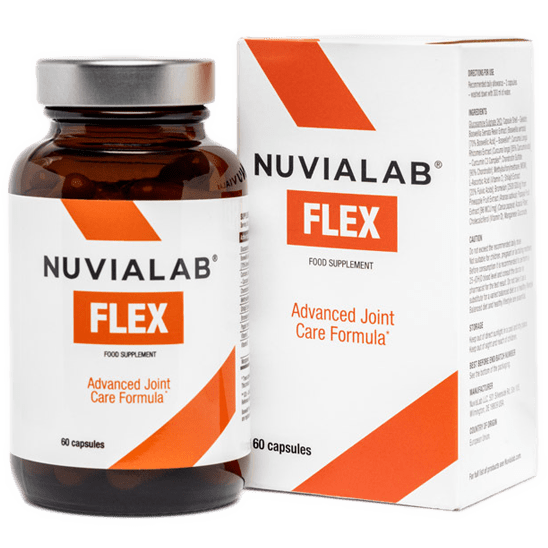
Our Recommendation — NuviaLab Flex
Score: 5.2/10 · Best for: boswellia and curcumin in one fully disclosed capsule. Main caution: no money-back guarantee is published, and the glucosamine trio sits at fractions of the research doses. Fair trial: the three-bottle pack ($99.98 + $12 shipping), judged over two to three months.
The Timelines, in One Summary
Ingredient timelines are covered in full in our companion guide, how long joint supplements take to work. This section is only the summary you need to apply the stop rule below.
The short version runs like this. The earliest signals anyone credibly reports arrive at two to three weeks. Substantial effects, where trials find them at all, usually need six to eight weeks of daily use.
The longest relevant trials ran up to twenty-four weeks. That matters because a supplement judged at ten days has not been tested, while one judged at six months has been given more than the evidence asks.
Different ingredients sit at different points on that clock. Botanicals such as boswellia were assessed over weeks in their trials. Glucosamine, the category's anchor ingredient, is conventionally judged at two to three months.
Combination formulas inherit the slowest clock on their panel, not the fastest. A product containing glucosamine cannot borrow boswellia's shorter assessment window and call itself fairly tested at three weeks.
That is the whole timeline picture this article needs. Anything more detailed — per-ingredient tables, trial by trial — lives in the linked guide, and deliberately not here.
The Stop Rule
The rule itself is simple: take the product at its full label dose for two to three months. If pain and function have not improved by then, stop. Do not drift into a fourth, fifth or sixth month on hope.
This is not our invention. Licensed glucosamine products carry reassessment wording built around the same window: review the treatment after two to three months, and reconsider it if there is no benefit.
Buying-guide consensus lands in the same place. Most guidance allows two to three months before calling a trial failed, with six months as an outer bound a few sources mention for slow responders.
We use the shorter, stricter version, for one practical reason. Every extra month costs real money, and the probability of a late turnaround falls as the weeks pass without any signal at all.
A supplement that is going to help usually leaves some trace by twelve weeks: a slightly easier staircase, a longer comfortable walk, a morning that starts less stiffly. Silence at twelve weeks is itself information.
Why open-ended use persists anyway
If the rule is this clear, why do people take joint supplements for years without knowing whether they work? The largest single reason is the placebo response, and in this category it is unusually large.
In the GAIT trial of 1,583 adults with knee osteoarthritis, 60.1% of the placebo group met the responder definition, compared with rates in the supplement arms that were not significantly higher overall.
Read that again. Six in ten people taking an inert capsule improved enough to count as responders. Joint pain also fluctuates naturally, so a good fortnight will always arrive sooner or later to reward whatever you are taking.
Add ordinary hope and the money already spent, and open-ended use explains itself. Nobody wants to conclude that three bottles bought nothing. The stop rule exists to make that conclusion before a fourth bottle does.
Stopping is a result, not a failure
A completed fair trial that ends in stopping has still done its job. You have answered a question about your own joints, with your own baseline, instead of renting an unanswered question month after month.
Stopping also frees the budget and the attention for the next step. Joint care is a sequence of decisions, and a capsule that earns a clear no lets the better-evidenced options move up the list.
How to Run a Fair Trial of One
A fair trial has four parts: one product at a time, the label dose, a written baseline, and a re-score date fixed in advance. Remove any one of them and the verdict at the end becomes guesswork.
One product at a time
Start one formula and change nothing else you can avoid. If you begin two products in the same month and improve, neither can be credited. If you worsen, neither can be blamed, and both get continued.
The same applies to new exercise programmes and new painkillers started mid-trial. Life will not always cooperate, but note any change in the same diary, so the re-score can be read honestly.
The label dose, not an improvised one
Take the dose the maker prints — for NuviaLab Flex, two capsules a day. Halving the dose to stretch a bottle tests a product nobody studied and nobody sells, and its failure proves nothing.
Escalating above the label dose is equally unfair, in the other direction. With a combination panel, extra capsules multiply every ingredient at once, including nutrients with upper limits. Dose experiments belong in our dose-audit articles, not in a home trial.
Write the baseline before the first capsule
Before you start, write down two or three measures you can repeat. Keep them concrete and personal: pain on stairs out of ten, how far you can walk comfortably, how long morning stiffness lasts.
Add one functional task if you can: rising from a low chair without using your arms, kneeling to garden, opening jars. Function is harder to imagine than pain, which makes it the more honest measure.
Score each measure once, in ordinary words and numbers, and date the page. Memory edits baselines generously after twelve weeks of spending. Paper does not, which is exactly why the paper matters.
Re-score the same measures at 8–12 weeks
At eight to twelve weeks, repeat the identical measures under similar conditions. Same staircase, same walk, same time of day if you can manage it. Then compare the two pages side by side.
Judge the pattern, not a single good day. One pain-free afternoon proves weather, not efficacy. A measure that has moved on most days, in the same direction, is the signal the trial was built to detect.
If two of your three measures are clearly better, continuing is a defensible choice. If none has moved, the stop rule applies. If exactly one has moved slightly, one final month — not three — is the generous reading.
What a fair trial of Flex actually costs
Now the cost reality, because a fair trial is a purchase before it is a verdict. One bottle of NuviaLab Flex holds sixty capsules: at two a day, one bottle is exactly one month.
A two-to-three-month trial therefore means two to three bottles. The single-bottle price is $49.99. On the standard bundle, the per-bottle price falls to $33.33, which is the realistic route for a multi-month trial.
Shipping is $12 on every order, with no free-shipping tier on this panel. Order the trial quantity in one shipment where you can, rather than paying that $12 again for each month's bottle.
And there is no money-back guarantee behind any of it. The maker publishes none. If the verdict at twelve weeks is no, the full cost of finding out stays with you — price that in before bottle one.
When to Stop Sooner Than the Rule
The two-to-three-month rule governs products that simply do nothing. It does not govern products that cause problems. Side effects, new symptoms or a worrying interaction question all end a trial immediately, whatever week it is.
Mild stomach upset in the first days is the common pattern in this category and often settles. Anything beyond mild — a rash, unusual bruising, a swollen or suddenly much more painful joint — is not a wait-and-see event.
Anyone taking regular medication, warfarin above all, should not be running an unsupervised trial in the first place. Our companion safety article covers the interaction list in full; read it before, not after, the first bottle.
Stopping early for a safety reason is not a failed trial either. It is the monitoring working. Record what happened and when, because that note is useful to any clinician you discuss it with.
What Has Better Evidence
Here is the honest redirect, and it is the reason this cluster can be trusted. The interventions with the strongest evidence for osteoarthritis are not capsules at all, and every major guideline says so.
Exercise and strength training sit at the top of both the NICE NG226 guideline for osteoarthritis and the American College of Rheumatology recommendations. Strengthening the muscles around a joint reduces the load the joint itself must carry.
Weight management stands beside exercise in the same guidelines. For weight-bearing joints, lost weight is lost load on every step, all day — a mechanical benefit no ingredient on any panel can replicate.
These are core treatments in the guidelines' own framing, recommended for essentially everyone with osteoarthritis. The same guidelines that place them first are the ones that decline to recommend glucosamine. That contrast is the category in one sentence.
None of this requires a gym membership or a programme you cannot sustain. Guideline-consistent activity can be ordinary: progressive walking, sit-to-stand practice, resistance bands, water-based exercise for sore joints. Consistency outranks intensity.
For pain relief options beyond supplements, our guide to natural alternatives to ibuprofen for joint pain works through the non-drug and topical routes with the same evidence grading used here.
The practical sequence, then, is this. Run one fair supplement trial if you wish. In parallel, start the exercise and weight work. If the capsule earns a no at twelve weeks, the better-evidenced work is already under way.
The Verdict
Applied to this wave's formula, the stop rule gives a clean, testable plan. Our full NuviaLab Flex review scores it 5.2/10: a disclosed panel, plausible botanicals, and structural ingredients well below their trialled doses.
A fair trial of Flex is possible precisely because its timelines can be borrowed from its ingredients. Boswellia contributes a weeks-scale clock; glucosamine contributes the two-to-three-month judgement point. Together they set the re-score date.
Its maker, notably, promises no timeline at all. We note that without inventing one. A maker who will not say when a product should work has left the stop rule entirely to you — so use this one.
Buy two or three bottles only if you will actually keep the baseline diary. Without the diary, the same money buys an opinion you already have. With it, twelve weeks buys an answer you can act on.
Our Recommendation — NuviaLab Flex
Score: 5.2/10 · Best for: boswellia and curcumin in one fully disclosed capsule. Main caution: no money-back guarantee is published, and the glucosamine trio sits at fractions of the research doses. Fair trial: the three-bottle pack ($99.98 + $12 shipping), judged over two to three months.
Keeping the Diary Honestly
The diary only works if it records bad days as faithfully as good ones. Score your measures on a fixed day each week — Sunday evening, say — rather than whenever the joint happens to feel memorable.
Weather, activity and sleep all move joint pain, and a fair diary notes them in a word or two beside the score. A stiff score after a long drive is data, once the drive is written next to it.
Resist mid-trial peeking as a verdict. A glance at week three is fine for encouragement, but no stop-or-continue decision is legitimate before week eight. Early noise, good or bad, is the least reliable reading of the whole trial.
At the re-score, read the baseline page before you write the new scores, not after. Writing the new numbers first and the comparison second keeps today's hope from quietly editing what twelve weeks ago actually felt like.
If a partner or family member sees you climb the stairs daily, ask for their reading too. Outside observers often notice functional change — slower, steadier, fewer hands on the rail — before the person inside the joint does.
Frequently Asked Questions
How long should I give a joint supplement before stopping?
Two to three months at the full label dose. Write a pain and function baseline before you start, re-score the same measures at eight to twelve weeks, and stop if nothing has measurably improved by then.
What if I feel slightly better but I am not sure?
Slight and unsure is the placebo response's home territory — in GAIT, 60.1% of the placebo group met the responder definition. Compare your written baseline, not your impression, and allow at most one extra month for a genuinely borderline re-score.
Can I stop and restart later to check whether it was working?
You can, and a washout can be informative: if symptoms return off the product and ease on it again, that pattern means more than open-ended use ever will. Keep the diary running through the break, or the comparison is memory against memory.
Should I finish the bottle even if it is clearly doing nothing?
No rule requires it. A bottle already paid for is a sunk cost; your next twelve weeks are not. If the re-score says no and no safety issue is involved, stopping mid-bottle is a perfectly rational end to the trial.
What should I do instead once I stop?
Move the budget and effort to the guideline core: progressive exercise and strength work, and weight management where relevant. If pain persists or the pattern changes, that is a clinician conversation — supplements were never the only door.
Last reviewed: October 2026. This article is educational and is not medical advice.
