
- Quick Answer
- What Cameron 2014 Actually Found
- The Metric Problem: Boswellic Acid % vs AKBA
- What boswellic acids are, and which one the trials keyed on
- What this label declares
- The Dose Placement: Where 200 mg Sits
- How Fast Does Boswellia Work — Days or Weeks?
- The Mechanism, in Plain Terms
- Safety and Tolerability, Briefly
- The Verdict for This Label
- Frequently Asked Questions
- What did the Cochrane review find for boswellia?
- What is AKBA, and why does it matter more than boswellic acid percentage?
- Is 200 mg of Boswellin the same as the 100 mg used in trials?
- How long does boswellia take to work?
- What AKBA percentage does ordinary boswellia extract contain?
- Is Boswellin a bad ingredient?
- Read This Next
Disclosure: This article contains affiliate links. If you buy through them, we may earn a commission at no extra cost to you. It never changes our conclusions.
Quick Answer
Boswellia has the strongest small-trial file of any botanical in the formula audited here — but the positive trials tested a specific kind of extract. The Cochrane-reviewed material was enriched for one compound, AKBA, and given at just 100 mg a day.
NuviaLab Flex declares Boswellin at 70% total boswellic acid, with no AKBA figure anywhere on its panel. Total boswellic acid and AKBA content are different metrics. A large number on the first tells you nothing certain about the second.
So the honest verdict is two-sided: the weight, 200 mg, is plausible — and the headline metric is not the one the trials used. Best for: readers comparing boswellia labels. Flex scores 5.2/10 in our review.
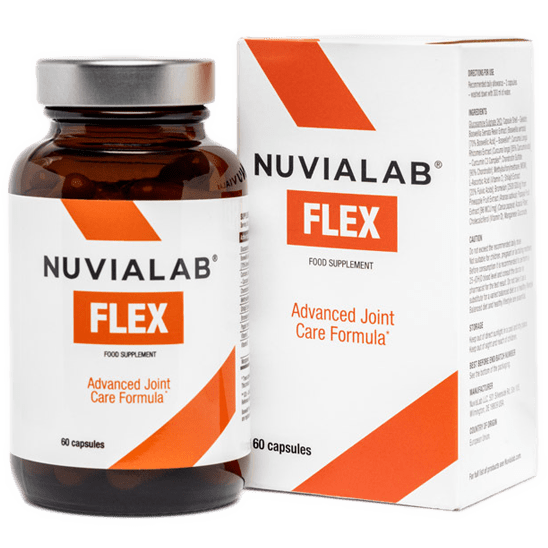
Our Recommendation — NuviaLab Flex
Score: 5.2/10 · Best for: boswellia and curcumin in one fully disclosed capsule. Main caution: no money-back guarantee is published, and the glucosamine trio sits at fractions of the research doses. Fair trial: the three-bottle pack ($99.98 + $12 shipping), judged over two to three months.
What Cameron 2014 Actually Found
The anchor evidence is Cameron and Chrubasik's 2014 Cochrane review of herbal medicines for osteoarthritis (PMID 24848732, CD002947). Cochrane reviews sit at the top of the evidence hierarchy: independent, protocol-driven, and obliged to report weak findings as weak.
For Boswellia serrata extract, the review rated the evidence high quality — a grade Cochrane rarely hands to a botanical. The result it summarised was a genuinely strong effect on the two outcomes patients care about most: pain and physical function.
The figures, in full: two studies, 85 participants in total, took 100 mg a day of enriched Boswellia serrata extract for 90 days. Pain fell by a mean of 17 points more than placebo, with a 95% confidence interval of 8 to 26 points.
That pain scale ran from 0 to 100, and the placebo groups sat at about 40 points. A 17-point advantage against a placebo score of 40, among those 85 participants, is a large relative effect — the kind supplement marketing dreams about.
Function improved too, by a mean of 8 points more than placebo on the same 0–100 framing, with a 95% confidence interval of 2 to 14 points. Smaller than the pain effect, but in the same direction and statistically distinguishable from zero.
Now the other half of the sentence, which we print every time: two studies and 85 participants is a small evidence base. High-quality methods in tiny trials still leave wide uncertainty, and small positive literatures are exactly where later, larger trials often disappoint.
Both halves are the finding. A strong effect, on small numbers, for a specific enriched extract, over 90 days. Remove any one of those qualifiers — especially the word "enriched" — and you are no longer describing what Cameron and Chrubasik reviewed.
Later work has not overturned that picture so much as underlined its scale problem. A 2020 meta-analysis by Yu and colleagues found large short-term effects for boswellia across more trials, while rating the underlying evidence quality very low. Direction consistent; certainty still thin.
The Metric Problem: Boswellic Acid % vs AKBA
Boswellia serrata is frankincense — the resin of a tree tapped for centuries in Ayurvedic practice. Its active chemistry is a family of related compounds called boswellic acids, and "family" is the word this entire article turns on.
What boswellic acids are, and which one the trials keyed on
The boswellic acids share a structure and a name, but they are not interchangeable. One member — AKBA, short for 3-O-acetyl-11-keto-beta-boswellic acid — is the family's most potent inhibitor of 5-LOX, an enzyme on the inflammatory pathway these extracts are used for.
That potency is why the research extracts were built around it. The best-known enriched material, 5-Loxin, is standardised to 30% AKBA — a concentration far beyond what raw resin naturally carries. Enrichment is a manufacturing process, not a description of the plant.
When Cameron's reviewed trials reported success at only 100 mg a day, the low dose makes sense only alongside the enrichment. A small amount of a concentrated, AKBA-rich extract is a different intervention from the same weight of ordinary resin extract.
This is the pattern to carry to every label: for boswellia, the meaningful specification is not how much extract, or even how much total boswellic acid. It is how much AKBA the standardisation guarantees. Trials keyed on that number. Marketing keys on the others.
What this label declares
NuviaLab Flex uses Boswellin, a branded Boswellia serrata extract, at 200 mg per day, standardised to 70% boswellic acid. Seventy percent sounds rigorous — and as a statement about the total family of boswellic acids, it may well be accurate.
What the panel does not state, anywhere, is an AKBA figure. Not a percentage, not a milligram amount. The one member of the family the enriched trial extracts were standardised for is the one number this label leaves blank.
The two metrics cannot be equated. Seventy percent total boswellic acid could conceal a wide range of AKBA content, because AKBA is only one fraction of that total — qualitatively, a minor fraction of unenriched extracts. We print no specific share, because no verified figure exists for this grade.
That restraint is itself the lesson. If a reviewer cannot convert "70% boswellic acid" into an AKBA amount from published data, neither can a buyer — and neither, honestly, can the comparison the marketing invites between this label and the Cochrane trials.
None of this accuses the maker of a false claim. "70% boswellic acid" is a real specification, printed openly. The failure is comparative: the number answers a question the evidence never asked, while the question the evidence did ask goes unanswered.
The Dose Placement: Where 200 mg Sits
Judged on milligrams alone, 200 mg of boswellia extract looks comfortable. The Cochrane pattern was 100 mg a day — and this label doubles it. That comparison is the one the formula wants you to make, and it is incomplete in an instructive way.
The dose-ranging evidence comes from Sengupta et al. 2008, which tested 5-Loxin at 100 mg and 250 mg a day against placebo in knee osteoarthritis. At 250 mg, pain, stiffness and function all improved; at 100 mg, mainly pain did.
Provenance matters for that study, and we state it plainly: the work came from the enriched extract's own research line, run at the maker's research centre, and it has not been replicated by independent teams. Maker-centre trials are evidence — discounted evidence, not no evidence.
The same research line produced a 2010 comparison by Sengupta and colleagues, in which a second enriched extract, Aflapin, performed better than 5-Loxin on several outcomes. We include it because honest reviewing does: even inside the maker's own programme, the enriched extracts are not interchangeable.
Against those enriched-extract trials, set the older dosage pattern for ordinary extracts. Standardised-extract guides commonly describe 300–500 mg, two to three times daily, of extracts standardised to at least 65% boswellic acid — gram-level daily totals, far above any enriched-extract dose.
Flex's 200 mg of a 70% extract sits between those two patterns. It is double the enriched trials' weight without their enrichment, and a fraction of the gram-level totals the ordinary-extract pattern describes. Between the patterns is exactly where a metric question, not a milligram question, decides.
So the dose placement verdict is deliberately unglamorous. Two hundred milligrams is a plausible weight for a boswellia ingredient — the kind of figure a serious formulator might choose. Plausible weight, unverifiable specification. Both clauses belong in any honest summary of this ingredient.
How Fast Does Boswellia Work — Days or Weeks?
Boswellia marketing loves speed. Claims of meaningful relief within a week circulate widely in this category, and they trace back to a traceable source: the enriched-extract research line, where the 250 mg group in Sengupta 2008 showed improvements from day seven.
Hold that claim to its conditions. Day-seven signals appeared at the higher dose of an AKBA-enriched extract, in a maker-centre trial, on the extract's own research programme. Independent teams have not replicated the rapid-onset finding, and it cannot be detached from the material that produced it.
The independent evidence works on a slower clock. Cameron's Cochrane assessment measured outcomes at 90 days — three months of daily use before the pain and function figures quoted above were recorded. That is the timeframe the strongest evidence actually supports.
Guide consensus lands between the two: most dosage references suggest allowing four to eight weeks before judging a boswellia product. That is slower than the advertising and faster than glucosamine's two-to-three-month judgement window, and it is the expectation we would set.
For this formula specifically, no timeline can be promised at all. Its extract is not the enriched material behind the seven-day claims, and the maker publishes no trial of the finished product. A fair self-trial is weeks, judged in writing — not days, judged by hope.
There is a wider point here about how onset claims travel. A result earned by one branded extract, at one dose, in one centre, gets retold as a property of the plant. Boswellia does not work in seven days. One enriched preparation, in one study, showed early signals.
The Mechanism, in Plain Terms
Why would a tree resin affect joint pain at all? The working explanation runs through inflammation chemistry. Boswellic acids inhibit 5-lipoxygenase — 5-LOX — an enzyme that produces leukotrienes, signalling molecules involved in inflammatory responses in joint tissue.
That pathway is also what separates boswellia from the glucosamine story. Glucosamine and chondroitin are structural ingredients, sold as building material. Boswellia is a signalling ingredient: it does not supply cartilage parts, it interferes with one of the chemical cascades that make joints hurt.
Within the boswellic acid family, the members differ sharply at this enzyme. AKBA inhibits 5-LOX most potently, which is why researchers bothered to enrich extracts for it at all. A family-wide percentage averages the strong member together with its weaker relatives.
Laboratory potency is not clinical proof, and we do not present it as such. Plenty of potent enzyme inhibitors disappoint in people. The mechanism's role here is narrower: it explains why the AKBA specification is scientifically meaningful, rather than a pedantic detail reviewers invented.
It also explains the dose paradox that confuses label readers. A hundred milligrams of an extract engineered around the most potent family member can expose tissue to more of that member than several hundred milligrams of a general extract. Weight comparisons assume uniform contents; resin extracts are not uniform.
Safety and Tolerability, Briefly
Boswellia's trial safety record is part of its appeal. In the osteoarthritis literature, reported side effects are generally mild — digestive upset, nausea or diarrhoea in a minority of participants — and dropout rates in the enriched-extract trials were low. Nothing in the file suggests a hazardous ingredient.
Two cautions still belong on the record. Boswellia products are not all identical, so tolerability data from an enriched extract does not automatically describe every resin preparation. And anyone on regular medication should treat any daily botanical as a conversation for their pharmacist, not an assumption.
For this formula, the practical point is simpler. Boswellia is not the ingredient that drives our safety reservations about NuviaLab Flex — those sit elsewhere on its panel. The reservation here is evidentiary: an unmeasured AKBA content behind a strong ingredient's good name.
That distinction is worth keeping, because category marketing blurs it deliberately. "Clinically studied ingredient" can mean the exact extract was trialled, or that a chemically different extract of the same plant was. Boswellia shows how wide that gap can be inside one honest-looking panel.
A final reading habit follows from all of this. When a boswellia label names its extract, ask three questions: how many milligrams, standardised to what, and is the standardised compound the one the trials used? Flex answers the first two cleanly. The third is where it stops.
The Verdict for This Label
Of everything in this formula, boswellia is the ingredient we criticise least. It has a Cochrane-reviewed evidence file, a plausible daily weight on this panel, and a branded extract with a printed standardisation. That combination puts it ahead of the formula's token-dose structural ingredients.
As our full NuviaLab Flex review records, the reservation is precise rather than general: the specification that made the trials positive — AKBA enrichment — is the specification this label does not declare. Until it does, the Cochrane figures describe a relative of this ingredient, not this ingredient.
The fix costs the maker one printed number. An AKBA percentage on the panel would let every reader perform the comparison this article had to leave unfinished. Its absence, on an otherwise fully disclosed label, is the most revealing gap in the formula.
Our Recommendation — NuviaLab Flex
Score: 5.2/10 · Best for: boswellia and curcumin in one fully disclosed capsule. Main caution: no money-back guarantee is published, and the glucosamine trio sits at fractions of the research doses. Fair trial: the three-bottle pack ($99.98 + $12 shipping), judged over two to three months.
Frequently Asked Questions
What did the Cochrane review find for boswellia?
Cameron and Chrubasik (2014) found high-quality evidence from two studies with 85 participants: 100 mg a day of enriched Boswellia serrata extract for 90 days reduced pain by 17 points (95% CI 8 to 26) on a 0–100 scale where placebo sat at 40, and improved function by 8 points (95% CI 2 to 14).
What is AKBA, and why does it matter more than boswellic acid percentage?
AKBA is one member of the boswellic acid family — and the most potent inhibitor of the 5-LOX inflammatory enzyme among them. The enriched extracts behind the positive trials were standardised to AKBA (5-Loxin carries 30%). A label quoting total boswellic acid percentage is measuring the whole family, not the member the trials keyed on.
Is 200 mg of Boswellin the same as the 100 mg used in trials?
No — the comparison fails on specification, not weight. The trials used AKBA-enriched extract; this label declares 70% total boswellic acid with no AKBA figure. Two hundred milligrams of an unenriched-metric extract cannot be equated with 100 mg of an enriched one, in either direction, from the information published.
How long does boswellia take to work?
The Cochrane evidence was assessed at 90 days, and guide consensus suggests judging a product at four to eight weeks. The widely quoted seven-day improvements come from one maker-centre trial of an enriched extract at 250 mg, unreplicated independently. Plan on weeks, and judge against a written baseline.
What AKBA percentage does ordinary boswellia extract contain?
We do not print a figure, because no verified share for unenriched, Boswellin-grade extract is published in the material available to us. Qualitatively, AKBA is a minor fraction of the total boswellic acids in unenriched extracts — which is precisely why enrichment exists, and why a missing AKBA figure cannot be filled in by assumption.
Is Boswellin a bad ingredient?
Not on the evidence available. It is a branded extract with an openly printed total-boswellic-acid standardisation, present at a plausible 200 mg. Our criticism is comparative: its specification cannot be matched against the AKBA-standardised extracts the positive trials used. That is a disclosure gap, not a quality finding — and one printed number would close it.
Last reviewed: October 2026. This article is educational and is not medical advice.
