
- Quick Answer
- Why Is Vitamin D in a Joint Formula at All?
- 50 µg = 2,000 IU: The Unit Maths
- Two frames, two impressions
- Why the conversion trips people up
- Should You Really Get a 25-(OH)D Test Before Taking It?
- What the 2024 guideline actually says
- The other official voice: insufficient evidence
- When testing does earn its cost
- Our verdict on the maker's instruction
- Stacking: How 4,000 IU Sneaks Up on You
- The tie-back to doubling up
- What the Label Does Not Tell You
- Food, Sunlight and the Rest of the Total
- The Verdict for This Label
- Frequently Asked Questions
- Is 2,000 IU of vitamin D a high dose?
- How do I convert micrograms to IU for vitamin D?
- Do I need a blood test before taking vitamin D?
- What happened to the 30 ng/mL target I have seen quoted?
- Can I take this alongside a multivitamin?
- What are the signs of too much vitamin D?
- Read This Next
Disclosure: This article contains affiliate links. If you buy through them, we may earn a commission at no extra cost to you. It never changes our conclusions.
Quick Answer
The vitamin D dose in this joint formula is 50 micrograms, which is 2,000 IU. That is more than three times the adult recommended amount, and exactly half the tolerable upper limit. Mid-range, in other words — not a trace, not a megadose.
Unusually, the panel itself tells you to take a 25-(OH)D blood test and consult the result before use. Current guidelines are less demanding than that instruction — for healthy adults, the 2024 guidance advises against routine testing altogether.
Our verdict: at this dose, taken long-term, a baseline test is defensible for reasons the guidelines themselves supply. The maker's caution is a point in its favour — provided "test first" never becomes "test forever". NuviaLab Flex scores 5.2/10 overall.
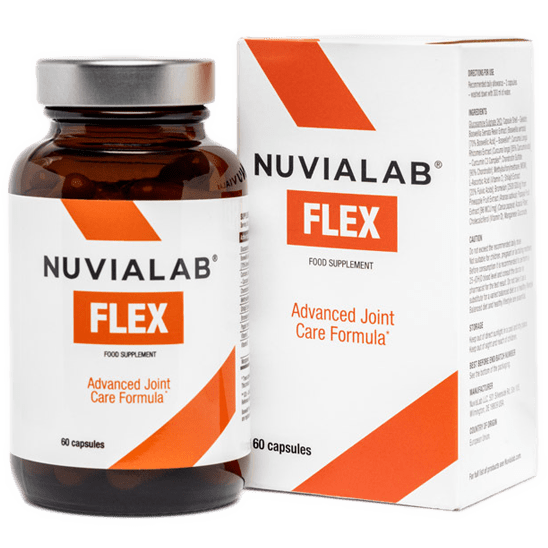
Our Recommendation — NuviaLab Flex
Score: 5.2/10 · Best for: boswellia and curcumin in one fully disclosed capsule. Main caution: no money-back guarantee is published, and the glucosamine trio sits at fractions of the research doses. Fair trial: the three-bottle pack ($99.98 + $12 shipping), judged over two to three months.
Why Is Vitamin D in a Joint Formula at All?
Credit the rational kernel first, because there is one. Vitamin D deficiency genuinely causes bone pain and, when severe, osteomalacia — softened bones that ache in ways patients and clinicians alike can mistake for joint pain.
Correcting a real deficiency can therefore ease real pain. That is a legitimate reason for a joint formula to contain vitamin D, and at 2,000 IU this panel contains enough to matter for a deficient user.
But notice the claim's exact shape. Repletion helping a deficient person is a different claim from vitamin D helping osteoarthritis in a person whose levels are already adequate. The first has a mechanism and a record; the second does not.
Osteoarthritis is a cartilage and joint-structure condition, not a deficiency state. No honest panel can promise that topping up an already sufficient vitamin D level will repair it, and this article will not pretend otherwise.
The deficiency question itself — how deficiency presents, who gets it, and how it mimics joint disease — is covered in full in our companion article on vitamin D deficiency and joint pain. This page stays on dose, testing and stacking.
So the ingredient earns its place conditionally. If you are deficient, it is arguably the most useful line on the panel. If you are not, it is a maintenance nutrient riding inside a joint product — harmless within limits, but not a joint treatment.
50 µg = 2,000 IU: The Unit Maths
Vitamin D is labelled in two units that confuse almost everyone, including many people who take it daily. Micrograms measure weight. International Units measure biological activity. For vitamin D, one microgram equals forty IU.
The arithmetic for this panel is therefore simple: 50 µg multiplied by forty gives 2,000 IU per day, at the label dose of two capsules. Every figure that follows in this article is that same dose, restated.
Now place it against the reference figures in the NIH Office of Dietary Supplements vitamin D fact sheet. The Recommended Dietary Allowance is 600 IU a day for adults up to age seventy.
Above age seventy, the RDA rises to 800 IU a day. So this formula delivers roughly three times the RDA for a younger adult, and two and a half times the RDA for an older one, before any other source is counted.
The ceiling matters more than the target. The tolerable upper intake level for adults is 4,000 IU a day from all sources. At 2,000 IU, this single product uses half your entire upper-limit budget on its own.
Two frames, two impressions
Here is why the same dose can look extreme or modest depending on who prints it. The label expresses vitamin D as 1,000% of the Nutrient Reference Value — a frame that makes 2,000 IU look enormous.
The NRV is a labelling reference set at a low, population-wide level, equivalent to 200 IU. Against that small denominator, any genuinely useful dose produces a startling percentage. Percentages of NRV are a labelling convention, not a risk scale.
The upper-limit frame tells the calmer story: 2,000 IU is fifty percent of the 4,000 IU ceiling — a real dose with real headroom, provided nothing else is stacking on top of it.
Neither frame is lying; they answer different questions. Our habit is to judge supplemental vitamin D against the upper limit and the RDA together, and to treat four-digit NRV percentages as typography, not toxicology.
Why the conversion trips people up
The dual-unit system causes a recurring practical error. A reader sees "50" on one label and "2,000" on another and assumes the second product is forty times stronger, when both may deliver the identical dose.
It also causes the reverse error when stacking. A multivitamin printed in micrograms and a standalone product printed in IU can be the same nutrient counted twice under two names. Section five of this article does that sum carefully.
Should You Really Get a 25-(OH)D Test Before Taking It?
This question is product-specific for a simple reason: the maker asks it. The panel of this formula instructs the user to take a 25-(OH)D blood test and consult the result before use. Few supplement panels say anything of the kind.
25-(OH)D — twenty-five-hydroxyvitamin D — is the blood marker clinicians use for vitamin D status. The maker's instruction therefore deserves a serious answer, not a marketing one: does current guidance agree that you should test first?
What the 2024 guideline actually says
The current position is the Endocrine Society's 2024 clinical practice guideline by Demay and colleagues, published in the Journal of Clinical Endocrinology and Metabolism. For generally healthy adults, it suggests against routine 25-(OH)D testing.
That "against" is broad. It covers adults with obesity and adults with darker skin — two groups the society's earlier guidance had specifically flagged for testing. The 2024 panel looked for trial evidence that screening improves outcomes, and did not find it.
The same guideline quietly retired a number many readers will recognise. The 2011 guidance treated 30 ng/mL as the target level for sufficiency. The 2024 guideline no longer endorses that target, because outcome-linked thresholds were not established in trials.
This matters for anyone holding an old test result. A report flagging you "insufficient" against a 30 ng/mL line is using a retired ruler. Ask which threshold your clinician is applying before treating the flag as a diagnosis.
The other official voice: insufficient evidence
The United States Preventive Services Task Force reached a neighbouring conclusion in 2021. Reviewing screening for vitamin D deficiency in asymptomatic adults, the USPSTF found the evidence insufficient to judge whether screening helps or harms.
"Insufficient evidence" is not a recommendation against testing; it is an honest statement that the trials needed to settle the question have not been done. Together, the two bodies describe a field screening widely ahead of its proof.
That context disciplines both extremes. Routine testing of every healthy adult is not evidence-based. Neither is the claim that testing is useless — in the right clinical situation, below, it answers questions nothing else can.
When testing does earn its cost
Testing earns its cost when the result would change what you do. Symptoms suggesting deficiency or bone disease — unexplained bone pain, muscle weakness, a fragility fracture — make a baseline level genuinely informative for a clinician.
Malabsorption changes the picture as well. Coeliac disease, inflammatory bowel disease, bariatric surgery and certain medicines can all impair vitamin D handling, and a test verifies whether oral doses are being absorbed at all.
Long-term use of a higher-dose product is the third case, and it is the one this formula creates. If you intend to take 2,000 IU daily for months or years, one baseline result converts guesswork into a known starting point.
That is the reason the guidelines themselves quietly supply: they address routine screening of healthy, unsupplemented adults. A person committing to a standing daily dose above the RDA is no longer quite the population the recommendation was written for.
Our verdict on the maker's instruction
The maker is more cautious than the guidelines demand, and that caution is a point in the maker's favour. A panel that asks for a blood test before use is behaving more responsibly than one promising effortless benefit.
The nuance is the stopping rule for testing itself. "Test first" must not become "test forever". Without symptoms, a change in dose, or a clinical reason, routine repeat testing adds cost without adding decisions.
One baseline, a result discussed with a doctor or pharmacist as the panel directs, and then a settled dose — that is the proportionate reading of the instruction, and the one we recommend printing alongside any purchase.
Stacking: How 4,000 IU Sneaks Up on You
Upper limits apply to totals, not to products. Nobody exceeds 4,000 IU by taking one sensibly dosed capsule; people exceed it by taking three sensible products whose vitamin D nobody added together.
Run a realistic sum. This joint formula contributes 2,000 IU. A typical multivitamin contributes around 1,000 IU. A standalone winter vitamin D product, bought separately and forgotten in the same cupboard, commonly contributes another 1,000 to 2,000 IU.
The total is 4,000 to 5,000 IU a day — at or above the tolerable upper limit — assembled entirely from products that each looked moderate on their own label. Add fortified foods and the dietary contribution, and the margin narrows further.
Excess vitamin D harms through calcium. Too much vitamin D raises blood calcium, and hypercalcaemia brings nausea, thirst, frequent urination and confusion, with kidney stones among its longer-term costs. It is a slow harm, which is why the arithmetic matters early.
The remedy is a list, not a test. Write down every supplement you take, convert each vitamin D line to IU using the forty-times rule, and add them. That five-minute sum is the stacking check this category actually requires.
The tie-back to doubling up
Our dose-audit article for this formula works the mirror-image problem: a reader who triples the capsules to chase the glucosamine dose simultaneously triples the vitamin D to 6,000 IU, past the upper limit.
The two articles meet at the same lesson. In a combination formula, no ingredient can be adjusted alone. Every escalation and every stack moves the vitamin D line too, and that line has a hard ceiling.
What the Label Does Not Tell You
Two facts about this vitamin D line are absent from the panel, and both are worth naming. The label does not state whether the vitamin D is D2 or D3, the two forms used in supplements.
That omission is common rather than sinister, and at 2,000 IU either form will raise levels in most people. But a reader comparing products, or correcting a diagnosed deficiency, is entitled to know which form they are buying.
The label also gives no source information for the vitamin D. For most readers that is trivia; for readers avoiding specific animal-derived ingredients, it is one more unanswered line on an otherwise unusually complete panel.
We record these as gaps, not as faults that change the dose maths. The amount is printed, the unit conversion checks out, and the test instruction is present — the three things this article most needed the label to provide.
Food, Sunlight and the Rest of the Total
Supplemental IU are only part of a person's vitamin D total, and the upper limit counts all of it. Diet contributes modestly for most people: oily fish is the one genuinely rich ordinary food source.
Fortified foods — milk, plant drinks, spreads and cereals in many markets — add smaller amounts that are easy to overlook precisely because nobody bought them as supplements. They belong in the same written sum.
Sunlight is the source the body regulates itself. Skin synthesis slows as levels rise, which is why the toxicity cases in the medical literature are supplement stories, not sunshine stories. You cannot sunbathe your way past the upper limit.
That asymmetry is the practical point of this section. The controllable, countable risk sits in the cupboard, in printed doses. Add those doses up once, in IU, and the food and sunlight background rarely changes the verdict.
Season and latitude still matter for status, if not for toxicity. A reader starting a long-term dose in winter, far from the equator, is the reader for whom the baseline test discussion in the previous section carries most weight.
The Verdict for This Label
Judged on its vitamin D line alone, this is one of the panel's stronger entries. Our full NuviaLab Flex review records the dose, the test instruction and the 5.2/10 overall score the wider panel earns.
The ingredient is rational, the dose is real, and the attached instruction is unusually responsible. In a formula whose structural ingredients sit far below their trialled doses, the vitamin D is the one nutrient delivered at full scale.
The joint benefit, if any arrives, runs through deficiency — through correcting a low level in a person who needed correcting. For a reader whose level is already adequate, expect maintenance, not repair, from this line of the panel.
Take the maker's test instruction in its proportionate form: one baseline if you will take it long-term, the result discussed as directed, your other vitamin D sources added up once, in writing. Then the dose can be left alone.
Our Recommendation — NuviaLab Flex
Score: 5.2/10 · Best for: boswellia and curcumin in one fully disclosed capsule. Main caution: no money-back guarantee is published, and the glucosamine trio sits at fractions of the research doses. Fair trial: the three-bottle pack ($99.98 + $12 shipping), judged over two to three months.
Frequently Asked Questions
Is 2,000 IU of vitamin D a high dose?
It is a mid-range dose. It is roughly three times the 600 IU recommended amount for adults up to seventy, and exactly half the 4,000 IU tolerable upper limit. Judge it against both numbers, not against the label's 1,000% NRV figure.
How do I convert micrograms to IU for vitamin D?
Multiply micrograms by forty. This panel's 50 µg is therefore 2,000 IU. The same rule converts any label: 25 µg is 1,000 IU, and 10 µg is 400 IU. Use it whenever you add up doses across products.
Do I need a blood test before taking vitamin D?
For a healthy adult at ordinary doses, the 2024 Endocrine Society guideline suggests against routine testing. Testing earns its cost with deficiency symptoms, malabsorption, bone disease, or a plan to take a higher dose long-term — the situation this formula creates.
What happened to the 30 ng/mL target I have seen quoted?
It was retired. The Endocrine Society's 2011 guidance used 30 ng/mL as a sufficiency target; the 2024 guideline no longer endorses it, because trials did not establish outcome-linked thresholds. Older reports and articles still quote it widely.
Can I take this alongside a multivitamin?
Only after doing the sum. This formula gives 2,000 IU; a typical multivitamin adds around 1,000 IU, and a standalone vitamin D product can add 1,000–2,000 IU more. Keep your all-sources total under the 4,000 IU upper limit.
What are the signs of too much vitamin D?
Excess vitamin D raises blood calcium. Early signs of hypercalcaemia include nausea, loss of appetite, thirst, frequent urination and confusion, with kidney stones a longer-term risk. If those appear on a stacked regimen, stop and seek medical advice promptly.


Last reviewed: October 2026. This article is educational and is not medical advice.
