
- Quick Answer
- Where 1,500 mg Comes From
- The Forms: Sulfate, Hydrochloride, and Why the Split Matters
- Sulfate vs Hydrochloride: Different Forms, Different Trial Records
- What "Crystalline" and Pharmaceutical-Grade Mean
- Salt vs Base: The Conversion Every Label Hides
- Reading Any Label Against the Standard
- Frequently Asked Questions
- How much glucosamine should I take per day?
- Is it better to take 1,500 mg at once or 500 mg three times a day?
- Is 500 mg of glucosamine a full dose?
- What is the difference between glucosamine sulfate and hydrochloride?
- How do I convert a label's salt figure to glucosamine itself?
- What if a label just says "glucosamine 1,500 mg" with no form named?
- Does the standard dose differ for hands, hips or other joints?
- Does a combination formula need less glucosamine?
- Read This Next
Disclosure: This article contains affiliate links. If you buy through them, we may earn a commission at no extra cost to you. It never changes our conclusions.
Quick Answer
The standard glucosamine dose is 1,500 mg per day. That is the amount the major trials used, and the amount licensed glucosamine medicines are built around, taken either once daily or as 500 mg three times a day.
Crucially, 1,500 mg is a figure for the glucosamine salt, not for glucosamine itself. Every glucosamine ingredient is a salt or a stabilised complex, and part of its weight is the carrier chemistry, not glucosamine.
So two labels can both look close to the standard while delivering different amounts of glucosamine itself. Reading a label means asking three questions: which form, which figure, and salt or base?
Form matters as much as amount. The strongest trial dataset belongs to one pharmaceutical-grade crystalline sulfate preparation, at the full 1,500 mg, and that result cannot simply be borrowed by any sulfate label.
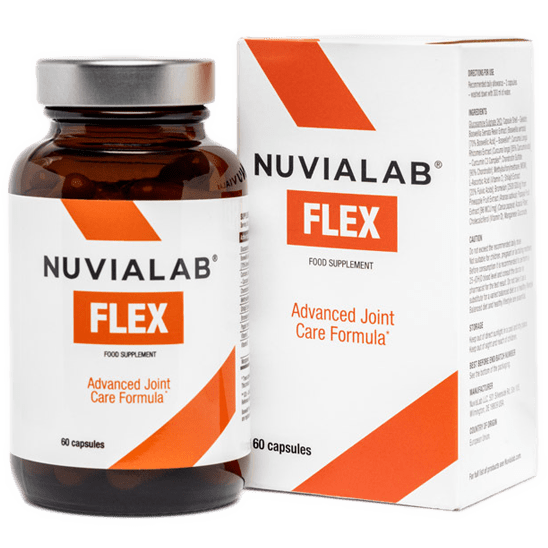
Our Recommendation — NuviaLab Flex
Score: 5.2/10 · Best for: boswellia and curcumin in one fully disclosed capsule. Main caution: no money-back guarantee is published, and the glucosamine trio sits at fractions of the research doses. Fair trial: the three-bottle pack ($99.98 + $12 shipping), judged over two to three months.
Where 1,500 mg Comes From
The 1,500 mg figure was not chosen by marketers. It emerged from the European trial programme on glucosamine sulfate for knee osteoarthritis, where researchers settled on that daily amount and then repeated it across studies.
Licensed products followed the trials. In countries where glucosamine sulfate is sold as a medicine, the standard licensed presentation is a 1,500 mg once-daily dose, commonly as a powder dissolved in water.
That convergence matters. When trialists, regulators and licence holders all land on the same number, the number becomes the reference point against which every supplement label should be measured.
It does not make 1,500 mg a recommendation. NICE guideline NG226, covering osteoarthritis in people over 16, does not recommend glucosamine at all, a position we examine properly in our companion evidence article.
The dose question and the effectiveness question are therefore separate. This article answers the first: if glucosamine is used at all, what dose does the evidence base actually describe?
The answer stays 1,500 mg. Lower amounts appear on countless combination labels, but appearance is not evidence. No major osteoarthritis trial programme was built around 500 mg a day.
Splitting the dose changes nothing in total. Regimens of 500 mg taken three times daily and regimens of 1,500 mg taken once daily both describe the same daily amount of the salt.
Once-daily dosing belongs mainly to the licensed crystalline sulfate products. Three-times-daily dosing appears in several older trials and in supplement routines built around capsules taken with meals.
What no credible regimen does is present 500 mg, taken once, as the full standard. Yet that is exactly how many combination labels are read, because the number 500 sits beside the word glucosamine.
The trial dose was also a daily dose, taken consistently for months. The symptom studies ran for weeks to months, and the structural studies ran for up to three years, always at the same 1,500 mg of salt per day.
That consistency cuts against a common label defence: that a smaller amount, taken for longer, amounts to the same thing. No trial tested that trade. Dose and duration were fixed together, and only that pairing carries evidence.
The dose was not adjusted for body weight, joint, or severity in those programmes. Trial participants of different sizes received the same 1,500 mg. Labels suggesting personalised smaller doses are improvising beyond the record.
The licensed equivalence figures show why precision matters.
The licence convention states that 1,884 mg of the stabilised complex is equivalent to 1,500 mg of glucosamine sulphate, which is itself equivalent to 1,178 mg of glucosamine.Read that chain slowly. Three different numbers can describe the same dose, depending on whether the writer means the whole complex, the sulphate salt, or glucosamine itself. Labels exploit that ambiguity, deliberately or not.
A buyer comparing a 1,500 mg headline on one product with a 500 mg line on another may not even be comparing the same layer of that chain. Our dose audit article works one real label through every layer.
The Forms: Sulfate, Hydrochloride, and Why the Split Matters
Glucosamine is unstable on its own, so it is sold in stabilised forms. The two common ones are glucosamine sulfate, usually stabilised with potassium chloride or sodium chloride, and glucosamine hydrochloride.
The forms are not interchangeable in the trial record. Positive and negative results cluster by form and by preparation quality, which is why a simple glucosamine-works-or-not verdict misleads in both directions.
Sulfate vs Hydrochloride: Different Forms, Different Trial Records
The positive European trials cluster on sulfate. The long-term studies that reported slower joint-space narrowing and symptom benefits used glucosamine sulfate, at 1,500 mg daily, over periods running to three years.
The best-known null result used the other form. In GAIT, reported by Clegg and colleagues in the New England Journal of Medicine in 2006, patients took glucosamine hydrochloride at 1,500 mg per day.
GAIT found no supplement arm beating placebo overall in its knee osteoarthritis population, compared with the placebo arm of the same trial. That result is about hydrochloride, tested in that population, at that dose.
It is routinely quoted as a verdict on all glucosamine. It is not. Equally, the sulfate trials are routinely quoted as a verdict on all glucosamine, and they are not that either.
There is also a chemistry difference worth knowing. Hydrochloride carries more glucosamine per gram than the stabilised sulfate complex does, because its carrier is lighter. Milligram headlines therefore mislead across forms too.
A gram of hydrochloride and a gram of sulfate complex do not deliver the same amount of glucosamine itself. The sulfate case rests on its trial record, not on superior glucosamine content per gram.
Some researchers have suggested the sulfate component itself may contribute. That remains a hypothesis, not a settled mechanism, and it is another reason the two forms should not be treated as identical.
Readers will also meet a third form, N-acetyl glucosamine. It is a different chemical relative, sold in some joint and gut products. Its osteoarthritis record is thinner than either main form, and the 1,500 mg standard does not describe it.
The sodium chloride stabilised sulfate deserves a mention too. Some sulfate material is stabilised with sodium chloride rather than potassium chloride. The glucosamine fraction differs accordingly, which is why the full stabiliser name belongs in any honest comparison.
For a label reader, the practical rule is simple.
Note the form first, then the amount, then ask whether trials of that form, at that amount, exist at all.What "Crystalline" and Pharmaceutical-Grade Mean
The preparation behind the strongest dataset has a specific name: prescription or pharmaceutical-grade crystalline glucosamine sulfate, often abbreviated to pCGS. It is a patented, stabilised crystalline form, dosed at 1,500 mg once daily.
Crystalline describes how the sulfate is stabilised so it does not degrade. Ordinary glucosamine sulfate is hygroscopic, meaning it absorbs moisture and breaks down, which is why cheap material needs stabilising salts.
The crystalline patent solved that stability problem in a particular way. The resulting product was then used, consistently, through the European trial programme, giving that one preparation an unusually coherent dataset.
Guideline bodies notice that coherence. The ESCEO group, for example, supports pharmaceutical-grade crystalline sulfate specifically, while treating other glucosamine preparations as lacking the same evidence, a split we detail in the evidence article.
Supplement-grade sulfate is not assumed equivalent. A capsule labelled glucosamine sulphate 2KCl uses a potassium-chloride-stabilised material, made to food-supplement standards, not the patented crystalline medicine used in those trials.
That does not make supplement material inert or fake. It means the strongest evidence in the category belongs to a defined preparation, and a different preparation cannot automatically inherit it.
Its legal status varies by country, which confuses comparisons. In several European markets the crystalline preparation is a licensed medicine. Elsewhere, including the United States, glucosamine is sold only as a food supplement, whatever the label language implies.
Quality language on labels needs the same care.
Words like pure, premium and pharmaceutical-grade are marketing unless they name the actual crystalline preparation and its licence. Ask what, exactly, is in the capsule.Dose and form therefore work as a pair. Full dose of the trialled preparation is one claim. Full dose of a different form is a weaker claim. Part dose of a different form is weaker still.
Salt vs Base: The Conversion Every Label Hides
Every glucosamine figure hides a conversion. The ingredient is weighed as a salt or complex, but the active molecule is only part of that weight. The rest is the stabilising chemistry.
Take the common supplement form, glucosamine sulphate 2KCl. Its full chemical complex has a molecular weight of 605.52, and glucosamine itself accounts for 59.2 percent of that weight, by molecular weight.
So 1,500 mg of the 2KCl complex provides 888 mg of glucosamine itself. The arithmetic is simple multiplication: the complex weight, multiplied by 0.592, gives the glucosamine base figure.
Printed labels confirm the same conversion. Products declaring 1,500 mg of the complex declare about 888 mg of glucosamine, and products declaring 1,000 mg of the complex declare about 591 mg of glucosamine.
Neither figure is a lie. The 1,500 mg trial standard is itself a salt figure, so a label quoting 1,500 mg of the complex is quoting the same layer the trials quoted.
The problem starts when layers are mixed. A label quoting its glucosamine base figure can look smaller than a rival quoting its salt figure, even when both products deliver exactly the same dose.
The reverse trick also exists. A label can headline the largest number in the chain, the whole complex, while a reader assumes that number is glucosamine itself. The gap is over 40 percent, by weight.
Stabilisers differ, so conversions differ. The 2KCl complex, the sodium chloride form and hydrochloride each carry glucosamine in a different proportion. There is no single conversion factor for every label.
That is why the licence equivalence chain is so useful. It anchors one form honestly: 1,884 mg of complex, 1,500 mg of sulphate, 1,178 mg of glucosamine, all describing one licensed dose.
A smaller worked example shows the method in miniature. A serving of 750 mg of the 2KCl complex provides about 444 mg of glucosamine itself, and sits at half the trialled salt dose. Both statements are true, at different layers.
Per-capsule figures need the same care. One capsule holding 250 mg of the complex provides about 148 mg of glucosamine itself. Two such capsules make the 500 mg serving our audit article examines in full.
For any other label, the method matters more than memorised numbers.
Find the full ingredient name, find which layer its amount describes, then convert, or compare like with like at the salt layer.Our next article applies exactly that method to one real label, where 500 mg of the 2KCl salt becomes only about 296 mg of glucosamine itself. The gap decides that product's score.
Reading Any Label Against the Standard
Start with the daily amount, not the capsule amount. Labels quote per capsule, per serving and per day in different places, and only the daily figure can be compared with the 1,500 mg standard.
Next, read the full chemical name. Glucosamine sulphate 2KCl, glucosamine hydrochloride and crystalline glucosamine sulfate are three different ingredients for evidence purposes, however similar their names look on a crowded panel.
Then decide which layer the number describes. If a panel prints both a complex figure and a glucosamine figure, it is being unusually honest. If it prints one number, work out which layer it must be.
Watch the front of the pack as well as the panel. A large 1,500 mg claim may describe a three-capsule serving, a two-ingredient combined weight, or the complex weight rather than glucosamine itself. The panel's serving definition decides which reading is honest.
Then compare like with like.
A daily salt figure goes against the 1,500 mg salt standard. A daily base figure goes against the roughly 1,178 mg base equivalent of that licensed standard.Finally, discount combination logic. Putting glucosamine beside chondroitin, MSM and botanicals does not lower the dose glucosamine itself was trialled at. Each ingredient keeps its own trial dose, whatever shares its capsule.
Applied to this wave's product, the method is unkind. As our full NuviaLab Flex review records, its panel prints glucosamine sulphate 2KCl at 500 mg per daily serving of two capsules.
That is one third of the 1,500 mg salt standard, before any conversion. Converted, it is about 296 mg of glucosamine itself, against the 888 mg base figure a full 1,500 mg of the same complex provides.
Credit where due: the form is at least sulfate, the form the European trials used, and the amount is printed in full. Many rival labels hide behind proprietary blends, where even this audit is impossible.
But a printed low dose is still a low dose. The same panel gives chondroitin and MSM at 100 mg each, far below their own trial ranges, which our chondroitin and MSM article audits separately.
The label's stronger ground is its botanicals. It carries Boswellin at 200 mg and Curcumin C3 Complex at 200 mg, providing about 170 mg of curcuminoids, with no BioPerine or other absorption enhancer declared.
It also carries vitamin D at 50 micrograms, or 2,000 IU, a full dose by any standard. That strength cuts both ways, as our article on taking extra capsules shows in uncomfortable arithmetic.
The verdict on dose is therefore narrow and firm. Anyone choosing glucosamine on the trial model needs the full 1,500 mg salt dose, of a defined form, and should read every smaller figure as a different, untested proposition.
Our Recommendation — NuviaLab Flex
Score: 5.2/10 · Best for: boswellia and curcumin in one fully disclosed capsule. Main caution: no money-back guarantee is published, and the glucosamine trio sits at fractions of the research doses. Fair trial: the three-bottle pack ($99.98 + $12 shipping), judged over two to three months.
Frequently Asked Questions
How much glucosamine should I take per day?
The trial and licensed standard is 1,500 mg per day of the glucosamine salt. That is the only dose with a substantial osteoarthritis trial record behind it. Smaller amounts are common on labels, but common is not the same as tested.
Is it better to take 1,500 mg at once or 500 mg three times a day?
Both patterns appear in the evidence base, and both total the same daily amount. Licensed crystalline sulfate products are designed for once-daily use. Supplement routines often split the dose with meals. The total matters more than the split.
Is 500 mg of glucosamine a full dose?
No. Five hundred milligrams is one third of the 1,500 mg standard. If the 500 mg figure describes the 2KCl salt, it provides only about 296 mg of glucosamine itself. No major trial supports 500 mg daily for osteoarthritis outcomes.
What is the difference between glucosamine sulfate and hydrochloride?
They are different stabilised forms with different trial records. The positive long-term trials cluster on sulfate, particularly one crystalline preparation. The largest independent trial, GAIT, used hydrochloride and found no overall benefit against placebo in its population.
How do I convert a label's salt figure to glucosamine itself?
For glucosamine sulphate 2KCl, multiply the complex weight by 0.592. That gives the glucosamine base figure: 1,500 mg becomes 888 mg, and 500 mg becomes about 296 mg. Other forms use different factors, so check the full ingredient name first.
What if a label just says "glucosamine 1,500 mg" with no form named?
Treat the claim as unverifiable. Without the form, you cannot know which conversion applies, which trial record is relevant, or whether the figure describes salt or base. A defined full dose names its form. Silence on form is itself information about the label.
Does the standard dose differ for hands, hips or other joints?
The trial record behind the standard is overwhelmingly a knee osteoarthritis record. The 1,500 mg figure was not established separately for hands or hips. Extending it to other joints is common practice in this market, but it is an extension, not a tested finding.
Does a combination formula need less glucosamine?
There is no evidence that companion ingredients lower glucosamine's trialled dose. Combination trials that reported results used full doses of each main ingredient. A combination label carrying a third of the glucosamine standard is making an untested claim, not applying a known synergy.

Last reviewed: October 2026. This article is educational and is not medical advice.
