
- Quick Answer
- The Trial Doses
- Why Absorption Matters More Than the Milligram Number
- The Missing Partner: C3 Without BioPerine
- Turmeric Powder vs Curcumin Extract
- What "Curcuminoids" Actually Contains
- The Other Enhancement Routes, and What They Show
- How to Read Any Curcumin Label in Thirty Seconds
- The Interaction Pointer
- The Verdict for This Label
- Frequently Asked Questions
- How much curcumin did the joint trials use?
- Why does curcumin need an absorption enhancer?
- Does NuviaLab Flex contain BioPerine?
- Is eating turmeric the same as taking a curcumin extract?
- Can curcumin interact with blood thinners?
- Is 85% curcuminoids a strong standardisation?
- Read This Next
Disclosure: This article contains affiliate links. If you buy through them, we may earn a commission at no extra cost to you. It never changes our conclusions.
Quick Answer
Curcumin's joint trials used 500–1,500 mg a day of extract — and, overwhelmingly, absorption-enhanced forms of it. Curcumin is absorbed so poorly on its own that the enhancer is not a bonus feature in this literature. It is close to the price of entry.
NuviaLab Flex provides 200 mg of Curcumin C3 Complex, standardised to 85% curcuminoids — about 170 mg of curcuminoids — with no BioPerine and no other absorption enhancer anywhere on its panel. It starts two handicaps down: below the trial dose band, and unenhanced.
This article deliberately stays narrow: dose, absorption, and one branded extract. The general questions live in our guides to turmeric for joint pain and turmeric versus glucosamine, which we do not restate here.
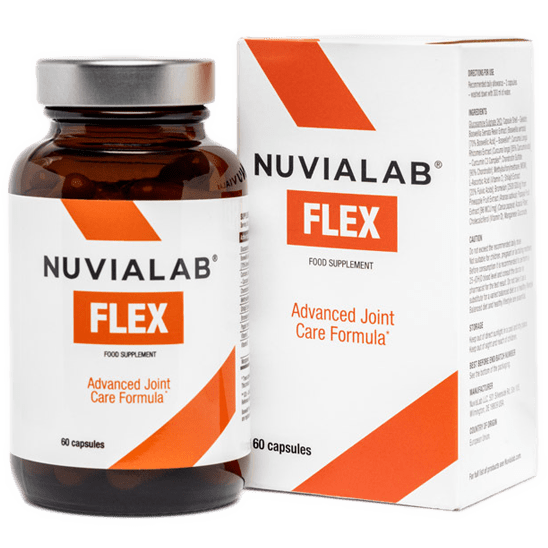
Our Recommendation — NuviaLab Flex
Score: 5.2/10 · Best for: boswellia and curcumin in one fully disclosed capsule. Main caution: no money-back guarantee is published, and the glucosamine trio sits at fractions of the research doses. Fair trial: the three-bottle pack ($99.98 + $12 shipping), judged over two to three months.
The Trial Doses
Start with the range. Human trials of curcumin extracts for joint pain typically use 500–1,500 mg of extract a day, most of it standardised — commonly to around 95% curcuminoids in the trial material. That band is the yardstick every label should be measured against.
The high-water mark is Kuptniratsaikul and colleagues, 2014, in Clinical Interventions in Aging. People with knee osteoarthritis took 1,500 mg a day of a Curcuma domestica extract, in divided doses, for four weeks — and it matched ibuprofen at 1,200 mg a day.
Read that result with its full frame attached. Four weeks is short. The comparison was against a standard painkiller dose, in knee osteoarthritis specifically, and matching ibuprofen on pain scores over a month is not the same as modifying the disease underneath.
Even with those cautions, it remains the strongest curcumin-for-joints result in print — and it was earned at 1,500 mg a day. Seven and a half times the extract weight on the label audited here, before any question of absorption is even raised.
At the band's lower end, 500 mg a day is where most commercial curcumin trials begin, and those trials overwhelmingly use enhanced formulations — the subject of the next section. An ordinary, unenhanced extract at 500 mg is already a weaker proposition than the same figure suggests.
Flex's position is therefore doubly exposed. Its 200 mg sits below the entire 500–1,500 mg trial band, and its curcuminoid content — 85% of 200 mg, roughly 170 mg — sits further below the curcuminoid amounts the standardised trial extracts delivered daily.
Percentages deserve one clarification here, because labels exploit the confusion. Eighty-five percent curcuminoids is a purity figure: it describes what fraction of the 200 mg is curcuminoid. It does not enlarge the 200 mg. Purity and dose are separate numbers, and both matter.
Why Absorption Matters More Than the Milligram Number
Curcumin has a defining pharmacological problem: the body barely lets it in. Swallowed on its own, most curcumin is broken down or expelled before it reaches the bloodstream, and what does arrive is rapidly processed by the liver and gut wall.
This is not a fringe view from the ingredient's critics. Poor oral bioavailability is the agreed starting point of curcumin research — the fact that has driven two decades of formulation science, from phytosomes to nanoparticles to simple, older tricks.
The oldest trick is the best documented. In Shoba et al. 1998, published in Planta Medica, healthy human volunteers took 2 g of curcumin with and without 20 mg of piperine — the active alkaloid of black pepper.
Curcumin alone produced serum levels that were undetectable or very low in those volunteers. With 20 mg of piperine alongside, curcumin bioavailability rose roughly twenty-fold compared with the same curcumin dose taken without it. Twenty-fold is not a refinement; it is a different exposure.
The mechanism explains the size of the effect. Piperine slows glucuronidation, one of the disposal processes that tags curcumin for removal, and interferes with transport pumps that push compounds back into the gut. Block the exits, and far more of a poorly absorbed compound survives.
Shoba's study was small and measured blood levels, not joint outcomes. We state that plainly. But its lesson for label reading is direct: for curcumin, the formulation around the milligrams can matter more than the milligrams themselves. Dose without delivery is half a specification.
That is why the enhanced-form literature dominates the trial record. Phytosome preparations bind curcumin to phospholipids to carry it across. Other programmes pair it with piperine. Plain extract trials exist, but the field's centre of gravity sits with enhanced forms — at enhanced doses.
It also reframes what a fair label comparison looks like. "200 mg of curcumin extract" and "200 mg of a piperine-paired curcumin extract" are not two versions of one dose. On Shoba's numbers, their blood-level consequences can differ by an order of magnitude.
The Missing Partner: C3 Without BioPerine
Now the specific check this article exists to make. Curcumin C3 Complex is Sabinsa's branded curcumin extract — a respected raw material with a genuine clinical programme behind it. The question is what that programme actually administered to its participants.
Sabinsa's own clinical programme pairs Curcumin C3 Complex with BioPerine, the same maker's branded piperine. Panahi and colleagues, 2014, gave people with metabolic syndrome 500 mg of C3 with 5 mg of BioPerine — the combination, not the curcumin alone.
The pairing repeats across the programme. The curcuminoids–piperine trials in type 2 diabetes used the combination, and Sabinsa's own study list includes an osteoarthritis trial run on C3 plus BioPerine together. We cite the maker's list for the pairing fact only, and name it as a maker source.
That distinction matters. We are not asking you to trust Sabinsa's effect claims; we are noting what Sabinsa itself chose to test. When the ingredient's own maker studies its curcumin, it adds its piperine. The combination is the studied product, in the maker's own judgement.
Against that record, read this panel. NuviaLab Flex lists Curcumin C3 Complex at 200 mg per day, standardised to 85% curcuminoids — and lists no BioPerine, no piperine, no black pepper extract, and no other absorption enhancer of any kind, anywhere among its ingredients.
The formula has, in effect, bought the famous half of a famous pair. C3's clinical reputation was built in combination, at higher doses, with the enhancer included. This label keeps the brand name, reduces the dose below the trial band, and omits the partner.
Could the curcumin still do something unenhanced? Possibly, at some level — unenhanced curcumin is not literally inert, and gut-level effects are discussed in the literature. But "not literally inert" is a long way from the trial record the brand name invites you to imagine.
The fair summary is exact: the ingredient is genuine, the standardisation is printed, the dose is 200 mg, and the absorption partner its own maker pairs it with is absent. Every clause of that sentence is checkable from the panel and the published programme.
Turmeric Powder vs Curcumin Extract
A common reader question deserves its short, separate answer: can't you just eat turmeric? Whole turmeric root powder is only about 2–5% curcuminoids by weight. The spice is mostly starch, fibre and other compounds; the studied molecule is a small minority of it.
Do the kitchen arithmetic. A generous teaspoon of turmeric powder weighs roughly three grams, which at 2–5% delivers approximately 150–200 mg of curcuminoids — before absorption losses, which for unenhanced curcumin are severe. Cooking fat and a long simmer change the picture only modestly.
Surprisingly, that teaspoon figure is in the same neighbourhood as this capsule's 170 mg of curcuminoids. The comparison cuts both ways: it shows kitchen turmeric is not the trial material — and it shows how modest a 200 mg extract dose really is.
Trial extracts concentrate the curcuminoids to 85–95% and deliver them at 500–1,500 mg a day, usually enhanced. Neither a spice rack nor this label reproduces that exposure. Enjoy turmeric as food; do not mistake it, or a small extract dose, for the Kuptniratsaikul regimen.
The extract-versus-powder distinction also explains label pricing games. "Turmeric 1,000 mg" on a cheap label often means a gram of root powder — perhaps 20–50 mg of curcuminoids. A smaller printed weight of standardised extract can carry several times more of the studied compounds. Milligrams of what is always the question.
What "Curcuminoids" Actually Contains
One more piece of label literacy pays off here. "Curcuminoids" is itself a family name, covering three related compounds in turmeric extract: curcumin, demethoxycurcumin and bisdemethoxycurcumin. Curcumin is the largest share and the most studied; the other two ride along in every standard extract.
C3 Complex's 85% figure counts all three together. So the roughly 170 mg of curcuminoids in this formula is not 170 mg of pure curcumin — it is 170 mg of the family, with curcumin as its majority member. Trial extracts quoted at 95% curcuminoids carry the same family structure.
This is not a trick unique to this maker; it is how the ingredient class is standardised everywhere. We explain it because buyers compare percentages across labels as if they were a single molecule's purity. They are a family's combined share, on every label, including the good ones.
The Other Enhancement Routes, and What They Show
Piperine is not the only answer the field produced. Phytosome technology binds curcumin to phosphatidylcholine, a fat-like carrier, so the compound crosses the gut wall with its escort. Products built this way were then trialled in osteoarthritis at defined, enhanced doses.
Other programmes used micelles, nanoparticles or simply combined curcumin with turmeric's own oils. The technologies differ; the shared admission does not. Every serious research group treated plain curcumin's absorption as a problem to be engineered around, not a detail to be ignored.
That consensus is the strongest argument in this article. You do not need to trust any single study — not Shoba, not any brand's programme — to conclude that delivery matters. The entire formulation literature, across competing companies and methods, behaves as if it matters.
Set against that consensus, an unenhanced extract is not a neutral choice. It is the one format the research mainstream moved away from. A maker choosing it owes the buyer either a much larger dose to compensate, or a reason. This label offers neither.
Dose compensation has limits worth noting. Swallowing five times more unenhanced curcumin does not reliably produce five times the blood level, because the bottleneck is processing, not supply. That is why "just take more capsules" fails as a fix here, quite apart from this formula's other ingredients.
How to Read Any Curcumin Label in Thirty Seconds
The checklist mirrors the one we teach for every ingredient in this set. First, find the extract amount per day — not per capsule. Second, multiply by the curcuminoid percentage to get the curcuminoid dose. Third, look for the absorption technology, named explicitly.
Then compare against the trial frame: 500–1,500 mg of extract a day, enhanced. A product at 500 mg with a named enhancer passes the frame's shape, whatever its other merits. A product at 200 mg with no enhancer named fails it twice, as this one does.
Finally, distrust any label that prints only "turmeric" with a large weight and no standardisation. That is root powder arithmetic — a gram of it may carry less curcuminoid than this capsule does. Whatever Flex's curcumin shortcomings, an openly standardised 85% extract is not that game.
The Interaction Pointer
One safety point belongs here, briefly, because curcumin buyers meet it constantly. Curcumin has antiplatelet activity, and the standard caution in the literature is about combining curcumin products with blood-thinning medication, where the effects could add together in the wrong direction.
We give that interaction its full treatment in our joint-supplement safety and interactions guide, alongside the warfarin record for glucosamine — not here. If you take an anticoagulant, that guide, and your anticoagulant clinic, come before any curcumin purchase. This paragraph is a pointer, deliberately.
The Verdict for This Label
Curcumin is a reasonable ingredient choice with a real, if short-duration, trial record — at 500–1,500 mg a day, in enhanced forms. Judged against its own literature, this label's curcumin fails on both of the dimensions that literature says decide the outcome.
As our full NuviaLab Flex review sets out, the 200 mg of C3 Complex delivers about 170 mg of curcuminoids, unenhanced — below the dose band and without the BioPerine its maker's programme pairs it with. The brand is famous. The specification is not the famous one.
If curcumin is the ingredient you actually want, the buying rule writes itself: choose a product that prints its curcuminoid amount, doses inside the trial band, and states its absorption technology. A label that does all three can be judged. This one, on curcumin, does only the first.
Our Recommendation — NuviaLab Flex
Score: 5.2/10 · Best for: boswellia and curcumin in one fully disclosed capsule. Main caution: no money-back guarantee is published, and the glucosamine trio sits at fractions of the research doses. Fair trial: the three-bottle pack ($99.98 + $12 shipping), judged over two to three months.
Frequently Asked Questions
How much curcumin did the joint trials use?
Typically 500–1,500 mg a day of extract, usually standardised and usually in an absorption-enhanced form. The strongest single result, Kuptniratsaikul 2014, used 1,500 mg a day of extract for four weeks in knee osteoarthritis and matched ibuprofen 1,200 mg a day over that period.
Why does curcumin need an absorption enhancer?
Because unenhanced curcumin is barely absorbed: most is broken down or expelled before reaching the blood. Shoba 1998 showed 20 mg of piperine raised curcumin bioavailability roughly twenty-fold in human volunteers compared with curcumin alone. Formulation can change exposure more than a modest change in milligrams.
Does NuviaLab Flex contain BioPerine?
No. Its panel lists Curcumin C3 Complex at 200 mg a day (85% curcuminoids, about 170 mg) and no BioPerine, piperine, black pepper extract or any other absorption enhancer. That matters because Sabinsa's own clinical programme — Panahi 2014 included — studied C3 paired with BioPerine, not C3 alone.
Is eating turmeric the same as taking a curcumin extract?
No. Whole turmeric is roughly 2–5% curcuminoids, so a teaspoon of powder provides about 150–200 mg of curcuminoids before severe absorption losses. Trial extracts are concentrated to 85–95% curcuminoids and dosed at 500–1,500 mg a day, usually enhanced. Food turmeric and trial curcumin are different exposures entirely.
Can curcumin interact with blood thinners?
It carries that caution: curcumin has antiplatelet activity, and combining it with anticoagulant medication is the standard warning in this category. We cover the full interaction picture in our joint-supplement safety guide rather than here. Anyone on a blood thinner should raise curcumin with their anticoagulant clinic before buying.
Is 85% curcuminoids a strong standardisation?
It is a respectable purity figure — 85% of the 200 mg extract is curcuminoid, giving about 170 mg. But purity is not dose. Trial material is often standardised higher and dosed at 500–1,500 mg a day in enhanced forms. A pure ingredient at a low, unenhanced dose remains a low, unenhanced dose.
Last reviewed: October 2026. This article is educational and is not medical advice.
