
- Quick Answer
- Chondroitin: the Trial Dose and the Combination Logic
- What the trials used
- Is the combination better than either alone?
- MSM: Why Labels Ration It
- What Is Chondroitin Made From — and Why the Source Matters
- How to Spot a Token Dose in Any Joint Formula
- What a Trial Dose Actually Looks Like in Practice
- The Verdict for This Label
- Frequently Asked Questions
- How much chondroitin did the trials actually use?
- Is the glucosamine–chondroitin combination proven better than either alone?
- Why is there so little MSM in joint capsules?
- What is chondroitin made from?
- What counts as a token dose?
- Does a 90% standardisation figure change the chondroitin maths?
- Read This Next
Disclosure: This article contains affiliate links. If you buy through them, we may earn a commission at no extra cost to you. It never changes our conclusions.
Quick Answer
Chondroitin trials used 800–1,200 mg a day. MSM trials used 1,500–3,000 mg a day. Those are the two dose ranges worth memorising before you read any joint formula label, because combination products routinely deliver a small fraction of both.
NuviaLab Flex, the formula audited throughout this article, delivers 100 mg of chondroitin and 100 mg of MSM per day. That is roughly a twelfth of chondroitin's low trial dose and roughly a fifteenth of MSM's low trial dose.
An ingredient present at a twelfth of its studied dose is not a smaller version of the evidence. It is a different claim altogether — one no trial has tested. Best for: readers learning to spot a token dose on any label.
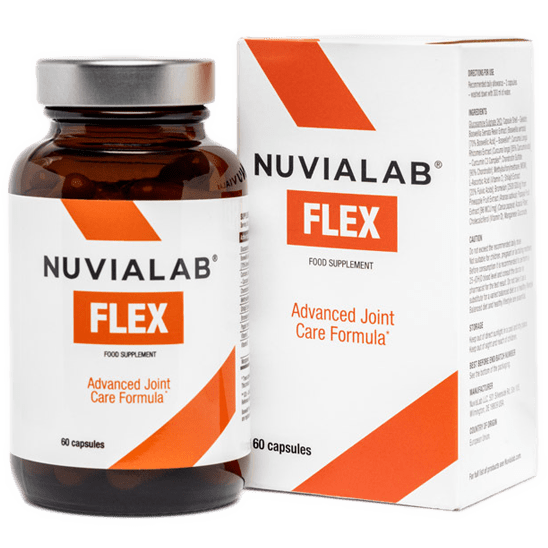
Our Recommendation — NuviaLab Flex
Score: 5.2/10 · Best for: boswellia and curcumin in one fully disclosed capsule. Main caution: no money-back guarantee is published, and the glucosamine trio sits at fractions of the research doses. Fair trial: the three-bottle pack ($99.98 + $12 shipping), judged over two to three months.
Chondroitin: the Trial Dose and the Combination Logic
Chondroitin sulfate is a structural component of cartilage — one of the long sugar chains that help cartilage hold water and resist compression. That genuine biological role is why it entered osteoarthritis research in the first place, decades ago.
It is also why the marketing writes itself. An ingredient that is literally part of cartilage sounds like replacement material for worn cartilage. The trial question, though, was never whether chondroitin belongs in cartilage. It was whether swallowing it changes pain or function.
What the trials used
The anchor regimen comes from GAIT, the large independent trial published by Clegg et al. in the New England Journal of Medicine in 2006. GAIT gave its chondroitin groups 1,200 mg a day, split across the day, for 24 weeks.
GAIT enrolled 1,583 people with knee osteoarthritis in the United States. Its scale and independence are why its dose still anchors discussions like this one: when researchers wanted a fair test of chondroitin, 1,200 mg a day was the amount they chose.
Other chondroitin trials cluster just below that figure. The commonly studied range across the osteoarthritis literature runs from 800 mg to 1,200 mg a day — never anywhere near 100 mg. The low end of the serious range is eight times this label's dose.
Dose is not a detail here; it is the intervention. A trial of 1,200 mg tests 1,200 mg. Its result — positive, negative or mixed — says nothing direct about 100 mg, any more than a trial of a full-strength medicine validates a twelfth of the tablet.
Chondroitin's own results, even at full dose, are modest and contested. Some trials and meta-analyses find small pain benefits; guideline bodies remain divided. That matters for the arithmetic ahead: the case being divided by twelve was never an overwhelming case to begin with.
Is the combination better than either alone?
The strongest combination result is MOVES, published by Hochberg and colleagues in the Annals of the Rheumatic Diseases in 2016. It randomised 606 people with moderate-to-severe knee osteoarthritis — the group with the most pain and the most room to improve.
At six months, the glucosamine-plus-chondroitin group matched celecoxib, a prescription anti-inflammatory, on pain and function outcomes. That headline is real, and it is quoted constantly in this category — usually without the two qualifications that define what it actually shows.
The first qualification: MOVES had no placebo arm showing the combination beating placebo consistently. Matching an active drug in a trial without consistent placebo superiority is a weaker finding than it sounds, because osteoarthritis pain fluctuates and improves in trial settings generally.
The second qualification decides this article. MOVES used full doses of both ingredients — glucosamine at trial scale and chondroitin at 1,200 mg a day. Whatever the combination did, it did it with twelve times the chondroitin printed on the label audited here.
Combination logic itself is reasonable. Glucosamine and chondroitin are both cartilage-related compounds, and pairing them was a legitimate research hypothesis. But a hypothesis tested at full doses cannot be inherited by a pairing that keeps the names and discards the amounts.
GAIT tells the same story from the other side. Its overall result was null, and its one encouraging signal — the combination in the moderate-to-severe subgroup — was exploratory. Even that fragile signal belonged to 1,500 mg of glucosamine plus 1,200 mg of chondroitin, daily.
MSM: Why Labels Ration It
MSM — methylsulfonylmethane — is a sulfur-containing compound sold on the idea that sulfur supports connective tissue. It is inexpensive, generally well tolerated, and genuinely studied for joint pain. None of those facts is the problem. The dose is the problem.
Dosage-consensus guides, of the Bolt Pharmacy and Verywell tier, place the studied MSM band at 1,500–3,000 mg a day for joint pain, usually split into two or three doses. We name those as consensus guides, not trials — but the band they summarise matches the trial literature.
Within that band, results were modest. Trials at gram-level doses found small improvements in pain and function for some people with knee osteoarthritis, alongside mild side effects such as digestive upset or headache in a minority. Nobody describes MSM's full-dose effect as dramatic.
Now place the label next to the band. NuviaLab Flex provides 100 mg of MSM a day — one fifteenth of the band's floor. There is no MSM joint trial at 100 mg a day, and no reasonable way to scale a modest gram-level effect down to it.
Why do labels ration MSM so hard? Because it is bulky. Three grams of MSM is a heaped teaspoon of powder, or several large capsules on its own. A two-capsule combination formula simply does not have the physical room for a trial dose.
Do the capsule arithmetic. Two ordinary capsules hold roughly a gram to a gram and a half of combined fill, shared here among eleven listed ingredients. A full MSM dose alone would need two to three times the entire capsule capacity of the product.
So formulators face a choice: build an MSM product, with enough capsules to hold grams — or add 100 mg to a blend and print a fashionable name. The second option is cheaper, prettier and, on the evidence, functionally decorative.
This is the token-dose pattern in its purest form, and MSM is its most common victim across the joint category. Whenever you see MSM inside a multi-ingredient capsule, assume rationing until the milligrams prove otherwise. The proof takes five seconds of label reading.
None of this makes MSM a bad ingredient. At studied doses, in a dedicated product, it has a small but real evidence file and a generally mild safety profile. The criticism belongs to the format that shrinks it, not to the compound itself.
What Is Chondroitin Made From — and Why the Source Matters
Chondroitin sulfate is not synthesised from nothing. Commercial chondroitin is extracted from animal cartilage — most commonly cattle, but also pig, chicken, shark and other fish sources. Newer fermentation-based, non-animal versions exist, but they are the exception and are usually advertised loudly.
The source matters to real readers for concrete reasons. Someone avoiding pork for religious reasons, someone avoiding beef, a vegetarian, or someone concerned about shark cartilage and ocean sustainability each needs a different answer from the same ingredient line.
It can matter for allergy questions too. A fish-derived chondroitin and a bovine chondroitin are the same molecule family on paper, but the person with a specific animal allergy is entitled to know which animal supplied their capsule before they swallow it.
Here is the gap on this label: NuviaLab Flex prints "chondroitin sulfate" with a 90% standardisation figure, and does not state the animal source anywhere on its panel. A reader who needs that information cannot get it from the label they are holding.
That silence pairs with a second panel fact. This formula's capsule shell is gelatin — itself an animal product, likewise without a stated source on the material we reviewed. Together, the two gaps mean the product cannot be confirmed suitable for several common dietary patterns.
A transparency gap is not proof of a bad ingredient. Plenty of reputable chondroitin is bovine and perfectly well made. The point is narrower: a maker who prints eleven ingredient amounts deserves credit for disclosure — and this is exactly where that disclosure stops.
Our standing advice is simple. If the source matters to you, ask the maker directly and keep the answer in writing. A label that will not say where its cartilage extract came from has told you something, even in its silence.
How to Spot a Token Dose in Any Joint Formula
Everything above reduces to a checklist you can run on any joint label in under a minute. It needs no chemistry degree — just the trial dose, the label dose, and one division. Learn it once and marketing copy loses most of its power.
Step one: find the trial dose. Search the ingredient's name with the word "dose" and look for the amount used in human trials or printed in dosage guides. For the structural ingredients, the anchors are stable: glucosamine 1,500 mg, chondroitin 800–1,200 mg, MSM 1,500–3,000 mg.
Step two: find the label dose — per day, not per capsule. Panels quote amounts per serving, and servings vary. Convert everything to the daily amount at the directed dose before comparing, or a two-capsule serving will flatter a formula by exactly half.
Step three: divide. Label dose divided by trial dose. A half or better is a real formulation choice worth debating. A third is weak. Under a quarter, the ingredient is present for the label photograph, not for the effect it was studied for.
Run the checklist on this label. Chondroitin: 100 divided by 800, using the kindest trial figure, gives an eighth — and a twelfth against GAIT's 1,200 mg. MSM: 100 divided by 1,500 gives a fifteenth. Both fail the quarter test easily.
Watch for the standard disguises while you divide. Percentages describe purity, not amount: "90% chondroitin sulfate" says nothing about milligrams. Blend totals hide individual doses entirely. And an ingredient listed without any amount cannot be checked at all — treat uncheckable as zero.
The checklist also tells you what a fair formula looks like. Dedicated single-ingredient products usually dose honestly, because the ingredient is the product. It is the eleven-ingredient combination capsule — where every name must fit inside two shells — where token doses breed.
That is not an argument against all combinations. It is an argument for combinations that publish their arithmetic. If a maker believes 100 mg of chondroitin contributes something at that dose, the honest move is to cite the study that tested 100 mg. None was offered here.
What a Trial Dose Actually Looks Like in Practice
It helps to picture the studied regimens as physical objects. Eight hundred to 1,200 mg of chondroitin a day is typically two or three large capsules of a dedicated product, taken every day for months. It is a regimen, not a garnish.
MSM at trial dose is more conspicuous still. Most people who take 1,500–3,000 mg a day take it as a powder stirred into water, or as a handful of capsules from a single-ingredient bottle. Nobody reaches three grams of MSM by accident inside a blend.
Duration compounds the difference. GAIT ran 24 weeks; MOVES ran six months. A trial dose is therefore also a trial commitment — hundreds of full-strength servings, judged at the end. One month of a twelfth-strength serving is not a shortened version of that experiment.
Cost explains why the token version outsells the real one. A dedicated chondroitin product plus a dedicated MSM product costs more, takes more capsules, and looks less elegant than one small bottle promising eleven ingredients. Convenience is the product being sold; the doses are the price.
None of that convenience is dishonest by itself. It becomes a problem only when the marketing borrows the trial results — the celecoxib comparison, the combination story — without borrowing the trial doses. Results and doses are a package. Labels should not be allowed to split them.
The Verdict for This Label
Applied fairly, the audit is not all negative. NuviaLab Flex prints a full panel, which is precisely what made this article possible. An undisclosed proprietary blend could not be caught delivering a twelfth of a trial dose, because nobody could see the dose.
But disclosure is the beginning of the judgement, not its end. As our full NuviaLab Flex review sets out, the two ingredients examined here sit at token level, alongside a glucosamine dose at a third of its own standard. The formula's plausible content is its botanicals.
So read chondroitin and MSM on this label as label content, not as joint content. If chondroitin at trial dose interests you, buy chondroitin at trial dose. If MSM interests you, buy the grams. Neither decision is served by 100 mg of each.
Our Recommendation — NuviaLab Flex
Score: 5.2/10 · Best for: boswellia and curcumin in one fully disclosed capsule. Main caution: no money-back guarantee is published, and the glucosamine trio sits at fractions of the research doses. Fair trial: the three-bottle pack ($99.98 + $12 shipping), judged over two to three months.
Frequently Asked Questions
How much chondroitin did the trials actually use?
Between 800 and 1,200 mg a day in the main osteoarthritis trials. GAIT, the largest independent study, used 1,200 mg a day for 24 weeks in 1,583 people with knee osteoarthritis. No major trial tested anything close to the 100 mg found in typical combination capsules.
Is the glucosamine–chondroitin combination proven better than either alone?
Not proven. MOVES found the combination matched celecoxib at six months in 606 people with moderate-to-severe knee osteoarthritis, but without consistent superiority over placebo — and at full doses of both ingredients. GAIT's combination signal was confined to an exploratory subgroup. Neither result transfers to low-dose pairings.
Why is there so little MSM in joint capsules?
Space. Studied MSM doses run 1,500–3,000 mg a day — several grams of a bulky powder. Two combination capsules cannot physically hold that alongside ten other ingredients, so formulators include a token 100 mg instead. Dedicated MSM powders and larger capsule regimens are how trial doses are actually delivered.
What is chondroitin made from?
Animal cartilage — usually cattle, but also pig, chicken, shark or fish, with rare fermentation-based versions. The source matters for religious, vegetarian and allergy reasons. NuviaLab Flex does not state its chondroitin source on its panel, which we count as a transparency gap; ask the maker if it matters to you.
What counts as a token dose?
Our working rule: divide the label's daily dose by the dose used in trials. At half or more, the ingredient deserves a hearing. At a third, it is weak. Under a quarter — like the 100 mg of chondroitin and MSM here, at a twelfth and a fifteenth — it is decoration, whatever the label implies.
Does a 90% standardisation figure change the chondroitin maths?
Only slightly, and in the wrong direction for the maker. A percentage like 90% describes the purity or standardisation of the extract, not its amount. The dose question is still answered in milligrams per day — and 100 mg of a 90%-standardised extract remains roughly a twelfth of the trial regimen.
Last reviewed: October 2026. This article is educational and is not medical advice.
