
- Quick Answer
- The Salt Maths, Done Properly
- Can't You Just Take More Capsules?
- The Supporting Cast, at Label Doses
- Shilajit 50 mg: A House-Style Inclusion
- Bromelain and Papain, 50 mg Each: Enzymes Out of Their Usual Home
- The Fair Reading of This Label
- Frequently Asked Questions
- Is 500 mg of glucosamine enough?
- How much glucosamine itself is in 500 mg of glucosamine sulphate 2KCl?
- Can I take three times as much to reach the full dose?
- Why do combination formulas use such low glucosamine doses?
- Why is shilajit in a joint formula?
- Is 500 mg at least worth taking for general joint comfort?
- What doses did the combination trials themselves use?
- Does a fully disclosed panel make a product good?
- Read This Next
Disclosure: This article contains affiliate links. If you buy through them, we may earn a commission at no extra cost to you. It never changes our conclusions.
Quick Answer
No. Five hundred milligrams of glucosamine sulphate 2KCl is one third of the 1,500 mg daily salt dose the trials and licences use. Judged as a glucosamine dose, it falls short before anything else is considered.
The shortfall is larger than it first looks. The 2KCl salt is only partly glucosamine, so 500 mg of that salt provides only about 296 mg of glucosamine itself.
No trial supports 500 mg a day for osteoarthritis outcomes. That dose exists because combination capsules must share their space among many ingredients, not because any study found a third of the standard sufficient.
This article audits one real label in full: NuviaLab Flex. Its maker prints every amount, which is precisely why this audit is possible, and why the findings deserve to be stated exactly.
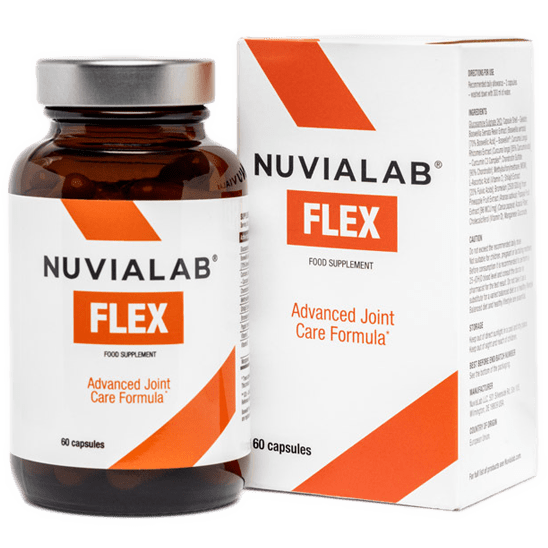
Our Recommendation — NuviaLab Flex
Score: 5.2/10 · Best for: boswellia and curcumin in one fully disclosed capsule. Main caution: no money-back guarantee is published, and the glucosamine trio sits at fractions of the research doses. Fair trial: the three-bottle pack ($99.98 + $12 shipping), judged over two to three months.
The Salt Maths, Done Properly
Start with the ingredient's full name: glucosamine sulphate 2KCl. That name describes a complex of two glucosamine molecules with sulphate and potassium chloride, the stabilising chemistry that keeps glucosamine usable.
The USP monograph for this complex gives its molecular weight as 605.52. Two glucosamine molecules account for 59.2 percent of that weight, calculated from the molecular weights in the monograph.
Everything else in the complex is carrier. Sulphate, potassium and chloride make up the remaining weight, which is why a milligram of the complex is not a milligram of glucosamine.
Now apply the fraction. Five hundred milligrams, multiplied by 0.592, gives 296 mg. That is the amount of glucosamine itself in a daily serving that headlines 500 mg of the salt.
Check the conversion against labels that print both layers. A product declaring 1,500 mg of this complex declares 888 mg of glucosamine, and 1,500 multiplied by 0.592 is indeed 888.
The cross-check works at other sizes too. One thousand milligrams of the complex corresponds to 591 mg of glucosamine on printed labels, within rounding of the 592 mg the fraction predicts.
The licensed equivalence figures tell the same story from another direction. The licence convention states that 1,884 mg of the complex is equivalent to 1,500 mg of glucosamine sulphate, equivalent in turn to 1,178 mg of glucosamine.
Those three numbers describe one dose at three layers. A label can quote any layer, and a careless comparison between layers can make identical products look different, or different products look identical.
Some secondary sources quote a higher base figure for this salt, using a fraction that belongs to a different glucosamine form. The monograph arithmetic, cross-checked against printed labels at two serving sizes, gives about 296 mg for this serving. That is the figure to use.
Why does the base figure matter, if the trial standard is itself a salt figure? Because it stops a second, quieter misunderstanding: the belief that 500 mg on this label is 500 mg of glucosamine.
It is not. It is 500 mg of a complex that is roughly three-fifths glucosamine. Against the salt standard it is a third of the dose. Against the base equivalent, it is about a quarter.
The base equivalent of the full standard makes that plain. A full 1,500 mg of this complex provides 888 mg of glucosamine itself. This label provides about 296 mg of glucosamine itself per day.
Per capsule, the figures are smaller still. The daily serving is two capsules, so each capsule carries 250 mg of the complex, providing about 148 mg of glucosamine itself. One capsule, taken alone, is a sixth of the trialled salt dose.
Rounding deserves one sentence. We write about 296 mg because labels round their declared base figures, and the monograph fraction produces 296 mg from this serving size. The approximation is in the last milligram, not in the conclusion.
None of this requires the maker to have hidden anything.
The panel prints the full chemical name and the 500 mg figure openly. The conversion is simply work most buyers never do, and most sellers never volunteer.That is the point of an audit. The numbers were always on the label. Reading them properly, layer by layer, turns a plausible-looking headline into a dose that can be judged.
Can't You Just Take More Capsules?
The obvious workaround deserves a full answer. If two capsules provide 500 mg of the salt, then six capsules provide 1,500 mg. The glucosamine arithmetic works. Everything else in the capsule also triples.
That is the catch, and it is not a small one. A combination formula is a fixed ratio. You cannot raise one ingredient by taking more capsules without raising every other ingredient by the same multiple.
Work the example through this panel, ingredient by ingredient. Tripling the daily serving takes glucosamine sulphate 2KCl from 500 mg to 1,500 mg, exactly matching the trialled salt dose. So far, so good.
Vitamin D is where the example breaks. The panel carries vitamin D at 50 micrograms per daily serving, which is 2,000 IU. Tripled, that becomes 150 micrograms, which is 6,000 IU per day.
The NIH Office of Dietary Supplements vitamin D fact sheet sets the tolerable upper intake level for adults at 4,000 IU per day. The tripled serving exceeds that adult upper limit by half as much again.
An upper limit is not a poisoning threshold, and one day above it is not an emergency. It is, however, the line expert bodies draw for routine daily intake, and this workaround crosses it deliberately, every day.
The panel itself warns about its vitamin D strength. The maker instructs users to take a 25-(OH)D blood test and consult the result before use, an unusual and honest instruction that deserves to be taken seriously.
The botanicals triple as well. Boswellin rises from 200 mg to 600 mg per day, and Curcumin C3 Complex rises from 200 mg to 600 mg per day, providing about 510 mg of curcuminoids.
Those tripled botanical amounts are not obviously dangerous, but they are untested at that pattern in this formula. No trial, and no maker instruction, describes this product taken at three times its stated serving.
The minor ingredients triple too. Chondroitin reaches only 300 mg and MSM only 300 mg, still far below their trial ranges, while bromelain, papain, shilajit, vitamin C and manganese all rise to three times their label amounts.
Notice what that means. Even after tripling everything, the formula's token ingredients remain token. The buyer takes on a vitamin D excess to fix the glucosamine, and the chondroitin and MSM are still underdosed.
The practical burden triples too. Six capsules a day, every day, is a different routine from two. Adherence to supplement routines falls as the daily capsule count rises, and a workaround that depends on perfect adherence is fragile by design.
Put prices to it, using the maker's own figures. A bottle costs $49.99 bought singly, or $25.00 per bottle on the six-pack. At three times the serving, a month needs three bottles, not one, before shipping is counted.
Shipping compounds it. Every order carries $12 shipping, and a tripled routine exhausts bottles three times as fast, so orders, and their shipping charges, arrive three times as often. The workaround is the most expensive way to buy glucosamine.
Cost triples with the dose.
A bottle built to last a month at two capsules a day lasts about ten days at six. The cheapest advertised per-bottle price stops describing the real monthly cost.So the arithmetic is the answer. Yes, extra capsules can reach 1,500 mg of the glucosamine salt. No, that does not make the product a full-dose glucosamine product, and we do not present escalation as a recommendation.
Taking more than a label directs is off-label use of a food supplement, decided against the maker's own instructions. Anyone considering it should be discussing the vitamin D question with a clinician, not improvising it.
The cleaner conclusion runs the other way. A buyer who wants the trialled glucosamine dose should buy a product built to deliver it in its stated serving, not multiply a combination capsule until its other ingredients object.
The Supporting Cast, at Label Doses
Glucosamine is not the only line worth auditing. Two smaller ingredients raise fair questions, because neither belongs to the classic joint-formula trio of glucosamine, chondroitin and MSM.
Shilajit 50 mg: A House-Style Inclusion
The panel includes shilajit at 50 mg per daily serving, standardised to 20 percent fulvic acids, the standardisation the maker declares on its label. That provides about 10 mg of fulvic acids per day.
Shilajit has no joint-trial record at this dose. Its published human research sits mainly in other areas, at considerably larger daily amounts, and none of it establishes 50 mg as a joint dose.
Context from the same maker is telling. The maker's dedicated shilajit product carries four times this amount per day. By the maker's own product line, 50 mg is a quarter-strength cameo, not a headline dose.
We grade it as a house-style inclusion: a fashionable ingredient added at a token amount, of the kind combination formulas use to lengthen an ingredient list. It does no evident harm at this size, and no evident joint work either.
Bromelain and Papain, 50 mg Each: Enzymes Out of Their Usual Home
Bromelain and papain are proteolytic enzymes, from pineapple and papaya respectively. Each appears at 50 mg per daily serving, declared at 125 GDU for the bromelain and 4,800 MCU for the papain.
Those activity units are the honest way to declare enzymes, and printing them is good practice. Enzyme potency is about activity, not just weight, and this panel states both, which many labels omit.
Their usual home is digestive formulas, where protein-splitting enzymes are taken with food. Their presence in a joint capsule follows a different tradition: the oral-enzyme approach to inflammation, associated with long-standing European enzyme combinations.
That tradition works at far higher enzyme activities than this panel delivers. The classic oral-enzyme products are built around large, repeated doses of enzyme combinations, not 50 mg inclusions inside a two-capsule serving.
The units themselves resist comparison, which is worth understanding. GDU and MCU come from different activity assays, and neither converts neatly into the units other enzyme products use. Even an honest enzyme declaration cannot be ranked against rivals by weight alone.
Timing undercuts them further. Digestive enzymes are normally taken with the food they are meant to act on. This panel's directions are a daily capsule routine. An enzyme swallowed away from its digestive context is being used on the oral-enzyme theory, at oral-enzyme doses it does not reach.
So the same audit pattern repeats.
A real ingredient, honestly declared, at an amount well below the range its own tradition uses. Declaration earns the formula transparency credit. It does not earn the dose an evidence claim.Read together, the supporting cast explains the formula's design. It is a broad list built for label appeal, with two genuinely plausible botanicals, and several famous names present at amounts too small to judge by their own literatures.
The Fair Reading of This Label
Fairness matters here, because this audit cuts both ways. Every criticism in this article was possible only because the maker publishes a complete panel, with full amounts, standardisations and enzyme activity units.
An undisclosed proprietary blend could not be caught this way. A rival label hiding its glucosamine inside a blend total would leave a buyer guessing whether the dose was 500 mg, 200 mg or a dusting.
As our full NuviaLab Flex review states, the score credits that disclosure. Transparency is a real virtue in this category, and this formula has it. The doses are where it loses marks.
The full panel, for the record, also includes chondroitin sulfate at 100 mg, MSM at 100 mg, vitamin C at 80 mg and manganese at 1.80 mg, in a gelatin capsule shell, so the product is not vegetarian.
It publishes no money-back guarantee. The word guarantee does not appear on its sales page, and its terms offer only a short withdrawal window for unused goods. A low-dose formula without a guarantee asks buyers to carry the trial risk themselves.
The commercial terms complete the picture. Beyond the absent guarantee, the maker's terms allow only a 10-day withdrawal for unused goods. A buyer testing whether a third-dose formula works for them has no results-based refund route if it does not.
Contrast that with the trialled route. A licensed full-dose product states its dose, its preparation and its evidence plainly, and costs one serving a day. The audit keeps returning to that comparison because the market keeps avoiding it.
The maker's broader claims also need distance.
Its statements that the product is safe and has no side effects, works regardless of the cause of the pain, and is recommended by almost all customers are maker claims, not findings we can verify.Our verdict on the dose question is unchanged by those claims. Five hundred milligrams of this salt, providing about 296 mg of glucosamine, is not enough to match the evidence base the category trades on.
A buyer who values the botanicals, accepts the token structural doses, and wants a fully disclosed panel may still choose it knowingly. That is a legitimate choice, provided it is made with these numbers in view.
Our Recommendation — NuviaLab Flex
Score: 5.2/10 · Best for: boswellia and curcumin in one fully disclosed capsule. Main caution: no money-back guarantee is published, and the glucosamine trio sits at fractions of the research doses. Fair trial: the three-bottle pack ($99.98 + $12 shipping), judged over two to three months.
Frequently Asked Questions
Is 500 mg of glucosamine enough?
No, not against the evidence base. The trialled and licensed standard is 1,500 mg per day of the glucosamine salt. Five hundred milligrams is a third of that, and no trial supports the smaller amount for osteoarthritis outcomes.
How much glucosamine itself is in 500 mg of glucosamine sulphate 2KCl?
About 296 mg. The 2KCl complex has a molecular weight of 605.52, of which glucosamine accounts for 59.2 percent by weight. Multiply 500 mg by 0.592 and the result is 296 mg of glucosamine itself.
Can I take three times as much to reach the full dose?
The glucosamine arithmetic works, but everything else triples too. On this panel, vitamin D would reach 150 micrograms, or 6,000 IU a day, above the 4,000 IU adult upper limit. We do not recommend exceeding a label's stated serving.
Why do combination formulas use such low glucosamine doses?
Space and cost. A two-capsule serving shared among eleven ingredients cannot hold a full 1,500 mg of glucosamine salt alongside everything else. Makers ration the bulky structural ingredients and lean on the ingredient list itself to sell the product.
Why is shilajit in a joint formula?
The maker gives no joint-specific evidence for it at 50 mg. It has no joint-trial record at that dose, and the maker's own dedicated shilajit product carries four times as much. We read it as a label-appeal inclusion rather than a working joint ingredient.
Is 500 mg at least worth taking for general joint comfort?
That claim has no trial record of its own. The evidence base is an osteoarthritis outcome record, built at 1,500 mg. At 500 mg, any comfort a user feels cannot be separated from the large placebo responses this category produces, which our evidence article examines.
What doses did the combination trials themselves use?
Full doses of both partners. GAIT paired glucosamine at 1,500 mg per day with chondroitin at 1,200 mg per day. No major combination trial tested a third-dose glucosamine alongside a twelfth-dose chondroitin, which is the pairing a label like this one actually sells.
Does a fully disclosed panel make a product good?
It makes a product auditable, which is not the same thing. Disclosure lets buyers and reviewers check doses against trials, as this article does. This panel earns credit for being checkable, and loses marks for what the checking reveals.
Last reviewed: October 2026. This article is educational and is not medical advice.
