
- Quick Answer
- Our Findings — Pros and Cons
- What we like
- What gives us pause
- Why You Should Trust This Review
- Our Verdict
- Is Zinamax a Scam?
- How We Scored It
- What Is Zinamax?
- How to Take Zinamax
- The Ingredients — and What Each One Can Actually Claim
- The Dose Audit: Three Checks, One Failure
- Check one — lactoferrin (200 mg)
- Check two — zinc (15 mg)
- Check three — vitamin B6 (18 mg)
- The Evidence, Read Properly
- How Long Does Zinamax Take to Work?
- How to Run a Fair 12-Week Check
- Is Zinamax Safe?
- When a Supplement Is the Wrong Route
- Price — and the Guarantee That Isn’t Published
- Purchase Options
- How It Compares
- Who Should Buy Zinamax — and Who Should Skip It
- Frequently Asked Questions
- Does Zinamax actually work?
- How long does Zinamax take to work — and how should I track it?
- Is there a money-back guarantee on Zinamax?
- Can I take Zinamax if I am allergic to milk, lactose intolerant, or vegan?
- Is Zinamax a probiotic?
- Can I take Zinamax with acne antibiotics like doxycycline or minocycline?
- Can teenagers, children, or pregnant or breastfeeding women take Zinamax?
- Is Zinamax a scam, and where is it sold?
- Will Zinamax upset my stomach or cause other side effects?
- Will Zinamax help hormonal acne or oily skin?
- What if Zinamax makes my skin worse — do oral acne supplements cause "purging"?
- Can Zinamax replace topical treatments, or help with acne scars, eczema, or psoriasis?
- Does Zinamax contain vitamin D or omega-3?
- Sources & Method
- Read This Next
Disclosure: This article contains affiliate links. If you buy through them, we may earn a commission at no extra cost to you. It never changes our conclusions.
Quick Answer
Zinamax scores 5.7/10 on our rubric. Its genuine strength is full label transparency: the European maker, NuviaLab, publishes the exact amount of all 12 ingredients, led by two compounds with real human acne research — lactoferrin (200 mg) and zinc (15 mg).
The central limit is that no clinical trial has ever tested the Zinamax capsule itself. The widely quoted lactoferrin numbers come from a 12-week study of a fermented probiotic milk drink and a separate three-ingredient capsule, while the benchmark acne trial on zinc used 30 mg daily — twice what Zinamax provides. Before buying, weigh three clear caveats: its vitamin B6 (18 mg) sits above the European Food Safety Authority’s 12 mg/day adult upper limit, its bovine lactoferrin carries a declared milk allergen, and no money-back guarantee is published on the official website.
Best for: adults with mild, persistent breakouts who want a nutritional adjunct alongside a topical routine, judged fairly over 12 weeks.
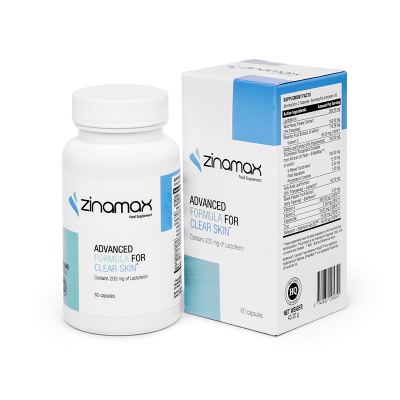
Zinamax — Our Score: 5.7/10
Score: 5.7/10
Best for: adults with mild, persistent breakouts who want a nutritional adjunct alongside a topical routine, judged fairly over 12 weeks
Main caution: it carries a declared milk allergen, its vitamin B6 (18 mg) sits above EFSA’s upper limit, and no money-back guarantee is published
Fair trial: the three-bottle pack at $39.33 a bottle — one full trial at the trials’ own 8–12 week length
Our Findings — Pros and Cons
Zinamax pairs a transparent, fully dosed label with an evidence file that belongs to other products in other forms — plus one vitamin dose we would change. Here is the audit in short.
What we like
- Complete label disclosure: Every one of the 12 ingredients has its exact milligram or microgram dose printed on the panel, with no proprietary blends hiding the weights.
- 200 mg of lactoferrin: Matches the daily amount used in the best-known lactoferrin acne trial (Kim 2010), even though the delivery format differs.
- 15 mg of zinc as zinc citrate: Supplies the best-studied oral acne mineral at a gentle daily amount well inside the 40 mg/day adult upper limit.
- Clear allergen warning: The maker states plainly on its sales page that the capsule contains milk protein.
What gives us pause
- No trial on the finished product: Zero human studies have measured what this 12-ingredient capsule does for lesions or sebum.
- Vitamin B6 at 18 mg/day: Exceeds EFSA’s 12 mg/day adult tolerable upper intake level by 50% before food or a multivitamin are counted.
- Half the studied zinc dose for acne: The landmark inflammatory-acne trial tested 30 mg of elemental zinc daily, twice the 15 mg included here.
- No money-back guarantee: The official website publishes no refund policy on single bottles or multi-packs.
- A traditional supporting cast: Wild pansy, nettle leaf and gotu kola rest on traditional use or topical literature, with no human oral acne trials.
Why You Should Trust This Review
To build this review, we audited NuviaLab’s official order page, checked all 12 ingredient amounts and form disclosures in the maker’s FAQ against the product label, and read the primary human papers on lactoferrin, zinc and B-vitamins — printing the parts that complicate the sales pitch, including the fermented-milk vehicle mismatch, the 18 mg vitamin B6 dose, and the absent refund policy. Every score on SuppChecked comes from one fixed rubric applied to every product we review and never moves for a brand; when verified facts change, we lower scores and say so. We earn an affiliate commission through our links and are never paid to place or praise a product.
Our Verdict
At 5.7/10, Zinamax is a reasonable nutritional adjunct for a narrow buyer — not a stand-alone acne cure. If you are an adult dealing with mild, stubborn inflammatory spots, you already run a steady topical routine, and you want 200 mg of lactoferrin plus 15 mg of zinc in one two-capsule daily serving, the core pairing makes sense on paper.
What keeps the score in the middle of our range is the gap between the sales page and the evidence shelf. You are buying an untested 12-ingredient blend whose lead ingredients were studied in a probiotic milk drink, a three-ingredient capsule, or at double the zinc dose. You also have to clear three practical hurdles before checkout: you must have no milk allergy, you should not stack its 18 mg of vitamin B6 with a multivitamin or B-complex, and you must accept that a fair 90-day trial costs $117.98 ($39.33 a bottle), or $129.98 in total with the $12 shipping fee — with no money-back guarantee.
Is Zinamax a Scam?
No — Zinamax is not a scam. It is a legitimate oral supplement made in the European Union by a named company (NuviaLab), shipped with a fully disclosed 12-ingredient label, and sold as a straightforward one-time purchase with no hidden recurring subscription.
When buyers search "is Zinamax a scam," they are usually reacting to three real frustrations around how the product is marketed online:
- Unrealistic timeline claims: The maker’s sales page tells buyers they will notice a significant improvement "after just the first month." In human trials, oral lactoferrin and zinc took 8 to 12 weeks to reach their measured endpoints.
- Affiliate spam inventions: Third-party review mills routinely copy clinical trial numbers from a fermented-milk drink and print them as if the Zinamax capsule itself achieved those results, or invent a 90-day refund guarantee that does not exist.
- No refund safety net: Because the official website carries no money-back guarantee, buyers who stop after one bottle or see no change at 12 weeks have no refund route.
How We Scored It
Every product on SuppChecked is graded on the same five-part rubric so scores stay comparable across the store. Here is how Zinamax earns its 5.7/10:
| Criterion | Weight | Score | Why |
|---|---|---|---|
| Ingredients | 30% | 6.0/10 | Lactoferrin and zinc are rational, published-amount choices; the rest is traditional or cosmetic-grade support |
| Evidence | 25% | 5.0/10 | Small human trials support zinc and lactoferrin for acne as adjuncts; nothing tests this formula; first-line acne care is topical/prescription |
| Safety | 15% | 5.5/10 | B6 at 18 mg is above EFSA’s 12 mg/day upper level; contains milk (lactoferrin) — a real allergen, clearly labelled |
| Value | 10% | 5.5/10 | $58.99/month single; bundles to $29.50/bottle; skin cycles mean a multi-month trial |
Maker Credibility (20% weight) — 6.5/10: NuviaLab is an identifiable EU supplement maker that publishes every dose on the label, declares the bovine milk allergen openly, and — to its credit — actually names the fermented-milk vehicle in its text when referencing the lactoferrin study rather than inventing a fake clinical trial on its own site. We deduct for three things: the complete absence of a money-back guarantee, sales-page overclaims that the product is "completely safe" and "does not cause any side effects" while promising visible results after the first month, and reliance on an unnamed "skin expert" alongside four unverifiable first-name testimonials (Piotr, 30; Anna, 26; Hubert, 20; Aneta, 45) that carry no dates or order verification. Combining all five weighted criteria (1.80 + 1.25 + 1.30 + 0.825 + 0.55 = 5.725) rounds to 5.7/10.
What Is Zinamax?
Zinamax is an over-the-counter oral supplement formulated for adults with acne-prone skin. Manufactured in the European Union by NuviaLab and sold exclusively via the official website, each bottle contains 60 capsules — a 30-day supply when taken at the standard dose of two capsules daily.
The maker pitches the capsule around three jobs: calming skin inflammation, moderating sebum (skin oil) output, and supporting wound healing and skin texture. On the actual label, nearly all of the evidence-backed heavy lifting belongs to lactoferrin and zinc, while the herbal extracts and vitamins provide general nutritional background.
It is equally important to be clear about what Zinamax is not. It is not a probiotic (lactoferrin is a purified cow’s milk protein, and the capsule contains zero live bacteria or CFU count). It is not a hormonal acne treatment, and it is not a replacement for topical or prescription acne care.
These statements have not been evaluated by the Food and Drug Administration. This product is not intended to diagnose, treat, cure, or prevent any disease.
| Field | Details |
|---|---|
| Our score | 5.7/10 |
| Brand | Zinamax |
| Company | NuviaLab |
| Product type | oral acne-support supplement capsules (60 per bottle) |
| Primary purpose | nutritional support for acne-prone skin — sebum balance and skin clarity |
| Formula | 12 ingredients, every amount published |
| Clinical research | none for the finished product; small trials exist for two ingredients (lactoferrin, zinc) in other forms and combinations |
| Research limitation | the lactoferrin trial delivered it in fermented milk, the largest zinc trial used twice this dose, and vitamin B6 (18 mg) exceeds EFSA’s adult upper limit |
| Recommended use | 2 capsules a day with water, after a meal |
| Money-back guarantee | none published |
How to Take Zinamax
The label and the maker’s FAQ give identical directions: take 2 capsules a day with 300 ml of water, after a meal.
Do not skip the "after a meal" instruction. Zinc salts — including the 15 mg of zinc citrate in Zinamax — frequently trigger nausea or stomach cramping when swallowed on an empty stomach, and taking the capsules with food prevents most of that irritation.
If a doctor has prescribed you a tetracycline or quinolone antibiotic for acne (such as doxycycline or minocycline), do not swallow Zinamax at the same time. Zinc binds those antibiotics in the gut and blunts their absorption, so take your antibiotic at least 2 hours before, or 4 to 6 hours after, this supplement.
The Ingredients — and What Each One Can Actually Claim
Every two-capsule daily serving of Zinamax delivers the following 12 ingredients, listed in the exact order they appear on the panel:
| Ingredient | Amount per 2 Capsules | Form / Standardisation | Role in the Formula |
|---|---|---|---|
| Lactoferrin (from bovine milk — contains milk) | 200 mg | Purified bovine milk protein | Lead active; iron-binding protein with antibacterial and anti-inflammatory research |
| Wild pansy flower extract | 150 mg | 5% flavones | Traditional European skin botanical; no human acne trials |
| Rosehip fruit extract | 114.29 mg | 70% vitamin C (80 mg vitamin C) | Vitamin C source for collagen and antioxidant support; no acne trial |
| Nettle leaf extract | 100 mg | 4% polyphenols | Traditional herbal extract; no human clinical acne evidence |
| Tocotrienol/tocopherol complex (EVNolMax™) | 100 mg | 12.10 mg d-mixed tocotrienols (plus 3 mg squalene, 1 mg phytosterol) | Vitamin E-family antioxidant complex (100 mg is the whole complex weight) |
| Gotu kola leaf extract (Centellin®) | 50 mg | 8% triterpenes | Connective-tissue herb studied mostly topically for wounds/scars; no oral acne trial |
| Vitamin B6 | 18 mg | Pyridoxine hydrochloride | No acne benefit established; sits above EFSA’s 12 mg/day adult upper limit |
| Zinc | 15 mg | Zinc citrate | Second active pillar; best-studied oral acne nutrient, here at half the 30 mg trial dose |
| Vitamin A | 800 µg | Nutritional daily dose | Supports normal skin-cell turnover; far below prescription retinoid doses |
| Vitamin E | 3.36 mg | Antioxidant vitamin | Also a component of the three-ingredient capsule trialled by Chan 2017; oral scar claims are not supported |
| Selenium (SeLECT®) | 55 µg | L-selenomethionine | Standard daily trace mineral; backed only by older, small acne studies |
| Black pepper fruit extract (BioPerine®) | 5 mg | 95% piperine | Standard absorption enhancer; can affect how some medicines are metabolised |
The two active pillars: Lactoferrin (200 mg) is an iron-binding glycoprotein purified from cow’s milk that limits bacterial growth and dampens skin inflammation. Zinc (15 mg, as zinc citrate) is the single most-studied oral mineral for inflammatory acne.
The botanical and antioxidant middle: Wild pansy (150 mg), nettle leaf (100 mg), and rosehip extract (114.29 mg, standardized to 70% to supply 80 mg of vitamin C) are traditional or general-nutrition additions with zero human acne trials. Gotu kola (50 mg Centellin®) has wound-healing research, mostly topical rather than oral for acne. EVNolMax™ prints at 100 mg for the whole complex, which actually delivers 12.10 mg of d-mixed tocotrienols alongside 3 mg of squalene and 1 mg of phytosterol.
The vitamin base — and what is missing: Vitamins A, E, and B6 plus selenium (55 µg SeLECT®) and BioPerine® (5 mg) finish the panel. Vitamin A sits at a normal 800 µg nutritional dose, whereas vitamin B6 (18 mg) is needlessly high. Just as important is what Zinamax leaves out: there is no vitamin D, no omega-3, and none of the ingredients sought in supplements for hormonal acne — no inositol, DIM, spearmint, or saw palmetto.
The Dose Audit: Three Checks, One Failure
When we audit a supplement label, we compare the daily dose in the bottle against the doses actually tested in human clinical trials and the safety ceilings set by regulators. On Zinamax, that audit comes down to three checks:
| Ingredient | Zinamax Daily Dose (2 Caps) | Trial Dose / Regulatory Benchmark | Audit Result |
|---|---|---|---|
| Lactoferrin | 200 mg | 200 mg/day in fermented milk (Kim 2010) | Pass on amount; caveat on delivery vehicle |
| Zinc (citrate) | 15 mg | 30 mg/day elemental zinc in inflammatory acne (Dréno 2001); adult upper limit 40 mg/day | Half the clinical trial dose; comfortable safety margin |
| Vitamin B6 | 18 mg | No acne trial benchmark; EFSA 2023 adult upper limit is 12 mg/day from all sources (US limit 100 mg/day) | Fails EFSA check (1.5 times the European limit) |
Check one — lactoferrin (200 mg)
At 200 mg per two capsules, Zinamax matches the exact daily milligram figure used in the best-known human acne trial on lactoferrin. NuviaLab deserves credit for not under-dosing its headline protein. The limitation is context: 200 mg of dry powder mixed with 11 other ingredients in a capsule is not automatically equivalent to 200 mg delivered in a fermented probiotic milk drink.
Check two — zinc (15 mg)
Zinamax supplies 15 mg of zinc (as citrate), which is half the 30 mg daily elemental zinc dose used in the largest multicentre inflammatory-acne trial. You cannot assume a 15 mg maintenance dose will match a 30 mg clinical regimen, though 15 mg is easier on the stomach and stays safely under the 40 mg/day adult upper limit. (Be wary of competitor blogs presenting 50 to 150 mg of zinc a day as normal acne dosing — that is up to nearly four times the safe adult ceiling and risks copper deficiency and severe nausea.)
Check three — vitamin B6 (18 mg)
This is the formula’s clear dose failure. In 2023, the European Food Safety Authority (EFSA) set the adult tolerable upper intake level for vitamin B6 at 12 mg/day from all dietary and supplement sources combined, citing peripheral neuropathy risks. While the US ceiling remains 100 mg/day, Zinamax is an EU-made supplement that puts 18 mg into two capsules alone — despite zero clinical evidence that high-dose B6 clears acne.
The Evidence, Read Properly
No clinical study has ever tested Zinamax. Every number quoted for this product online is borrowed from trials of individual ingredients in different vehicles or combinations. As we explain in our guide on whether acne supplements actually work, reading the exact study designs changes what you expect:
The fermented-milk trial (Kim et al., 2010): This double-blind, placebo-controlled trial enrolled 36 acne patients aged 18 to 30 for 12 weeks. One group drank fermented milk enriched with 200 mg of lactoferrin daily; the control group drank the same fermented milk without lactoferrin. Versus placebo, the lactoferrin drink reduced inflammatory lesion count by 38.6%, sebum content by 31.1%, total lesion count by 23.1%, and acne grade by 20.3%. To be fair to NuviaLab, its sales text mentions the fermented milk — whereas spam blogs print those four percentages as Zinamax capsule results, sometimes adding an invented "Dr. Emily Ruiz, MD" and a nonexistent "2023 Kim study." The vehicle is the finding: those numbers belong to a probiotic milk drink, not this capsule.
The three-ingredient capsule trial (Chan et al., 2017): This placebo-controlled study tested a combination capsule of lactoferrin, vitamin E, and zinc. Kept apart, both endpoints hit their maximum at week 10: median total lesions dropped by 28.5% versus placebo, and inflammatory lesions fell by 44%. (A widely copied MDPI review table mistakenly lists this capsule with "vitamin D" — an error; the trial used vitamin E.) It supports Zinamax’s core trio, but a three-ingredient trial cannot certify a 12-ingredient product. A dermatology systematic review (Hassoun et al., 2017) covering six clinical studies rightly judged lactoferrin evidence "encouraging," not established.
The zinc vs. antibiotic trial (Dréno et al., 2001): Across 332 inflammatory acne patients over 3 months, 30 mg of elemental zinc (as gluconate) was tested against 100 mg of minocycline. On the primary success endpoint (more than a two-thirds reduction in inflammatory lesions at day 90), zinc succeeded in 31.2% of patients versus 63.4% for minocycline. Zinc worked, the antibiotic worked roughly twice as well, and Zinamax carries half that zinc dose. (Some sites misquote a within-arm 49% figure from this paper as a "zinc meta-analysis" — it is not.)
The B-vitamin porphyrin mechanism (Kang et al., 2015): Human research showed that vitamin B12 supplementation represses Cutibacterium acnes’ own B12 synthesis, increasing inflammatory porphyrin production. Zinamax has no B12, but its 18 mg of B6 sits in the same literature on supplements that can cause acneiform eruptions.
How Long Does Zinamax Take to Work?
The maker’s sales page promises that "you will notice a significant improvement in your skin’s appearance after just the first month." The clinical literature disagrees.
Human skin renews on a cycle of roughly four to six weeks, and a developing spot takes weeks to surface and resolve. In the actual trials behind Zinamax’s two lead ingredients, Chan et al. (2017) reached its peak lesion reductions at week 10, Kim et al. (2010) measured its final sebum and lesion outcomes at week 12, and Dréno et al. (2001) graded zinc at day 90. As we map out in our guide on how long acne supplements take to work, 8 to 12 weeks is the only fair window to judge an oral acne adjunct.
How to Run a Fair 12-Week Check
- Day 0 (Baseline): Take three clear, unedited phone photos (front, left side, right side) in consistent bathroom lighting, and jot down a simple count of active red inflammatory spots on one cheek or jawline.
- Freeze the rest of your routine: Keep your cleanser and topical treatments unchanged for all 12 weeks so a new cream does not muddy the result.
- Week 4 check: Audit tolerance only — make sure the capsules are not upsetting your stomach or triggering a sudden crop of uniform small bumps.
- Weeks 6–8 check: Look for the plausible early signal — fewer new sore spots forming. Nothing stronger than that is a fair expectation yet.
- Week 12 verdict: Retake the same three photos in the same lighting. If active inflammatory breakouts are not clearly quieter by week 12, stop buying.
Is Zinamax Safe?
The maker’s FAQ states that Zinamax contains "only natural ingredients that are tested and completely safe for your health" and "does not cause any side effects." No independent reviewer can repeat that claim. Here are the verified safety checks to run before taking a single capsule:
- Milk allergy is a hard exclusion (plus the dairy paradox): Lactoferrin is purified from cow’s milk, and the maker prints a direct warning: "Caution! Zinamax contains milk. Do not use if you are allergic to any ingredient of the product." Anyone with a cow’s milk protein allergy — and anyone who eats vegan — must skip Zinamax. Because many readers exploring diet, dairy, and acne avoid dairy on purpose, we surface this before purchase. (Lactose intolerance involves milk sugar rather than milk protein, but ask a pharmacist or doctor if you are unsure.)
- Vitamin B6 stack-counting (18 mg): Two capsules put you at 18 mg of B6, already above EFSA’s 12 mg/day all-sources adult upper limit before food, a multivitamin, or energy drinks. Do not stack Zinamax with other B-vitamin products. If you develop tingling, pins and needles, or numbness in your hands or feet, stop immediately and speak with a clinician.
- Antibiotics and regular medicines: Zinc binds tetracycline and quinolone antibiotics (doxycycline, minocycline) in the gut; take your antibiotic at least 2 hours before, or 4 to 6 hours after, Zinamax — and if the schedule is impractical, pause the supplement so the antibiotic wins. Because BioPerine® (5 mg) can alter drug absorption and metabolism, check with a pharmacist if you take regular prescription medication.
- Age, pregnancy, and worsening skin: The maker excludes children and pregnant or breastfeeding women (this exclusion holds regardless of vitamin A form). As our guide on acne supplements and teenagers explains, under-18s have lower upper limits and should not take adult B6 doses. Take capsules after food to avoid zinc nausea. Finally, oral supplements have no established "purge" mechanism: if a sudden, uniform eruption of small bumps appears early on, stop and assess for an ingredient reaction.
| Safety check | Verdict | What to do |
|---|---|---|
| Allergic to cow’s milk protein, or vegan | Do not buy | The formula contains 200 mg of bovine milk lactoferrin and carries a declared milk allergen. |
| Taking a multivitamin, hair pill or energy drink with B6 | High caution (18 mg B6) | Drop the other source or skip Zinamax — 18 mg exceeds EFSA’s 12 mg/day limit on its own. Tingling or numbness in hands or feet means stop and ask a clinician. |
| Prescribed doxycycline or minocycline | Spacing required | Take the antibiotic at least 2 hours before, or 4–6 hours after, Zinamax — or wait until the antibiotic course ends. The antibiotic wins. |
| Regular prescription medication | Medical check required | BioPerine® (5 mg) can alter how medicines are absorbed; ask a pharmacist before combining. |
| Under 18, pregnant or breastfeeding | Do not use | Excluded on the maker’s label; under-18 nutrient ceilings are lower, and the B6 dose exceeds even the adult European limit. |
When a Supplement Is the Wrong Route
Zinamax is an optional nutritional adjunct for mild acne, not a medical treatment. Acne that is moderate-to-severe, cystic, deep, painful, scarring, or hormonal-pattern belongs with a dermatologist: first-line care is topical (retinoids and benzoyl peroxide), and prescription options — topical or oral antibiotics, hormonal therapy, or isotretinoin for severe cases — are a doctor’s conversation backed by trial depth no supplement approaches (in Dréno 2001, an oral antibiotic doubled zinc’s success rate). Delay has a permanent price in this category because scarring formed while waiting three months on a capsule cannot be undone simply by stopping the bottle. Never stop or delay a working prescribed treatment for a supplement, and disclose the zinc if antibiotics are prescribed.
Price — and the Guarantee That Isn’t Published
Zinamax is sold exclusively on the official website as a one-time order with no recurring subscription. Flat shipping adds $12 to every checkout:
| Pack | Price | Per bottle | Total with $12 shipping | Covers |
|---|---|---|---|---|
| 1 bottle | $58.99 | $58.99 | $70.99 | 30 days (1 month) |
| 3 bottles (Buy 2, get 1 free) | $117.98 | $39.33 | $129.98 | 90 days (3 months) |
| 6 bottles (Buy 3, get 3 free) | $176.97 | $29.50 | $188.97 | 180 days (6 months) |
The missing guarantee: Several third-party affiliate sites claim Zinamax carries a 90-day money-back guarantee (or a vague "satisfaction guarantee"). Those claims are inventions. We checked the maker’s sales and order pages firsthand: no money-back guarantee is published anywhere on the official website.
Because the human studies on lactoferrin and zinc ran for 8 to 12 weeks, a single 30-day bottle ($70.99 shipped) cannot give you a fair read. If you decide to test Zinamax, the three-bottle pack ($117.98, or $129.98 with shipping) is the realistic 90-day trial — and because there is no refund policy, you should treat that total as money spent, not a refundable deposit.
Purchase Options
Zinamax is available only through the official website, where the three-bottle and six-bottle bundle discounts are applied at checkout with no auto-ship subscription.
How It Compares
We do not carry a higher-scored oral acne capsule on SuppChecked, so we compare Zinamax across four practical category frames instead:
- Versus first-line acne care: Over-the-counter topicals (benzoyl peroxide, salicylic acid, adapalene) and prescription dermatology treatments target follicular plugging, bacteria, and oil glands directly, backed by large clinical trials. Zinamax is a secondary oral adjunct to pair with a gentle topical routine for mild breakouts, never a replacement for first-line care.
- Versus the category’s louder numbers: A rival lactoferrin-zinc-vitamin E capsule advertises that it "lessens pimples by up to 94% in 12 weeks." That 94% figure is irreconcilable with its own cited randomized trial (Chan et al., 2017), where the median total-lesion reduction versus placebo peaked at 28.5% at week 10 (and 44% for inflammatory lesions). Credit NuviaLab for not printing a fabricated 94% claim on its own page.
- Versus cross-shopped acne capsules (Derminax, Nonacne, Normatabs): Buyers often cross-shop Zinamax with European blends like Derminax, Nonacne, and Normatabs. We have not audited those labels, so we print no scores or claims for them. Instead, run a three-question check on any rival bottle: does it publish a full panel with every milligram amount, does it name the maker, and does it print a real guarantee where sold? Zinamax passes the first two and fails the third.
- Versus a skin formula for a different job: If your primary goal is smoothing fine lines and supporting aging skin texture rather than calming active blemishes, an acne capsule is the wrong category — look instead at a dedicated skin-firmness cream like Kollagen Intensiv.
Who Should Buy Zinamax — and Who Should Skip It
Who should consider buying Zinamax:
- Adults with mild, persistent breakouts who already use a steady topical routine and want a convenient daily capsule combining 200 mg of lactoferrin with 15 mg of zinc.
- Label-first shoppers who want all 12 ingredient amounts disclosed upfront and prefer a one-time checkout with no recurring subscription.
- Buyers who clear the safety and budget checks: no cow’s milk allergy, no other vitamin B6 supplements in their daily stack, and comfort spending $129.98 shipped for a 90-day trial with no refund guarantee.
Who should skip Zinamax:
- Anyone with a milk allergy or a vegan diet, because the 200 mg of lactoferrin is purified from cow’s milk.
- Anyone already taking a multivitamin, B-complex, or energy drink with B6, since Zinamax’s 18 mg of vitamin B6 already exceeds EFSA’s 12 mg/day adult upper limit.
- Anyone with moderate-to-severe, cystic, painful, scarring, or hormonal acne, who should see a dermatologist rather than waiting 12 weeks on a supplement.
- Teenagers under 18, pregnant or breastfeeding women, and buyers who want a money-back guarantee.
Frequently Asked Questions
Does Zinamax actually work?
No clinical trial has tested the Zinamax capsule itself, so nobody can guarantee how the full 12-ingredient blend will perform. However, its two lead ingredients — lactoferrin (200 mg) and zinc (15 mg) — are supported by small human trials showing modest reductions in inflammatory lesions when used for 8 to 12 weeks in other forms or combinations. Treat it as a nutritional adjunct for mild adult breakouts alongside topical care, not a standalone cure.
How long does Zinamax take to work — and how should I track it?
Ignore the maker’s promise of major changes after the first month; in human acne trials, lactoferrin and zinc took 8 to 12 weeks (peaking at week 10 in Chan 2017 and measured at week 12 in Kim 2010 and day 90 in Dréno 2001). Take baseline photos in consistent bathroom light on Day 0, keep your topical routine unchanged, and compare again at week 12. If inflammatory spots are not noticeably calmer after three bottles (90 days), stop buying.
Is there a money-back guarantee on Zinamax?
No — NuviaLab publishes no money-back guarantee anywhere on its official sales or checkout pages. Third-party review sites that advertise a 60-day, 90-day, or "satisfaction" refund policy for Zinamax are printing invented claims. Only order if you are comfortable treating the purchase price as final.
Can I take Zinamax if I am allergic to milk, lactose intolerant, or vegan?
If you have a cow’s milk allergy or follow a vegan diet, do not take Zinamax: its 200 mg of lactoferrin is a protein purified from bovine milk, and the label carries a declared milk allergen. Lactose intolerance is a separate issue involving milk sugar rather than milk protein, though if you are unsure which condition applies to you, check with a doctor or pharmacist first.
Is Zinamax a probiotic?
No, Zinamax is not a probiotic and contains zero live bacterial strains or CFU counts. Its headline ingredient, lactoferrin, is an iron-binding milk protein; the confusion arises because the famous 2010 clinical trial delivered lactoferrin inside a fermented probiotic milk drink rather than a dry capsule.
Can I take Zinamax with acne antibiotics like doxycycline or minocycline?
Not at the same time of day, because the 15 mg of zinc in Zinamax binds tetracycline and quinolone antibiotics in your digestive tract and reduces how much medicine you absorb. Take your antibiotic at least 2 hours before, or 4 to 6 hours after, taking Zinamax, and tell your prescriber or pharmacist. If spacing the doses is impractical, pause the supplement so your prescribed antibiotic course comes first.
Can teenagers, children, or pregnant or breastfeeding women take Zinamax?
No — the maker explicitly excludes children and pregnant or breastfeeding women on its label. Teenagers under 18 should also skip Zinamax: its 18 mg of vitamin B6 already exceeds the 12 mg/day European adult upper limit, adolescent safety ceilings are even lower, and teenage acne has established topical and dermatology routes.
Is Zinamax a scam, and where is it sold?
Zinamax is a real, EU-manufactured supplement from a named company (NuviaLab) with every ingredient dose printed on the label, not a fake product or a subscription trap. It is sold only via the official website as a one-time purchase, though its lack of a refund policy and first-month marketing claims are genuine drawbacks to know upfront.
Will Zinamax upset my stomach or cause other side effects?
The most realistic day-to-day watch-point is mild stomach upset or nausea from the 15 mg of zinc if you swallow the capsules on an empty stomach, which is why the label directs taking them after a meal with water. Over longer use, the 18 mg of vitamin B6 sits above EFSA’s 12 mg/day upper limit; stop taking the product and consult a clinician if you ever feel tingling or numbness in your hands or feet.
Will Zinamax help hormonal acne or oily skin?
Zinamax is not a hormonal acne formula — it contains no inositol, DIM, spearmint, or saw palmetto, so cyclical jawline flares driven by androgens are outside its design. For oily skin, the 200 mg lactoferrin trial in fermented milk did measure a 31.1% reduction in sebum content over 12 weeks, though whether a dry capsule reproduces that drink’s effect has not been tested.
What if Zinamax makes my skin worse — do oral acne supplements cause "purging"?
No established "skin purging" mechanism exists for oral nutritional supplements, unlike topical retinoids or exfoliating acids that speed up cell turnover. Mild week-to-week fluctuation is usually normal acne variability, but a sudden, uniform breakout of similar small bumps shortly after starting can signal an ingredient reaction (high-dose B vitamins are documented suspects) — stop the capsules and see a dermatologist if acne deepens or scars.
Can Zinamax replace topical treatments, or help with acne scars, eczema, or psoriasis?
No — Zinamax cannot replace proven topical treatments like benzoyl peroxide or retinoids, and it has no clinical evidence for treating eczema, psoriasis, or existing indented acne scars. While gotu kola and vitamin C support general skin repair, oral vitamin E and herbal extracts do not remodel established acne scarring.
Does Zinamax contain vitamin D or omega-3?
No, Zinamax contains neither vitamin D nor omega-3 fatty acids, even though both frequently appear on general "best nutrients for acne" lists. Some websites mistakenly claim the three-ingredient lactoferrin capsule study used vitamin D because of a widely copied journal table error, when both that trial and Zinamax actually use vitamin E.
Zinamax — Our Score: 5.7/10
Score: 5.7/10
Best for: adults with mild, persistent breakouts who want a nutritional adjunct alongside a topical routine, judged fairly over 12 weeks
Main caution: it carries a declared milk allergen, its vitamin B6 (18 mg) sits above EFSA’s upper limit, and no money-back guarantee is published
Fair trial: the three-bottle pack at $39.33 a bottle — one full trial at the trials’ own 8–12 week length
Sources & Method
This review is based on the published studies behind the formula's skin ingredients — Kim 2010 on lactoferrin, Chan et al. 2017, Hassoun et al. 2017 and Kang et al. 2015 — the EFSA 2023 vitamin B6 upper-limit assessment, and the maker's official label, price and guarantee pages, read in November 2026. Every dose, price and claim was checked against those records before scoring.
Last reviewed: November 2026. This article is educational and is not medical advice.
