
- Quick Answer
- What Lactoferrin Is
- The Whole Human Record: the Attribution Table
- The Dose-Matching Sentence, Applied to Zinamax
- The Dairy Paradox, Answered Properly
- The Gut–Skin Axis — and Why Lactoferrin Is Not a Probiotic
- Timeline, Safety and What Would Change Our Mind
- Who Should Buy Zinamax — and Who Should Skip It
- Frequently Asked Questions
- Is lactoferrin proven to work for acne?
- Can I take lactoferrin if I avoid dairy?
- Is lactoferrin a probiotic?
- How long does lactoferrin take to work on acne?
- What dose of lactoferrin did the studies use?
- Read This Next
Disclosure: This article contains affiliate links. If you buy through them, we may earn a commission at no extra cost to you. It never changes our conclusions.
Quick Answer
Lactoferrin — an iron-binding protein from milk — has the second-best human trial record in the acne-supplement category, and it is a record of exactly four studies, none of which tested a plain lactoferrin capsule on its own.
The two randomised trials are genuinely positive but context-bound: one delivered 200 mg/day of lactoferrin in fermented milk to 36 young adults; the other tested a three-ingredient capsule (lactoferrin + vitamin E + zinc) in 168 people.
Across the placebo-controlled literature, inflammatory-lesion reductions run roughly 20–40% over 12 weeks — real, modest, and not transferable to any specific product without the caveats this article prints next to every number. Best for: adults with mild inflammatory acne who understand they are buying an ingredient with promising small trials — and who are not allergic to milk, because lactoferrin is a milk protein and carries a MILK allergen.
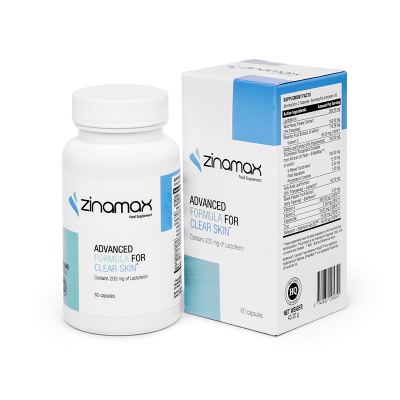
Our Recommendation — Zinamax
Score: 5.7/10 · Best for: adults with mild, persistent breakouts who want a nutritional adjunct alongside a topical routine, judged fairly over 12 weeks. Main caution: it carries a declared milk allergen, its vitamin B6 (18 mg) sits above EFSA's upper limit, and no money-back guarantee is published. Fair trial: the three-bottle pack at $39.33 a bottle — one full trial at the trials' own 8–12 week length.
What Lactoferrin Is
Lactoferrin is a glycoprotein your own body makes — it is concentrated in colostrum and milk, and present in tears, saliva and the secretions that guard mucosal surfaces. Its day job is iron management: it binds free iron tightly, which starves iron-dependent bacteria, and it interacts with the immune system in ways researchers describe as anti-inflammatory and immunomodulatory.
Supplemental lactoferrin is almost always bovine — purified from cow's milk (or whey) — a fact with two consequences this article will not bury: it is not vegan, and it is a milk protein, which makes it an allergen issue, not a lactose issue (more below).
The acne rationale is coherent: sebum oxidation and C. acnes-driven inflammation are plausible targets for an anti-inflammatory, iron-chelating protein, and sebum itself was a measured endpoint in the trials. Coherent rationale, however, is the entry ticket — the trials are the evidence, and there are four.
The Whole Human Record: the Attribution Table
This is the table no competitor publishes, because it makes the category's favourite percentages impossible to misuse. Every human lactoferrin-for-acne study from 2010 to 2022, with what was actually taken, against what, and what the result does not prove:
| Study | What was actually taken | Comparator & design | Result | What it does NOT prove |
|---|---|---|---|---|
| Kim et al. 2010 (Nutrition) | 200 mg/day lactoferrin in fermented milk | Same fermented milk without lactoferrin; RCT, double-blind, n=36, ages 18–30, 12 weeks | Inflammatory lesions −38.6%, total lesions −23.1%, acne grade −20.3%, sebum −31.1% vs control | Anything about a dry capsule. The fermented milk is part of the intervention; the famous 38.6% and 31.1% figures belong to this drink, not to any pill |
| Mueller et al. 2011 | Lactoferrin 100 mg twice daily, chewable | No control group — open-label, single-arm; n=43, 39 completed, 8 weeks | 76.9% of participants improved; total lesions −32.5% vs baseline | Causation. Without a comparator, improvement cannot be separated from acne's natural fluctuation and study participation |
| Chan et al. 2017 (Int J Dermatol) | Capsule: lactoferrin 100 mg + vitamin E 11 IU + zinc 5 mg, twice daily (200 mg / 22 IU / 10 mg per day) | Placebo capsule; RCT, double-blind, n=168, ages 13–40, 3 months | Median total-lesion reduction vs placebo: −14.5% at week 2 (earliest significant signal), peaking at −28.5% at week 10; comedones −32.5%, inflammatory lesions −44% at week 10; sebum improved by week 12; no adverse events | That lactoferrin alone did it. Three ingredients were tested as a unit; the effect cannot be divided among them |
| Kazandjieva et al. 2022 | Topical cream plus a multi-ingredient oral supplement (prebiotic sugars, zinc, lactoferrin, niacinamide) | Cream alone; women 25–40 only | Lesion reduction −73% (oral + cream) vs −63% (cream alone) | A lactoferrin effect. The 10-point gap is the whole supplement's increment on top of a working cream, in women only |
Read the table as a whole and the honest headline writes itself — it is also the headline the peer-reviewed review literature uses: across the placebo-controlled settings, lactoferrin-containing interventions reduced inflammatory lesions by approximately 20–40%, with heterogeneous formulations, doses and designs, and a proposed supplemental range of 100–200 mg/day.
A more critical review in Clinical, Cosmetic and Investigational Dermatology calls the evidence "significantly limited" and positions lactoferrin as a potential adjunctive therapy. Both characterisations are compatible with the table; the marketing version — in which 38.6% becomes a product result — is not.
One more act of attribution hygiene, because the error is propagating across the web: a widely copied review table lists Chan's capsule as containing "11 IU vitamin D". The primary abstract says vitamin E. If a page you are reading repeats the vitamin D version, it copied the table without reading the trial.
The Dose-Matching Sentence, Applied to Zinamax
Our house rule for this ingredient is a single sentence shape, and here it is for the product this cluster reviews: Zinamax's 200 mg of lactoferrin matches Kim's and Chan's daily amounts numerically — but Zinamax is a capsule with different co-ingredients (15 mg zinc, 3.36 mg vitamin E), so neither trial is a trial of Zinamax.
The numerical match is the strongest thing the product has going for it — most supplement ingredients are dosed at a fraction of their studied amounts, and this one is not.
But dose is only one variable: Kim's lactoferrin arrived inside a fermented-milk matrix that may itself matter (fermentation products, a probiotic food context), and Chan's arrived with zinc and vitamin E in specific proportions. A capsule delivering the same milligrams of the headline ingredient is a reasonable bet on the ingredient, not a replication of the intervention.
Any review — including ours — that lets the 200 mg match silently upgrade into "clinically proven" has failed its reader. (For the same reason, treat the claim circulating on other brands' pages that a lactoferrin combination "lessens pimples by up to 94%" as what it is: irreconcilable with either of its own cited trial's endpoints — a 28.5% maximum median reduction in total lesions, and 44% in inflammatory lesions, both at week 10.)
The Dairy Paradox, Answered Properly
The acne audience is the most dairy-suspicious audience in nutrition — our diet-and-acne article grades the skim-milk evidence in full — so a milk-derived lead ingredient raises an obvious question, and it deserves a precise answer rather than reassurance. First, the allergen point, which is not negotiable: lactoferrin is a purified cow's-milk protein.
If you have a milk-protein allergy, Zinamax and every bovine lactoferrin product are a hard no — full stop, whatever the dose or purification. Second, lactose is a different issue: lactoferrin is a protein, not the milk sugar; lactose intolerance is not, by itself, the obstacle — milk-protein allergy is.
Third, the vegan point: supplemental lactoferrin is bovine, so the product is not vegan, and our review of Zinamax says so on the product page, not in a footnote.
Fourth, the apparent contradiction — a milk protein helping acne while milk intake is associated with acne — is less paradoxical than it looks: the dietary signal concentrates in skim milk as a food (its whey/casein protein load and hormonal/insulin context), while Kim's trial showed lactoferrin improving outcomes inside a milk vehicle against the same milk without it.
The protein fraction pulled one way; the food matrix, on present evidence, pulls the other. That is an observation, not a resolution — the dairy-acne mechanism is unsettled — but it is why "it comes from milk" is an allergen warning and a vegan disclosure, not by itself an efficacy argument either way.
The Gut–Skin Axis — and Why Lactoferrin Is Not a Probiotic
Lactoferrin marketing leans heavily on gut language, so let us separate the terms. Probiotics are live microorganisms — specific Lactobacillus and Bifidobacterium strains, dosed in colony-forming units — and the gut–skin axis research on them for acne is early, small and heterogeneous. Lactoferrin is not a live organism. It is a protein; it has no strains and no CFUs.
It may influence the gut environment (iron chelation affects which bacteria thrive), and it was literally delivered inside a fermented — i.e., probiotic-containing — food in Kim's trial, but that context is a reason for attribution care, not a licence to call the ingredient a probiotic. Zinamax contains no live strains; its FAQ on the product page says exactly that.
If a page describes a lactoferrin capsule as "probiotic support", it is borrowing credibility from a different category — and, in Kim's case, from the very vehicle the trial's control group also drank.
Timeline, Safety and What Would Change Our Mind
Timeline from the endpoints, not from hope: Chan's combination produced its first statistically significant separation at week 2 (−14.5% median reduction in total lesions), peaked at week 10 (−28.5% median reduction in total lesions; inflammatory lesions fell 44% at the same peak), and ran 12 weeks; Kim's milk trial read out at 12 weeks.
Judge a lactoferrin product the way the trials were designed: expect nothing provable before week 4–6, take the week-10-to-12 reading as the verdict, and photograph weekly in identical light.
Safety: lactoferrin was well tolerated in these trials (Chan recorded no adverse events), and it carries a long food-use history; the hard exclusions are milk-protein allergy, and — on the maker's label for Zinamax — children, pregnancy and breastfeeding.
What would change our mind: a lactoferrin-only capsule RCT — the ingredient alone, in the form people actually buy, against placebo, at 200 mg/day for 12 weeks. That single trial would do more for this category than another decade of combination studies. Until it exists, the systematic-review literature — summarised by Hassoun and colleagues (2017) for lactoferrin's dermatological potential — supports "promising adjunct", and nothing stronger.
Who Should Buy Zinamax — and Who Should Skip It
Buy it if you are an adult with mild inflammatory acne who wants the lactoferrin bet at its studied dose — 200 mg/day, the full amount from both randomised trials — inside a formula whose zinc (15 mg) sits inside its own studied range, and you are content to judge it at week 12 with photographs.
Skip it if you are allergic to milk protein (hard no — this is a bovine milk protein with a declared MILK allergen), if you are vegan (bovine source), if you are under 18, pregnant or breastfeeding (maker's exclusions), if your acne is cystic or scarring (dermatologist first), or if you are buying the 38.6% figure — that number belongs to a fermented-milk drink in a 36-person trial, and no capsule has earned it.
There is also no published money-back guarantee, so the 12-week test is at your expense; the six-bottle pack ($29.50 a bottle) only makes sense after a first bottle has earned it.
Our Recommendation — Zinamax
Score: 5.7/10 · Best for: adults with mild, persistent breakouts who want a nutritional adjunct alongside a topical routine, judged fairly over 12 weeks. Main caution: it carries a declared milk allergen, its vitamin B6 (18 mg) sits above EFSA's upper limit, and no money-back guarantee is published. Fair trial: the three-bottle pack at $39.33 a bottle — one full trial at the trials' own 8–12 week length.
Frequently Asked Questions
Is lactoferrin proven to work for acne?
It has two small positive randomised trials — one in fermented milk (Kim 2010), one as part of a three-ingredient capsule (Chan 2017) — plus an uncontrolled study and a combination cream study. That is promising, adjunctive-level evidence: roughly 20–40% inflammatory-lesion reductions in the controlled settings. It is not proof for lactoferrin alone in a capsule, which has never been trialled.
Can I take lactoferrin if I avoid dairy?
Depends why. Milk-protein allergy: no — lactoferrin is a bovine milk protein and Zinamax carries a MILK allergen. Lactose intolerance: lactoferrin is a protein, not the milk sugar, so lactose alone is not the obstacle. Vegan or dairy-free on principle: no — the ingredient is purified from cow's milk.
Is lactoferrin a probiotic?
No. It is a protein, not a live microorganism; it has no strains or CFUs. Zinamax contains no live probiotic strains. The confusion partly comes from Kim 2010, where lactoferrin was delivered inside a fermented (probiotic) milk — the vehicle was probiotic; the ingredient is not.
How long does lactoferrin take to work on acne?
The trials read out at 12 weeks; the combination capsule separated from placebo at week 2 and peaked at week 10. Judge at 10–12 weeks with weekly photographs — earlier verdicts are measuring skin that formed before the ingredient could plausibly act.
What dose of lactoferrin did the studies use?
200 mg/day in both randomised trials (Kim in fermented milk; Chan as 100 mg twice daily within a combination capsule). Zinamax provides 200 mg/day — a numerical match, with different co-ingredients and delivery form, which is why neither trial counts as a trial of the product.
Last reviewed: October 2026. This article is educational and is not medical advice.
