
- Quick Answer
- The Dose Table Nobody Publishes
- B12: the Strongest Case, With a Real Mechanism
- B6: Case Reports, Combinations, and an Honest Confession
- Whey, Iodine and Biotin: Three Different Grades of Suspicion
- The Timeline Self-Test: Is a Supplement Your Culprit?
- Who Should Buy Zinamax — and Who Should Skip It
- Frequently Asked Questions
- Can vitamin B6 cause acne?
- How do I know if a supplement is causing my breakouts?
- Does whey protein cause acne?
- Does biotin cause acne?
- Can iodine cause breakouts?
- Read This Next
Disclosure: This article contains affiliate links. If you buy through them, we may earn a commission at no extra cost to you. It never changes our conclusions.
Quick Answer
Yes — some supplements can trigger or worsen acne-like eruptions, and the evidence is strongest for high-dose vitamin B12 (a demonstrated bacterial mechanism plus case reports), moderate for vitamin B6 (mostly in combination with B12 in case reports), mixed for whey protein (case series and observation, one null trial), case-level for excess iodine, and unproven for biotin — whose real, documented problem is interfering with laboratory blood tests.
The eruptions in the case literature share a signature: sudden, uniform (monomorphic) papules and pustules appearing days to weeks after starting a high-dose product, and resolving within weeks of stopping it.
This article grades each suspect, prints the doses, and — because transparency is the point — ends with our own product's label on the table: Zinamax contains 18 mg of vitamin B6, above the European upper limit. Best for: anyone whose breakouts began suspiciously soon after a new supplement, and anyone stacking products without adding up the B vitamins.
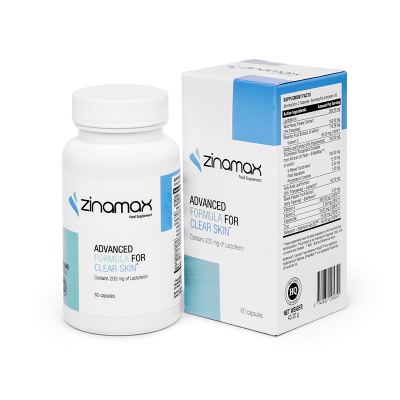
Our Recommendation — Zinamax
Score: 5.7/10 · Best for: adults with mild, persistent breakouts who want a nutritional adjunct alongside a topical routine, judged fairly over 12 weeks. Main caution: it carries a declared milk allergen, its vitamin B6 (18 mg) sits above EFSA's upper limit, and no money-back guarantee is published. Fair trial: the three-bottle pack at $39.33 a bottle — one full trial at the trials' own 8–12 week length.
The Dose Table Nobody Publishes
Articles in this genre name ingredients and omit milligrams — which makes them useless for the only question a reader actually has: "is my dose in the range that causes this?" Here is the table, with the column no competitor includes:
| Ingredient | Form in the cases & studies | Ceiling (where one exists) | In Zinamax? |
|---|---|---|---|
| Vitamin B12 | High-dose supplements and injections; mechanism demonstrated by Kang et al. 2015 | No UL set (low toxicity generally) — but "no UL" is not "no acne link" | No |
| Vitamin B6 | Case reports, usually combined high-dose B6 + B12 | EFSA (2023): UL 12 mg/day · US UL: 100 mg/day | Yes — 18 mg: above EFSA's UL, below the US UL |
| Whey protein | Protein powders (tens of grams/day); case series in young men | No UL — a food-level protein dose, not a vitamin dose | No. Zinamax's milk ingredient is lactoferrin, a single purified protein at 200 mg — not a whey-protein dose (but it is a MILK allergen) |
| Iodine | Excess: kelp/seaweed supplements, high-dose multivitamins | Adult UL 1,100 µg/day (US); normal dietary iodine is not implicated | No added iodine |
| Biotin | No proven acne cases with a mechanism; hypothesis only | No UL; its proven harm is lab-test interference at megadoses | No |
One footnote belongs under the B6 row in permanent marker: the EFSA and US upper limits are neuropathy ceilings, not acne thresholds. EFSA's 12 mg/day was set in 2023 against peripheral nerve damage from chronic high intake — the opinion from the European Food Safety Authority is a toxicology document, not an acne document.
No study has ever established a B6 dose at which acne begins, and this article will not invent one. What the case literature shows is eruptions at high supplemental doses, usually in B-complex or injection contexts — which is why our product's 18 mg is a disclosure item and a stacking concern, not a claim that Zinamax causes acne. Precision about what a number means is the whole game in this category.
B12: the Strongest Case, With a Real Mechanism
Vitamin B12 is the one suspect with a demonstrated mechanism, and it is routinely stated backwards in popular coverage (one major pharmacy site explains that the skin bacteria "need B12 to grow" and that porphyrin "helps you make red blood cells" — both wrong).
The actual finding, from Kang and colleagues (2015) in Science Translational Medicine: when Cutibacterium acnes — the skin bacterium central to acne — is supplied with abundant B12, it represses its own B12-synthesis genes and shunts its metabolism toward producing porphyrins, compounds that provoke inflammation in the pore.
In the study's human arm, 10 healthy subjects were supplemented with B12 and one developed acne within a week. Around that mechanism sits the older case literature — sudden monomorphic papulopustular eruptions following high-dose B12 (including injections), resolving after withdrawal. Grade: strongest in this article — mechanism plus cases.
The caveat rides with it: B12 is also an essential nutrient, deficiency is genuinely harmful, and prescribed B12 (for pernicious anaemia, deficiency, or a restricted diet that requires it) is a medical treatment, not a beauty experiment. The guardrail below exists precisely for this ingredient.
B6: Case Reports, Combinations, and an Honest Confession
B6's file is thinner: the eruption reports typically involve high-dose B6 together with B12 (B-complex products, injections), which makes isolating B6's contribution genuinely hard — no trial has tested B6 alone against acne, and no acne dose-threshold exists.
What can be said: B6 belongs on the suspect list at high supplemental doses; the regulatory ceilings diverge wildly (EFSA 12 mg/day vs US 100 mg/day, a disagreement about neuropathy margins, not acne); and intake stacks invisibly, because B6 hides in multivitamins, energy products, hair-and-nail gummies, PMS formulas — and acne formulas themselves.
Which brings us to the confession this article exists to make. Zinamax — the product this cluster reviews and this site scores 5.7/10 — contains 18 mg of vitamin B6 per daily serving. That is above EFSA's 12 mg/day upper limit and well below the US limit of 100 mg/day, and the formula contains no B12.
We print that on the product page, in our vitamins article, and here, because a review site that audits competitors' labels while hiding its own product's awkward number is doing marketing, not reviewing. Does 18 mg of B6 cause acne?
The honest answer is that nobody knows — the case reports involve higher, usually combined doses, and no threshold study exists. Does it belong in your stacking arithmetic and in a "my skin got worse after starting this" investigation? Absolutely — including if the product is ours.
Whey, Iodine and Biotin: Three Different Grades of Suspicion
Whey protein — mixed evidence.
The mechanism story is insulin/IGF-1 signalling from a large, fast protein dose, and the clinical record is a handful of case series in young male lifters (our diet article tells the best-known series correctly: five males, four clearing fully on stopping whey, one flaring again on re-challenge) plus observational data — counterweighted by a randomised trial in young men with acne that found whey did not worsen acne versus a non-whey supplement.
Verdict: a plausible trigger for a subset of users, worth a stop-test if your breakouts track your shakes, not a proven cause. And a distinction this article insists on: Zinamax is not a whey supplement. Its milk-derived ingredient is lactoferrin — one purified protein at 200 mg, not a 25-gram whey serving. The milk connection matters for allergy (a hard exclusion), not for the whey-acne question.
Iodine — case-level, excess-only. Acneiform eruptions from iodine are a documented response to excess: kelp and seaweed supplements (whose iodine content can be enormous and variable) and high-dose multivitamins are the usual vehicles; iodinated contrast and certain medicines appear in the medical literature too.
Normal dietary iodine — iodised salt, dairy, seafood at ordinary intakes — is not implicated, and iodine is essential for thyroid function. Zinamax contains no added iodine. The teen-marketed formulas that include kelp iodine are the ones to scrutinise — our teenager article does.
Biotin — unproven for acne; proven for a different harm. The popular claim is that biotin competes with vitamin B5 (pantothenic acid) absorption and thereby provokes breakouts. That mechanism is a hypothesis — repeated until it sounds established, but no study demonstrates biotin causing acne.
What is documented, with regulator warnings behind it, is biotin's interference with laboratory tests: megadose biotin distorts immunoassays, including thyroid panels and troponin (the heart-attack marker). If you take high-dose biotin, tell the lab and your doctor before blood tests.
Grading biotin honestly — acne: unproven; lab interference: real — is what separates an evidence audit from a listicle, and it is why biotin sits at the bottom of this suspect list rather than the top.
The Timeline Self-Test: Is a Supplement Your Culprit?
The case literature gives you a usable diagnostic pattern. Work through it before blaming (or exonerating) any product:
- Dates. Did the eruption begin within days to a few weeks of starting a supplement — or of a dose increase, a new brand, or an injection course? Supplement-triggered eruptions in the reports are temporally tight.
- Pattern. Do the lesions look uniform — many similar papules and pustules arriving together, often without the comedones (blackheads/whiteheads) that precede ordinary acne? The reported eruptions are characteristically monomorphic and sudden.
- The stop-test. If the suspect is a non-essential supplement, stopping it is the experiment: case reports describe resolution within weeks of withdrawal. One change at a time, or the test tells you nothing.
- The stack audit. List everything — multivitamin, gummies, energy drinks, protein, the acne formula itself — and total the B6 and B12. The culprit is often arithmetic, not a single product.
The guardrail, without exceptions: do not stop prescribed B12 or B6 on your own. Pernicious anaemia, diagnosed deficiency, pregnancy-related prescriptions and several medication regimens make these vitamins medical treatment, and deficiency harms are worse than breakouts.
If you suspect a prescribed product, that is a conversation with the prescriber — who can test levels, adjust form or dose, and treat the skin in parallel. And if an eruption is severe, painful, blistering or accompanied by feeling unwell, that is not a self-test situation at all: see a doctor promptly, because not every sudden eruption is acneiform or benign.
Who Should Buy Zinamax — and Who Should Skip It
Buy it if you have read this article and buy with eyes open: a lactoferrin-and-zinc formula (the two trialled ingredients) whose one awkward number — B6 18 mg, above EFSA's ceiling, below the US one — you have counted into your total intake and accepted, and whose maker publishes no money-back guarantee.
Skip it if your breakouts began after starting a B-complex or any high-dose B-vitamin product (solve that first — adding another B6 source during the investigation muddies the stop-test), if you already take a multivitamin plus gummies stack you won't audit, if you are allergic to milk (the lactoferrin is bovine; MILK allergen), or if you need a product whose label contains nothing you have to make a judgement call about — on B6, this one asks for a judgement call, and we would rather lose the sale to that sentence than hide it.
Our Recommendation — Zinamax
Score: 5.7/10 · Best for: adults with mild, persistent breakouts who want a nutritional adjunct alongside a topical routine, judged fairly over 12 weeks. Main caution: it carries a declared milk allergen, its vitamin B6 (18 mg) sits above EFSA's upper limit, and no money-back guarantee is published. Fair trial: the three-bottle pack at $39.33 a bottle — one full trial at the trials' own 8–12 week length.
Frequently Asked Questions
Can vitamin B6 cause acne?
It is suspected, on case-report evidence — usually at high doses and usually combined with B12. No acne threshold dose has ever been established, and the regulatory upper limits (EFSA 12 mg/day, US 100 mg/day) were set against nerve damage, not skin. Zinamax contains 18 mg of B6; we disclose that prominently rather than hide it.
How do I know if a supplement is causing my breakouts?
Run the timeline self-test: onset within days-to-weeks of starting, a sudden uniform (monomorphic) pattern of papules/pustules, and resolution within weeks of stopping the suspect product. Audit the whole stack's B6/B12 totals. Never stop a prescribed B vitamin without the prescriber.
Does whey protein cause acne?
Mixed evidence: case series describe young men clearing after stopping whey (one flaring on re-challenge), but a randomised trial in young men found no worsening. It is a reasonable stop-test candidate if your breakouts track your protein shakes. Note that lactoferrin products are not whey products — different protein, different dose scale.
Does biotin cause acne?
Unproven. The biotin-blocks-B5 mechanism is a hypothesis with no demonstrating study. Biotin's documented harm is different: megadoses distort laboratory blood tests (including thyroid and troponin), which is why clinicians ask about it before testing.
Can iodine cause breakouts?
At excess intakes, yes — acneiform eruptions are documented, typically from kelp/seaweed supplements or high-dose multivitamins. Ordinary dietary iodine is not implicated, and iodine is essential. Scrutinise teen formulas containing kelp-derived iodine.
Last reviewed: October 2026. This article is educational and is not medical advice.
