
- Quick Answer
- What Makes Acne "Hormonal" — and Why the Word Sells
- What Supplements CAN Do
- Support the inflammation side of the lesion count — zinc's honest slice
- Address a diagnosed metabolic piece — inositol, in PCOS, with the counterweight attached
- Fill a measured gap — vitamin D, by blood test only
- What Supplements CAN'T Do
- What Is UNPROVEN for Acne
- Spearmint, told exactly
- The Absent-Ingredient Register — and the Zinamax Honesty Box
- What the Real Hormonal Treatments Do
- Two Presentations That Deserve Their Own Paragraphs
- Post-pill acne
- Perimenopausal acne
- DIM, Examined Slowly
- The Gut Question, Briefly
- "Estrogen Dominance" and Detox Language: a Vocabulary Audit
- Omega-3, Selenium and the Supporting Cast
- A Word on Testing Hormones Yourself
- A Sensible Sequence, If You Are Doing This Yourself
- Who Should Buy Zinamax — and Who Should Skip It
- FAQ
- Can supplements balance hormones?
- Does inositol help hormonal acne?
- Does spearmint tea clear hormonal acne?
- Do DIM and saw palmetto work for hormonal acne?
- How long should I try a supplement before judging it?
- Does zinc "balance hormones"?
- When is hormonal acne a doctor's problem, not a supplement problem?
- Read This Next
Disclosure: This article contains affiliate links. If you buy through them, we may earn a commission at no extra cost to you. It never changes our conclusions.
Quick Answer
Hormonal acne — the adult, often jawline-and-chin pattern that flares with the menstrual cycle, after stopping the pill, or alongside PCOS — is the acne subtype most aggressively marketed to and least honestly served by the supplement industry.
Start with the sentence the honest end of that industry prints and the rest omit: no supplement has research showing it corrects a hormonal imbalance.
What supplements can do is narrower: zinc can modestly reduce inflammatory lesions (in trials of acne generally, not hormonal acne specifically); inositol has genuine PCOS trials behind it — for insulin and androgen measures, with acne as a secondary outcome — while remaining officially "experimental" for PCOS in the international guideline; spearmint tea lowered testosterone in one small 30-day trial that never measured acne.
What they cannot do is replace the treatments with actual hormonal action — combined oral contraceptives and spironolactone — or a PCOS workup. Best for: adults who want the demanded ingredients (inositol, DIM, spearmint, saw palmetto) graded one by one before spending — including the register, below, of which of them are absent from the product this cluster reviews.
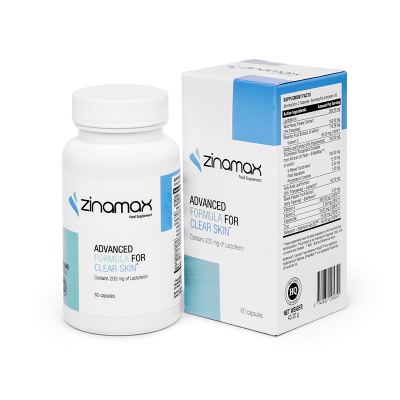
Our Recommendation — Zinamax
Score: 5.7/10 · Best for: adults with mild, persistent breakouts who want a nutritional adjunct alongside a topical routine, judged fairly over 12 weeks. Main caution: it carries a declared milk allergen, its vitamin B6 (18 mg) sits above EFSA's upper limit, and no money-back guarantee is published. Fair trial: the three-bottle pack at $39.33 a bottle — one full trial at the trials' own 8–12 week length.
What Makes Acne "Hormonal" — and Why the Word Sells
All acne involves hormones at some level — androgens drive sebum production in everyone, which is why acne ignites at puberty.
The pattern clinicians call hormonal acne in adult women has a recognisable shape: deep, tender, inflammatory lesions concentrated on the lower face, jawline, chin and neck; flares timed to the cycle (typically the week before a period); onset or worsening after stopping hormonal contraception; persistence into the thirties and forties long past the teenage pattern; and, in a significant subset, company — irregular or absent periods, excess hair growth, scalp hair thinning, weight that concentrates centrally — pointing toward polycystic ovary syndrome, which deserves diagnosis in its own right because its implications (insulin resistance, fertility, metabolic risk) extend far beyond skin. The reason "hormonal" is the industry's favourite adjective is that it promises a root cause a capsule can reach: balance the hormones, clear the skin. The promise fails on a simple evidentiary point that the most rigorous competitor in our audit — a supplement brand, notably — prints in its own guide: it does not cover research showing that any supplement corrects a hormonal imbalance, because there isn't any. Hormones in adult women are not a dimmer switch that a botanical blend adjusts; they are a regulated system with feedback loops, and the interventions proven to move acne through that system are pharmaceutical (anti-androgen contraception, spironolactone) precisely because moving it takes pharmacology. Everything below is graded against that reality, in three buckets: what supplements can do, what they can't, and what is unproven — sold on mechanism and testimonials while the acne trial that would settle it has never been run.
What Supplements CAN Do
Support the inflammation side of the lesion count — zinc's honest slice
Zinc is the strongest card any supplement holds in acne, hormonal or otherwise, and its honesty requirements are specific.
The trial record (graded in full in our zinc article) shows a modest reduction in inflammatory papules at 15–30 mg of elemental zinc a day over 12 weeks, with the best-known head-to-head trial — Dreno and colleagues (2001), 332 patients — reaching its success endpoint (a greater-than-two-thirds drop in inflammatory lesions at day 90) in 31.2% on zinc versus 63.4% on the antibiotic minocycline.
A 2020 meta-analysis by Yee and colleagues confirmed significantly fewer inflammatory papules and noted that acne patients tend to run lower serum zinc. What zinc is not shown to do is alter androgen levels or cycle-timed flare patterns — the hormonal machinery itself.
So zinc's place in hormonal acne is as an anti-inflammatory adjunct that may take the edge off lesion counts while the hormonal driver is addressed elsewhere. Inside the product this cluster reviews, the dose honesty matters: Zinamax provides 15 mg of elemental zinc — half the 30 mg dose of the Dreno trial, the bottom of the studied range.
A review that calls that "the clinically studied dose" is rounding in its own favour; ours calls it what it is.
Address a diagnosed metabolic piece — inositol, in PCOS, with the counterweight attached
Inositol (usually myo-inositol, typically ~2 g once or twice daily in the trials) is the one "hormonal acne supplement" with a real clinical literature — and precision about what that literature is for is the whole story. The trials are PCOS trials.
Zacchè and colleagues (2009, n=50) found testosterone and insulin improved at three months, with acne and hirsutism improving by six. Formuso and colleagues (2015, n=137) reported similar metabolic and skin directions. Bahadur and colleagues (2021, n=72) tested inositol as an add-on to metformin and found better acne scores at six months.
That is a better file than any other ingredient in this article owns — and here is the counterweight that the pages selling inositol rarely print beside it: a 2024 review of the PCOS inositol evidence rates it limited and inconclusive, and the 2023 international evidence-based PCOS guideline classifies inositol as experimental — to be considered in specific contexts, not an established therapy.
Both halves are true at once: promising small-to-midsize trials in PCOS populations, and a guideline establishment that has not yet been persuaded. If you have PCOS, inositol is a legitimate conversation to have with the clinician managing it.
If you do not have PCOS, the trials say almost nothing about you — their acne outcomes were secondary endpoints in a metabolic condition you don't have. And the disclosure this section owes you: inositol is not in Zinamax. It is absent from the formula entirely, so nothing in this section is a reason to buy the product below; it is a reason to have an informed PCOS conversation.
Fill a measured gap — vitamin D, by blood test only
Vitamin D deficiency is measurably more prevalent in acne patients than controls (Lim and colleagues, 2016), and in that study the subgroup who were deficient and supplemented improved. That supports a test-and-correct approach — deficiency is worth fixing for bone and general health regardless of skin — not blind supplementation as an acne therapy. Vitamin D is also, for the register: not in Zinamax.
What Supplements CAN'T Do
Correct a hormonal imbalance. Covered above because everything depends on it: no supplement trial demonstrates normalisation of androgens, oestrogen, progesterone or insulin as an acne treatment in non-PCOS populations — and in PCOS, the one candidate (inositol) remains guideline-experimental.
Any page that grades DIM as "reducing androgen production" is ahead of its evidence: DIM's studied action is on oestrogen metabolism pathways, and direct acne evidence for it is thin to absent.
The related claim that vitamin B6 "elevates progesterone and drops oestrogen" appears in practitioner listicles with no trial behind it at all — and B6 has its own section in this cluster, because at high doses it is a suspected acne trigger (our Q5 article; note for later that Zinamax contains 18 mg of B6, above EFSA's 12 mg/day upper limit — disclosed, not hidden).
Replace the pill, spironolactone, or a dermatologist. Combined oral contraceptives approved for acne and the anti-androgen spironolactone have controlled-trial evidence for hormonal-pattern acne in women, act on the actual mechanism, and are prescribed with screening and monitoring. A supplement stack is not a gentler equivalent; it is a different category of thing.
Likewise, adult-onset acne with PCOS features is a diagnostic situation: the workup (androgen levels, cycle history, metabolic screening) identifies conditions whose management matters beyond skin. A capsule that delays that workup by six months of "let's see" is not neutral; it is a cost.
Work in days. Every timeline in this cluster obeys skin biology and the trial record: 8–12 weeks minimum for a fair judgement of anything oral, with cycle-timed conditions honestly needing two to three full cycles to read.
"Hormonal rebalancing fully kicks in at 3–6 months" (a real claim from a competitor's page) translates, stripped of poetry, to "pay us for half a year before judging" — while the actual trials read out at 10–12 weeks. Judge at 12 weeks; escalate at 12 weeks if nothing has moved.
What Is UNPROVEN for Acne
The following ingredients are sold for hormonal acne on mechanism, tradition, or a biomarker trial that did not measure acne. "Unproven" is not an insult — it is a research status, and it is the status of most of this article's bestsellers. The distinction that matters is whether a page says so.
| Ingredient | Claim | What exists | What's missing |
|---|---|---|---|
| Inositol | Balances hormones / helps PCOS acne | PCOS trials: metabolic + androgen measures improve; acne secondary | Guideline status still "experimental"; no large acne-primary trial |
| Spearmint | Anti-androgen, clears hormonal acne | One 30-day trial (Grant 2010, n=42): free testosterone fell | Acne was never measured; no acne RCT at all |
| DIM | Rebalances oestrogen, clears acne | Mechanism on oestrogen metabolism pathways | No acne trial; one acne-adjacent study mixed DIM with other ingredients |
| Saw palmetto | Blocks DHT, clears hormonal acne | 5-alpha-reductase inhibition in vitro; BPH literature | No acne trial in women; unregulated potency |
| Reishi / white peony | Balances hormones | Traditional use; small endocrine studies | No acne trials |
| Omega-3 | Anti-inflammatory acne support | One small RCT (Jung 2014, n=45) suggested improvement | Single small trial, never replicated at scale |
| Zinc | Reduces acne lesions | Multiple trials + meta-analysis in acne generally | Not hormonal-specific; modest effect; dose matters |
| Lactoferrin | Reduces acne lesions | Two trials (Kim 2010, Chan 2017) in acne generally | Not hormonal-specific; Chan used a combination capsule |
Spearmint, told exactly
Spearmint tea is the single most shared "hormonal acne supplement" online, and its evidence is exactly one study: Grant (2010), 42 women with PCOS, randomised to spearmint tea twice daily or placebo tea for 30 days. Free testosterone fell significantly in the spearmint group; total testosterone and DHEAS did not change significantly.
Acne was not an endpoint. Nobody counted a lesion. A 30-day biomarker study in PCOS is not an acne trial, and the tea's effect size on the one marker that moved was modest.
Spearmint is cheap, low-risk, and a reasonable thing to drink if you enjoy it — but a supplement capsule selling "the Grant study" as proof it clears hormonal acne is selling a study that never looked at skin. (For completeness: spearmint is not in Zinamax either.)
The Absent-Ingredient Register — and the Zinamax Honesty Box
This cluster reviews one product, Zinamax, whose formula is lactoferrin, zinc (15 mg), vitamin A, vitamin E, vitamin B6 (18 mg) and evening primrose oil. Everything in this article that a hormonal-acne shopper is most likely searching for is, verifiably, absent from that formula:
- Inositol: absent.
- DIM: absent.
- Spearmint: absent.
- Saw palmetto: absent.
- Reishi / white peony: absent.
- Vitamin D: absent.
We print this register for a reason a commerce site normally avoids: if what you want is a hormonal acne supplement, Zinamax is not one, and buying it for that reason would be a category error. What Zinamax is, on the evidence in this cluster, is a lactoferrin-plus-zinc adjunct whose honest use case is inflammatory breakouts generally — graded, with its own dose and B6 problems disclosed, in our hub article and its lactoferrin article.
A site that tells you a product is the wrong tool for your stated job is a site whose recommendation, when it does come, is worth more than a site that never says no. That is the trade this cluster makes, and we make it in every article.
What the Real Hormonal Treatments Do
For completeness, and because a supplement article that never names the effective alternative is a funnel rather than a guide:
- Combined oral contraceptives (several FDA-approved for acne in women) suppress ovarian androgen production and raise sex-hormone-binding globulin, which lowers free testosterone. Evidence: controlled trials; effect size meaningful; side-effect and contraindication screening required.
- Spironolactone blocks androgen receptors and reduces sebum production. Evidence: randomised trials and large cohort data in adult women; off-label for acne in many jurisdictions; requires monitoring of potassium and blood pressure, and is not used in pregnancy.
- Topical retinoids and benzoyl peroxide remain the local backbone regardless of hormonal pattern — they do not need a hormonal rationale to work, and every supplement in this cluster is an adjunct to, not a replacement for, that backbone.
If your acne is severe, scarring, or accompanied by the PCOS features named above, the correct first move is a clinician, not a cart.
Two Presentations That Deserve Their Own Paragraphs
Post-pill acne
Stopping a combined pill removes both its androgen suppression and its SHBG-raising effect, so a rebound flare in the months after stopping is common and, for most people, self-limiting as the axis re-equilibrates.
The supplement pages targeting this moment sell "post-pill detox" protocols, which is a category error dressed as a protocol: there is no detoxification process involved, and nothing to detox.
What the evidence supports is patience (three to six months), a topical retinoid backbone, and a clinician conversation if the flare is severe, scarring, or still worsening at six months — because at that point the question becomes whether an underlying PCOS was masked by years of contraception, which is a diagnosis, not a detox.
Perimenopausal acne
Perimenopause shifts the androgen-to-oestrogen ratio as oestrogen falls, and late-onset acne in this window is again a reason for clinical assessment rather than a supplement stack — not least because new hirsutism, voice change or rapid virilisation at this age has a differential that includes androgen-secreting tumours.
Those are rare and the sentence exists to name them, not to frighten: the routine presentation is a ratio shift. But "rare and serious" is exactly the profile that belongs with a clinician, not a cart.
DIM, Examined Slowly
DIM (diindolylmethane, from cruciferous vegetables) deserves its own paragraph because it is the best-marketed hormonal acne ingredient and the most misdescribed. The claim chain usually runs: DIM "supports healthy oestrogen metabolism" → therefore it "balances hormones" → therefore it clears hormonal acne. Step one is a real biochemical statement (DIM shifts oestrogen metabolism toward 2-hydroxyestrone in human studies).
Step two is a leap — shifting a metabolite ratio is not "balancing hormones" in any clinically validated sense — and step three is unproven: there is no randomised acne trial of DIM alone. The one study sometimes cited combined DIM with other ingredients and was not designed to isolate it. DIM also interacts with drug-metabolising enzymes (CYP pathways), which is a real consideration for anyone on hormonal contraception or other medication — a fact the pages selling it as a gentle balancer omit with notable consistency.
DIM is, for the register: not in Zinamax.
The Gut Question, Briefly
The gut–skin axis is real biology — intestinal permeability and microbial composition interact with systemic inflammation — and it is also the supplement industry's favourite un-falsifiable frame, because "support your gut" can be claimed for anything and disproven for nothing.
The acne-specific trial record for probiotics is small and mixed, and the lactoferrin trials in this cluster used a fermented-milk vehicle (Kim 2010) without isolating a gut mechanism. Our position, stated in the lactoferrin article and repeated here: gut health is worth supporting for its own sake; selling it as a hormonal acne mechanism is a story in search of a trial.
"Estrogen Dominance" and Detox Language: a Vocabulary Audit
Two phrases do most of the selling work in this category, and neither survives contact with an endocrinologist.
"Estrogen dominance" is not a diagnosis. It is a wellness-industry coinage describing a supposed excess of oestrogen relative to progesterone, diagnosed by symptom lists rather than measured hormone ratios, and treated with the very supplements this article grades as unproven. Clinically, oestrogen excess has specific causes (including, rarely, tumours) and specific presentations; a symptom list is not a hormone panel.
"Detox" language — liver cleanses, post-pill detoxes, hormone detoxes — implies the body accumulates hormones or toxins that a supplement flushes. The liver metabolises and excretes hormones continuously without assistance, and no supplement trial demonstrates accelerated hormonal clearance as an acne treatment.
When a page's mechanism section is written in these two phrases, it is telling you its evidence standard before you reach its product section. Read accordingly.
Omega-3, Selenium and the Supporting Cast
Omega-3 (fish oil) has one small acne RCT — Jung and colleagues (2014, n=45) — in which the omega-3 group improved more than controls over 10 weeks. One small trial, never replicated at scale: promising, unproven, and cheap enough that a fish-oil capsule is a low-stakes experiment if you want one — but not a hormonal treatment.
Selenium is sometimes bundled into hormonal blends on antioxidant reasoning; the acne evidence is a single older combination study and nothing standalone. Evening primrose oil — present in Zinamax — has no acne trial evidence at all; its inclusion is traditional rather than evidential, and we say so in the product's own review rather than letting the ingredient list imply otherwise.
The pattern to notice: the supporting cast is sold by association with the one or two ingredients that have trials, and the association is doing all the work.
A Word on Testing Hormones Yourself
Direct-to-consumer hormone panels and at-home saliva tests are sold as the diagnostic companion to hormonal acne supplements. Their limitations are worth stating plainly: hormone levels fluctuate across the cycle and across the day, reference ranges are population statistics rather than personal targets, and a single panel without clinical context rarely changes management.
If your cycles are irregular, you have excess hair growth or hair loss, or acne appeared suddenly in adulthood, the useful test is a clinician-ordered panel interpreted alongside your history — not a kit that returns a traffic-light graphic and a supplement recommendation from the same company that sold the kit.
A Sensible Sequence, If You Are Doing This Yourself
- Topical backbone first. A retinoid (adapalene over the counter in many regions, tretinoin by prescription) plus benzoyl peroxide or azelaic acid, used consistently for 12 weeks. This is the highest-yield move in the entire article and it costs the least.
- Pattern check. Is the acne cycle-timed, jawline-concentrated, adult-onset? Are there PCOS features? If yes to the second question, book the clinician before the cart.
- One oral adjunct at a time. If you add a supplement, add one, at the studied dose, for 12 weeks, with a photo diary. Zinc at 15–30 mg elemental, or a lactoferrin product at the trial-matched dose, are the defensible choices from this cluster's evidence. Adding a five-ingredient "hormone balance" blend makes it impossible to know what helped or harmed.
- Escalation rule. No meaningful change at 12 weeks, or any worsening, scarring or distress at any point: clinician, not a second supplement.
Who Should Buy Zinamax — and Who Should Skip It
Buy: someone with mild-to-moderate inflammatory acne who wants a lactoferrin-plus-zinc adjunct, understands its dose is at the bottom of the studied range, has read the B6 disclosure (18 mg, above EFSA's 12 mg/day limit), and is using it alongside — not instead of — topical treatment.
Skip: anyone buying it as a hormonal acne treatment — it contains none of the ingredients this article's readers are searching for, and its own review says so. Anyone with PCOS features who has not had a workup. Anyone pregnant, trying to conceive, or under 18 (see our teenagers article for why the under-18 line is absolute for this product, given its vitamin A content).
Our Recommendation — Zinamax
Score: 5.7/10 · Best for: adults with mild, persistent breakouts who want a nutritional adjunct alongside a topical routine, judged fairly over 12 weeks. Main caution: it carries a declared milk allergen, its vitamin B6 (18 mg) sits above EFSA's upper limit, and no money-back guarantee is published. Fair trial: the three-bottle pack at $39.33 a bottle — one full trial at the trials' own 8–12 week length.
FAQ
Can supplements balance hormones?
No supplement has research showing it corrects a hormonal imbalance. Zinc can modestly reduce inflammatory lesions; inositol has PCOS trials with an "experimental" guideline status; spearmint moved one testosterone marker in one 30-day study that never measured acne. "Balancing hormones" as a supplement claim is marketing language, not a demonstrated effect.
Does inositol help hormonal acne?
In PCOS populations, inositol trials show improved insulin and androgen measures with acne as a secondary outcome, and the international PCOS guideline still classifies it as experimental. Outside PCOS, the trials say almost nothing. It is a legitimate conversation with a PCOS clinician, not a proven acne treatment.
Does spearmint tea clear hormonal acne?
Unproven. The entire evidence base is Grant (2010): 42 women with PCOS, 30 days, free testosterone fell, total testosterone did not change significantly, and acne was never measured. Drinking spearmint tea is cheap and low-risk; claiming it clears acne is ahead of the evidence by a full trial that has never been run.
Do DIM and saw palmetto work for hormonal acne?
Neither has an acne trial. DIM shifts oestrogen metabolite ratios in human studies but has no randomised acne evidence and interacts with drug-metabolising enzymes. Saw palmetto inhibits 5-alpha-reductase in vitro and has BPH literature, but no acne trial in women and unregulated potency. Both are unproven for acne.
How long should I try a supplement before judging it?
Twelve weeks minimum for any oral adjunct, judged against a photo diary and a single change at a time. For cycle-timed acne, two to three full cycles is the honest window. "Hormonal rebalancing kicks in at 3–6 months" is a sales timeline, not a trial timeline — escalate to a clinician at 12 weeks if nothing has moved.
Does zinc "balance hormones"?
No. Zinc's acne evidence is anti-inflammatory: fewer inflammatory papules at 15–30 mg elemental daily over 12 weeks, per trials and a 2020 meta-analysis. It has not been shown to alter androgen levels or cycle-timed flare patterns. Its role in hormonal acne is as an adjunct that may reduce lesion counts while the hormonal driver is addressed elsewhere.
When is hormonal acne a doctor's problem, not a supplement problem?
When it is severe or scarring; when it appears suddenly in adulthood; when it comes with irregular or absent periods, excess hair growth, scalp thinning or rapid virilisation; when it persists after stopping the pill beyond six months; or when it causes significant distress. Those presentations need diagnosis — PCOS workup, androgen assessment, and treatments with actual hormonal action — not a supplement stack.
Correcting a deficiency is restoring a baseline, and that is worth doing: a measured vitamin D deficiency, for example, should be corrected for bone and general health regardless of skin. But correcting a deficiency is not rebalancing a hormonal system, and the distinction is the whole article in one sentence.
Read This Next

Last reviewed: October 2026. This article is educational and is not medical advice.
