
- Quick Answer
- The Dose-and-Ceiling Table
- Topical Fame, Oral Reality
- Vitamin A and Pregnancy: the Warning, Done Correctly
- The "Be Careful With" List
- Who Should Buy Zinamax — and Who Should Skip It
- Frequently Asked Questions
- Which vitamin is best for acne?
- Is vitamin A safe to take for acne?
- Does vitamin E help acne scars?
- Why isn't vitamin D in Zinamax?
- Read This Next
Disclosure: This article contains affiliate links. If you buy through them, we may earn a commission at no extra cost to you. It never changes our conclusions.
Quick Answer
Of the vitamins marketed for acne, exactly one has a real oral trial record — and it is a mineral: zinc (15–30 mg elemental/day, modest effect, 12 weeks). Vitamin D has association data and a deficiency-subgroup signal.
Vitamins A, C and E trade mostly on reputations earned elsewhere — A's from prescription retinoid drugs, E's from topical scar lore that is weak even topically — and oral vitamin A carries the category's most serious safety warning: preformed vitamin A is toxic in excess and teratogenic in pregnancy.
Two nutrients on most "best vitamins" lists, vitamin D and omega-3, are not in every formula — including Zinamax, whose label this article audits below. Best for: adults who want to correct plausible gaps (zinc above all) with doses and ceilings in front of them — not anyone expecting a vitamin to do a retinoid's job.
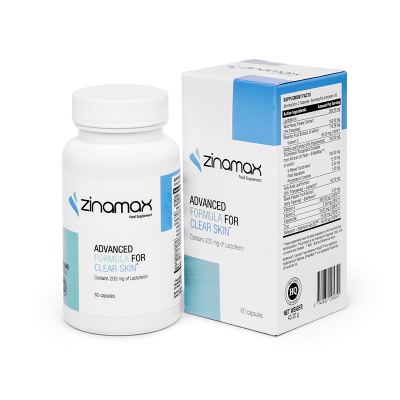
Our Recommendation — Zinamax
Score: 5.7/10 · Best for: adults with mild, persistent breakouts who want a nutritional adjunct alongside a topical routine, judged fairly over 12 weeks. Main caution: it carries a declared milk allergen, its vitamin B6 (18 mg) sits above EFSA's upper limit, and no money-back guarantee is published. Fair trial: the three-bottle pack at $39.33 a bottle — one full trial at the trials' own 8–12 week length.
The Dose-and-Ceiling Table
Every competitor list we audited names vitamins without doses. Doses are where benefit and harm both live, so here is the whole article in one table:
| Nutrient | What the evidence actually tested | Upper limit / caution | In Zinamax? |
|---|---|---|---|
| Zinc | 15–30 mg elemental/day orally, 12 weeks; fewer inflammatory papules (see our zinc article) | UL 40 mg/day (US, all sources, per the NIH Office of Dietary Supplements); chronic excess → copper deficiency | Yes — 15 mg |
| Vitamin A (preformed retinol) | Historical high-dose use, largely superseded by retinoid drugs | UL 3,000 µg RAE/day; teratogenic in pregnancy (see below) | Yes — 800 µg (≈ daily requirement level) |
| Vitamin C | No adequate oral acne trial; antioxidant rationale and topical use | Doses above ~1,000 mg/day commonly cause GI upset; very safe at label doses | Yes — 80 mg (from rosehip) |
| Vitamin E | Oral: no strong acne evidence. Topical scar use: weak (see below) | High doses interact with blood thinners; label doses are nutritional, not therapeutic | Yes — 3.36 mg (a label dose, not a treatment dose) |
| Vitamin D | Deficiency more prevalent in acne patients; one small trial's benefit sat in the deficient subgroup | Test before supplementing for acne; excess is fat-soluble and accumulates | No — not in Zinamax |
| Omega-3 (EPA/DHA) | Small, mixed pilots; one null | Generally safe; not a vitamin, whatever listicles imply | No — not in Zinamax |
| Selenium | Low levels observed in acne patients (association only) | Narrow margin: adult UL 400 µg/day (US); excess causes selenosis | Yes — 55 µg (≈ daily requirement) |
| Vitamin B6 | No acne benefit evidence; high doses are a suspected acne trigger (see our article on supplements that can cause acne) | EFSA UL 12 mg/day; US UL 100 mg/day | Yes — 18 mg, above the EFSA limit; we flag it on our own product |
Topical Fame, Oral Reality
The single most useful distinction in this topic: several "acne vitamins" earned their reputations on skin or as drugs, not as oral supplements. Vitamin A is the clearest case. The retinoids that genuinely transform acne — tretinoin, adapalene, isotretinoin — are regulated medicines with drug-level evidence and drug-level risks.
Swallowing retinol at supplement doses is not a gentler version of that therapy; it is a different intervention with a thin evidence base and a real toxicity profile, which is why dermatology moved to standardised retinoids in the first place.
Vitamin E is the second case: its fame is for scars, and it is topical fame — and even there the record is poor (in the most-quoted study, topical vitamin E produced no improvement in 90% of scars and contact dermatitis in a third of users; a 2022 review of 17 topical studies rated the evidence low-quality).
For oral vitamin E and acne or scarring there is no strong evidence at all. When a brand calls vitamin E "renowned for acne scarring" without the topical/oral split and the weak-even-there caveat, it is spending a reputation the data never issued.
Vitamin C sits in between: a legitimate antioxidant nutrient with plausible skin biology and topical data, but no adequate oral acne trial — nutritional support, honestly labelled, is the whole claim. It is worth noting that the American Academy of Dermatology's 2024 guidelines reached the umbrella version of this conclusion for the whole shelf: evidence insufficient to recommend vitamins or plant-based alternatives for acne at all.
Vitamin A and Pregnancy: the Warning, Done Correctly
Two forms of vitamin A circulate in advice columns, and confusing them produces warnings aimed at the wrong target — our competitor audit found a skincare brand cautioning pregnant women about carrots. The facts: the risk form is preformed vitamin A (retinol and retinyl esters, from supplements, cod liver oil and liver).
Its adult upper limit is 3,000 µg RAE/day, and Rothman and colleagues reported in the New England Journal of Medicine (1995) that supplemental intakes above 10,000 IU/day in early pregnancy were associated with roughly 1 in 57 babies having a malformation attributable to the vitamin.
Beta-carotene — the provitamin in carrots, squash and leafy greens — has no upper limit and is not the teratogenic form; the body converts only what it needs. The practical risks are therefore stacking risks, not salad risks:
Do not stack: a multivitamin + cod liver oil + an acne formula + a retinoid prescription can quietly multiply preformed-A intake. And the standing rules: if you are pregnant, trying to conceive, or could become pregnant, treat oral vitamin A supplements as a doctor conversation, full stop. Zinamax's 800 µg is, for a non-pregnant adult, an unremarkable RDA-level dose — and the maker excludes pregnancy anyway.
The "Be Careful With" List
The title promised cautions, so here they are in one place: B6 and B12 at high supplement doses are linked to acneiform eruptions — the subject of our supplements-that-cause-acne article, where we flag this cluster's own product (Zinamax's B6 is 18 mg, above EFSA's 12 mg ceiling, below the US 100 mg). Zinc above 40 mg/day courts copper deficiency.
Vitamin C above roughly 1,000 mg/day is a gastrointestinal complaint waiting to happen. Selenium has a narrow corridor between requirement (55 µg) and excess. And vitamin D — the list's most defensible "maybe" — should be a test-and-correct decision, not a guess: deficiency is common and worth fixing for general health; megadosing without a blood level is not an acne strategy.
Who Should Buy Zinamax — and Who Should Skip It
Buy it if you understand what Zinamax's vitamin panel is: nutritional support at label doses (A 800 µg, C 80 mg, E 3.36 mg, selenium 55 µg) around the two ingredients with actual acne trials — zinc 15 mg and lactoferrin 200 mg.
Skip it if you are shopping for vitamin D or omega-3 (neither is in it — buy those separately if a test or your diet justifies them), if you are pregnant or trying to conceive (maker's exclusion, and the preformed-A caution above), or if you already take a multivitamin and a B-complex — audit the stack first, because this formula's B6 (18 mg) sits above the EFSA ceiling before anything else you swallow is counted.
Our Recommendation — Zinamax
Score: 5.7/10 · Best for: adults with mild, persistent breakouts who want a nutritional adjunct alongside a topical routine, judged fairly over 12 weeks. Main caution: it carries a declared milk allergen, its vitamin B6 (18 mg) sits above EFSA's upper limit, and no money-back guarantee is published. Fair trial: the three-bottle pack at $39.33 a bottle — one full trial at the trials' own 8–12 week length.
Frequently Asked Questions
Which vitamin is best for acne?
Strictly, the best-evidenced "vitamin for acne" is a mineral — zinc, at 15–30 mg elemental/day over 12 weeks, with a modest effect. Among actual vitamins, vitamin D has the most interesting (association plus deficiency-subgroup) data; A, C and E have no adequate oral acne trials behind their reputations.
Is vitamin A safe to take for acne?
At RDA-level doses in a formula (Zinamax: 800 µg), for non-pregnant adults, it sits far below the 3,000 µg upper limit. The dangers are high-dose products, stacking several preformed-A sources, and pregnancy — preformed vitamin A above 10,000 IU/day in early pregnancy carries a documented malformation risk. Beta-carotene from food is not the risk form.
Does vitamin E help acne scars?
The claim is topical in origin and weak even there — the classic study found no improvement in 90% of scars and dermatitis in a third of users. For oral vitamin E and scars there is no strong evidence at all. Scar management is a dermatology conversation (retinoids, procedures), not a capsule.
Why isn't vitamin D in Zinamax?
Because the maker didn't formulate it in — and honesty requires the gap to be stated: vitamin D and omega-3 appear on most "best for acne" lists but are absent from this product. If a blood test shows deficiency, correct it as its own decision; don't assume your acne formula covers it.
Last reviewed: October 2026. This article is educational and is not medical advice.
