
- Quick Answer
- Why Teenagers Are a Special Case, in Plain Language
- The Receipts: Two Labels, Read Closely
- The Three Warnings Every Honest Teen Guide Repeats
- What to Do Instead: the Route That Actually Works
- The Red Flags: When "Soon" Means This Month
- How the Purchase Happens: the Funnel You Are Actually Up Against
- A 60-Second Label Check for Any "Teen" Product
- The Conversation, Briefly
- Frequently Asked Questions
- Can teenagers take acne supplements at all?
- Why is the zinc dose a problem for teens?
- What should a teenager use for acne instead?
- The product says "for teens, ages 12–18". Doesn't that make it safe?
- Are there any supplements a dermatologist might suggest for a teen?
- Read This Next
Disclosure: This article contains affiliate links. If you buy through them, we may earn a commission at no extra cost to you. It never changes our conclusions.
Quick Answer
If you are a parent reading this because your teenager wants an acne supplement — or because one is already in the bathroom cabinet — the short answer is: adult acne formulas are not for under-18s, and "teen" versions deserve the same scepticism with better marketing. The reasons are structural, not squeamish.
Safety limits for nutrients are age-banded, and teenagers' ceilings sit below adults' — sometimes below the doses adult acne trials used. No acne supplement formula, adult or teen-labelled, has been trialled in adolescents as a formula. Fat-soluble ingredients accumulate in bodies that are still growing.
And the medical system already has a pathway for teenage acne — topical-first, prescription when needed — that the American Academy of Dermatology's 2024 guidelines describe in detail, in which supplements appear nowhere, because the guideline panel found the evidence for vitamins and alternative therapies insufficient to recommend for anyone.
What to do instead is in the second half of this article, including the red flags that mean "dermatologist soon", not "stronger supplement". Best for: parents who want the receipts — the actual labels, the actual numbers — before having the conversation with their teenager.
Why Teenagers Are a Special Case, in Plain Language
Their ceilings are lower. Nutrient safety limits are not one-size-fits-all; they are set by age band, because body weight, metabolism and development differ. Take zinc, the best-studied acne nutrient.
Per the NIH Office of Dietary Supplements, teenagers aged 14–18 need about 11 mg a day (boys) or 9 mg (girls), and their tolerable upper limit is 34 mg/day from all sources — while the adult acne trials that generate the glowing headlines used 30 mg a day as a starting concept and adult-oriented guides routinely discuss 25–45 mg.
In other words, an adult formula at a "studied dose" can put a teenager at or beyond their entire safe ceiling before food is counted. Our competitor audit found a teen-nutrition guide recommending "30–40 mg of elemental zinc daily" for teenagers as a study-based norm — in the same article that correctly warns about other ingredients.
Those studies were adult studies. Transferring adult doses downward by vibes is precisely the error this article exists to prevent.
Nobody has tested these formulas on teenagers. The trials behind acne ingredients enrolled adults, or mixed ages analysed together, or (in the small cohort studies) adolescents observed eating ordinary diets — not adolescents swallowing a commercial blend.
A multi-ingredient formula is a specific chemical proposition; testing its two famous ingredients separately, in adults, at different doses, says nothing reliable about the blend in a 15-year-old. When a label says "for teens", it is describing a marketing segment — a decision made in a branding meeting — not a tested category with paediatric data behind it.
Some ingredients accumulate. Fat-soluble vitamins (A, D, E, K) are stored, not excreted; in a still-growing body the margin for error is thinner and the consequences of chronic overshoot (vitamin A is the acne-relevant case: liver toxicity, and effects on bone) land on developing systems. Selenium's corridor between "enough" and "too much" is narrow at any age.
And hormonal development is not finished at 16 — which is why formulas built around adult hormonal-acne marketing have no business being aimed at adolescents at all.
The stakes are asymmetric. Teenage acne affects about 85% of adolescents, is usually time-limited, and has effective medical treatments. A supplement experiment that goes mildly wrong — an overloaded kidney of zinc crowding out copper, a vitamin A stack quietly doubling — trades a temporary, treatable condition for a nutritional injury.
The risk calculus that might be acceptable for an informed adult is not transferable to a child who cannot consent to it in the same way.
The Receipts: Two Labels, Read Closely
Receipt one — a real adult formula. Walk an adult acne label the way a pharmacist would.
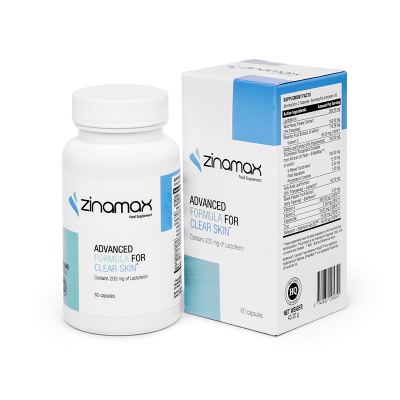
This cluster's example, stated once and factually: Zinamax's maker excludes children from the product outright — its label says not suitable for children, and its published panel shows why an adult formula is an adult formula: vitamin B6 at 18 mg, which exceeds even the adult European Food Safety Authority upper limit of 12 mg/day (the limit was set against nerve damage from chronic excess); preformed vitamin A at 800 µg, an adult requirement-level dose that belongs in adult stacking arithmetic, not a teenager's; selenium at 55 µg, the full adult daily amount in a nutrient with a narrow safety corridor; and a bovine milk protein carrying a formal MILK allergen declaration. None of that makes the product improper — for adults, with the flags read. All of it makes the product an adult product, exactly as its maker states.
Receipt two — a real teen-marketed formula. Now the more instructive label, because it wears the word "teen" on the front. A leading teen-marketed acne product (Codeage Teen ClearFace, sold on Amazon) is marketed for "Ages 12–18" and contains vitamins A, C, D3 and E, zinc, probiotics — and iodine derived from organic kelp.
Kelp iodine is one of the specific ingredients teen-focused guidance repeatedly cautions against, because seaweed iodine content is high, variable, and capable of triggering acneiform eruptions as well as burdening the thyroid. And the same product's own legal disclaimer states it is "intended for healthy adults, 18 years of age or older".
Read that again: the front of the listing sells to 12-year-olds; the fine print disclaims anyone under 18. When the marketing and the disclaimer disagree, believe the disclaimer — it is the part written by lawyers. This is not an outlier pattern; it is the category's business model, and it is why "formulated for teens" should lower, not raise, your trust until the label itself proves otherwise.
The Three Warnings Every Honest Teen Guide Repeats
Across the independent teen-skin guidance our research reviewed — including sources that are otherwise happy to discuss supplements — three warnings recur with unusual consistency, which is usually a sign they are load-bearing:
- Avoid high-dose vitamin A supplements. Preformed vitamin A is fat-soluble and toxic in excess; the acne connection comes from retinoid drugs, which are prescribed and monitored precisely because the vitamin family is powerful. A teenager self-dosing retinol from an acne gummy is taking the risk side of that family without the monitoring side.
- Be cautious with iodine supplements. Excess iodine — kelp and seaweed products above all — can provoke acneiform eruptions and disturb thyroid function. Ordinary dietary iodine is essential and not the issue; concentrated seaweed in a skin formula is.
- Avoid biotin megadoses. Hair-skin-nails marketing has normalised biotin doses hundreds of times the requirement. Biotin at those levels distorts laboratory blood tests — thyroid panels, hormone assays, even the troponin test used in heart emergencies — a concrete, documented harm in exactly the age group most likely to be having hormone bloodwork for the acne itself.
To those three, this article adds a fourth from the numbers in section one: check any zinc dose against the 34 mg/day teen ceiling (ages 14–18), counting food and every other product — and treat any guide quoting adult trial doses (30–45 mg) as teen advice as having disqualified itself.
What to Do Instead: the Route That Actually Works
The constructive half of this article matters more than the warnings, because "no" without a route just sends teenagers to TikTok.
The American Academy of Dermatology's 2024 acne guidelines — covering adolescents and children over 9 as well as adults — put topical therapy first, and the pathway is neither exotic nor expensive: a gentle cleanser; benzoyl peroxide and a topical retinoid (adapalene is available without prescription in the US) as the strongly recommended foundations, used in combination rather than as monotherapy; topical or oral antibiotics only alongside benzoyl peroxide and for limited durations; hormonal therapy and isotretinoin, prescribed and monitored, for the severe or resistant end. Judge topicals the way all acne therapy is judged: 6–8 weeks for the first signs, 3–4 months for a fair verdict — the single most common reason teen acne "treatment doesn't work" is that it was abandoned at week three. Diet, from our diet-and-acne research, is a dial worth a gentle look (the skim-milk and glycaemic signals are real associations) — but teenagers should never run elimination diets without an adult ensuring calcium and overall nutrition stay intact, and diet is an adjunct, never the treatment. And the AAD's own guidance for parents, which this article endorses in full: take acne seriously — its effects on self-esteem and mood are medical facts, not vanity; don't nag about treatment adherence; help reduce stress where you can; watch for signs of depression; and let your teenager meet the dermatologist alone for part of the visit, because adherence improves when the treatment plan is theirs.
The Red Flags: When "Soon" Means This Month
- Cystic, nodular or painful deep lesions — the scarring kind. Early prescription treatment is what prevents permanent marks.
- Scars or persistent dark marks already forming.
- No improvement after 3–4 months of consistent, correctly used topical therapy.
- Acne with company: in girls, irregular periods or excess hair growth (a PCOS evaluation is warranted); in any teen, very early, very severe or suddenly explosive acne.
- Mood impact — withdrawal, avoidance, distress about appearance. This is a referral reason on its own, and dermatologists treat it as one.
- A supplement reaction — a sudden, uniform eruption after starting any product: stop the product, and if it is severe or the teen feels unwell, seek care promptly.
How the Purchase Happens: the Funnel You Are Actually Up Against
Understanding why your teenager wants a supplement helps more than refuting the supplement. The modern funnel rarely starts with an advertisement; it starts with a peer or an influencer describing their skin routine, in which a gummy or capsule appears as the casual, "natural" step between cleanser and moisturiser — positioned, precisely, as not a medicine.
From there the mechanics are standard: a quiz that diagnoses nothing but recommends a subscription; before-and-after imagery that no regulator has reviewed (and that the trial literature's real numbers — 20–40% median lesion reductions over 12 weeks, in adults — would not produce); and age-targeted branding that borrows the visual language of paediatrics without any of its obligations.
One affiliate roundup in our audit recommends a vitamin-A-containing "Anti Acne Supplements for Teens" as a "proven formula" with no doses printed, no age floor and no cautions — on a page that elsewhere promises "up to 87% reduction" and "results in as little as three days" for other products, none of it sourced.
That is the information environment the purchase decision is forming in. The counterweight is not a ban — bans lose to feeds — but better material in the same conversation: the guideline pathway, the label arithmetic, and a dermatology appointment that treats the teenager as the plan's owner.
Parents who show up with the receipts in this article are not saying "because I said so"; they are out-evidencing the funnel, which is the only durable way to beat it.
A 60-Second Label Check for Any "Teen" Product
- Find the disclaimer first. If the fine print says "intended for healthy adults, 18+", close the tab — the front of the listing was marketing at your child against its own legal text.
- Total the zinc. More than ~15 mg in the product itself leaves little headroom under the 34 mg/day ceiling for ages 14–18 once food is counted; adult-trial doses (30 mg+) have no place in a teen product at all.
- Search the panel for the three warnings: high-dose vitamin A (preformed retinol), iodine from kelp or seaweed, and biotin in the thousands of micrograms. Any one of them is a reason to stop and ask a clinician instead.
- Check for allergens and drug-family ingredients — milk proteins, and anything hormonal in framing ("balance", "androgen support") aimed at a body still developing.
- Ask the trial question: has this formula, or even its key ingredient at this dose, been studied in adolescents? For every product in this category, the honest answer is no — and a seller who implies otherwise is the finding.
The Conversation, Briefly
Most parents reading this are about to have a negotiation, not issue a decree — teenagers buy with their own money and their own feeds. The strongest position in that conversation is not authority; it is the receipts. Show them the teen product whose disclaimer contradicts its own age marketing.
Show them the zinc ceiling arithmetic — 34 mg total, against adult doses of 30–45. Show them that the dermatology guideline, written by the people who treat acne for a living, recommends no supplement for anyone, and a clear, cheap, effective topical route for them.
And offer the trade that actually protects them: a proper dermatology visit and a real routine, judged properly over 3–4 months, in place of a cabinet of experiments. Teenage skin is doing something temporary and treatable. The goal is to get it treated — without handing a developing body an adult experiment in the meantime.
One practical footnote: if a supplement is already in the cabinet and your teenager has been taking it, there is no need for alarm — stop it, note anything unusual (a sudden uniform eruption is the pattern worth mentioning to a clinician), and let the dermatology appointment carry the subject from there.
The point of this article was never that a few weeks of a gummy is a catastrophe; it is that the category's doses, disclaimers and evidence were never built for the person the marketing is aimed at.
Frequently Asked Questions
Can teenagers take acne supplements at all?
Adult formulas: no — their makers exclude children, and their doses are set against adult limits (one common formula's vitamin B6 exceeds even the adult European ceiling). Teen-marketed formulas: treat with the same scepticism.
Safety limits are age-banded (teen zinc ceiling 34 mg/day vs adult trial doses of 30–45 mg), no formula has paediatric acne trials behind it, and the AAD recommends no supplement for acne at any age. A specific supplement for a specific diagnosed deficiency is a doctor's decision, not a skincare purchase.
Why is the zinc dose a problem for teens?
Because of arithmetic. Teenagers (14–18) need 9–11 mg/day and have an upper limit of 34 mg/day from all sources; adult acne trials used 30 mg/day and adult guides discuss up to 45 mg. An adult product can therefore consume a teenager's entire safe allowance in one serving — before food — and chronic zinc excess causes copper deficiency. Guides quoting adult doses as teen norms have transferred the numbers without the age bands.
What should a teenager use for acne instead?
The AAD pathway: gentle cleansing, benzoyl peroxide and a topical retinoid as foundations (adapalene is over-the-counter in the US), judged over 6–8 weeks for first signs and 3–4 months for a fair verdict; a dermatologist for anything cystic, scarring, stubborn or accompanied by other symptoms. That route has the trials supplements lack.
The product says "for teens, ages 12–18". Doesn't that make it safe?
It makes it marketed. One leading example pairs that age claim with kelp-derived iodine — an ingredient teen guidance specifically cautions against — while its own legal disclaimer states "intended for healthy adults, 18 years of age or older". "Teen" on a label is a marketing segment, not a tested category; no acne formula has adolescent trials behind it.
Are there any supplements a dermatologist might suggest for a teen?
Only in specific, diagnosed contexts — correcting a measured deficiency, for example — and that is a clinician's call made with blood results, not a category recommendation. The 2024 AAD guidelines found the evidence insufficient to recommend vitamins or alternative therapies for acne for anyone, teenagers included.
Last reviewed: October 2026. This article is educational and is not medical advice.
