
- Quick Answer
- Why Zinc Is Plausible: the Mechanism
- The Trial Record, With the Endpoint Named
- The Dose: Three Numbers That Mean Three Different Things
- Forms Compared — With an Honesty Column
- The Antibiotic Spacing Rule (the Box Nobody Else Publishes)
- Too Much Zinc: Copper, Nausea and the Ceiling
- The Timeline: What 12 Weeks Actually Looks Like
- Who Is Actually Low in Zinc — and Why It Changes the Bet
- A Practical 12-Week Zinc Protocol
- Does Zinc "Cure" Acne?
- Who Should Buy Zinamax — and Who Should Skip It
- Frequently Asked Questions
- How much zinc should I take for acne?
- Which form of zinc is best for acne?
- Can I take zinc with my acne antibiotic?
- How long until zinc works for acne?
- Can zinc make acne or health worse?
- Is topical zinc the same as taking zinc?
- Is 15 mg of zinc enough?
- Read This Next
Disclosure: This article contains affiliate links. If you buy through them, we may earn a commission at no extra cost to you. It never changes our conclusions.
Quick Answer
Zinc is the best-studied oral nutrient for acne — and "best-studied" in this category means modest, not mighty.
Randomised trials and a 2020 meta-analysis find that oral zinc significantly reduces inflammatory pimples, with a smaller effect than tetracycline antibiotics: in the largest head-to-head trial, 30 mg of elemental zinc daily for three months achieved the success endpoint in 31.2% of patients versus 63.4% for the antibiotic minocycline.
The sane dose frame is 15–30 mg of elemental zinc a day, judged at 12 weeks, kept under the 40 mg/day adult upper limit, and — the warning almost nobody prints — spaced away from tetracycline and quinolone antibiotics, whose absorption zinc blocks.
Best for: adults with mild-to-moderate inflammatory acne who want an adjunct with a real trial record (or are correcting a low intake), taken with food, at the studied dose, for a full 12-week test.
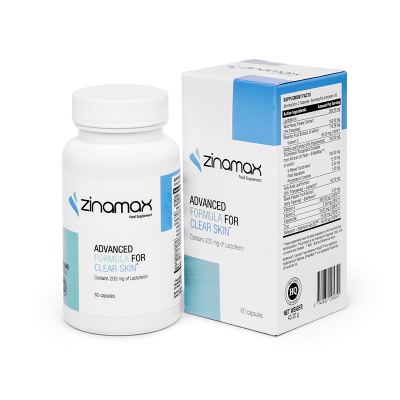
Our Recommendation — Zinamax
Score: 5.7/10 · Best for: adults with mild, persistent breakouts who want a nutritional adjunct alongside a topical routine, judged fairly over 12 weeks. Main caution: it carries a declared milk allergen, its vitamin B6 (18 mg) sits above EFSA's upper limit, and no money-back guarantee is published. Fair trial: the three-bottle pack at $39.33 a bottle — one full trial at the trials' own 8–12 week length.
Why Zinc Is Plausible: the Mechanism
Zinc is not a folk remedy that wandered into dermatology; it sits inside acne's biology at several documented points. It is anti-inflammatory, moderating the neutrophil and cytokine responses that turn a blocked pore into a red, sore lesion. It has direct antibacterial activity against Cutibacterium acnes at skin-relevant concentrations, without driving the resistance that limits long-term antibiotics.
It modestly influences sebum activity and androgen metabolism, and it is essential to the skin's own repair machinery — wound healing is one of zinc's oldest established roles.
There is also a deficiency angle: the meta-analysis by Yee and colleagues (2020), pooling 25 studies and 2,445 participants, found that people with acne have significantly lower serum zinc than people without — an association that does not prove low zinc causes acne (inflammation itself lowers circulating zinc), but which makes correction of a genuinely low intake the most defensible reason to supplement. Mechanism, though, is the trailer, not the film.
Plenty of plausible acne mechanisms have failed in trials; what zinc has that most supplement ingredients lack is an actual trial record, and the record is what the next section grades.
The Trial Record, With the Endpoint Named
The centrepiece is Dreno and colleagues (2001) — a multicentre, randomised, double-blind trial in 332 patients comparing 30 mg of elemental zinc (as gluconate) against 100 mg of minocycline, a front-line oral antibiotic, over three months.
Read the endpoint before the numbers, because the endpoint is what most summaries hide: "clinical success" was defined as a greater-than-two-thirds decrease in inflammatory lesions at day 90 — a demanding bar, not "some improvement". By that bar, zinc succeeded in 31.2% of patients and minocycline in 63.4%.
The honest sentence is therefore: zinc works, and the antibiotic works about twice as well on the endpoint that matters. Pages that present zinc as "as effective as antibiotics" are quoting the same trial and hoping you never find the abstract.
Around Dreno sits a wider, older literature. Zinc was trialled for acne from the 1970s onward, often as zinc sulfate at doses delivering around 135 mg of elemental zinc a day — effective in some early studies, but abandoned as a routine approach because gastrointestinal intolerance ran as high as roughly 40% at those doses.
The modern literature settled at 15–30 mg/day elemental, where Yee and colleagues (2020) confirmed a statistically significant reduction in inflammatory papules, whether zinc was used alone or as an add-on, with effect sizes smaller than tetracyclines. Two statistical traps in this literature deserve naming because competitors fall into both.
First, the eye-catching "zinc cut lesions by ~49%" figure circulating online is a within-arm average from a single trial — how much the zinc group's lesions fell from their own baseline — not a pooled, placebo-controlled effect; within-arm numbers always look bigger because acne fluctuates and regresses on its own.
Second, "success" rates and "average reduction" rates are different units; an article that swaps between them mid-paragraph is inflating by construction. Our numbers discipline for this cluster: Dreno's 31.2% vs 63.4% is the anchor, the meta-analysis confirms direction, and nothing stronger than that gets printed.
The Dose: Three Numbers That Mean Three Different Things
Almost every zinc page quotes one number. There are three, they answer different questions, and confusing them is how people end up taking two and a half times the safe ceiling on the advice of a skincare blog (one page in our competitor research recommends "50–100 mg/day" as the study norm — up to 2.5× the adult upper limit; another lists 150 mg). Here is the reconciliation:
| The number | Value | What it actually is |
|---|---|---|
| Studied dose | 15–30 mg elemental/day | The range modern acne trials used; 30 mg is Dreno's dose. The bottom of the range is a real dose, not a token one — but expect the bottom of the effect range too |
| NHS unsupervised ceiling | 25 mg/day | The UK health service's advice for self-supplementing without medical supervision — a caution line, not a target |
| US tolerable upper limit (UL) | 40 mg/day from all sources | The NIH Office of Dietary Supplements ceiling for adults, counting food plus every supplement — the line above which adverse effects (copper deficiency above all) become a realistic risk |
| The abandoned era | ~135 mg elemental/day (sulfate) | 1970s–80s trial doses; GI intolerance up to ~40%; historical context, not a recommendation |
And the label trap that sits underneath all of it: elemental versus salt weight. A capsule of "zinc gluconate 200 mg" contains roughly 28 mg of actual zinc — gluconate is about 14% elemental. Picolinate is about 21% elemental, citrate about 31%, sulfate (heptahydrate) about 23%, oxide about 80% but poorly soluble.
Competent labels state the elemental amount ("zinc: 15 mg") and name the salt in the ingredient list. If a label quotes only a large salt weight with no elemental figure, assume the marketing department chose the bigger number on purpose.
Applying the frame to the product this cluster reviews: Zinamax provides 15 mg of elemental zinc per daily serving — the bottom of the studied range, half of Dreno's 30 mg. That is a defensible, sustainable dose, and it is also plainly not the dose of the best-known trial; both halves of that sentence belong in any honest review, and they are in ours.
Forms Compared — With an Honesty Column
| Form | Elemental zinc | Acne-trial record | Honest note |
|---|---|---|---|
| Gluconate | ~14% | The form Dreno 2001 trialled at 30 mg elemental | Low elemental share means bigger capsules; the trial record belongs to the dose, not the brand of salt |
| Sulfate | ~23% | The 1970s high-dose trials | Cheapest; harshest on the stomach at trial-era doses |
| Picolinate | ~21% | No dedicated acne-outcome trial | Sold as "best absorbed / best studied" — the absorption claim rests on small non-acne work, and even pages promoting it concede fewer acne trials. Superior absorption for acne outcomes is unproven |
| Citrate | ~31% | No dedicated acne trial | Reasonable absorption data in nutrition studies; the acne evidence is borrowed from the element, not the form |
| Oxide | ~80% | Mostly a topical ingredient (creams, sunscreens) | High elemental share, poor solubility; rarely the right oral choice |
| "Chelated" / bisglycinate | ~14–20% (varies) | No dedicated acne trial | Gentler reputation; acne claims are extrapolation |
The pattern to notice: the acne evidence attaches to elemental zinc at a dose for 12 weeks, not to any fashionable salt. Form choice is mostly about tolerance and honest labelling. Pick the product that states its elemental dose and fits the 15–30 mg frame; be suspicious of any page whose form ranking conveniently tops out at the form it sells.
The Antibiotic Spacing Rule (the Box Nobody Else Publishes)
Here is the interaction that matters most in this entire category, stated plainly because our competitor audit found it in exactly one rival article: zinc chelates tetracycline and quinolone antibiotics in the gut, binding them and reducing absorption of both the antibiotic and the zinc.
The irony is structural — the people most likely to take zinc for acne are the people most likely to be prescribed doxycycline or minocycline for it — and the consequence of ignoring the interaction is a silently weakened antibiotic course.
The NIH Office of Dietary Supplements rule: take the antibiotic at least 2 hours before, or 4–6 hours after, the zinc. The same spacing logic applies to penicillamine (separate by at least 1 hour).
If you are on a prescribed antibiotic, the cleanest course is to tell the prescriber or pharmacist you are taking a zinc-containing supplement and let them schedule it — and never to let a supplement quietly undermine the treatment with the stronger evidence.
Too Much Zinc: Copper, Nausea and the Ceiling
Zinc's adverse-effect profile at sane doses is mostly gastrointestinal: nausea, stomach ache, a metallic taste — which is why the standard instruction is to take it with food, accepting a small absorption trade-off for a supplement you will actually keep taking.
The serious risk is chronic overdose, and its mechanism is worth understanding rather than just fearing: sustained high zinc intake induces a protein called metallothionein in the intestinal wall, which binds copper preferentially and traps it, so copper is lost as gut cells shed.
The result, over months, is copper deficiency — anaemia, neutropenia (low white cells), and in rare severe cases a spinal-cord syndrome (myeloneuropathy) that mimics B12 deficiency. This is the reason the 40 mg/day UL exists, and the reason "more" is not a strategy in this category.
The mitigation used in longer therapeutic courses is 1–2 mg of copper alongside — but the primary mitigation is simpler: stay inside the studied range, count your total intake (food, multivitamin, lozenges and any second skin or hair product), and treat any plan that requires exceeding the UL as a doctor-supervised decision, not a blog recommendation.
Also note that intranasal zinc products have their own separate warning (loss of smell) — irrelevant to oral acne use, but a reminder that "zinc" is not one thing.
The Timeline: What 12 Weeks Actually Looks Like
Zinc trials were designed around 12 weeks — Dreno's endpoint is day 90 — because acne biology runs on skin time, not supplement-marketing time.
A realistic expectation curve: weeks 1–4, nothing measurable should be promised (any page promising reduced redness at week 2 is ahead of every trial endpoint in the literature); weeks 6–8, an early signal is possible — fewer new inflammatory lesions is the sign to watch, not the fate of existing ones; weeks 10–12, the judgement point, where the trials measured their outcomes and where you should measure yours, with photographs taken in the same light since week 0. If nothing has changed by week 12, zinc has had the same fair trial the studies gave it, and the honest move is to stop and escalate care rather than extend indefinitely. Our dedicated timeline article builds this week-by-week from the trial endpoints across all the cluster's ingredients.
Who Is Actually Low in Zinc — and Why It Changes the Bet
The meta-analytic finding that acne patients carry lower serum zinc than controls cuts in two directions, and both matter for how you spend money.
If low zinc is partly a consequence of inflammation (inflammation redistributes zinc out of the blood), then supplementing a replete person is topping up a tank that was never empty, and expectations should be set by Dreno's modest success rate.
If low zinc is partly a cause — an intake problem feeding the inflammatory response — then the people most likely to benefit are the people whose intake is genuinely low: those eating little meat or seafood (the concentrated zinc sources), strict vegetarians and vegans whose plant zinc arrives bound to phytates that reduce absorption, people with absorption disorders, and heavy alcohol users.
That reasoning also explains a pattern in the older literature, where the most dramatic responses tended to appear in patients with demonstrably low levels.
The practical consequence is not "test before you buy" as a ritual — serum zinc is an imperfect, inflammation-sensitive marker, and a dermatologist will interpret it in context — but a cheaper piece of self-knowledge: audit your diet first.
Someone eating oysters, beef and dairy daily is unlikely to be running the deficiency the correction story depends on; someone on a long-term restricted diet may be. Zinc for acne is most rational as correction-plus-adjunct, and least rational as a megadose sprayed at a problem it was never measured against.
A Practical 12-Week Zinc Protocol
For readers who decide to run the experiment, here is the protocol form of everything above — the version we would hand a friend:
- Pick the dose in elemental terms. 15–30 mg of elemental zinc daily. If the label quotes only salt weight, convert it (gluconate ≈14% elemental, picolinate ≈21%, sulfate ≈23%, citrate ≈31%) or choose a product that states the elemental figure.
- Take it with food. The absorption penalty is small; the nausea that makes people quit at week 3 is not. Consistency across 12 weeks beats theoretical absorption on the days you manage it.
- Audit the stack before day one. Total every zinc source — multivitamin, hair or skin gummies, cold lozenges, fortified drinks — and hold the all-sources total under 40 mg/day.
- Schedule around antibiotics. If a tetracycline or quinolone enters the picture, apply the spacing rule (antibiotic at least 2 hours before, or 4–6 hours after, zinc) or pause the zinc for the course — and tell the prescriber either way.
- Photograph weekly, count new inflammatory lesions, change nothing else. The full method is in our timeline article; the short version is that your week-12 photograph set is the result, and your week-2 mirror impression is not.
- Pre-commit the endings. Signal by weeks 6–8 and a fair reading at 12 → continuing is defensible. Nothing by 12 → stop. Deeper, painful or scarring lesions at any point → the protocol is over and a dermatologist takes the case.
One last framing, because protocol language can make modest things sound clinical-grade: even run perfectly, this protocol is buying Dreno's odds — roughly a one-in-three chance of a two-thirds reduction in inflammatory lesions over three months, in the trial's population, at the trial's full 30 mg dose. Some buyers will find those odds fair for an inexpensive, well-tolerated adjunct.
Others will look at the antibiotic's two-in-three and choose the prescription route first. Both are reasonable readings of the same numbers — which is what the numbers are for.
Does Zinc "Cure" Acne?
No — and the question deserves a straight answer because it is one of the most searched in this cluster.
Acne is a multifactorial condition (sebum, pore biology, bacteria, inflammation, hormones, genetics) with a relapsing course; nothing in the zinc literature shows eradication, permanent remission after stopping, or benefit for the comedonal and cystic ends of the disease comparable to retinoids and prescription therapy.
What the literature shows is a modest, real reduction in inflammatory lesion counts over 12 weeks in mild-to-moderate acne, in a nutrient many acne patients run low on. That is worth having. It is not a cure, and a page that lets you believe otherwise is setting you up to delay treatment that works — the costliest outcome in acne care, because delay is measured in scars.
Who Should Buy Zinamax — and Who Should Skip It
Buy it if you want zinc inside a formula rather than alone: Zinamax pairs its 15 mg of elemental zinc (bottom of the studied range — half of Dreno's dose, and we score it as such) with lactoferrin 200 mg, the only other ingredient in this category with human acne trials, at the full daily amount those trials used.
Skip it if your plan is a zinc-only, maximum-trial-dose strategy — a plain 30 mg elemental zinc product matches Dreno more closely and costs less; if you are taking a tetracycline or quinolone antibiotic and cannot manage the spacing rule reliably; if you are allergic to milk (Zinamax's lactoferrin is bovine and the product carries a MILK allergen); if you are under 18, pregnant or breastfeeding (maker's exclusions); or if your acne is cystic or scarring — that needs a dermatologist, and no zinc dose changes that sentence.
Our Recommendation — Zinamax
Score: 5.7/10 · Best for: adults with mild, persistent breakouts who want a nutritional adjunct alongside a topical routine, judged fairly over 12 weeks. Main caution: it carries a declared milk allergen, its vitamin B6 (18 mg) sits above EFSA's upper limit, and no money-back guarantee is published. Fair trial: the three-bottle pack at $39.33 a bottle — one full trial at the trials' own 8–12 week length.
Frequently Asked Questions
How much zinc should I take for acne?
The studied frame is 15–30 mg of elemental zinc per day for 12 weeks. Keep total intake (food plus all supplements) under the 40 mg/day adult upper limit, take it with food to limit nausea, and beware labels quoting salt weight instead of the elemental figure.
Which form of zinc is best for acne?
The trial record belongs to gluconate (Dreno 2001) and sulfate (older trials) at stated elemental doses. Picolinate's "best absorbed" reputation has no acne-outcome trial behind it. Choose by elemental dose on the label and stomach tolerance, not by form marketing.
Can I take zinc with my acne antibiotic?
Only with spacing: zinc binds tetracycline and quinolone antibiotics and reduces their absorption. Take the antibiotic at least 2 hours before, or 4–6 hours after, zinc — and tell your prescriber or pharmacist you are taking it.
How long until zinc works for acne?
Judge at 12 weeks — the trials' endpoint. An early signal (fewer new inflammatory lesions) is possible at 6–8 weeks; promises of change at 2 weeks are ahead of the evidence. Photograph weekly in the same light to judge honestly.
Can zinc make acne or health worse?
At label doses, the common problem is nausea. Chronically exceeding 40 mg/day risks copper deficiency (anaemia, low white cells, rarely nerve damage) via the metallothionein mechanism. Zinc itself is not a recognised acne trigger — unlike high-dose B6/B12, covered in our article on supplements that can cause acne.
Is topical zinc the same as taking zinc?
No. Zinc appears in creams, calamine-style preparations and sunscreens (as zinc oxide, a physical UV filter and skin protectant) — that is surface pharmacology, unrelated to the oral trial record this article grades.
A zinc sunscreen is excellent daily practice for acne-prone skin (sun protection also guards against post-inflammatory dark marks lingering), but it delivers none of the systemic effect the 15–30 mg oral studies measured, and an oral supplement provides no sun protection. The two share an element, not an evidence base.
Is 15 mg of zinc enough?
It is the bottom of the 15–30 mg studied range — a real dose with real (if smaller) expectations, and the dose inside Zinamax. If matching the best-known trial is the priority, 30 mg elemental is Dreno's dose; if sustainability and ceiling headroom matter more, 15 mg is the conservative end of the same evidence.
Last reviewed: October 2026. This article is educational and is not medical advice.
