
- Quick Answer
- The Mechanism in One Paragraph (and Its Limits)
- Dairy: the Adebamowo Cohorts, Study by Study
- Sugar and Glycaemic Load: Two Positive Trials, One Confounder, One Negative
- Whey: the Case Series, Told Correctly
- Chocolate: the Only Honest Grading on This Page's SERP
- The Evidence-Grading Table
- The Protocol Nobody Gives You: Test One Change at a Time
- The Foods That Probably Don't Deserve Their Reputations
- Alcohol, Gluten and the Rest of the Usual Suspects
- Elimination Diets: the Three Failure Modes
- Where the Guidelines Land — and the Bridge to Supplements
- Who Should Buy Zinamax — and Who Should Skip It
- Frequently Asked Questions
- Does dairy cause acne?
- Does sugar cause acne?
- Is chocolate bad for acne?
- Should I quit whey protein?
- Should I quit dairy completely?
- What about probiotics and fermented foods for acne?
- How long should a diet test run?
- Read This Next
Disclosure: This article contains affiliate links. If you buy through them, we may earn a commission at no extra cost to you. It never changes our conclusions.
Quick Answer
Diet is a dial for acne, not a switch — that is what the evidence supports, and it is less than the internet promises and more than dermatology used to admit.
The two signals that survive scrutiny are skim milk (a modest, repeated association in large cohorts — prevalence ratios around 1.2–1.44 for severe teenage acne, strongest for skim; no randomised dairy trial exists, so causation is unproven) and high-glycaemic-load diets (two small randomised trials favour low-glycaemic eating over 10–12 weeks, one negative trial disagrees).
Whey protein has case-series evidence in young men. Chocolate has one tiny controlled study pointing at cocoa itself — too small to generalise from, too controlled to dismiss as "just the sugar".
Neither the American Academy of Dermatology nor NICE recommends a specific diet for acne; both leave room for exactly what this article prescribes: a structured, one-change-at-a-time self-test, run for the same 10–12 weeks the trials used. Best for: adults who suspect a food pattern in their breakouts and want a method for testing it honestly — instead of a forbidden-foods list assembled from anecdotes.
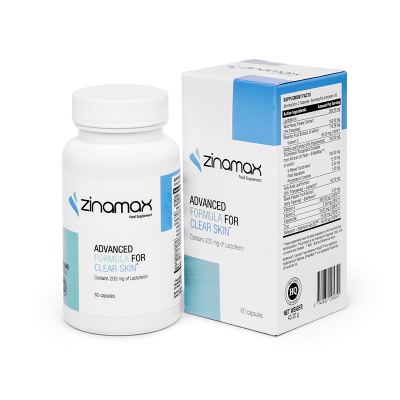
Our Recommendation — Zinamax
Score: 5.7/10 · Best for: adults with mild, persistent breakouts who want a nutritional adjunct alongside a topical routine, judged fairly over 12 weeks. Main caution: it carries a declared milk allergen, its vitamin B6 (18 mg) sits above EFSA's upper limit, and no money-back guarantee is published. Fair trial: the three-bottle pack at $39.33 a bottle — one full trial at the trials' own 8–12 week length.
The Mechanism in One Paragraph (and Its Limits)
The biological story connecting food to acne runs mainly through insulin. High-glycaemic meals spike insulin and insulin-like growth factor 1 (IGF-1); IGF-1 and insulin signalling stimulate sebum production and the androgen activity that feeds it, and milk — particularly its protein fraction — is insulinotropic beyond what its sugar content predicts.
That pathway is real physiology, and it is why the skim-milk finding (less fat, same or more protein-driven signal) is at least coherent rather than backwards. But a plausible pathway is not a proven prescription: mechanism tells you where to look, trials tell you what happens, and in diet-and-acne the trials are few, small and short.
Keep that hierarchy in mind through every section below, because this topic's literature is a masterclass in association being sold as causation — in both directions, by people selling diets and by people selling the reassurance that diet doesn't matter at all.
Dairy: the Adebamowo Cohorts, Study by Study
The dairy evidence rests overwhelmingly on one research group's three cohort analyses — large, careful, and observational, which means they can show association and cannot show causation. Named, sized, and with their limits attached:
Nurses' Health Study II (Adebamowo et al., 2005). 47,355 women recalled their high-school diets and teenage acne history as adults. Milk intake — and skim milk most strongly — was associated with physician-diagnosed severe teenage acne, with a prevalence ratio of 1.44 for the highest skim-milk intake.
Two structural caveats ride with that number forever: the diet and the acne were both recalled years later (recall bias is the tax this design pays), and association in a cohort cannot exclude confounding — by overall diet pattern, by hormones in adolescence, by anything that travels with drinking a lot of skim milk.
Notably, the same analysis found no significant association for soda, french fries, pizza or chocolate candy — a specificity that cuts both ways: it strengthens the milk signal's credibility, and it undermines several other food villains of internet fame.
Growing Up Today Study, girls (2006) and boys (2008). The prospective offspring cohorts — 6,094 girls and 4,273 boys, followed rather than recalled — found weaker versions of the same pattern: milk prevalence ratios of roughly 1.17–1.29 in girls, and in boys an association for skim milk only (PR 1.19), not whole milk.
A 2019 meta-analysis pooling the observational literature put skim milk's odds ratio at 1.82 — while yoghurt and cheese came out non-significant, a detail worth keeping: if "dairy" were the culprit as a category, the fermented and solid forms should misbehave too, and in the pooled data they largely don't. The dairy meta-analysis literature is conveniently gathered in a 2018 systematic review and meta-analysis in Nutrients covering 78,529 children, adolescents and young adults.
The honest summary: a modest, repeated, skim-concentrated association, from observational data only, with no randomised trial of dairy removal ever run. That justifies a personal elimination test (below). It does not justify telling every acne patient to fear yoghurt, and it does not justify the mirror-image claim that the link is "a myth" — a 47,000-person cohort with a dose pattern is not nothing; it is simply not proof.
Sugar and Glycaemic Load: Two Positive Trials, One Confounder, One Negative
The glycaemic story has what dairy lacks — randomised trials — and they are small enough that all four data points fit in two paragraphs.
Smith and colleagues (2007), in the American Journal of Clinical Nutrition, randomised 43 males aged 15–25 to a low-glycaemic-load diet or a conventional control diet for 12 weeks: total lesion counts fell by −23.5 in the low-GL group versus −12.0 in controls.
Now the confounder the authors themselves flagged and most summaries bury: the low-GL group also lost weight (−2.9 kg versus +0.5 kg in controls). Weight loss itself improves insulin dynamics, so the trial cannot cleanly separate "glycaemic load" from "ate less overall" — the result is real, its attribution is shared. Smith's trial is linked here so you can read the abstract yourself: Smith et al. (2007).
Kwon and colleagues (2012) ran a 10-week low-glycaemic-load trial in 32 Korean patients and found both inflammatory and non-inflammatory lesions improved — with the study's distinctive strength: biopsies.
Treated skin showed smaller sebaceous glands and reduced expression of SREBP-1 (a lipogenesis regulator) and IL-8 (an inflammatory signal) — tissue-level corroboration that the dietary change reached the gland, rare in this literature. Small, single-country, but mechanistically tidy. And the honesty entry almost no competitor prints: an 8-week low-glycaemic trial in 58 adolescents found no significant improvement.
Adolescents are not small adults metabolically, eight weeks is shorter than the positive trials ran, and null results are exactly what a literature looks like when an effect is modest and population-dependent. The graded verdict: low-glycaemic eating is the diet intervention with the best (still small) trial support — a reasonable, low-risk experiment for an adult, not a prescription and not a guarantee.
Whey: the Case Series, Told Correctly
Whey protein's evidence is a case series — the design that generates hypotheses rather than conclusions — and it is consistently mis-told in both directions, so here is the accurate version. Silverberg (2012) described five males aged 14–18 with acne responding poorly to standard therapy, all using whey protein supplements.
On stopping whey, four of the five cleared fully; one was lost to follow-up; and one patient flared again when whey was re-challenged — that re-challenge flare is the single strongest causal hint in the whole whey file, because it is the closest thing case medicine has to an experiment.
Trade coverage that upgraded this to whey causing "rapid and complete resolution" in the series was overstating a five-person observation. Counterweight, from our article on supplements that can cause acne: a randomised trial in young men with acne found whey did not worsen acne versus a non-whey supplement.
Net position: for a young lifter whose breakouts track his shakes, a 10–12-week whey pause (swapping to a non-whey protein or whole-food protein) is a cheap, safe, genuinely informative test. For everyone else, whey is a suspect to note, not a verdict.
(Distinction that matters to this cluster: Zinamax's lactoferrin is a purified milk protein at 200 mg — not a whey serving — but it carries a milk allergen, which is a separate, absolute issue covered in our lactoferrin article.)
Chocolate: the Only Honest Grading on This Page's SERP
Chocolate is where diet-acne writing splits into two lazy camps — "total myth" versus "definitely causes breakouts" — and where one small, clever study embarrasses both. Caperton and colleagues (2014) ran a double-blind trial in 14 acne-prone men: capsules of 100% cocoa versus gelatin placebo, with lesions counted over the following days.
Lesions rose significantly by day 4 (P=.006) and day 7 (P=.043) in the cocoa group. The design is the point: by delivering cocoa in capsules, the study removed the sugar and milk that the "it's just the sugar" camp blames — and still saw an effect.
So the correct sentence is neither camp's: small controlled data hint that cocoa itself may worsen acne in some acne-prone men, and n=14 is far too small to generalise into advice for the population.
The NHS II cohort, for its part, found no association for chocolate candy — which is consistent with a small, subgroup, or short-lived effect that a dietary-recall cohort would miss. Our grading table below scores chocolate "weak/mixed", and if you personally suspect it, the protocol below tests it for the price of a few weeks' abstinence and a camera.
The Evidence-Grading Table
| Food / pattern | Best study | Design | Verdict |
|---|---|---|---|
| Skim milk | Adebamowo 2005 (n=47,355); GUTS cohorts; 2019 meta-analysis (OR 1.82) | Observational cohorts; no RCT exists | Modest association — test-worthy, causation unproven |
| Whole milk | Same cohorts | Observational | Weaker/inconsistent association than skim |
| Yoghurt & cheese | Meta-analyses | Observational | No significant association — do not lump into "dairy" |
| Low-glycaemic-load diet | Smith 2007 (n=43); Kwon 2012 (n=32); one negative adolescent trial (n=58) | Small RCTs, 8–12 weeks | Modest trial support — best in the diet file, with a weight-loss confounder in Smith |
| Whey protein | Silverberg 2012 (n=5); one null RCT | Case series vs small RCT | Mixed — plausible trigger for a subset; pause-test if suspected |
| Chocolate / cocoa | Caperton 2014 (n=14) | Double-blind capsule trial | Weak/mixed — neither myth nor cause at this size |
| Fried / greasy food | NHS II (no association for fries/pizza) | Observational | No signal in the big cohort — grease on fingers is not grease in glands |
| Soda / sugary drinks | NHS II (no association); NutriNet-Santé (sugary drinks aOR 1.18) | Observational | Fits the glycaemic story generally; no acne-specific trial |
The Protocol Nobody Gives You: Test One Change at a Time
Because the evidence is association-grade, the rational response is a self-experiment designed well enough to mean something. Five rules, each borrowed from how the trials were run:
- One change at a time. Cut skim milk or lower glycaemic load or pause whey — never all three. Simultaneous changes produce uninterpretable results and unsustainable diets.
- Run it 10–12 weeks. That is the trial window (Smith 12, Kwon 10) and roughly three skin cycles. A two-week dairy holiday tests nothing but your willpower.
- Skim-milk-first, not all-dairy. The signal concentrates in skim milk; yoghurt and cheese carry no significant association. Start with the narrowest change the evidence suggests — swap skim milk for whole milk or a fortified alternative before declaring war on a food group.
- Keep a food-and-photo diary. Weekly photographs, same light and angle (the full protocol is in our timeline article), plus a simple daily note of the test food and any flare. Without records, you will remember the flare after the pizza and forget the three that followed nothing.
- Hold everything else constant. Same skincare, same supplements, same sleep as far as life allows. Every extra change is a confounder you introduced yourself.
Guardrails. Do not cut dairy in teenagers, in pregnancy, or in anyone whose calcium intake is already low, without a calcium-and-vitamin-D plan — growing and pregnant bodies are not self-experiment platforms. Do not let diet testing delay real treatment for cystic or scarring acne by a single week.
And if a dietary pattern becomes a source of anxiety or restriction spirals, stop: acne is common and treatable; an eating problem is a worse diagnosis than the one you were trying to fix.
The Foods That Probably Don't Deserve Their Reputations
A grading table cuts both ways: it should acquit as well as convict, because dietary fear has its own costs. Greasy and fried food is the oldest acquittal owed.
The belief that dietary fat becomes skin oil confuses two different substances — sebum is synthesised by your sebaceous glands under hormonal instruction, not delivered from your plate — and the largest cohort in this article's file found no significant association for french fries or pizza.
Fried food travels with high-glycaemic eating patterns, so it may appear guilty by association in uncontrolled observation; as a named culprit, it has no case to answer. Spicy food flushes faces and can aggravate rosacea-type flushing, but there is no acne evidence against it; a food that makes you sweat has not been shown to make you break out.
"Mango causes pimples" — a claim one competitor's own FAQ asserts while its article body calls the evidence anecdotal — has no study behind it at all; it is a seasonal coincidence (mango season is hot, humid and sweat-heavy in the countries where the belief thrives) promoted to a rule.
And sugar as a contact poison deserves the correction from the other direction: the glycaemic evidence concerns dietary patterns and lesion counts over weeks, not a dessert on Friday producing a pimple on Saturday. Acne lesions take weeks to form; the next-morning spot was already in the pipeline before the meal it gets blamed on.
Finally, a word for the "detox" framing that wraps so much diet-acne content: the liver and kidneys detoxify continuously and for free, no food or supplement "flushes toxins" through the skin, and breakouts during a restrictive "cleanse" are more parsimoniously explained by the stress, sleep loss and abrupt dietary change that accompany cleanses than by toxins leaving via the face. Eat in patterns the evidence grades as reasonable; decline the folklore in both directions.
Alcohol, Gluten and the Rest of the Usual Suspects
Two more names complete the suspect list most readers arrive with. Alcohol has no acne trial literature at all — no cohort conviction comparable to skim milk, no RCT, only mechanisms-by-association (sugary mixers belong to the glycaemic story; dehydration and sleep destruction are real but are lifestyle effects, not lesion pharmacology) and one honest observation: alcohol reliably degrades the behaviours acne care depends on — sleep, routine adherence, and not picking at skin.
Drink less for those reasons if they apply; do not expect a lesion-count verdict the literature has never measured.
Gluten has no evidence base in acne whatsoever for people without coeliac disease or a diagnosed sensitivity; its presence on acne food lists is borrowed from general wellness culture, and eliminating it is the classic shotgun move our failure-modes section warns about — a major dietary upheaval with no hypothesis specific enough to test.
The same applies, a fortiori, to the rotating cast of seasonal suspects (stone fruit, nightshades, "acidic foods") that populate comment sections: a food earns a place in your personal protocol only when it carries either population-level evidence, like skim milk and glycaemic load, or a repeatable pattern in your own diary — three flares timed to the same exposure, documented, not remembered. Everything else is folklore with a grocery bill.
Elimination Diets: the Three Failure Modes
Because our protocol section recommends self-testing, it owes you the ways self-testing goes wrong. Failure mode one: the shotgun elimination.
Cutting dairy, gluten, sugar, eggs and joy simultaneously for a month, improving (or not), and learning nothing — because six variables moved, because a month is inside the noise window of a cyclical condition, and because almost any month of heightened care (better sleep, gentler skincare, less picking) improves skin on its own.
The protocol's one-change rule exists precisely to prevent this expensive non-answer. Failure mode two: the horizon error. Acne fluctuates on its own schedule; a change judged at two weeks is being judged on lesions that predate it, which is how innocent foods get convicted (they were eaten near a flare that was already scheduled) and useless ones get acquitted.
Ten to twelve weeks is not pedantry — it is the minimum window in which a signal can rise above the condition's own weather. Failure mode three: nutritional collateral.
Dairy is the main calcium vehicle in many diets; grain restriction cuts fibre and B vitamins; the more charismatic the restriction, the more likely the eater is a teenager, a pregnant woman, or someone with a history of disordered eating — the three groups for whom our guardrails say the experiment needs professional supervision or should not run at all.
A diet test that trades a modest chance of fewer pimples for a calcium gap or a restriction spiral has failed even if the skin improves. The through-line: diet in acne is a measurement exercise with a safety envelope, not a purity contest.
Where the Guidelines Land — and the Bridge to Supplements
NICE recommends no specific diet for acne. The American Academy of Dermatology's 2024 guidelines found evidence insufficient to recommend dietary changes as treatment. The fair reading of both positions is not "diet is irrelevant" but "diet is an adjunct-grade lever": reasonable to test personally, irresponsible to prescribe universally, and never a substitute for treatment that works.
That is also the honest sequence for this whole cluster: diet test first (it is free), topical foundations always, supplements as the third layer — an adjunct like Zinamax (lactoferrin 200 mg + zinc 15 mg, the trialled pairing) considered only once the first two layers are in place.
With one dairy-shaped irony printed in advance: the best-evidenced supplement ingredient in this set is a milk protein. If your personal test fingers dairy as your trigger, or you avoid it on principle, that product is not for you — and if you are allergic to milk protein, it is not for you absolutely, whatever the trial table says.
Who Should Buy Zinamax — and Who Should Skip It
Buy it if you have run (or are running) the free experiments first — skim-milk and glycaemic tests, topical basics in place — and still want the adjunct with human trials behind its two main ingredients, judged over 12 weeks with photographs.
Skip it if your dairy test is currently pointing at milk as your trigger and you are mid-experiment (don't add a milk protein during a dairy elimination — it contaminates the test), if you are milk-allergic (hard no) or vegan (bovine lactoferrin), if you are hoping it replaces the diet work rather than following it, or if your acne is cystic or scarring — dermatologist first, diet diary second, supplements a distant third.
The maker publishes no money-back guarantee, so sequence matters financially as well: free tests first, the $58.99 bottle after.
Our Recommendation — Zinamax
Score: 5.7/10 · Best for: adults with mild, persistent breakouts who want a nutritional adjunct alongside a topical routine, judged fairly over 12 weeks. Main caution: it carries a declared milk allergen, its vitamin B6 (18 mg) sits above EFSA's upper limit, and no money-back guarantee is published. Fair trial: the three-bottle pack at $39.33 a bottle — one full trial at the trials' own 8–12 week length.
Frequently Asked Questions
Does dairy cause acne?
Not proven — associated. Large cohorts (47,355 women in NHS II; the GUTS offspring studies) link skim milk most strongly to teenage acne (skim PR up to 1.44; meta-analytic OR 1.82), whole milk more weakly, and yoghurt/cheese not significantly. No randomised dairy-elimination trial exists, so the evidence supports a personal 10–12-week test, not a universal ban.
Does sugar cause acne?
The better framing is glycaemic load. Two small RCTs (Smith 2007, n=43; Kwon 2012, n=32) found low-glycaemic-load diets improved lesion counts over 10–12 weeks — though Smith's group also lost weight, a real confounder — and one adolescent trial found no effect. Reasonable to test; not a settled prescription.
Is chocolate bad for acne?
Neither "myth" nor "cause" survives the one controlled study: Caperton 2014 gave 14 acne-prone men 100% cocoa capsules (no sugar, no milk) and lesions rose by days 4–7. Too small to generalise, too controlled to wave away. If you suspect it, the one-change protocol in this article settles it for you personally.
Should I quit whey protein?
If your breakouts track your shakes, a 10–12-week pause is a cheap, informative test: the case series (4 of 5 young men clearing on stopping, one flaring on re-challenge) points that way for a subset of users, though a small RCT found no worsening. Swap to whole-food protein or a non-whey powder during the test.
Should I quit dairy completely?
The evidence doesn't ask that of you. The association concentrates in skim milk; whole milk is weaker and yoghurt and cheese show no significant association in the pooled data.
The proportionate experiment is narrow: swap out skim milk (the specific suspect) for 10–12 weeks while keeping the rest of your dairy — and your calcium — intact, and judge on photographs. Total elimination is a bigger intervention than the data supports, and in teenagers, pregnancy or low-calcium diets it should not happen without a calcium plan and professional input.
What about probiotics and fermented foods for acne?
The gut–skin axis is a live research area with small, strain-specific trials — interesting, not settled. Fermented foods need no acne justification: yoghurt and kefir are nutritionally sound, and notably they are the dairy forms that show no significant association with acne in the pooled observational data.
Eat them for general reasons if you enjoy them; do not buy a probiotic capsule as an acne treatment on current evidence, and do not confuse the two — as our lactoferrin article shows, even a trial that delivered its ingredient inside a probiotic food credited the design carefully rather than claiming the vehicle.
How long should a diet test run?
Ten to twelve weeks — matching the trial durations — with weekly same-light photographs and a simple food diary, changing one thing at a time. Shorter tests measure noise; multi-change tests measure nothing attributable.
Last reviewed: October 2026. This article is educational and is not medical advice.
