
- Quick Answer
- First, the Triage Question: How Bad Is the Acne?
- What "Work" Can Honestly Mean
- The Ingredients, Graded
- The Dose-Check: the Method Nobody Publishes
- Supplements vs Topicals: Different Jobs
- How to Run a Fair Test (and When to Stop)
- Who Should Buy Zinamax — and Who Should Skip It
- Frequently Asked Questions
- Can a supplement replace my acne treatment?
- Which supplement ingredient has the best evidence for acne?
- How much improvement is realistic?
- How long should I try a supplement before judging it?
- Are acne supplements safe?
- Read This Next
Disclosure: This article contains affiliate links. If you buy through them, we may earn a commission at no extra cost to you. It never changes our conclusions.
Quick Answer
Partly — and "partly" needs unpacking before it means anything. A small number of oral ingredients (zinc and lactoferrin are the best documented) have small human trials showing modest reductions in inflammatory acne lesions when used as an adjunct alongside normal skincare, typically over 12 weeks.
Most ingredients sold in acne formulas — the botanicals, the B-vitamin blends, the "skin detox" herbs — have no acne trial behind them at all.
No supplement has evidence comparable to first-line dermatology care (topical retinoids, benzoyl peroxide, prescription options), and the American Academy of Dermatology's 2024 guidelines found the evidence for vitamins and alternative therapies insufficient to recommend any of them. Best for: adults with mild, persistent, mostly inflammatory breakouts who already have a sensible topical routine and want a nutritional adjunct with realistic expectations — not anyone with cystic, painful or scarring acne, which needs a dermatologist first.
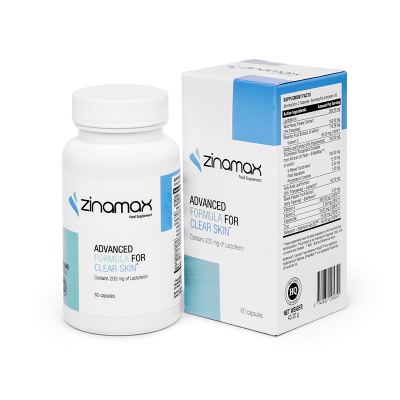
Our Recommendation — Zinamax
Score: 5.7/10 · Best for: adults with mild, persistent breakouts who want a nutritional adjunct alongside a topical routine, judged fairly over 12 weeks. Main caution: it carries a declared milk allergen, its vitamin B6 (18 mg) sits above EFSA's upper limit, and no money-back guarantee is published. Fair trial: the three-bottle pack at $39.33 a bottle — one full trial at the trials' own 8–12 week length.
First, the Triage Question: How Bad Is the Acne?
Every honest answer to "do supplements work?" starts with a question about severity, because the right answer differs completely by what is on your face. If your acne is cystic, nodular, painful, deep, or leaving scars or dark marks that persist, stop reading supplement pages — including this one — and book a dermatologist.
Deep inflammatory acne scars permanently while you experiment, and the treatments that change its course (prescription retinoids, hormonal therapy where appropriate, isotretinoin for severe or resistant disease) sit behind that appointment, not in a capsule.
The same applies if acne arrived suddenly in adulthood alongside irregular periods, excess hair growth or weight change (a PCOS conversation belongs with a doctor), or if it is significantly affecting your mood.
Supplements, at their evidence-based best, are for the other end of the spectrum: mild, persistent, mostly surface-level inflammatory breakouts in adults whose skin is not scarring, who are already cleansing gently and using a reasonable topical, and who want to know whether nutrition can move the needle a modest amount.
That framing is not false modesty — it is where the trials were actually done, and it is the framing the American Academy of Dermatology's 2024 acne guidelines support: strong recommendations for topical benzoyl peroxide, topical retinoids and (where needed) systemic prescription therapy, and a plain statement that evidence was insufficient to recommend vitamins or plant-based alternatives at all.
A supplement seller who quotes that guideline selectively is selling; a guide that prints it whole is informing.
What "Work" Can Honestly Mean
Most disappointment in this category is a definitions problem. Marketing uses "works" to mean "clears skin". Trials measure something much narrower, and the gap between the two is where buyers get burned. Here is the honest outcome table — what the supplement literature can and cannot deliver, in the units the studies actually used:
| Outcome | What trials typically show | What that is NOT |
|---|---|---|
| Fewer inflammatory lesions (red, sore pimples) | Median reductions of roughly 20–45% versus placebo over 8–12 weeks for the best-studied ingredients (zinc, lactoferrin combinations) | Not clearance. A 30% reduction on 20 lesions leaves about 14 |
| Fewer comedones (blackheads/whiteheads) | Smaller, less consistent effects; the lactoferrin combination trial's comedone reduction (−32.5% at week 10) is the standout | Not pore "unclogging" of the kind a topical retinoid produces over months |
| Less sebum (oil) | Measured reductions in two lactoferrin trials (one in fermented milk — context matters, see our article on lactoferrin for acne) | Not a permanent change in oil production; effects end when the trial ends |
| Scar fading | No oral supplement trial demonstrates scar improvement | Scars are a dermatology-procedure and retinoid conversation |
| "Hormone balance" | No supplement trial shows correction of a hormonal imbalance (see our hormonal acne article) | Not a substitute for the pill, spironolactone or a PCOS workup |
Hold those numbers against the claims on a typical product page — "clinically shown to clear skin", percentages with no trial attached — and the discipline this site applies becomes clear: a percentage is only meaningful with its trial, population, dose and duration attached, and most supplement percentages in the wild fail that test on at least two counts.
A 2023 systematic review of oral nutraceuticals for acne in JAMA Dermatology gathered the whole field — 42 randomised trials, 3,346 participants — and rated only four of those trials good quality. That is the literature: real, but thin, and mostly short (8–12 weeks).
The Ingredients, Graded
Here is the category ingredient by ingredient, graded by the strongest human evidence for acne specifically — not for skin health in general, not in animals, not in a dish. The grades are: Modest (small human trials, real but limited effects), Weak (association data, tiny or inconsistent trials), and None (no human acne trial we can find).
| Ingredient | Grade | The record in one line |
|---|---|---|
| Zinc (oral, 15–30 mg elemental) | Modest | Decades of trials; a meta-analysis by Yee and colleagues (2020) found significantly fewer inflammatory papules — and in the largest head-to-head trial, Dreno and colleagues (2001), the antibiotic succeeded about twice as often |
| Lactoferrin (200 mg/day) | Modest | Two small positive RCTs — one delivered in fermented milk, one a three-ingredient combination capsule; never trialled alone in a capsule |
| Omega-3 fatty acids | Weak | Small pilots, mixed results, one null; plausible mechanism, unproven effect |
| Vitamin D | Weak | Deficiency is more common in acne patients (association); supplementation benefit seen mainly in the deficient subgroup of one small trial |
| Probiotics | Weak | Early, small, heterogeneous trials; the gut–skin axis is a research area, not a result |
| Vitamin A (oral) | Weak, with a safety asterisk | High-dose retinol was used historically; toxicity (including birth defects from preformed vitamin A) caps its use — see our vitamins article |
| Selenium | Weak | Low levels observed in acne patients in case-control work; no convincing supplementation trial |
| Nettle, wild pansy, gotu kola, rosehip | None | Traditional skin botanicals. No human acne trials. They appear in formulas — including the one this cluster reviews — as support cast, and should be priced as such |
| Tocotrienols (vitamin E family) | None for oral acne | Vitamin E's skin reputation is topical, and weak even there; oral acne evidence does not exist in any useful form |
Two things follow from this table. First, a formula's credibility rests on its one or two graded ingredients — everything else is decoration, and a label that lists fifteen ingredients is not fifteen times better; it is usually the same two studied ingredients wearing a crowd.
Second, the grades explain our product scoring across this site: when we reviewed Zinamax (5.7/10), the score credited exactly this structure — lactoferrin 200 mg and zinc 15 mg carrying the evidence, the botanicals counted as tradition, and deductions for a vitamin B6 dose above the European upper limit and the absence of a published money-back guarantee.
The Dose-Check: the Method Nobody Publishes
Whether a specific product can plausibly reproduce a trial result is an arithmetic question, and it takes about a minute per ingredient. Run these three checks on any acne supplement label — including ours.
Check 1 — studied dose vs label dose. Find the dose the human trials used, then find the amount per daily serving on the label. Zinc's acne trials cluster at 15–30 mg of elemental zinc per day. Lactoferrin's trials used 200 mg/day. If the label hides amounts inside a "proprietary blend", the check is impossible — treat that as the answer.
Check 2 — elemental vs salt weight. Mineral labels are the trap here: "zinc gluconate 100 mg" is not 100 mg of zinc; zinc salts are mostly carrier. Gluconate is roughly 14% elemental, so a label quoting salt weight can overstate the real dose seven-fold. Honest labels state the elemental figure ("zinc: 15 mg"). Run the same suspicion over magnesium, iron and calcium labels everywhere else in your cabinet.
Check 3 — the ceiling and the stack. Compare the dose with the tolerable upper intake level (UL) — for zinc, 40 mg/day for adults from all sources — and then add up everything else you take: a multivitamin, a hair gummy, a "skin" drink.
Stacking three modest products is how people quietly exceed ceilings, and it is also how high-dose B vitamins sneak in — B6 and B12 at supplement doses are themselves linked to acneiform breakouts, which our article on supplements that can cause acne covers in full.
The worked example. Zinamax, run through its own cluster's method: lactoferrin 200 mg — matches the daily amount used in both human trials numerically (with the form caveat — the trials were a fermented milk and a combination capsule, not this capsule).
Zinc 15 mg elemental — inside the studied 15–30 mg range, at its lower end; half the 30 mg dose of the best-known head-to-head trial.
Vitamin B6 18 mg — above the European Food Safety Authority's 12 mg/day upper limit, though well below the US limit of 100 mg/day; a genuine deduction, printed on our product page and in our Q5 article.
Vitamin A 800 µg — around the daily requirement, far below the 3,000 µg upper level for preformed vitamin A. Every amount is published, which is precisely what makes this audit possible; most competitors in this set do not print a full panel at all.
Supplements vs Topicals: Different Jobs
The comparison buyers actually need is not supplement A vs supplement B; it is supplement vs the tube already in the bathroom cabinet.
Topical retinoids (adapalene is available over the counter in the US) and benzoyl peroxide carry the guideline-grade recommendations because they act where acne forms — inside the pore — with decades of controlled data and known timelines (judge at 8–12 weeks, like everything in acne).
An oral supplement, at best, nudges systemic contributors: a mineral deficiency corrected, inflammation modestly damped, sebum modestly reduced. The two are not rivals; they are different categories of intervention, and the trial literature for supplements almost always studies them as add-ons in people using ordinary skincare, not as replacements for treatment.
The practical rule: build the topical foundation first (gentle cleanser, a retinoid or benzoyl peroxide used consistently, moisturiser, sunscreen), give it its 12 weeks, and only then judge whether an adjunct is worth adding — one change at a time, or you will never know what helped. Chasing a supplement instead of topicals for anything beyond mild acne is the category's most expensive mistake, because time is the one input scarring acne does not refund.
How to Run a Fair Test (and When to Stop)
If you do trial a supplement, run it like the trials did. Twelve weeks minimum — the endpoints of the zinc and lactoferrin studies sit at 10–12 weeks, and skin formed this month was programmed weeks ago (our timeline article does the skin-cycle maths in full).
Take weekly photographs in the same light, same angle, no filter; memory is a terrible dermatologist. Change nothing else in the routine during the test window.
And set the stop rules in advance: no meaningful change by week 12 means stop — the ingredient has had the same chance the trials gave it — and worsening, deepening or scarring acne at any point means a dermatologist now, not at the end of the bottle.
One interaction deserves printing here because so few pages mention it: zinc interferes with tetracycline and quinolone antibiotics — the very drugs prescribed for acne — by chelating them in the gut. The NIH Office of Dietary Supplements spacing rule is to take the antibiotic at least 2 hours before, or 4–6 hours after, zinc. If you are on a prescribed antibiotic, ask the pharmacist before adding any zinc-containing supplement.
Who Should Buy Zinamax — and Who Should Skip It
Buy it if you are an adult with mild, persistent inflammatory breakouts, your topical basics are in place, and you want the adjunct the trial literature actually points to — lactoferrin at the studied 200 mg plus zinc inside the studied range — with every dose printed so you can run the checks above yourself.
Judge it over 8–12 weeks with photographs; the multi-bottle packs ($39.33 a bottle on three, $29.50 on six, plus $12 shipping per order) match that timeline.
Skip it if your acne is cystic, nodular, painful or scarring (dermatologist first — non-negotiable), if you are allergic to milk (the lactoferrin is a bovine milk protein and the product carries a MILK allergen — a hard no, not a caution), if you avoid dairy on principle (this is a milk protein; it is not vegan), if you are under 18 or pregnant (the maker excludes both), or if you need a money-back guarantee — the maker publishes none, so the 12-week test is funded by you. Skip it, too, if you already take a B-complex or multivitamin you are unwilling to audit: stacking is how the B6 in this formula (18 mg, above EFSA's upper limit) becomes a bigger number than the label shows.
Our Recommendation — Zinamax
Score: 5.7/10 · Best for: adults with mild, persistent breakouts who want a nutritional adjunct alongside a topical routine, judged fairly over 12 weeks. Main caution: it carries a declared milk allergen, its vitamin B6 (18 mg) sits above EFSA's upper limit, and no money-back guarantee is published. Fair trial: the three-bottle pack at $39.33 a bottle — one full trial at the trials' own 8–12 week length.
Frequently Asked Questions
Can a supplement replace my acne treatment?
No. The guideline-recommended treatments — topical retinoids, benzoyl peroxide, and prescription options for more severe disease — have a depth of evidence no supplement approaches, and the AAD's 2024 guidelines found the evidence for vitamins and alternative therapies insufficient to recommend. Supplements are adjuncts for mild acne, used alongside basic skincare, not instead of treatment.
Which supplement ingredient has the best evidence for acne?
Zinc, by depth of literature: decades of trials and a meta-analysis finding significantly fewer inflammatory papules — though the effect is smaller than tetracycline antibiotics, and the best-known head-to-head trial saw the antibiotic succeed about twice as often. Lactoferrin is second: two small positive trials, both with form caveats (fermented milk; a combination capsule).
How much improvement is realistic?
For the best-studied ingredients, median lesion reductions of roughly 20–45% versus placebo over 8–12 weeks — fewer breakouts, not clear skin. Anyone promising clearance, scar removal or results in two weeks is describing marketing, not the trial record.
How long should I try a supplement before judging it?
Twelve weeks, with weekly photographs in identical light. The trials' endpoints sit at 10–12 weeks, and skin you see today was formed weeks ago. No change by week 12 means stop; worsening or scarring at any point means a dermatologist.
Are acne supplements safe?
Mostly, at label doses, for healthy adults — with specific exceptions this cluster documents: vitamin B6 above the EFSA upper limit in some formulas (including Zinamax's 18 mg), zinc above 40 mg/day risking copper deficiency, preformed vitamin A toxicity in pregnancy, and zinc's interference with tetracycline antibiotics. "Natural" is not a safety grade; the dose audit is.
Last reviewed: October 2026. This article is educational and is not medical advice.
