
- Quick Answer
- Our Findings
- What we like
- What gives us pause
- Why You Should Trust This Review
- Our Verdict
- How We Scored It
- What Is NuviaLab Sugar Control?
- The Numbers First: What Fasting Glucose and HbA1c Ranges Mean
- Ingredients
- 1. Bitter Melon Fruit Extract — Momordicin® (500 mg)
- 2. Gymnema Sylvestre Leaf Extract — GS4 PLUS® (200 mg)
- 3. Cinnamon Bark Extract (100 mg)
- 4. White Mulberry Extract (100 mg)
- 5. Green Tea Leaf Extract (100 mg)
- 6. Alpha Lipoic Acid (30 mg)
- 7. Vitamin B6 (14 mg, 1,000% NRV)
- 8. Zinc (15 mg, 150% NRV)
- 9. Chromium (200 µg, 500% NRV)
- The Dose Audit
- Evidence: What the Studies Actually Show
- How Long Does It Take? The 8–12 Week Test
- Safety and Drug Interactions
- Side Effects
- When Blood Sugar Needs a Doctor, Not a Supplement
- Is NuviaLab Sugar Control a Scam or Legit?
- The Maker's Claims, Checked
- Price and Packs
- Purchase Options
- How It Compares
- Who Should Buy NuviaLab Sugar Control — and Who Should Skip It
- How to Take NuviaLab Sugar Control
- Frequently Asked Questions
- Can I take it with metformin / diabetes medication?
- How long before I can judge whether it works?
- Why is the vitamin B6 dose flagged?
- Is there a money-back guarantee?
- Has this formula been clinically tested?
- What is NuviaLab Sugar Control?
- Does it have side effects?
- Is it vegan?
- What form of chromium does it use?
- Is it really the "undisputed No. 1" with 96% satisfied?
- Who makes it?
- How much does it cost, and is shipping free?
- Can I take it while pregnant or breastfeeding?
- Is it sold on Amazon or in pharmacies?
- Can it replace insulin or oral diabetes drugs?
- What are the signs of low blood sugar if combined with medication?
- Can I stack it with a multivitamin or B-complex?
- Does swallowing a capsule block sweet taste like gymnema tea?
- What time of day should I take it?
- How would I know if it is working?
- Sources & Method
- Read This Next
Disclosure: This article contains affiliate links. If you buy through them, we may earn a commission at no extra cost to you. It never changes our scores or conclusions.
Quick Answer
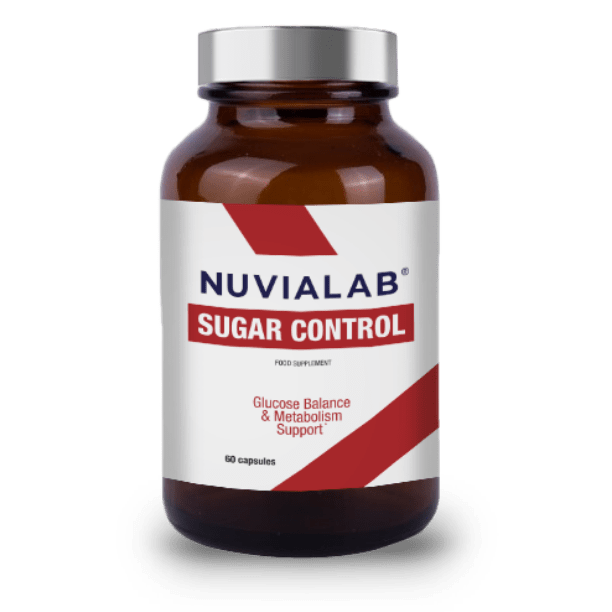
NuviaLab Sugar Control is a daily blood-sugar support food supplement sold in 60-capsule bottles (2 vegan capsules a day) with a fully disclosed nine-ingredient label. It scores 5.2/10 on our rubric. Its strongest point is formula transparency: every active amount is printed, anchored by two branded Sabinsa extracts—Momordicin® bitter melon (500 mg) and GS4 PLUS® gymnema (200 mg).
Four cautions hold the score back. Vitamin B6 at 14 mg/day exceeds the European 12 mg/day upper limit, the maker's own panel warns people on insulin or oral hypoglycaemic drugs to consult a doctor first, alpha lipoic acid at 30 mg is one twentieth of the roughly 600 mg/day research dose, and there is no money-back guarantee.
Best for: adults not on diabetes medication who know their numbers and want a disclosed formula they can judge with a follow-up blood test. The fair trial is three months—the three-bottle pack at $111.98 delivered covers one HbA1c cycle.
NuviaLab Sugar Control — Our Score: 5.2/10
Score: 5.2/10 · Best for: adults not on diabetes medication who know their numbers and want a fully disclosed formula they can judge with a follow-up blood test. · Main caution: vitamin B6 at 14 mg a day exceeds EFSA's 12 mg upper limit, and the maker's panel warns people on insulin or oral hypoglycaemic drugs to consult a doctor first. · Fair trial: three months — the three-bottle pack at $111.98 delivered covers one HbA1c cycle.
See the Product PageOur Findings
We audited the nine-ingredient supplement panel, the US checkout page, the caution label, and the published human studies behind each compound.
What we like
- Full label disclosure: Every active ingredient and milligram or microgram amount is printed on the panel with no proprietary blend.
- Named Sabinsa extracts: Momordicin® bitter melon (500 mg) and GS4 PLUS® gymnema (200 mg) come from a named supplier, with gymnema matching the low end of its studied 200–400 mg/day range.
- Sensible zinc dose: The 15 mg daily zinc serving (150% NRV) sits cleanly inside the standard adult reference-intake range.
What gives us pause
- Vitamin B6 overshoot: The 14 mg daily vitamin B6 dose exceeds EFSA's 12 mg/day tolerable upper limit before food or other supplements are counted.
- Medication stop sign: The maker's own caution panel warns people using insulin therapy or oral hypoglycaemic drugs to consult a doctor before use.
- Token ALA dose: Alpha lipoic acid at 30 mg is one twentieth of the roughly 600 mg/day dose used in diabetes research.
- Unpublished mineral forms: Neither the chromium form nor the zinc form is named on the verified label.
- Extract-to-powder gaps: The bitter melon (500 mg) and cinnamon (100 mg) extracts cannot be converted into the gram-level powders used in human trials.
- Untested finished blend: No clinical trial has ever tested this nine-ingredient formula together.
- No refund guarantee: The sales page publishes no money-back guarantee and never names the operating seller.
Why You Should Trust This Review
To write this review, we audited NuviaLab Sugar Control's US order page, its nine-ingredient panel, the caution label that contradicts the maker's own FAQ safety claim, Section 14 of its Hong Kong terms, and the primary PubMed, Cochrane, and EFSA records—including the dose and safety details that complicate the sales pitch. Every product we review is graded on one fixed five-part rubric that never moves for a brand; when verified facts change, we lower our scores and say so. We earn a commission when readers buy through our links, and we are never paid to place or praise a product.
Our Verdict
A score of 5.2/10 means NuviaLab Sugar Control is a transparent, mixed-evidence formula that demands a careful look at the label before you buy. As we detail on our NuviaLab Sugar Control product page, the product earns credit for publishing all nine active doses and using two standardized Sabinsa extracts—GS4 PLUS® gymnema at 200 mg and Momordicin® bitter melon at 500 mg—at or near studied extract ranges.
It loses points on four verifiable counts: the 14 mg vitamin B6 dose sits above EFSA's 12 mg/day upper limit, the 30 mg alpha lipoic acid dose is a twentieth of the research standard, the label carries a strict doctor warning for anyone on diabetes medication, and there is no refund guarantee. A single bottle costs $49.99 ($61.99 delivered), while the three-bottle pack at $111.98 delivered covers one three-month HbA1c test cycle. Because that bundle is a firm commitment rather than a refundable trial, order size is your only risk control.
How We Scored It
| Criterion | Weight | Score |
|---|---|---|
| Ingredients | 30% | 6.0 |
| Evidence | 25% | 5.0 |
| Safety | 15% | 4.0 |
| Value | 10% | 5.5 |
The fifth pillar of our rubric is Maker Credibility, which accounts for 20% of the total and scores 5.0/10 in our audit. Trademark ownership is stated (NuviaLab Limited), an FDA disclaimer is printed in the footer, and the two flagship botanical extracts come from a named supplier (Sabinsa), but the operating seller itself is never named, the sales claims are inflated, and no guarantee is published.
Combining all five weighted criteria gives the final score: 6.0 × 0.30 + 5.0 × 0.25 + 5.0 × 0.20 + 4.0 × 0.15 + 5.5 × 0.10 = 5.20 (5.2/10). No published clinical trial has tested the finished NuviaLab Sugar Control formula, and third-party review pages that invent named customer reviews or extra ingredients for this product carry no weight in our score.
What Is NuviaLab Sugar Control?
NuviaLab Sugar Control is a daily blood-sugar support food supplement sold in 60-capsule bottles (43.20 g net weight). The maker's directions call for 2 vegan capsules a day washed down with about 300 ml of water, giving each bottle a 30-day supply; the label states no specific time of day. It is a dietary supplement, not a drug, not a treatment for diabetes, and not a substitute for prescribed medication.
The corporate structure behind the bottle is only partly disclosed. The terms and conditions never name an operating company, referring only to the website name under Hong Kong law. NuviaLab® is a registered trademark of NuviaLab Limited (the trademark holder only), while Momordicin® and GS4 PLUS® are registered trademarks of the ingredient supplier Sabinsa, and the website footer prints a standard FDA disclaimer. The sales page also displays "Suitable for vegans", "Manufactured in the European Union", and "Laboratory tested" badges, which we report strictly as the maker's own sales-page badges rather than independently verified facts.
| Field | Verified Detail |
|---|---|
| Product | NuviaLab Sugar Control |
| Category | Blood Sugar Support Food Supplement |
| Format | 60 vegan capsules / 43.20 g |
| Daily serving | 2 capsules with ~300 ml water; 30 servings |
| Disclosed actives | 9, full amounts published |
| Branded extracts | Momordicin® 500 mg · GS4 PLUS® 200 mg — Sabinsa |
| Price | $49.99 / $99.98 / $149.97 + $12 flat shipping |
| Guarantee | None published; 10-day unused withdrawal, Terms §14 |
| Trademark / jurisdiction | NuviaLab Limited trademark; seller unnamed, Hong Kong terms |
| Our score | 5.2/10 |
The Numbers First: What Fasting Glucose and HbA1c Ranges Mean
Before looking at any blood-sugar capsule, it helps to know what standard lab numbers actually mean. The table below shows the diagnostic thresholds published on the NIDDK diabetes tests and diagnosis page.
| Diagnostic Category | HbA1c Range | Fasting Plasma Glucose |
|---|---|---|
| Normal | Below 5.7% | Below 100 mg/dL |
| Prediabetes | 5.7% to 6.4% | 100 to 125 mg/dL |
| Diabetes | 6.5% or higher | 126 mg/dL or higher |
Two clinical rules govern how doctors read this table. First, a medical diagnosis requires two abnormal test results, and an HbA1c test reflects your average blood sugar over roughly three months. Second, numbers in the diabetes range (HbA1c of 6.5% or higher, or fasting glucose of 126 mg/dL or higher) are a medical diagnosis to manage with a clinician, not a condition for a solo supplement trial.
That brings us to our house baseline rule: never judge a blood-sugar supplement by vague feelings like "more energy" or "fewer sweet cravings." Only a before-and-after lab test tells you whether your glucose moved, as we explain in our guide on whether blood sugar supplements actually work.
Ingredients
Every two-capsule daily serving of NuviaLab Sugar Control discloses nine active ingredients and four standardization percentages.
| # | Ingredient (Label Form) | Daily Amount | Standardization / Derived Active / NRV |
|---|---|---|---|
| 1 | Bitter Melon Fruit Extract (Momordicin®) | 500 mg | 0.5% charantin (2.5 mg), 7% bitter principle |
| 2 | Gymnema Sylvestre Leaf Extract (GS4 PLUS®) | 200 mg | 25% gymnemic acids (50 mg) |
| 3 | Cinnamon Bark Extract | 100 mg | 20% proanthocyanidins (20 mg) |
| 4 | White Mulberry Extract | 100 mg | No standardisation printed |
| 5 | Green Tea Leaf Extract | 100 mg | 40% EGCG (40 mg) |
| 6 | Alpha Lipoic Acid | 30 mg | — |
| 7 | Vitamin B6 | 14 mg | 1,000% NRV |
| 8 | Zinc | 15 mg | 150% NRV (form not published) |
| 9 | Chromium | 200 µg | 500% NRV (form not published) |
1. Bitter Melon Fruit Extract — Momordicin® (500 mg)
Momordicin® is a Sabinsa bitter melon fruit extract standardized to 0.5% charantin (delivering 2.5 mg of charantin) and 7% bitter principle. Bitter melon is studied for glucose-uptake support, but human clinical trials sit in a split, low-certainty evidence tier. Because those trials typically used 2 to 4 g/day of whole-fruit powder and no standard clinical dose exists for this branded extract, the 500 mg extract dose cannot be equated to gram-dose powder.
2. Gymnema Sylvestre Leaf Extract — GS4 PLUS® (200 mg)
GS4 PLUS® is Sabinsa's standardized gymnema leaf extract providing 25% gymnemic acids, or 50 mg of gymnemic acids per two-capsule serving. It is included to support glucose metabolism and sits at the bottom of the 200 to 400 mg/day extract range used in small, mostly older human studies. One practical caveat matters here: gymnema's famous sweet-taste blocking effect requires direct tongue contact from a leaf, tea, or lozenge, so swallowing a capsule with water is a different exposure that bypasses the taste buds.
3. Cinnamon Bark Extract (100 mg)
This bark extract is standardized to 20% proanthocyanidins, supplying 20 mg of proanthocyanidins per daily serving. Meta-analyses of cinnamon in people with elevated blood sugar show small average HbA1c reductions, but the clearest pooled effects sit above 1.5 g/day of ground cinnamon powder across trials using roughly 1 to 3 g/day. A 100 mg concentrated extract is a different material from gram-dose bark powder and cannot be converted into a powder equivalent.
4. White Mulberry Extract (100 mg)
White mulberry is included in blood-sugar blends to slow carbohydrate breakdown during digestion. However, NuviaLab Sugar Control prints only "100 mg" with no active standardization on the panel. Because human research relies on standardized mulberry leaf extracts that this label does not specify, there is no established benchmark to verify whether 100 mg of this unstandardized extract matches clinical preparations.
5. Green Tea Leaf Extract (100 mg)
Standardized to 40% EGCG, this 100 mg extract delivers 40 mg of epigallocatechin gallate (EGCG) a day. In pooled randomized controlled trials examining green tea and fasting glucose, daily catechin intakes ran from roughly 236 mg to 1,207 mg/day and produced only a tiny fasting-glucose shift. At 40 mg of EGCG, this label supplies a small fraction of the studied catechin intake.
6. Alpha Lipoic Acid (30 mg)
Alpha lipoic acid (ALA) is an antioxidant compound with an established human trial record in diabetes research, but that record focuses mainly on diabetic nerve symptoms rather than blood-sugar lowering. Those clinical studies consistently used around 600 mg/day of oral ALA. At 30 mg per daily serving, NuviaLab Sugar Control delivers just one twentieth of the studied research dose.
7. Vitamin B6 (14 mg, 1,000% NRV)
Vitamin B6 supports normal protein and glycogen metabolism, but the 14 mg daily dose is our primary safety flag on this label. In 2023, the European Food Safety Authority (EFSA) set the adult tolerable upper intake level for vitamin B6 at 12 mg/day over peripheral neuropathy concerns, whereas the older 1998 US upper limit remains 100 mg/day. At 14 mg/day, these two capsules exceed the European safety limit before food or any other supplement is counted.
8. Zinc (15 mg, 150% NRV)
Zinc contributes to normal carbohydrate metabolism and insulin storage. At 15 mg per day, the dose sits comfortably within standard adult reference-intake levels and well below adult upper limits. However, the verified panel never publishes which chemical form of zinc is used in the capsule.
9. Chromium (200 µg, 500% NRV)
Chromium is the most frequently studied trace mineral for insulin sensitivity and glucose tolerance. At 200 µg per day, this label sits on the bottom rung of the roughly 200 to 1,000 µg/day dose ladder tested in human trials, where stronger signals appeared at higher doses. Crucially, the panel states only "Chromium 200 µg" without naming the chemical form, so results from trials of named forms cannot be read straight across to this product.
The Dose Audit
Comparing the two-capsule label against published human research shows exactly where NuviaLab Sugar Control matches clinical dosing and where it falls short.
| Ingredient | Label | Studied Context | Verdict |
|---|---|---|---|
| Bitter melon | 500 mg standardised extract | Varied whole-plant preparations, often 2–4 g/day of powder; no standard dose for this extract | Unverifiable — plausible, unproven |
| Gymnema | 200 mg GS4 PLUS® | Human studies cluster around 200–400 mg/day of standardised extract | Low end of the studied range |
| Cinnamon | 100 mg extract | Clearest pooled effects above 1.5 g/day of powder; trials used ~1–3 g/day powder | Far below and a different material |
| White mulberry | 100 mg, no standardisation | Research uses standardised leaf extracts this label does not specify | Unverifiable |
| Green tea | 40 mg EGCG | Zheng 2013 trials used catechin intakes of ~236–1,207 mg/day | A fraction of the studied intake |
| Alpha lipoic acid | 30 mg | Around 600 mg/day in the diabetes (nerve-symptom) literature | One twentieth of the studied dose |
| Vitamin B6 | 14 mg | EFSA tolerable upper limit 12 mg/day (US limit 100 mg/day) | Over the EFSA limit |
| Zinc | 15 mg | Adult reference-intake level | In range |
| Chromium | 200 µg, form unnamed | Trials ran roughly 200–1,000 µg/day, stronger signal at the top | Bottom rung; form undisclosed |
Four takeaways stand out from the audit table:
The vitamin B6 overshoot: Delivering 14 mg/day pushes daily intake past EFSA's 12 mg/day adult upper limit (though below the looser 100 mg/day US limit) before counting diet or a daily multivitamin, a risk we break down in our guide on how much vitamin B6 is too much.
The ALA shortfall: Providing 30 mg of alpha lipoic acid against a roughly 600 mg/day clinical benchmark leaves a twenty-fold gap that no marketing copy can bridge, as shown in our alpha lipoic acid dosage audit.
The extract-vs-powder problem: Bitter melon trials used 2 to 4 g/day of powder and cinnamon trials used 1 to 3 g/day of powder, so you cannot convert 500 mg or 100 mg of concentrated extracts into gram-powder equivalents—see our reviews of bitter melon for blood sugar and cinnamon for blood sugar.
The honest middle: Gymnema at 200 mg matches the entry point of its 200 to 400 mg/day studied range, and chromium at 200 µg matches the bottom rung of the 200 to 1,000 µg/day trial ladder (albeit with its chemical form unpublished), as we detail in our gymnema for blood sugar review and chromium for blood sugar guide.
Do not double the dose: Never take four capsules a day to chase higher herbal amounts, because doubling the serving also doubles your vitamin B6 intake to 28 mg/day. Always judge this formula strictly at its two-capsule label dose.
Evidence: What the Studies Actually Show
No clinical trial has ever tested the finished NuviaLab Sugar Control capsule. All available human evidence comes from studies of individual ingredients in people with diabetes or prediabetes, and the findings are mixed.
For bitter melon, the clinical literature is split between null reviews and low-certainty pooled effects. The 2012 Cochrane review by Ooi et al. examined 4 randomized controlled trials (479 participants) and found no statistically significant difference from placebo. A larger 2025 GRADE meta-analysis by Mkhize et al. across 25 trials (34 sub-studies) found small pooled reductions in fasting glucose (SMD −0.46), HbA1c (SMD −0.57), and HOMA-IR (−0.52), but graded the evidence as low to very low certainty across preparations unlike this extract. Meanwhile, a 2024 Frontiers in Nutrition review of 9 placebo-controlled trials found no significant overall metabolic effect, and in a 10-week head-to-head trial (95 participants) comparing 2 g/day and 4 g/day of bitter melon powder against glibenclamide 5 mg/day, 2-hour glucose improved significantly only in the prescription drug arm.
For gymnema, a 2023 meta-analysis pooled a fasting glucose reduction of −4.96 mg/dL, but its HbA1c estimate (−1.78%) had a confidence interval crossing zero and was not statistically significant. An earlier pool by Devangan et al. 2021 (10 studies, 419 participants) measured changes against baseline rather than a placebo control, with 80% to 99% heterogeneity. On its sales page, the maker highlights the 1990 GS4 study by Shanmugasundaram et al., where 27 insulin-dependent patients took 400 mg/day of GS4 alongside insulin in an open-label design with no placebo group; the paper speculated that effects occurred "possibly by regeneration/revitalisation of the residual beta cells," which the maker hardens into a claim and which is never a basis for adjusting insulin.
Among the smaller herbal and antioxidant doses, a 2025 Frontiers in Nutrition umbrella review of 21 cinnamon meta-analyses reported a small HbA1c effect (SMD −0.26) that was clearer above 1.5 g/day of powder. In the 2013 green tea meta-analysis by Zheng et al. (22 RCTs, 1,584 adults), hundreds of milligrams of catechins shifted fasting glucose by −1.48 mg/dL with a non-significant −0.04% HbA1c change—an effect a 40 mg EGCG dose cannot claim. Likewise, the human diabetes literature on alpha lipoic acid tests roughly 600 mg/day for nerve symptoms, not 30 mg for blood sugar.
For chromium, the 2020 meta-analysis by Asbaghi et al. (28 trials) pooled a −19.0 mg/dL fasting glucose drop and −0.71% HbA1c drop, but with roughly 99% heterogeneity across named chromium forms. A 2025 meta-analysis by Fatahi et al. (20 trials, 1,147 participants) found a −13.71 mg/dL fasting glucose shift and a non-significant −0.17% HbA1c change (p = 0.42). In the classic 1997 dose-ladder trial by Anderson et al. (180 type 2 diabetes patients over 4 months), chromium picolinate lowered average HbA1c from 8.5% on placebo to 7.5% at 200 µg/day and 6.6% at 1,000 µg/day; because later reviewers (Balk 2007) rated that study poor quality, we print the ladder as the dose record rather than proof.
How Long Does It Take? The 8–12 Week Test
Because red blood cells turn over on a roughly three-month schedule, an HbA1c test reflects about 8 to 12 weeks of blood-sugar history. If you are an unmedicated adult testing NuviaLab Sugar Control, use this four-step measurement protocol matched to the three-bottle Standard pack ($111.98 delivered):
- Get a baseline blood test: Record your fasting plasma glucose and HbA1c with your doctor or lab before taking your first capsule.
- Take the label dose with nothing else changed: Take 2 capsules a day with about 300 ml of water for 8 to 12 weeks while keeping your diet and exercise steady, and never double the dose.
- Run a follow-up lab test: Re-test both your fasting glucose and HbA1c at the 8-to-12-week mark under the same fasting conditions.
- Apply the stop rule: If your numbers have not moved after finishing the three-bottle pack, stop taking the supplement and do not order a second bundle.
One boundary is absolute: if you use insulin, metformin, or any oral hypoglycaemic drug, never start a supplement test or alter your medication without your prescribing doctor's supervision.
Safety and Drug Interactions
The most important line on NuviaLab Sugar Control sits on the maker's own caution panel and is repeated in the website footer. We quote it verbatim: "In people using insulin therapy or oral hypoglycaemic drugs consult a use of the product with a doctor." Metformin is an oral hypoglycaemic drug and sits squarely inside that warning's scope. Combining glucose-lowering supplement ingredients with prescribed diabetes medicines creates an additive hypoglycaemia risk that can push blood sugar too low, as we explain in our safety hub on taking blood sugar supplements with metformin or insulin.
The second safety flag applies to every buyer, medicated or not. Two capsules supply 14 mg/day of vitamin B6, which exceeds the 2023 EFSA tolerable upper intake level of 12 mg/day for adults before food is counted (the older 1998 US upper limit is 100 mg/day). EFSA set that 12 mg/day limit over peripheral neuropathy risk—nerve tingling or numbness in the hands and feet that, in a blood-sugar audience, can easily be mistaken for diabetic neuropathy. Never stack this formula with a multivitamin, B-complex, or energy drink containing vitamin B6.
Two mineral-drug interactions also require spacing. According to the NIH Office of Dietary Supplements chromium fact sheet, chromium can add to hypoglycaemia risk alongside insulin or metformin, and taking chromium with levothyroxine reduced the thyroid drug's absorption in a small study (separate the doses and inform your clinician). Per Mayo Clinic zinc guidance, zinc can bind quinolone and tetracycline antibiotics in the digestive tract, so take the antibiotic at least 2 hours before or 4 to 6 hours after these capsules. Finally, the maker's panel excludes children, pregnant women, and lactating women, and warns not to exceed the recommended daily serving; see our overview of blood sugar supplement side effects for more detail.
Side Effects
On its sales page, the maker's FAQ claims that NuviaLab Sugar Control "does not cause any side effects" and is "completely safe and effective." That statement is flatly contradicted by the maker's own caution panel, which prints a diabetes-medication warning, a pregnancy and childhood exclusion, a do-not-exceed instruction, and a 14 mg vitamin B6 dose. Our house rule is simple: judge the product by its panel, not its FAQ.
In practice, three side-effect and risk mechanisms matter for this formula:
- Additive hypoglycaemia: Pairing glucose-lowering botanicals and chromium with insulin or oral hypoglycaemic drugs can drop blood glucose below safe thresholds; our metformin and insulin interaction guide lists the early warning signs.
- Peripheral nerve symptoms from vitamin B6: Sustained daily intake above EFSA's 12 mg/day upper limit is linked to sensory nerve tingling or numbness that can be confused with diabetic nerve damage.
- Class-level digestive upset: Multi-ingredient herbal and mineral blends can cause ordinary gastrointestinal upset in sensitive users; we cover the full reported-effects catalogue in our guide to blood sugar supplement side effects.
When Blood Sugar Needs a Doctor, Not a Supplement
NuviaLab Sugar Control is a food supplement, not a medical treatment for diabetes or prediabetes. If your lab numbers sit in the diabetes range (an HbA1c of 6.5% or higher, or fasting glucose of 126 mg/dL or higher) or you already use insulin or oral glucose-lowering drugs such as metformin, sulfonylureas, SGLT2 inhibitors, or GLP-1 receptor agonists, speak with a doctor before touching any supplement. Clinically tested prescription medicines and supervised care exist to control blood glucose safely, and untreated high blood sugar drives long-term vascular and nerve damage that require a doctor's check first.
Is NuviaLab Sugar Control a Scam or Legit?
NuviaLab Sugar Control is a legitimate, fully disclosed food supplement rather than a fake-charge subscription scam. You receive a real 60-capsule bottle with all nine active amounts printed on the label, genuine trademarked Sabinsa extracts (Momordicin® and GS4 PLUS®), a named trademark owner (NuviaLab Limited), and a standard FDA disclaimer in the footer.
Where the product loses credibility is corporate transparency and buyer protection. The operating seller and manufacturer are never named in words—the terms refer only to the website name under Hong Kong law—and the "Manufactured in the European Union" and "Laboratory tested" graphics on the sales page are unverified maker badges. No money-back guarantee exists anywhere on the site; Section 14 of the terms grants only a 10-day withdrawal right for unused, unopened goods. Finally, there is no independent body of verified customer reviews, and third-party review sites that invent named customer testimonials, list berberine as an ingredient, or name specific zinc or chromium forms for this product carry zero weight. To avoid counterfeits, buy only through the official website.
The Maker's Claims, Checked
The official sales page makes seven prominent marketing claims that look very different when checked against the evidence shelf:
Momordicin® "hypoglycemic effect in up to 86% of cases" and "glucose tolerance improved in 73%": These are maker-relayed figures printed with no checkable clinical citation, describing the raw ingredient in the maker's framing rather than trials of this finished capsule.
"Reverse the effects of an unhealthy lifestyle": No dietary supplement can honestly promise to undo lifestyle-driven metabolic risk.
"Undisputed No. 1": This is a marketing slogan asserted without any comparative testing or independent ranking data.
"96% of customers satisfied": The sales page publishes no survey, sample size, or methodology behind this percentage.
FAQ claim that the product "does not cause any side effects" and is "completely safe and effective": This is contradicted by the maker's own caution panel, which warns medicated diabetes patients, excludes pregnant and nursing women, and delivers 14 mg of vitamin B6.
The GS4 study presentation ("beta cell regeneration" and "reduced dependence on insulin"): The sales page retells Shanmugasundaram et al. 1990 (PMID 2259216)—an open-label, no-placebo study of 27 insulin-dependent patients taking 400 mg/day of GS4 alongside insulin—and hardens the paper's cautious phrase ("possibly by regeneration/revitalisation of the residual beta cells") into a headline claim.
Sales-page benefit bullets (stabilise blood sugar, improve mood, lose weight more easily, get rid of sweet cravings, increase immunity, reduce appetite and calorie intake): These are the maker's promotional benefit bullets, not findings from a clinical trial of NuviaLab Sugar Control.
Price and Packs
The official US checkout page offers three package tiers, and every order carries a flat $12.00 shipping fee.
| Pack | Price | Per Bottle | Delivered Total |
|---|---|---|---|
| Basic (1 bottle) | $49.99 | $49.99 | $61.99 |
| Standard — Buy 2, Get 1 Free (3 bottles) | $99.98 | $33.33 | $111.98 |
| Best Value — Buy 3, Get 3 Free (6 bottles) | $149.97 | $25.00 | $161.97 |
There is no free-shipping tier and no recurring auto-ship subscription—every purchase is a one-time charge plus the mandatory $12.00 delivery fee. For an unmedicated buyer running a structured blood-test check, the three-bottle Standard pack at $111.98 delivered is the fair-trial sweet spot because three months matches one HbA1c cycle. While the six-bottle pack lowers the per-bottle price to $25.00, it is also the largest unguaranteed commitment ($161.97 delivered): no money-back guarantee is published, and Section 14 of the terms allows only a 10-day withdrawal for unused goods. With this seller, order size is your only risk control.
Purchase Options
NuviaLab Sugar Control is sold directly via the official website, and we found no verified Amazon or pharmacy listing we can vouch for. If you decide to test the formula, starting with the three-bottle pack ($111.98 delivered) covers one full HbA1c cycle without overcommitting.
How It Compares
Because NuviaLab Sugar Control is the only blood-sugar support formula in our current catalogue, we compare it across the three practical alternatives available to a careful buyer:
Route 1 — Single-ingredient products at studied doses: Buying standalone alpha lipoic acid at roughly 600 mg/day, ground cinnamon powder at 1.5 to 3 g/day, or a named chromium picolinate supplement at 200 to 1,000 µg/day lets you match published trial doses while avoiding this blend's 14 mg vitamin B6 overshoot.
Route 2 — Other disclosed-panel blends: If you prefer a multi-ingredient capsule, check any rival label for three upgrades over NuviaLab Sugar Control: published chemical forms for zinc and chromium, a vitamin B6 dose safely below EFSA's 12 mg/day upper limit, and a written money-back guarantee.
Route 3 — Medication-and-lifestyle-first care: Whenever fasting glucose or HbA1c sits in the prediabetes or diabetes bands, clinician-guided diet, structured exercise, and prescribed medication come ahead of any over-the-counter supplement.
Who Should Buy NuviaLab Sugar Control — and Who Should Skip It
Use the verified limits from our label audit to decide whether this bottle fits your situation:
Consider it if: You are an adult not taking diabetes medication, you know your baseline fasting glucose and HbA1c numbers, you want a vegan, fully disclosed nine-active blend anchored by 200 mg GS4 PLUS® and 500 mg Momordicin®, you take no other vitamin B6 source, and you accept the $111.98 three-bottle test judged by a follow-up lab draw.
Skip it if: You use insulin, metformin, or any oral hypoglycaemic drug without your doctor's explicit sign-off, your labs sit in the diabetes range, you already stack a multivitamin or B-complex containing vitamin B6, you are pregnant, breastfeeding, or under 18, or you require a money-back guarantee.
How to Take NuviaLab Sugar Control
The maker's directions state to take 2 capsules a day washed down with about 300 ml of water. Each 60-capsule bottle lasts 30 days, and the label specifies no time of day. Never exceed 2 capsules a day, because doubling the serving doubles your vitamin B6 intake to 28 mg/day. If you take levothyroxine, separate it from these capsules, and take any quinolone or tetracycline antibiotic at least 2 hours before or 4 to 6 hours after taking NuviaLab Sugar Control.
Frequently Asked Questions
Can I take it with metformin / diabetes medication?
Speak with your prescribing doctor first before taking this product alongside any diabetes drug. The maker's own caution panel states verbatim: "In people using insulin therapy or oral hypoglycaemic drugs consult a use of the product with a doctor." Metformin is an oral hypoglycaemic drug inside that warning's scope, and combining glucose-lowering herbs with diabetes medication raises the risk of additive low blood sugar, as detailed in our guide on blood sugar supplements with metformin or insulin.
How long before I can judge whether it works?
Plan on 8 to 12 weeks (three months), which matches one red-blood-cell HbA1c cycle and the three-bottle Standard pack at $111.98 delivered. Take a baseline fasting glucose and HbA1c test before starting, take the two-capsule daily label dose with nothing else changed, and re-test at 8 to 12 weeks; if your numbers have not improved, stop.
Why is the vitamin B6 dose flagged?
Two capsules deliver 14 mg of vitamin B6 (1,000% NRV) every day, which exceeds the European Food Safety Authority (EFSA 2023) tolerable upper limit of 12 mg/day for adults before food or other supplements are counted. Although the older 1998 US upper limit is 100 mg/day, EFSA lowered its cap because chronic excess vitamin B6 can cause peripheral nerve tingling or numbness—see our full explainer on how much vitamin B6 is too much.
Is there a money-back guarantee?
No—no money-back guarantee is published anywhere on the official sales page. Section 14 of the terms and conditions allows only a 10-day right of withdrawal for unused, unopened goods, which is not a trial guarantee, making order size your only risk control.
Has this formula been clinically tested?
No clinical trial has ever tested the finished nine-ingredient NuviaLab Sugar Control formula. All published human research is at the individual ingredient level in people with diabetes or prediabetes, often using different preparations or much higher doses than this label provides.
What is NuviaLab Sugar Control?
It is a daily blood-sugar support food supplement sold in 60-capsule vegan bottles (43.20 g net weight; 2 capsules a day with about 300 ml of water for a 30-day supply). Each daily serving combines Momordicin® bitter melon (500 mg), GS4 PLUS® gymnema (200 mg), cinnamon bark extract (100 mg), white mulberry extract (100 mg), green tea leaf extract (100 mg, yielding 40 mg EGCG), alpha lipoic acid (30 mg), vitamin B6 (14 mg), zinc (15 mg), and chromium (200 µg). It is a food supplement, not a drug or diabetes treatment.
Does it have side effects?
The maker's FAQ claims the product "does not cause any side effects" and is "completely safe and effective," but that is contradicted by the maker's own caution panel. Judge the product by its panel, which warns of diabetes-medication interactions and delivers 14 mg of vitamin B6; we cover additive hypoglycaemia, nerve symptoms, and digestive upset in our guide to blood sugar supplement side effects.
Is it vegan?
Yes, according to the maker. The official sales page carries a "Suitable for vegans" badge and describes the product as vegan capsules.
What form of chromium does it use?
The chromium form is not published on the label or sales page—the panel states only "Chromium 200 µg (500% NRV)," and the zinc form is also unpublished. Because human clinical trials tested named forms such as chromium picolinate, pooled trial numbers cannot be assumed for this capsule without noting the undisclosed form.
Is it really the "undisputed No. 1" with 96% satisfied?
Those are unverified marketing claims printed on the maker's sales page. "Undisputed No. 1" is asserted without comparative measurement, and "96% of customers satisfied" is presented without any published survey, sample size, or methodology.
Who makes it?
The operating seller and manufacturer are never named in words on the label or in the terms, which refer only to the website name under Hong Kong law. NuviaLab® is a registered trademark of NuviaLab Limited (the trademark holder only), Momordicin® and GS4 PLUS® are registered trademarks of Sabinsa, and the "Manufactured in the European Union" graphic on the sales page is an unverified maker badge.
How much does it cost, and is shipping free?
On the official US order page, 1 bottle costs $49.99, the 3-bottle pack (Buy 2, Get 1 Free) costs $99.98 ($33.33 per bottle), and the 6-bottle pack (Buy 3, Get 3 Free) costs $149.97 ($25.00 per bottle). Shipping is never free: a flat $12.00 fee applies to every order, bringing the delivered totals to $61.99, $111.98, and $161.97.
Can I take it while pregnant or breastfeeding?
No. The maker's caution panel explicitly excludes children, pregnant women, and lactating women.
Is it sold on Amazon or in pharmacies?
NuviaLab Sugar Control is sold directly through the official website. There is no verified Amazon or pharmacy listing we can vouch for.
Can it replace insulin or oral diabetes drugs?
No—a dietary supplement cannot replace insulin, metformin, or any prescribed diabetes medication. Even in a 10-week head-to-head trial of 95 participants comparing 2 to 4 g/day of bitter melon powder against glibenclamide 5 mg/day, the prescription drug arm was strongest and 2-hour glucose improved significantly only in the drug arm.
What are the signs of low blood sugar if combined with medication?
Combining glucose-lowering supplements with diabetes drugs can push blood sugar below 70 mg/dL (the MedlinePlus threshold for low blood sugar). Per NHS guidance covered in our metformin and insulin safety guide, early signs include hunger, dizziness, sweating, shaking, tingling lips, heart palpitations, and confusion, while severe hypoglycaemia can lead to seizures or unconsciousness.
Can I stack it with a multivitamin or B-complex?
No—avoid stacking this product with a multivitamin, B-complex, energy drink, or sleep aid containing vitamin B6, and never double the daily capsule dose. At 14 mg/day, NuviaLab Sugar Control already exceeds EFSA's 12 mg/day upper limit before any second supplement is added.
Does swallowing a capsule block sweet taste like gymnema tea?
No. Gymnema's sweet-taste blocking effect on the tongue is demonstrated with direct oral contact from a leaf, tea, or lozenge; swallowing a capsule with 300 ml of water bypasses the taste buds entirely.
What time of day should I take it?
The maker states only to take 2 capsules a day with about 300 ml of water and gives no specific time of day. However, you should separate the capsules from levothyroxine and take quinolone or tetracycline antibiotics at least 2 hours before or 4 to 6 hours after the supplement.
How would I know if it is working?
Never rely on subjective feelings like "more energy" or "fewer cravings" to judge a blood-sugar capsule. Compare a baseline fasting glucose and HbA1c blood test against a follow-up lab test after 8 to 12 weeks at the label dose, as outlined in our guide on whether blood sugar supplements work.
NuviaLab Sugar Control — Our Score: 5.2/10
Score: 5.2/10 · Best for: adults not on diabetes medication who know their numbers and want a fully disclosed formula they can judge with a follow-up blood test. · Main caution: vitamin B6 at 14 mg a day exceeds EFSA's 12 mg upper limit, and the maker's panel warns people on insulin or oral hypoglycaemic drugs to consult a doctor first. · Fair trial: three months — the three-bottle pack at $111.98 delivered covers one HbA1c cycle.
See the Product PageSources & Method
This review is based on the blood-sugar literature behind the formula's ingredients — the Cochrane review by Ooi et al., Mkhize et al. 2025, Anderson et al. 1997 on chromium and the EFSA 2023 upper-limit assessment — the NIDDK's diabetes and prediabetes guidance, and the maker's official label, price and guarantee pages, read in November 2026. Every figure was checked against those records before scoring.
Last reviewed: November 2026. This article is educational and is not medical advice.
