
- Quick Answer
- What Vitamin B6 Does — and Why More Stops Being Better
- Why food reaches the requirement without help
- The Injury: Peripheral Neuropathy
- Why feeling suffers while strength is spared
- What Does Too Much Vitamin B6 Feel Like?
- Why Do the US and European Limits Disagree — 100 mg vs 12 mg?
- The US number: 1998, one study, a divisor of two
- The EFSA reset: 2023
- The regulators still moving
- The Stacking Problem
- How to Audit Your Own Intake
- A second worked example, step by step
- Our Verdict
- Frequently Asked Questions
- What is the safe daily limit for vitamin B6?
- What are the symptoms of too much vitamin B6?
- Is 14 mg of vitamin B6 a day dangerous?
- Can you overdose on B6 from food?
- Why do supplements contain so much B6 if the limit is 12 mg?
- Read This Next
Disclosure: This article contains affiliate links. If you buy through them, we may earn a commission at no extra cost to you. It never changes our conclusions.
Quick Answer
Europe's answer is 12 mg a day. In 2023, EFSA — the European Food Safety Authority — set the tolerable upper intake level for vitamin B6 at 12 mg/day for adults, including during pregnancy and breastfeeding. America's answer, set in 1998, is 100 mg/day. Both limits guard against the same injury: sensory peripheral neuropathy, damage to the nerves that carry feeling from hands and feet.
An eightfold disagreement between regulators is not a rounding error, and this article explains it. But first, the reason it sits in a blood-sugar category: one label on our own shelf — NuviaLab Sugar Control — delivers 14 mg of vitamin B6 in a day's serving.
That is above the European limit before anything from food is counted. It is not the only one: Brain Actives, an earlier product on this store, carries the identical 14 mg — a shared flag we disclose rather than hide, and the reason this explainer exists.
The short version: B6 is essential at about 1.5 mg a day, harmless across the range food provides, and a nerve toxin in slow motion at sustained supplement doses that begin — on the most recent regulatory reading — not far above the European limit.
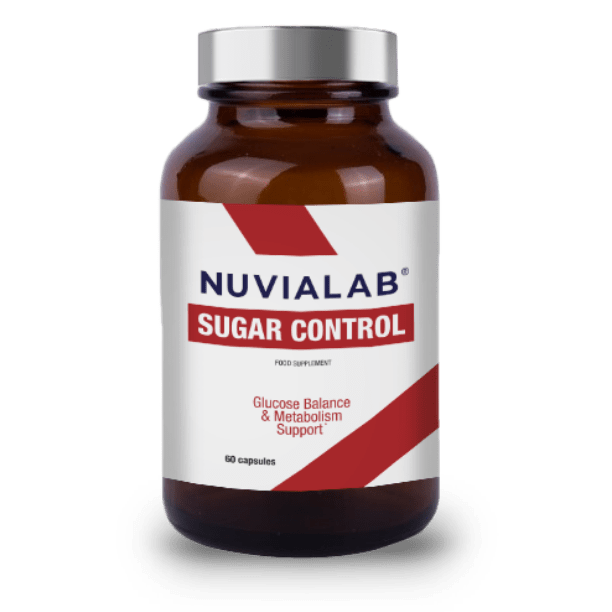
Our Recommendation — NuviaLab Sugar Control
Score: 5.2/10 · Best for: adults not on diabetes medication who know their numbers and want a fully disclosed formula they can judge with a follow-up blood test. Main caution: vitamin B6 at 14 mg a day exceeds EFSA's 12 mg upper limit, and the maker's panel warns people on insulin or oral hypoglycaemic drugs to consult a doctor first. Fair trial: three months — the three-bottle pack at $111.98 delivered covers one HbA1c cycle.
What Vitamin B6 Does — and Why More Stops Being Better
Vitamin B6 is a family of related compounds — pyridoxine on most labels — that the body converts to its active coenzyme form. That form participates in over a hundred enzyme reactions: amino-acid metabolism, neurotransmitter production, red-blood-cell formation. Adults need roughly 1.3–1.7 mg a day, and an ordinary diet supplies it without effort.
B6 is water-soluble, which generates the category's most durable myth: that excess is simply urinated away, making overdose impossible. The myth survives because it is half-true at dietary doses. At sustained high doses, the unconverted pyridoxine itself accumulates and becomes the problem — the vitamin's inactive form interfering with its own active form and injuring the sensory neurons it normally serves.
So B6 has a genuine ceiling, set by a specific organ system, with a specific injury at the end of it. The only question regulators have ever disagreed about is where the ceiling sits — and that disagreement is unusually large.
Why food reaches the requirement without help
Food-first is not a slogan here; it is arithmetic. The requirement sits at roughly the amount an ordinary mixed diet already supplies, which is why deficiency in people eating normally is uncommon. The body's need was never the gap supplements are filling.
An ordinary day's eating reaches the requirement through unremarkable foods eaten for other reasons. No single superfood, fortified product or careful plan is required. B6 is distributed widely enough through normal meals that reaching adequacy happens by accident, not design.
That changes what a supplement dose actually represents. It is not topping up a shortfall; it is adding a multiple of the requirement on top of a diet that already met it. The relevant comparison is therefore total intake, never the capsule alone.
It also explains why food has no overdose story attached to it. Meals deliver the vitamin diluted across a day, alongside everything else food contains, at dietary scale. Sustained excess in the case record is a manufactured-stack story, not a dinner story.
For most readers, then, the food-first conclusion is freeing rather than restrictive. Nothing needs to be bought, timed or stacked to meet the requirement. Attention belongs instead on the supplement column, where every milligram is a choice rather than a necessity.
None of this requires giving up supplements altogether. It requires knowing which ones carry a genuine need behind them and which are simply present. A requirement already met by food makes every additional milligram a question, not an automatic benefit.
The Injury: Peripheral Neuropathy
The injury was defined by excess itself. Schaumburg et al. 1983, in the New England Journal of Medicine, described patients who had taken gram-level doses — 2 to 6 grams a day — and developed a severe sensory neuropathy: numbness, burning, clumsiness, difficulty walking. The doses were enormous, but the paper established the mechanism's address: B6 toxicity attacks the dorsal root ganglia, the clusters of sensory nerve cells outside the spinal cord.
The pattern that matters at supplement doses is the same injury in miniature. Sensory nerves suffer first and worst: feeling degrades in the extremities while muscle strength is usually spared. Victims describe feet that feel wrapped, numb or burning, and an unsteady gait when proprioception — the sense of where the feet are — starts to fail.
Recovery after stopping is real but only partial, and it is slow. Some deficit can persist. That asymmetry — months to acquire, incomplete to reverse — is why regulators treat B6 differently from vitamins whose excess merely wastes money. The injury is not theoretical, and it does not fully forgive.
Why feeling suffers while strength is spared
The address given earlier explains the pattern. The dorsal root ganglia house the cell bodies of sensory neurons, the cells carrying feeling inward from skin, joints and feet. An injury centred there is, by anatomy, an injury to feeling first.
Motor neurons follow a different arrangement. The cells that command muscle sit protected inside the spinal cord itself, not out in the ganglia. That difference in address is why strength is usually spared while sensation degrades: the toxic exposure reaches one population first.
Position sense belongs to the sensory side of that divide, which is why balance suffers. Knowing where the feet are without looking is sensory information. When it fades, vision must substitute — and in the dark, or on uneven ground, substitution fails.
The longest sensory fibres are the most exposed, which orders the symptoms. Feeling for the feet travels the longest route in the body, so the feet report trouble first and hands follow later. The stocking-glove pattern is anatomy expressing itself, not coincidence.
This also clarifies what recovery has to accomplish. Sensory cell bodies and their long fibres must repair or adapt, over distances no other tissue asks of itself. Slow, incomplete recovery stops sounding mysterious once the geography of the injury is understood.
What Does Too Much Vitamin B6 Feel Like?
The early symptoms are easy to file under other causes: tingling and pins-and-needles in the fingers and toes, numbness that seems to come and go, a burning quality in the feet at night. The distribution is the classic stocking-glove pattern — longest nerves first, so feet before hands, symmetric on both sides.
As exposure continues, numbness becomes constant, balance suffers in the dark (where vision cannot substitute for foot position sense), and fine tasks — buttons, coins — get clumsy. Symptoms can persist for months after the supplement is stopped, which regularly convinces people the supplement was never the cause: they stopped, and nothing improved, so it must be something else.
For this site's audience, one confusion towers over the rest. Tingling, burning feet in a person with blood-sugar problems will be assumed — by the person, and sometimes by their clinician — to be diabetic neuropathy.
If the actual cause is the B6 in a blood-sugar supplement, the supplement continues, the "diabetic" symptom progresses, and the true cause is protected by its disguise. Anyone with new neuropathic symptoms who takes supplements should hand their clinician the full list, B6 doses included.
Why Do the US and European Limits Disagree — 100 mg vs 12 mg?
The US number: 1998, one study, a divisor of two
The American limit was set by the Institute of Medicine in 1998. Its derivation rested largely on a single occupational-exposure study, from which a no-observed-adverse-effect level of 200 mg/day was taken and divided by an uncertainty factor of just 2 — producing the 100 mg/day upper limit that still stands in the United States.
Read that again: the world's most permissive B6 limit rests substantially on one study and a safety divisor of two. It was a reasonable reading of a thin file in 1998. The file has not stayed thin.
The EFSA reset: 2023
EFSA's 2023 scientific opinion re-evaluated the dose-response relationship with decades more data. Its reference point was 50 mg/day, divided by an uncertainty factor of 4, yielding the 12 mg/day upper limit for all adults. The supporting record included surveillance experience — notably Dutch case series — in which neuropathy appeared at prolonged doses as low as about 24 mg/day, with case reports reaching down into the 12–21 mg/day band.
The disagreement, laid out this way, is not mysterious. The two limits were set twenty-five years apart, from different evidence bases, with different safety divisors. One of them has read the case reports from this century; the other predates most of them. Readers choosing which limit to organise their own intake around should know they are choosing between a 1998 file and a 2023 one.
The regulators still moving
The direction of travel is one-way. Germany's BfR has proposed capping B6 from supplements at levels under 1 mg/day. Australia's TGA requires warning labels above low thresholds. Health Canada has reviewed the nerve-damage signal at sustained doses around 10 mg/day and above. No regulator anywhere is moving toward the American number. Several are moving below the European one.
The Stacking Problem
Nobody takes "vitamin B6". They take products, each containing some. Worked arithmetic: a typical high-street B-complex delivers 50 mg. An energy drink adds about 10 mg. A magnesium-and-B6 sleep product adds about 25 mg. That ordinary stack totals roughly 85 mg a day — seven times the European limit, brushing the American one — assembled by someone who never made a single decision about vitamin B6.
B6 hides well: in energy drinks and fortified cereals, in "nerve support" and PMS formulas, in sleep and magnesium products, in every multivitamin. It is rarely the headline ingredient and never the reason for purchase, which is exactly how totals go uncounted.
Now place a 14 mg blood-sugar capsule into that stack. On its own it merely exceeds EFSA's limit. On top of a B-complex, it is invisible arithmetic — two more milligrams of nobody's attention, in a nerve-toxicity ledger kept entirely by default. The product did not create the stack. But its label is where the stack's existence should have been pointed out, and a score that ignores the 14 mg would be grading a fiction.
How to Audit Your Own Intake
The audit takes ten minutes and one rule: read labels, not front panels. List every product you take daily — multivitamin, B-complex, energy drinks, sleep and magnesium formulas, fortified cereals, and any condition-specific supplement like a blood-sugar or nootropic formula. Find the B6 line on each. Add the column.
Compare the total against both limits and decide which regulator's file you trust — this article has shown its reasoning for treating the 2023 European evaluation as the current state of knowledge. If the total surprises you, it surprised almost everyone the first time; that is the stacking problem working as designed.
Then ask a pharmacist the two questions labels cannot answer: which of these products do I actually need, and which B6 is simply riding along? In our experience of reading these panels, most stacks contain at least one product whose entire B6 contribution is decorative. Removing decoration is the cheapest risk reduction in this whole category.
A second worked example, step by step
Work a second example with a smaller, more ordinary stack. This reader takes no B-complex at all. The daily list is a magnesium-and-B6 sleep product, one energy drink, and the blood-sugar capsule already discussed throughout this article — nothing exotic, nothing extreme.
Now read the B6 lines exactly as the audit rule requires. The sleep product contributes about 25 mg. The energy drink contributes about 10 mg. The blood-sugar capsule contributes 14 mg. Each figure comes from its own label, not from the front panel.
Add the column slowly, because the total is the lesson. Twenty-five plus ten makes 35 mg before the capsule is even counted. Adding the capsule's 14 mg brings the supplement total to 49 mg a day — before anything eaten contributes at all.
Compare that total against both limits, as the audit instructs. Forty-nine milligrams is about four times the European limit, yet still only about half the American one. The same unremarkable stack is simultaneously far over one line and comfortably under the other.
Notice what this reader never did: choose a high B6 dose. No single product dominates the total, and removing any one product still leaves the stack above the European limit. That is why the audit counts everything, rather than hunting for one villain.
The practical fix follows the same arithmetic in reverse. Dropping the decorative product with the largest contribution changes the total most; swapping a fortified drink changes it least. The audit's value is that it shows which removal actually moves the number.
Our Verdict
How much vitamin B6 is too much? The defensible modern answer is EFSA's: above 12 mg a day, sustained, you are past the line the most recent full evaluation drew — and case reports put symptoms within reach of the teens and twenties of milligrams, not up at the gram doses of the original case series.
The American 100 mg limit is not a lie; it is an artefact — a 1998 reading of a thin file, preserved by inertia. Organising your intake by it in 2026 means preferring the older, smaller evidence base on purpose.
And the local lesson stands: two products on this store's own shelves carry 14 mg in a day's serving. We sell neither the dose nor the silence about it. Audit your stack; the arithmetic takes ten minutes and the nerves are yours.
Our Recommendation — NuviaLab Sugar Control
Score: 5.2/10 · Best for: adults not on diabetes medication who know their numbers and want a fully disclosed formula they can judge with a follow-up blood test. Main caution: vitamin B6 at 14 mg a day exceeds EFSA's 12 mg upper limit, and the maker's panel warns people on insulin or oral hypoglycaemic drugs to consult a doctor first. Fair trial: three months — the three-bottle pack at $111.98 delivered covers one HbA1c cycle.
Frequently Asked Questions
What is the safe daily limit for vitamin B6?
Two official answers exist. EFSA's 2023 tolerable upper limit is 12 mg/day for adults, including pregnancy and breastfeeding. The US limit, set in 1998, is 100 mg/day. Both target the same injury — sensory peripheral neuropathy. We treat the 2023 European evaluation as the current state of knowledge; this article shows the derivation of both numbers so you can judge.
What are the symptoms of too much vitamin B6?
Tingling, pins-and-needles and numbness in the hands and feet in a stocking-glove pattern, burning pain in the feet, and — when severe — an unsteady gait. Symptoms develop over months of excess and can persist after stopping, with recovery often only partial. In people with blood-sugar problems they are easily mistaken for diabetic neuropathy; tell your clinician about every supplement you take.
Is 14 mg of vitamin B6 a day dangerous?
It exceeds EFSA's 12 mg/day upper limit before food is counted — that is the factual statement. Case reports in the regulatory record describe neuropathy at prolonged doses in the 12–24 mg/day region, so 14 mg sits inside the band regulators now treat with caution, not in a zone anyone can call clearly safe. Stacked on a B-complex or multivitamin, the total goes far higher.
Can you overdose on B6 from food?
Effectively no. Ordinary diets provide roughly 1.3–1.7 mg a day — near requirement, nowhere near any limit — and neuropathy cases are supplement stories, not food stories. The exposure that matters is the manufactured stack: B-complexes, energy drinks, sleep and magnesium formulas, and condition-specific capsules, each adding a dose nobody totalled.
Why do supplements contain so much B6 if the limit is 12 mg?
Because labels were designed against the permissive 1998 American limit, because "1,000% of daily value" reads as potency on a panel, and because B6 is cheap. A 14 mg dose is legal in both jurisdictions and unremarkable by the standards of an industry that sells 50–100 mg B-complexes. Legality and a 2023 safety evaluation are simply measuring different things.
Last reviewed: October 2026. This article is educational and is not medical advice.
