
- Quick Answer
- Why Alpha Lipoic Acid Has a Real Trial Record at All
- What Drug-Style Development Does to the Evidence
- The SYDNEY Record: 600, 1,200 and 1,800 mg
- NATHAN 1: The Four-Year Trial That Missed
- Is 30 mg of Alpha Lipoic Acid Enough to Do Anything?
- The Second Bait-and-Switch: Neuropathy Trials, Glucose Shelf
- What If You Actually Want ALA?
- Reading an ALA Label Like an Auditor
- Our Verdict
- Frequently Asked Questions
- What is the correct alpha lipoic acid dosage?
- Is 30 mg of alpha lipoic acid effective?
- Did alpha lipoic acid work in long-term trials?
- What are alpha lipoic acid's side effects?
- Why do blood sugar supplements include alpha lipoic acid?
- Read This Next
Disclosure: This article contains affiliate links. If you buy through them, we may earn a commission at no extra cost to you. It never changes our conclusions.
Quick Answer
The alpha lipoic acid literature has the clearest dose consensus in this entire category: 600 mg a day. That figure comes from a real drug-development record — randomised trials in diabetic peripheral neuropathy, mostly German, mostly run by Ziegler and colleagues — testing 600, 1,200 and 1,800 mg, and finding that 600 mg captured the benefit while higher doses mostly added nausea.
Against that record, the label audited here — NuviaLab Sugar Control — contains 30 mg of alpha lipoic acid per daily serving. That is one-twentieth of the studied dose. And there is a second gap underneath the first: the 600 mg trials were about nerve pain symptoms in diagnosed diabetics, not about blood sugar.
The ingredient's presence on a blood-sugar capsule borrows a neuropathy drug's reputation at 5% of its dose. Both gaps are documented below, with the trials' own numbers — including the famous one's missed endpoint.
Best for: readers who want to see how a dose audit works when the literature is unusually honest. Not for: anyone expecting 30 mg of anything to reproduce a 600 mg drug record.
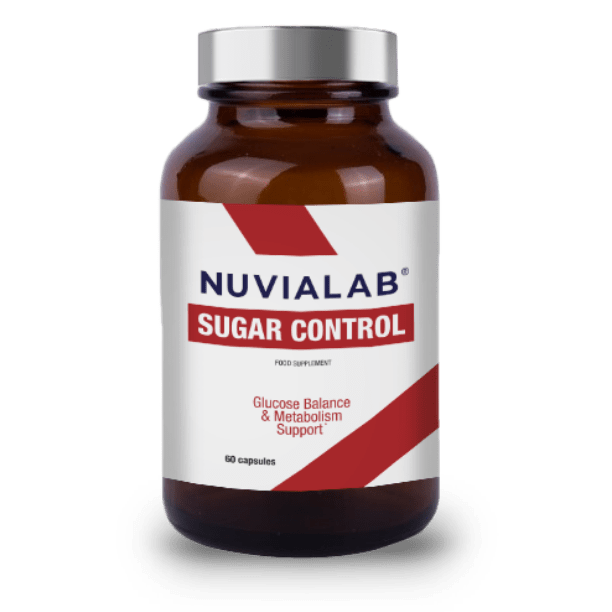
Our Recommendation — NuviaLab Sugar Control
Score: 5.2/10 · Best for: adults not on diabetes medication who know their numbers and want a fully disclosed formula they can judge with a follow-up blood test. Main caution: vitamin B6 at 14 mg a day exceeds EFSA's 12 mg upper limit, and the maker's panel warns people on insulin or oral hypoglycaemic drugs to consult a doctor first. Fair trial: three months — the three-bottle pack at $111.98 delivered covers one HbA1c cycle.
Why Alpha Lipoic Acid Has a Real Trial Record at All
Most supplement ingredients have folk literature. Alpha lipoic acid (ALA) has something rarer: a pharmaceutical history. In Germany, ALA has been used for decades as a licensed treatment for diabetic peripheral neuropathy — nerve damage from diabetes — which meant regulated trials, defined doses, and endpoints a drug regulator would accept. That history is why its record can be audited like a drug's.
The story those trials tell is coherent. ALA is a potent antioxidant cofactor; diabetic nerve damage involves oxidative stress; high-dose ALA over weeks improves neuropathic symptom scores versus placebo. Doses across the programme ran from 600 mg to 1,800 mg a day, by infusion and orally. The trials were run in diagnosed diabetics with symptomatic neuropathy — a defined patient population, not wellness consumers.
Hold onto the population and the endpoint. Neuropathy symptoms. Diagnosed diabetics. Six hundred milligrams. Every word matters when the ingredient turns up, at 30 mg, on a blood-sugar blend marketed to the worried well — the second bait-and-switch this article documents.
What Drug-Style Development Does to the Evidence
It is worth spelling out what that pharmaceutical history buys a reader, because the difference is not prestige — it is structure. A drug-development programme has to decide, in advance and in writing, what question each trial answers: which patients, which dose, which endpoint, over how long. Those decisions are recorded before the results arrive, which is what stops the results from quietly choosing the question afterwards.
Dose-ranging is the clearest example. A supplement literature typically tests whatever dose the maker chose and reports whether it beat placebo; a drug programme tests several doses against each other, which is how this record could discover that benefit plateaued while nausea kept climbing. Without the higher arms, nobody would know where the useful dose ended. With them, 600 mg is a finding, not a guess.
Defined endpoints do similar work. A symptom score chosen in advance, in a defined population, gives a later reader something checkable: the trial can succeed or fail against its own stated target. That is precisely what allows NATHAN 1, later in this article, to be described as having missed — a sentence that is only possible when a programme writes its targets down before shooting.
Regulation is the third leg. A licensed treatment is manufactured to a stated content, batch after batch, so the substance in the trial is the substance on the shelf — the assumption supplement labels ask buyers to make on trust. None of this guarantees a drug programme's conclusions are right. It guarantees they are auditable, which is why this ingredient's gaps can be measured instead of suspected.
Notice, finally, what this structure does to failure. In a folk literature, a disappointing trial can be ignored and the ingredient's story continues unchanged. In a programme like this one, the four-year miss is part of the record permanently — citable, checkable, and impossible to unpublish. Evidence that can record its own failures is the only kind whose successes deserve full weight.
The SYDNEY Record: 600, 1,200 and 1,800 mg
SYDNEY 2 (Ziegler et al. 2006, Diabetes Care) is the dose-finding centrepiece: 181 patients with diabetic neuropathy randomised to oral ALA at 600, 1,200 or 1,800 mg/day, or placebo, for five weeks. Total symptom scores improved by roughly half in the ALA groups — about 51% — against about 32% on placebo. All three doses performed similarly; the higher doses added adverse effects, notably nausea, without adding benefit.
That plateau is the finding the entire category should print: 600 mg was not the minimum effective dose discovered by marketing — it was the point beyond which more did nothing except cost tolerability. The earlier SYDNEY programme (Ziegler et al. 2003, Diabetes Care) rhymes: total symptom score improvements of 5.7 points on treatment against 1.8 on placebo with intravenous-then-oral regimens built around the same 600 mg scale.
Notice what even these good trials measured: symptom scores — pain, burning, numbness as reported by patients — over five weeks. Not nerve regeneration, not glucose control, not HbA1c. An honest citation of SYDNEY sounds like: "600 mg a day eased diabetic nerve symptoms by about half versus a third on placebo, over five weeks." Anything grander is decoration.
NATHAN 1: The Four-Year Trial That Missed
The record's credibility is completed by its failure, and we print it because borrowers never do. NATHAN 1 (Ziegler et al. 2011, Diabetes Care) followed patients for four years on 600 mg/day of oral ALA — the long-term test the short symptom trials demanded. Its primary endpoint, a composite of clinical and neurophysiological measures, did not significantly improve versus placebo. Secondary endpoints did.
A missed primary endpoint means the trial failed the question it was designed to answer. The fair summary of the whole ALA record is therefore: genuine short-term symptom relief in diabetic neuropathy at 600 mg; unproven long-term disease modification even at 600 mg. That is a respectable drug record — and it is the record in full, not the brochure version.
It also disciplines the dosage question in both directions. If 600 mg for four years could not move the primary endpoint, the idea that 30 mg in a blend accomplishes anything measurable in any population is not a small extrapolation. It is a different claim entirely — one with no trial behind it at all.
Is 30 mg of Alpha Lipoic Acid Enough to Do Anything?
No evidence says so, and the arithmetic is stark. Thirty milligrams is one-twentieth of 600 mg. It is below the lowest doses used anywhere in the serious literature. There is no 30 mg trial — not for neuropathy, not for glucose, not for anything. The dose exists in exactly one place: this label.
The full formula audit sits on our NuviaLab Sugar Control product page, where the 30 mg line is one of the findings behind the 5.2 score. In fairness, the pattern is category-standard, and this maker at least prints the number. Competitors using proprietary blends hide doses entirely, which is worse: an unauditable label borrows the same reputation with no arithmetic available to check it against.
Why would a formulator include 30 mg? Because the ingredient's name carries the record, and names are what panels sell. Thirty milligrams is not a pharmacological decision; it is a typographical one — the dose at which "contains alpha lipoic acid" becomes true, and truth-in-labelling does the rest.
The buyer's job is to notice that a true sentence ("contains ALA") and a supported claim ("the ALA studied at 600 mg") are different sentences sharing an ingredient.
The Second Bait-and-Switch: Neuropathy Trials, Glucose Shelf
Even the dose gap understates the borrowing, because the endpoint differs too. SYDNEY and NATHAN tested nerve symptoms in diagnosed diabetics. They did not test blood-sugar lowering as their question; ALA's glucose reputation is a secondary glow from metabolic studies and mechanistic work, never the headline of its big trials.
Sugar Control is sold for blood sugar. Its ALA line therefore borrows twice: a neuropathy literature, applied to a glucose purpose, at one-twentieth of the dose. Remove either borrowing and the line has nothing left — which is precisely why both are necessary to the marketing and why audits must check dose and endpoint as a pair.
Our efficacy hub applies the same two-part test to every ingredient in the formula; ALA is simply the cleanest failure, because its real literature is good enough to make the gaps measurable.
What If You Actually Want ALA?
Then the honest product conversation is a different one. A person with diabetic neuropathy symptoms belongs in a clinician's office first — neuropathy has causes and staging that matter — and if ALA enters that conversation, it enters at the studied 600 mg, as a single-ingredient product, with SYDNEY's nausea warning and NATHAN's missed endpoint both on the table.
Reading an ALA Label Like an Auditor
The label arithmetic itself deserves a slow pass, because this is where blend habits mislead. Labels state amounts two different ways: per capsule and per serving, and a serving may be more than one capsule. The only number that can be compared with the trial record is the total amount swallowed in a day. Every comparison that skips that conversion is comparing unlike quantities.
Run the conversion on this article's two numbers and the gap stops being abstract. The studied dose is 600 mg a day. The blend audited here delivers 30 mg in its daily serving. A buyer would need twenty of those daily servings to assemble one studied day — at which point they would also be taking twenty servings of everything else on the panel, including ingredients with limits of their own.
The single-ingredient route avoids that trap by construction. One ingredient, one stated amount per capsule, and a serving instruction the buyer can multiply honestly: capsules per day times milligrams per capsule, set against the 600 mg the trials used. If the product's daily total cannot reach the studied figure at its directed serving, the product is not a lower-dose version of the evidence. It is a different purchase.
Two smaller label habits complete the audit. Check whether the amount is printed at all — a proprietary blend that hides it fails before arithmetic begins, as this article noted earlier. And check the amount against the record's tolerability story as well as its benefit story: the doses above 600 mg in SYDNEY 2 added nausea without benefit, so 'more than studied' is not a bonus. It is the same error, sign reversed.
For blood sugar itself, ALA has no dose at which evidence supports it as the intervention. Spending on a 30 mg line item inside a blend is buying the most expensive way to receive the least ALA: the blend's price buys nine reputations at fractions of nine doses.
Single ingredients at studied doses — where studied doses exist — are the only form in which this category's purchases can be defended, and our side-effect file covers what even defensible doses require in caution.
Our Verdict
Alpha lipoic acid is the rare supplement ingredient with a drug-grade record: 600 mg a day eases diabetic nerve symptoms short-term; more adds nausea, not benefit; four years at 600 mg missed its primary endpoint. Printed whole, that record earns respect. Printed selectively — a name, no dose, no endpoint — it earns a 30 mg line on a blood-sugar label.
The distance between those two uses is the whole subject of this site. Sugar Control at least publishes its 30 mg, letting the audit be arithmetic instead of suspicion. One-twentieth of a neuropathy dose, for glucose, is not a supplement fact. It is a label decoration with an excellent bibliography.
Our Recommendation — NuviaLab Sugar Control
Score: 5.2/10 · Best for: adults not on diabetes medication who know their numbers and want a fully disclosed formula they can judge with a follow-up blood test. Main caution: vitamin B6 at 14 mg a day exceeds EFSA's 12 mg upper limit, and the maker's panel warns people on insulin or oral hypoglycaemic drugs to consult a doctor first. Fair trial: three months — the three-bottle pack at $111.98 delivered covers one HbA1c cycle.
Frequently Asked Questions
What is the correct alpha lipoic acid dosage?
For the purpose it was actually trialled for — diabetic neuropathy symptoms — the studied dose is 600 mg a day. SYDNEY 2 tested 600, 1,200 and 1,800 mg and found similar symptom improvement at all three, with more nausea at the higher doses, making 600 mg the record's answer. For blood sugar, no dose has trial support: the glucose claim borrows the neuropathy literature's reputation.
Is 30 mg of alpha lipoic acid effective?
There is no trial at 30 mg for any endpoint. It is one-twentieth of the 600 mg used in the SYDNEY and NATHAN studies and below every dose in the serious literature. A 30 mg inclusion makes the sentence "contains alpha lipoic acid" true; it does not connect the product to anything the ingredient demonstrated. We score it as label decoration.
Did alpha lipoic acid work in long-term trials?
Partially, with an honest failure included. NATHAN 1 ran 600 mg/day for four years and missed its primary endpoint — a composite of clinical and nerve-function measures — while secondary endpoints improved. Short-term symptom relief at 600 mg is supported; long-term disease modification is not proven even at full dose. Any citation of ALA that omits NATHAN 1 is quoting selectively.
What are alpha lipoic acid's side effects?
In the trials, nausea was the dose-related effect — the reason 1,200 and 1,800 mg offered no advantage over 600 mg. At blend doses like 30 mg, effects of any kind are unlikely, which is the same statement as the efficacy finding. Because ALA has genuine metabolic activity at real doses, the combination cautions in our metformin and insulin guide apply to full-dose products, not to decorations.
Why do blood sugar supplements include alpha lipoic acid?
Because it is diabetes-adjacent and genuinely studied — as a neuropathy drug, at 600 mg. A blood-sugar blend borrows that record twice over: a different endpoint (glucose instead of nerve symptoms) at a fraction of the dose (30 mg instead of 600). The ingredient's name is the transferable asset; the evidence is not.
Last reviewed: October 2026. This article is educational and is not medical advice.
