
- Quick Answer
- Can a Blood Sugar Supplement Replace Medication?
- The Blend Problem: Why Single-Ingredient Trials Don't Transfer
- One capsule, walked through all three failure modes
- Bitter Melon: A Real Signal Inside Weak Trials
- Gymnema: The Best Story Rests on Old, Open Trials
- Cinnamon, Chromium and the Supporting Cast
- The Ingredient Borrowing a Drug's Reputation
- How Long Before a Supplement Works — and How Would You Know?
- Why one good morning proves nothing
- When Should You Take One?
- Our Verdict
- Frequently Asked Questions
- Can a blood sugar supplement replace metformin or insulin?
- How long does a blood sugar supplement take to work?
- Which ingredient has the best evidence?
- When is the best time to take a blood sugar supplement?
- Is the zinc in a blood sugar formula useful?
- Read This Next
Disclosure: This article contains affiliate links. If you buy through them, we may earn a commission at no extra cost to you. It never changes our conclusions.
Quick Answer
Ingredient by ingredient, the honest summary of this entire category is: modest effects, low-certainty evidence, and not one blend ever tested as sold. Individual ingredients — bitter melon, gymnema, cinnamon, chromium — show small glucose improvements in pooled trials. The pooled effects are fractions of a percentage point of HbA1c at best, the certainty grades are low, and no study has ever given volunteers the nine-ingredient capsule a shopper actually buys.
One boundary comes first, before any ingredient gets its hearing: no — a blood sugar supplement cannot replace medication. Not insulin, not metformin, not anything prescribed. The evidence for that answer and the rest of this audit follow, ingredient by ingredient, with the product in our own shop — NuviaLab Sugar Control, 5.2/10 — audited by the same standard.
Best for: unmedicated adults with borderline readings who want a measured, self-monitored nudge alongside diet. Not for: anyone whose glucose is currently managed by a drug. That population's article is the safety one, linked below, not this one.
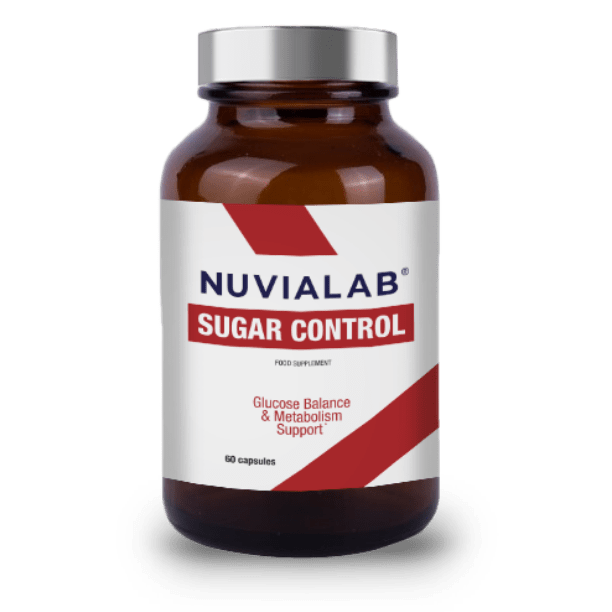
Our Recommendation — NuviaLab Sugar Control
Score: 5.2/10 · Best for: adults not on diabetes medication who know their numbers and want a fully disclosed formula they can judge with a follow-up blood test. Main caution: vitamin B6 at 14 mg a day exceeds EFSA's 12 mg upper limit, and the maker's panel warns people on insulin or oral hypoglycaemic drugs to consult a doctor first. Fair trial: three months — the three-bottle pack at $111.98 delivered covers one HbA1c cycle.
Can a Blood Sugar Supplement Replace Medication?
No — and the category's own anecdotes show what happens when someone tries. A published case describes an insulin-treated patient who stopped insulin in favour of gymnema and bitter melon; he was recorded with glucose around 350 mg/dL during a heart attack, and his clinician's summary has become the sentence this whole genre should be printed with: "Gymnema and bitter melon cannot replace insulin."
The pharmacology agrees with the anecdote. Insulin replaces a missing hormone; no botanical does that. Metformin suppresses liver glucose output with a potency supplements do not approach. A capsule whose ingredients show small pooled effects in borderline populations is not a substitute for either — it is a different order of intervention entirely.
If you are medicated and considering any product in this category, the governing document is our metformin and insulin safety guide, which quotes one maker's own label warning in full. This article is for the unmedicated reader only.
The Blend Problem: Why Single-Ingredient Trials Don't Transfer
Every efficacy claim in this category is borrowed. A trial tests one ingredient, at one dose, in one population; a blend then inherits the claim by association. The inheritance fails three ways: the blend's dose is usually lower than the trial's; the other eight ingredients may help, hinder or do nothing; and interactions inside the capsule are unstudied by definition.
Sugar Control illustrates the pattern precisely. Its strongest ingredient records belong to other products: bitter melon's trials used grams of powder, gymnema's used a studied extract over 18 months, alpha lipoic acid's famous 600 mg record belongs to a neuropathy drug literature. The blend borrows all three reputations at a fraction of all three doses.
So the question "do blood sugar supplements work?" decomposes into: do the ingredients do anything at trial doses (sometimes, modestly), and does the blend deliver those doses (usually not). Both halves get their hearing below.
One capsule, walked through all three failure modes
Walk one capsule through the three failure modes in order. Take the formula audited throughout this article: nine ingredients, every dose printed, each carrying a reputation earned somewhere else. The walk shows how a true trial result becomes a weak label implication.
Failure one is dose. The bitter melon trials used grams of powder a day; the capsule lists 500 mg of extract. The cinnamon trials used grams; the capsule lists 100 mg. Whatever those trials found, they did not find it at these amounts.
Failure two is company. In its trials, each ingredient performed alone, against a comparison group, under observation. In the capsule it performs alongside eight others, none of whose interactions with it have been studied. Company can help, hinder or cancel; nobody knows which.
Failure three is purpose, and alpha lipoic acid carries it alone. Its trials treated nerve symptoms at 600 mg a day; the capsule offers 30 mg for glucose support. The reputation crossed purposes and shrank twentyfold in the same journey between literatures.
Gymnema survives the walk better than the rest, which is instructive. Its label amount sits at the bottom of its studied range, so failure one barely applies. Failures two and three — untested company, add-on evidence — still apply in full.
The walk's conclusion is not that the capsule does nothing. It is that nobody can honestly say what it does, because each borrowed claim lost something different in transit. Three separate leaks explain why blend confidence should always trail ingredient confidence.
Notice that none of the three failures requires bad faith. A maker can print honest doses, cite real trials and still sell a blend whose combined effect is unknown. The gap is structural: trials are funded and designed ingredient by ingredient, while products are sold combination by combination.
Bitter Melon: A Real Signal Inside Weak Trials
Bitter melon has the category's most substantial recent synthesis. A 2025 meta-analysis in Metabolism Open (Mkhize et al.; PMC12630335) pooled 25 randomised trials and found statistically significant improvements: fasting glucose SMD −0.46, HbA1c SMD −0.57, insulin resistance (HOMA-IR) −0.52 — with the certainty graded low to very low.
Against it, a 2024 review in Frontiers in Nutrition (PMC10808600) read much of the same literature and concluded the glucose effect cannot be determined. Both reviews are honest; the literature is genuinely that unsettled. The Cochrane tradition adds the third voice: insufficient evidence to recommend it.
Then the dose problem. Trials used 2–4 grams a day of bitter melon powder. Sugar Control's label lists 500 mg of a branded extract standardised to charantin — a different material at a fraction of the studied mass, with no honest conversion between them. Our bitter melon deep-dive lays out the whole file, including the trial where the drug arm separated from the botanical arms and the botanicals did not separate from each other.
Gymnema: The Best Story Rests on Old, Open Trials
Gymnema's founding study is Baskaran et al. 1990: 400 mg a day of the GS4 extract for 18–20 months in 22 type 2 patients, as an add-on to their existing drugs, after which five patients were controlled on GS4 alone. It is quoted everywhere.
What is quoted less: the trial was open-label, had no placebo arm, and its patients kept their medication — so "five came off drugs" happened under supervision, inside a design that cannot isolate gymnema's contribution.
Gymnema also carries the category's one delightful mechanism: its acids block sweet taste receptors — on direct oral exposure. A capsule swallowed with water may never trigger it, which makes the famous "sugar destroyer" effect partly irrelevant to capsule products. Our gymnema audit holds both halves.
The dose note is the kindest in this formula: Sugar Control's 200 mg of a GS4-lineage extract sits at the bottom of the studied 200–400 mg range. One ingredient, roughly at a studied dose, on old uncontrolled evidence. That is the strongest true sentence available for any component — and it is a measured one.
Cinnamon, Chromium and the Supporting Cast
Cinnamon's literature contradicts itself at scale: an umbrella review of 21 meta-analyses finds significant fasting-glucose improvement, a dose-response meta-analysis finds null overall effects, and Cochrane's review finds a subgroup effect indistinguishable from zero. All three are summarised in our cinnamon analysis. The trials used grams of powder; the label in question uses 100 mg of extract. Whatever cinnamon does, it does it — if at all — at doses the capsule does not contain.
Chromium has the most interesting file: a real 1997 trial (Anderson et al.) at real doses, a pooled estimate with a catch (11 of 14 interventions null), and a label that lists 200 µg without stating the chemical form the trial used. Our chromium audit argues the dose is genuine and the form is unknowable — a fairer verdict than most ingredients here earn.
The remainder are supporting cast. White mulberry's 1-deoxyjirimycin slows carbohydrate digestion after meals — a plausible mechanism with thin human data, here at 100 mg. Green tea contributes 100 mg of extract, 40 mg of it EGCG — hundreds of milligrams below the catechin doses in the weight-and-glucose literature.
Zinc's 15 mg is a reference-intake dose in a public whose zinc status is rarely the constraint. Each ingredient is real. None is present at the scale its literature describes.
Mulberry deserves its mechanism stated plainly. Slowing carbohydrate digestion after a meal does not lower glucose overall; it spreads the same glucose over more time. A flatter, slower rise is a narrower claim than a lower total, and the distinction decides what the ingredient could plausibly deliver even if its thin human data strengthened considerably.
Green tea's problem is purely one of scale. The extract amount present is real, and its catechin content is honestly stated, but the literature being borrowed from worked at a scale this serving does not approach. An ingredient can be genuine, disclosed and still functionally decorative when the studied amounts and the served amounts describe different exposures altogether.
Zinc follows a different logic from both, because it is a nutrient with a status, not a drug with a dose-response promise. Correcting a genuine shortfall is useful; adding more on top of adequacy has no mechanism to offer. Since status is rarely measured, most buyers cannot know which of those two situations their purchase actually addresses.
The Ingredient Borrowing a Drug's Reputation
Alpha lipoic acid deserves its own paragraph because its borrowing is the boldest. Its evidence base — SYDNEY 2, NATHAN 1 and the rest — is a diabetic neuropathy literature, at 600 mg a day, in diagnosed diabetics, for nerve symptoms.
It is a glucose product's label only by adjacency: a diabetes-adjacent compound with real trials, transferred to a blood-sugar capsule at 30 mg — one-twentieth of the studied dose, for a purpose the trials never tested.
Our ALA dose audit prints the whole record, including NATHAN 1's missed primary endpoint, which the borrowing never mentions. When one ingredient's presence on a label is explained entirely by another literature's success, the label is decorating itself — and decoration is a marketing cost charged to the buyer's credulity.
How Long Before a Supplement Works — and How Would You Know?
The measurement biology answers the first half. HbA1c reflects roughly three months of glucose exposure, because it is a property of red blood cells with a ~120-day lifespan. Any verdict before about three months is a verdict about noise. The meta-analyses agree structurally: they pool trials of 8–12 weeks, because shorter trials cannot move the endpoint that matters.
How you would know is the second half, and it is a discipline, not a feeling: baseline HbA1c before starting, no other simultaneous changes you can avoid, repeat HbA1c at three months, and a threshold decided in advance for what counts as working. Fasting readings can supplement the picture. Energy, sleep and "feeling better" cannot — they are unblinded, and this category's entire retail model runs on them.
A maker or review that promises results in two weeks is describing a timeline on which the effect cannot be measured even if it exists. Treat the promise as information about the promiser.
Why one good morning proves nothing
Fasting readings feel precise because they arrive as a single clean number. They are not. A fasting value is one sample from a moving system, taken after one particular night, one particular evening meal and one particular quality of sleep.
Almost everything about the previous day leans on that number. A later or larger evening meal, a restless night, an early alarm, brewing illness or unusual activity can each nudge the morning value up or down without anything about treatment changing.
The body adds its own morning movement on top. Glucose regulation follows daily rhythms, and the hours around waking involve hormonal shifts that raise glucose as part of normal physiology. A fasting reading therefore mixes the supplement question with ordinary morning biology.
This is why a single encouraging morning proves nothing. One low reading can be a quiet night, a lighter dinner or simple variation wearing the supplement's colours. The same logic protects against despair: one high reading is equally incapable of delivering a verdict.
Patterns are the smallest unit of honest evidence here. Readings gathered the same way, across many mornings, with meals and routine held roughly steady, can show a direction. Even then, they support the three-month HbA1c verdict rather than replacing it with daily impressions.
The discipline is unglamorous: same timing, same conditions, written down. A notebook of ordinary mornings will outperform a memory of remarkable ones every time, because memory keeps the extremes and discards exactly the typical days a fair judgement needs most.
This variability is also why changing routine mid-trial is so costly. A new diet, a new walking habit and a new capsule started together produce one combined result that no notebook can separate afterwards. The trial stays readable only while everything else holds still.
When Should You Take One?
The honest answer begins with a silence. Sugar Control's label — as audited on our product page — states a serving of two capsules with about 300 ml of water and does not state a time of day.
The competitor page that answers "morning" is inventing it; the sales page's timing hints are not directions. We report the silence rather than filling it, because a fabricated protocol attached to a real product is how review sites quietly become marketing departments.
What can be said at category level: with food is gentler on the stomach for botanical formulas generally; consistency matters more than clock time for any three-month trial; and one product at a time is what makes the trial readable. Beyond that, the label is the protocol — and where the label is silent, so are we.
Our Verdict
Do blood sugar supplements actually work? The ingredients do small, real things in imperfect trials. The blends deliver those ingredients at smaller, unmatched doses and have never been tested as sold. The expected value of a purchase is a modest nudge for an unmedicated reader running a measured trial — and nothing at all, with added risk, for a medicated one.
Within the category, Sugar Control earns its 5.2 for the quality of its paperwork rather than the strength of its formula: a full disclosed panel is the only reason this audit could be written. Most competitors cannot be audited at all. Buy auditable products, measure at three months, and let the HbA1c — not the marketing — deliver the verdict.
Our Recommendation — NuviaLab Sugar Control
Score: 5.2/10 · Best for: adults not on diabetes medication who know their numbers and want a fully disclosed formula they can judge with a follow-up blood test. Main caution: vitamin B6 at 14 mg a day exceeds EFSA's 12 mg upper limit, and the maker's panel warns people on insulin or oral hypoglycaemic drugs to consult a doctor first. Fair trial: three months — the three-bottle pack at $111.98 delivered covers one HbA1c cycle.
Frequently Asked Questions
Can a blood sugar supplement replace metformin or insulin?
No. The strongest supplement ingredients show small pooled effects in borderline populations; insulin replaces a hormone and metformin suppresses liver glucose output at a potency no capsule approaches. A published case records an insulin user who switched to gymnema and bitter melon presenting with glucose around 350 mg/dL during a heart attack. Medication changes belong to clinicians.
How long does a blood sugar supplement take to work?
Judge at three months, not before. HbA1c reflects about three months of glucose exposure, and the meta-analyses pool 8–12-week trials for the same reason. Measure a baseline HbA1c first, change nothing else you can avoid, retest at three months, and decide in advance what change counts as working. Anything promised in two weeks cannot be measured even if real.
Which ingredient has the best evidence?
Bitter melon has the deepest recent synthesis — a 2025 meta-analysis of 25 trials found significant pooled effects, graded low-to-very-low certainty — but a 2024 review concluded the effect cannot be determined. Gymnema's studied extract roughly matches one label dose, on old open-label trials. Chromium's 200 µg is a genuinely studied dose, in a form the label does not state. "Best" here means least weak.
When is the best time to take a blood sugar supplement?
For Sugar Control, the label does not say: it specifies two capsules with about 300 ml of water and no time of day, and we report that silence rather than inventing a protocol. Generally, taking botanical formulas with food is gentler, and consistency across a three-month trial matters more than the hour chosen.
Is the zinc in a blood sugar formula useful?
At 15 mg it is a reference-intake dose — appropriate if your status is low, decorative if it is not, and rarely measured either way. Zinc form and amount comparisons are covered in our zinc forms guide. It is a panel's supporting cast, not a reason to buy the formula.
Last reviewed: October 2026. This article is educational and is not medical advice.
