
- Quick Answer
- What Is Gymnema — and Why 'Sugar Destroyer'?
- The Sweet-Taste Effect: What Is Actually Established
- What the Trick Would Mean in Practice
- The Two Trials Underneath Everything
- Baskaran 1990 — the founding study
- The companion trial
- The Meta-Analysis That Compares Gymnema to Itself
- The Dose Comparison
- The Capsule Problem: Swallowing the Sugar Destroyer
- A Test That Works on Any Botanical
- Interactions, and Who Should Not
- Our Verdict
- Frequently Asked Questions
- Does gymnema really block sugar taste?
- What did the gymnema trials actually show?
- Is 200 mg of gymnema a real dose?
- Can gymnema replace diabetes medication?
- Is there a meta-analysis supporting gymnema?
- Read This Next
Disclosure: This article contains affiliate links. If you buy through them, we may earn a commission at no extra cost to you. It never changes our conclusions.
Quick Answer
Gymnema sylvestre — gurmar, the "sugar destroyer" — has the most romantic mechanism in the blood-sugar category: its acids genuinely block sweet taste. Its clinical file, though, is two small open-label trials from 1990 and a meta-analysis whose pooled comparison is before-and-after, not against placebo. Everything since has been commentary on those.
And yet gymnema produces this formula's single kindest audit finding. The studied extract is GS4, used at 200–400 mg a day; the label of NuviaLab Sugar Control lists 200 mg of GS4 PLUS®, an extract of the same lineage. For once, a label dose sits inside its own literature's range — at the bottom of it, on old, uncontrolled evidence. That is the strongest honest sentence available, and it is a heavily qualified one.
Best for: readers who want the one ingredient whose dose roughly matches its trials. Not for: anyone reading "five patients came off their drugs" without the words "open-label, add-on, uncontrolled" attached — they are attached below, in the same sentences as the results, where they belong.
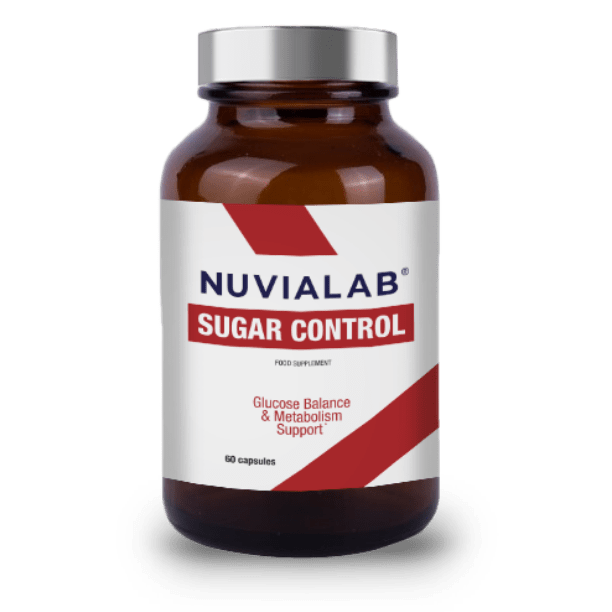
Our Recommendation — NuviaLab Sugar Control
Score: 5.2/10 · Best for: adults not on diabetes medication who know their numbers and want a fully disclosed formula they can judge with a follow-up blood test. Main caution: vitamin B6 at 14 mg a day exceeds EFSA's 12 mg upper limit, and the maker's panel warns people on insulin or oral hypoglycaemic drugs to consult a doctor first. Fair trial: three months — the three-bottle pack at $111.98 delivered covers one HbA1c cycle.
What Is Gymnema — and Why 'Sugar Destroyer'?
Gymnema sylvestre is a climbing plant of Indian and African traditional medicine, where its Hindi name gurmar translates as "sugar destroyer". The name is earned by a real, demonstrable party trick: chew the leaves, or hold a gymnema preparation in the mouth, and sweet foods temporarily lose their sweetness — sugar tastes like sand for a period afterwards.
The mechanism is receptor-level and specific. Gymnemic acids, the leaf's active saponins, block sweet taste receptors on the tongue. This is not folklore; it is reproducible pharmacology, and it is the reason gymnema has attracted serious research interest for decades as a possible tool against sugar consumption itself.
Note the condition hiding in the mechanism, though, because much of this article hangs on it: the receptors are on the tongue. The effect requires direct oral exposure — leaf, lozenge, tea, mouth rinse held in contact. What happens when gymnema arrives in a swallowed capsule is a different question, and we will come back to it.
The Sweet-Taste Effect: What Is Actually Established
Beyond the tongue, gymnema's proposed systemic mechanisms — supporting insulin secretion, slowing intestinal glucose absorption — are plausible pathways drawn largely from animal and mechanistic work. They are reasons researchers keep studying the plant. They are not clinical findings, and the distance between a receptor story and an HbA1c result is the distance this category habitually skips.
The honest stratification: sweet-receptor blockade on oral exposure — established. Appetite and craving effects from that blockade — suggested, commercially exaggerated. Systemic glucose effects at capsule doses — resting on the two 1990 trials below and not much else. Anyone selling gymnema should be able to tell you which layer their claim sits on. Almost none do.
There is also a subtlety the marketing never mentions: a person who cannot taste sweetness may compensate, consciously or not, with quantity or with fat and salt. Behaviour around a blocked sense is not automatically healthier behaviour. The receptor trick is real; what it does to a whole diet over months is a separate, thinner literature.
What the Trick Would Mean in Practice
Take the established layer seriously for a moment and ask what using it would actually involve. The blockade happens in the mouth, so the formats that can deliver it are the ones that linger there: a lozenge allowed to dissolve slowly, a tea sipped and held, a preparation chewed. Contact time is the dose. A format swallowed in seconds gives the receptors seconds, whatever the label's milligram count says.
Used that way, the plausible benefit is narrow and behavioural: a sweet food that tastes flat is easier to stop eating, and a drink that tastes like sand is easier to leave unfinished. That is a claim about a single eating occasion, in the minutes while the blockade lasts. Stretching it into a claim about body weight or blood sugar over months requires the further, unproven step that occasions add up.
The compensation worry deserves the same practical treatment. A person whose dessert tastes of nothing may simply choose a different pleasure — a larger portion of something savoury, a second helping justified by the first one's disappointment. Nothing in the receptor mechanism forbids that trade. The mechanism blocks one taste; appetite, habit and the rest of the menu remain fully operational around it.
None of this makes the effect worthless. It makes it specific: a short-lived change in how sweet food tastes, available only in mouth-contact formats, with whole-diet consequences that nobody has measured well. A buyer who wants that specific thing can at least shop for the right format. A buyer who wants glucose control is shopping for a different claim entirely — the one the next sections weigh.
The Two Trials Underneath Everything
Baskaran 1990 — the founding study
Baskaran et al. 1990, in the Journal of Ethnopharmacology, gave 400 mg/day of the GS4 gymnema extract to 22 type-2 diabetic patients for 18–20 months, as an add-on to their existing conventional treatment. Blood sugar control improved across the group, conventional drug requirements fell — and five patients were ultimately controlled on GS4 alone, the figure engraved on a thousand product pages.
Now the qualifiers, in the same breath as the result, because they are part of the result: the trial was open-label; there was no placebo group and no control arm; every patient kept their medication at the start, so gymnema's isolated contribution cannot be separated from the drugs, the monitoring, or eighteen months of intensified care.
Five patients coming off drugs under supervision, inside that design, is a hypothesis — an interesting one — not a demonstration.
The companion trial
The same research lineage published a companion study the same year (Shanmugasundaram et al. 1990, also in the Journal of Ethnopharmacology): a gymnema preparation given to 27 insulin-treated patients, in whom insulin requirements fell. Same strengths — a real clinical population, a real extract, a meaningful duration. Same structural limits: open, uncontrolled, add-on. The two trials rhyme because they share a design, and the design is the ceiling on what either can prove.
Reviewers have been fair to this file. Natural Standard's 2011 monograph on gymnema (Journal of Dietary Supplements) concluded that the evidence merits further study — which, three decades after the founding trials, is itself the verdict: the follow-up rigorous trial has still not been run.
The Meta-Analysis That Compares Gymnema to Itself
A 2021 meta-analysis attempted the modern synthesis: 10 studies, 419 participants, pooled improvements in blood sugar measures. A casual reader files it as confirmation. Read the methods and the file changes character: the pooled comparison is before-and-after within gymnema groups, without a placebo comparator. It establishes that people's readings changed while taking gymnema — which uncontrolled 1990s designs already suggested — and cannot establish that gymnema caused the change.
The heterogeneity statistic seals it: I² values of 80–99% mean the included studies disagree with each other almost completely, so the single pooled number describes no study actually in the pool. We describe this synthesis without attaching authors or journal deliberately: its design flaw is the finding, and naming it would lend an authority its methods do not support.
Before-and-after pooling is the standard failure mode of supplement meta-analysis — it converts a pile of weak designs into one strong-looking number. When a product page cites "a meta-analysis of 10 studies", this is usually the object being cited.
The Dose Comparison
Here the audit finally gets to be kind. The studied range across the GS4 literature is 200–400 mg/day. Sugar Control's label lists 200 mg of GS4 PLUS® — a branded extract of the same GS4 lineage — per daily serving. The label dose is the bottom rung of the studied range, not a homeopathic whisper beneath it, and the extract is of the type the trials actually used.
Set that against this site's other dose audits — bitter melon at a fraction of trial mass in a different material, alpha lipoic acid at one-twentieth of its studied dose, cinnamon in milligrams against grams — and gymnema is the formula's honourable exception: a dose a trialist would recognise, attached to evidence a trialist would not.
The full panel, including where the formula's other ingredients fall, is audited on our NuviaLab Sugar Control product page.
One caveat keeps the sentence honest: "bottom of the range" matters. The most-quoted result — Baskaran's five patients — occurred at 400 mg, double this label's dose, alongside medication. The label matches the literature's floor, not its headline.
The Capsule Problem: Swallowing the Sugar Destroyer
Now return to the tongue. The sweet-blocking effect — gymnema's best-established action and its entire nickname — requires the gymnemic acids to contact sweet receptors in the mouth. The trials' preparations and traditional use involve exactly that exposure.
Sugar Control is a capsule, directed to be swallowed with about 300 ml of water. Whatever a capsule does systemically, it cannot reproduce the oral mechanism: the acids pass the tongue sealed in gelatin and dissolve downstream of the receptors they are famous for blocking. The "sugar destroyer" effect, in this delivery format, is structurally unavailable.
This is a category-wide quietness, not one product's fault — nearly every gymnema product is a capsule trading on a lozenge's mechanism. But a buyer choosing gymnema for the craving effect should know they are buying the one format that cannot deliver it, and that any craving benefit they feel is arriving by some other, unmeasured route — or by expectation.
A Test That Works on Any Botanical
The capsule problem generalises, and it is worth stating as a test any buyer can run on any botanical in any shop. First, name the mechanism the marketing leans on — not the promised outcome, the mechanism. Then ask where in the body that mechanism has to happen. Finally, ask whether the format being sold ever takes the ingredient there. Three questions, no expertise required.
Botanicals fail this test in predictable places. A mechanism described at a surface — the tongue, the gut lining, the skin — cannot be assumed to survive being routed past that surface in a sealed capsule. A mechanism demonstrated with one preparation cannot be assumed for another preparation of the same plant. The plant's name survives every one of these changes. The mechanism often does not.
Marketed claims rarely volunteer which side of the test they sit on, because the famous mechanism is usually the one from the traditional or experimental format, while the sold format is chosen for shelf life and convenience. Neither choice is dishonest by itself. The dishonesty — where it exists — is in letting the buyer assume the two formats are one product wearing different clothes.
Gymnema's capsule is simply the cleanest illustration because the geography is unarguable: the receptors are in the mouth, and the capsule's contents are released beyond them. Most format questions are murkier than that. But the test does not require certainty to be useful — it requires only that the buyer notice when a claim's mechanism and a product's format have never been introduced.
Interactions, and Who Should Not
Gymnema sits squarely inside the additive-risk rule. Its entire proposed action is glucose-lowering; combined with insulin or oral hypoglycaemic drugs, it adds an unmeasured effect to measured ones. The maker of Sugar Control prints the governing sentence on its panel — "In people using insulin therapy or oral hypoglycaemic drugs consult a use of the product with a doctor" — and our combination guide explains the reasoning in full.
Gymnema also anchors the category's starkest cautionary case, retold in our efficacy hub: a patient who stopped insulin for gymnema and bitter melon, recorded at glucose around 350 mg/dL during a heart attack, with his clinician's verdict that the herbs cannot replace insulin. The five-patients-off-drugs headline and this case are the same coin; only one side gets printed on labels.
Our Verdict
Gymnema is a fascinating plant with a genuine receptor trick, a 35-year-old open-label evidence base, and a modern meta-analysis that compares it to itself. Its founding results are permanently inseparable from the drugs and supervision they occurred alongside.
Within a weak category, though, it holds one distinction: at 200 mg of a GS4-lineage extract, this label reaches the floor of the studied range with the studied type of extract — the only ingredient in the formula of which that can be said.
We score the difference between "the dose matches" and "the evidence convinces" as the difference between this paragraph and a recommendation. The first is true. The second still awaits a trial nobody has run since 1990.
Our Recommendation — NuviaLab Sugar Control
Score: 5.2/10 · Best for: adults not on diabetes medication who know their numbers and want a fully disclosed formula they can judge with a follow-up blood test. Main caution: vitamin B6 at 14 mg a day exceeds EFSA's 12 mg upper limit, and the maker's panel warns people on insulin or oral hypoglycaemic drugs to consult a doctor first. Fair trial: three months — the three-bottle pack at $111.98 delivered covers one HbA1c cycle.
Frequently Asked Questions
Does gymnema really block sugar taste?
Yes — on direct oral exposure. Gymnemic acids block sweet taste receptors on the tongue, which is the origin of the name gurmar, "sugar destroyer". The catch for capsule products is structural: a capsule swallowed with water never presents the acids to those receptors, so the famous effect is unavailable in the format most gymnema is sold in, including Sugar Control.
What did the gymnema trials actually show?
Baskaran et al. 1990 gave 22 type-2 patients 400 mg/day of GS4 extract for 18–20 months as an add-on to their medication; control improved and five patients were eventually managed on GS4 alone. The trial was open-label with no placebo group, so gymnema's isolated effect cannot be separated from the drugs and supervision surrounding it. A same-year companion trial in insulin-treated patients rhymes: requirements fell, same design limits.
Is 200 mg of gymnema a real dose?
It is the bottom of the studied range — the GS4 literature used 200–400 mg/day, and Sugar Control's 200 mg is of the same extract lineage, which makes it this formula's best-matched ingredient. But the headline result (five patients off medication) occurred at 400 mg alongside drugs, and the underlying evidence is open-label. A matched dose is not the same as proven efficacy.
Can gymnema replace diabetes medication?
No. The five-patients finding happened under supervision, as an add-on, in an uncontrolled trial — not as a substitution anyone tested. The same herbs appear in a published case of an insulin user who stopped his insulin for gymnema and bitter melon and presented with glucose around 350 mg/dL during a heart attack. Substitution is the one use the evidence actively warns against.
Is there a meta-analysis supporting gymnema?
There is one from 2021 pooling 10 studies and 419 participants — but it pools before-and-after changes without a placebo comparator, with heterogeneity (I²) of 80–99%, meaning the studies barely agree with each other. It shows readings changed while people took gymnema; it cannot show gymnema caused the change. We describe it without citation because its design flaw is the finding.
Last reviewed: October 2026. This article is educational and is not medical advice.
