
- Quick Answer
- Why the Combination Is the Risk
- Two glucose-lowering inputs, one bloodstream
- Why metformin-alone differs from insulin and sulfonylureas
- The GI stack
- An unmeasured dose cannot be titrated
- The Warning on a Real Label, Word for Word
- Insulin Specifically
- What Are the Signs Your Blood Sugar Has Dropped Too Low?
- The One Audience This Doesn't Apply To — and Its Own Catches
- How to Raise It With Your Doctor
- What the appointment itself involves
- Before Adding Another: Check What Is Already in the House
- Our Verdict
- Frequently Asked Questions
- Can I take a blood sugar supplement with metformin?
- Why is insulin a stronger warning than metformin?
- What does low blood sugar feel like?
- I have prediabetes and take no medication. Does this warning apply to me?
- My supplement's FAQ says it has no side effects. Should I believe it over the warning?
- Read This Next
Disclosure: This article is educational and is not medical advice. If you take medication for blood sugar, the decisions discussed here belong with your doctor.
Quick Answer
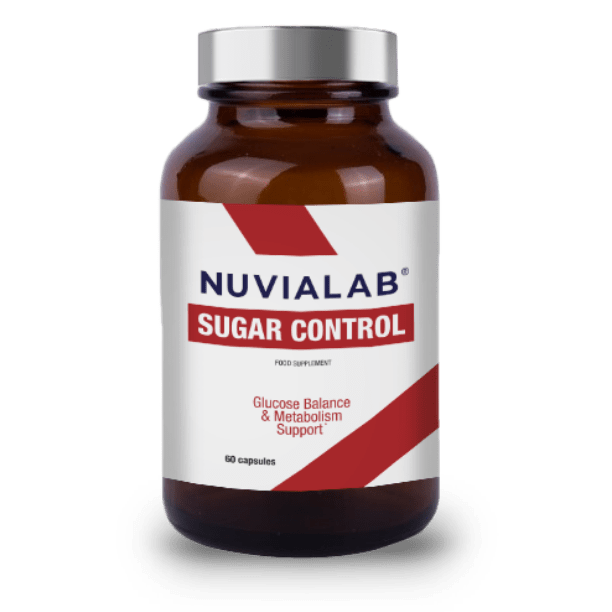
If you use insulin or any oral blood-sugar drug, do not combine it with a blood-sugar supplement on your own judgement. That answer is not ours alone — it is printed on a real product's label, and it is worth quoting word for word: "In people using insulin therapy or oral hypoglycaemic drugs consult a use of the product with a doctor."
The warning comes from the caution panel of NuviaLab Sugar Control, repeated in that maker's own footer. Metformin is an oral hypoglycaemic drug, so it sits inside the warning's scope — as do insulin and the sulfonylurea family. No supplement in this category can be named as safe to combine with them, by us or by anyone, because the combination has never been tested.
The reason is arithmetic, not alarm: two glucose-lowering inputs act on one bloodstream. Whether the addition is trivial or dangerous depends on the drug, the dose and the person — which is precisely why the label routes the question to a doctor rather than answering it.
Why the Combination Is the Risk
Two glucose-lowering inputs, one bloodstream
A blood-sugar supplement is sold on one promise: that its ingredients lower glucose. Bitter melon, gymnema, cinnamon, chromium — the entire category's marketing rests on glucose effects. A reader cannot simultaneously believe the ingredients work and believe they cannot interact with a drug designed to do the same thing.
If the ingredients are inert, there is no benefit to combine. If they are active, the combination is additive by definition. The category wants both beliefs at once; a medicated reader cannot afford either half of that bargain unexamined.
Why metformin-alone differs from insulin and sulfonylureas
The drugs are not interchangeable, and neither is the risk. Metformin lowers glucose mainly by reducing the liver's glucose output and does not stimulate insulin secretion — used alone, it rarely causes low blood sugar. That is the most forgiving profile in this discussion, and it is still inside the maker's warning.
Insulin changes the picture entirely: it lowers glucose directly, dose-dependently, with no internal off-switch — which is why insulin users already live with hypoglycaemia as a managed risk. Sulfonylureas sit between: they push the pancreas to release insulin, and they are the oral family most associated with lows. Adding a supplement's uncontrolled glucose effect on top of either is adding an unmeasured dose to a measured one.
The GI stack
The second interaction is undramatic and common. Metformin is well known for gastrointestinal side effects — nausea, loose stools, stomach upset — especially when started. Blood-sugar formulas bring their own digestive load: botanical extracts, chromium and bitter compounds. Stack the two and the predictable result is a miserable gut, which then gets misread: is it the drug, the supplement, or the combination? Nobody can tell, which is itself the problem.
An unmeasured dose cannot be titrated
A prescription dose can be titrated because it is known. A clinician chooses an amount, watches the readings it produces, and adjusts it in deliberate steps. Each change is recorded, so cause and effect can be separated when the pattern shifts unexpectedly.
A supplement dose cannot be handled that way. The label states an intended amount, but the amount reaching the bloodstream on a given day is not measured, not logged, and not adjusted against a reading in the way a drug dose is.
Batch variability sharpens the problem. Botanical material varies with growing conditions, harvest and extraction, and a capsule is a manufactured average of that variation. Two bottles carrying the same label can therefore deliver noticeably different exposures without anything being wrong with either bottle.
That variability matters most on ordinary days. A stronger batch taken on a day of smaller meals, more activity or missed food does not announce itself in advance. The drug dose stays fixed while the supplement contribution quietly moves underneath it.
This is why telling a clinician the product name is not enough. The useful information is the full panel, the stated amounts, how consistently it is taken, and when it was started. Without that timeline, an unexplained low looks like a drug problem alone.
Titration also depends on consistency, and supplement use is rarely consistent. Capsules are skipped on busy days, doubled after a worrying reading, or paused when the stomach objects. Each irregularity is another unrecorded change in an exposure nobody is tracking systematically.
None of this proves a particular combination will cause harm. It proves something narrower and more useful: the size of the added effect cannot be known in advance, cannot be held steady, and cannot be reconstructed afterwards from the label alone.
The practical consequence is a different standard of proof. A drug interaction can be looked up because someone measured it; a supplement interaction usually cannot. Decisions about unmeasured combinations therefore belong where unmeasured risk is managed professionally: with the prescribing clinician.
The Warning on a Real Label, Word for Word
Here is the caution panel's sentence again, because it deserves more weight than anything a review site writes: "In people using insulin therapy or oral hypoglycaemic drugs consult a use of the product with a doctor." The maker repeats it in the page footer. It is the single most responsible sentence in that product's paperwork.
Notice what it does not say. It does not say "consult a doctor if you feel unwell", or "use caution". It names two treatment categories — insulin therapy, oral hypoglycaemic drugs — and routes everyone in them to a physician before use. A maker's own warning outranks every review site's reassurance, including the same maker's FAQ, which elsewhere claims the product causes no side effects at all.
It is also worth being precise about what kind of interaction data does not exist.
Pharmacist references grade supplement–drug interactions pair by pair, and for most of this formula's ingredients against metformin, no pair record exists — berberine is the exception with a file of its own, covered as further reading in our berberine review. For bitter melon, gymnema and the rest, the absence of a grade is not evidence of safety. It is evidence the combination was never studied.
Insulin Specifically
For insulin users the answer is the shortest in this article, and the label gives it: "In people using insulin therapy or oral hypoglycaemic drugs consult a use of the product with a doctor." Insulin therapy is named first in the warning, and there is nothing to add that would soften it responsibly.
Insulin dosing is a calibrated balance against meals, activity and readings. A supplement introduces an uncalibrated variable into that balance — taken irregularly, at uncontrolled potency, with no way to know its contribution on a given day. If glucose then falls, neither the user nor their clinician can reconstruct why, because one of the inputs was never measured.
So: only with your doctor is the whole answer. Not "probably fine at a low dose", not "many people do it". The maker's label, our editorial position and basic pharmacology all land on the same sentence.
What Are the Signs Your Blood Sugar Has Dropped Too Low?
Anyone combining glucose-lowering inputs — deliberately or accidentally — should know this list cold. The NHS's hypoglycaemia guidance gives the early symptoms: hunger, dizziness, sweating, shaking, tingling lips, palpitations, irritability and confusion. A reading below 70 mg/dL (3.9 mmol/L) is low, whether or not symptoms have arrived.
Severe hypoglycaemia is a different event: slurred speech, clumsiness, confusion progressing to seizure or unconsciousness. At that point the person cannot treat themselves, and it is an emergency for the people around them. This is the outcome the additive-risk argument is actually about — not a mild wobble, but a low that arrives faster and deeper than the drug alone was calibrated to produce.
The standard immediate response, as MedlinePlus's hypoglycaemia guidance sets out, is the 15-gram rule: take about 15 grams of fast-acting carbohydrate — glucose tablets, juice, regular soda — wait 15 minutes, recheck, and repeat if still low. Then eat properly once readings recover. Anyone on insulin or a sulfonylurea should have this protocol from their own care team already; a supplement must never be the reason it gets used for the first time.
The One Audience This Doesn't Apply To — and Its Own Catches
There is exactly one defensible user for this product class: an adult with prediabetes-range readings who takes no glucose-lowering medication at all. For that reader, the additive-risk argument has nothing to add to, and a measured self-trial — baseline readings, one product, a three-month HbA1c — is a coherent experiment.
Even that reader inherits the label's other catches, and Sugar Control's is specific: the formula delivers 14 mg of vitamin B6 per day, which exceeds EFSA's tolerable upper limit of 12 mg/day before anything from food is counted. Long-term B6 excess is linked to peripheral neuropathy — tingling and numbness that, in a diabetes-adjacent audience, can be mistaken for diabetic nerve damage. Our B6 limit explainer runs the full audit.
The boundary is medication, and it is bright. The moment a prescription enters the picture — metformin included — this reader stops being the unmedicated audience and becomes the warning's audience. There is no intermediate category, and no supplement label creates one.
How to Raise It With Your Doctor
If you are medicated and still interested, the conversation is short and concrete. Bring the full ingredient panel — amounts included, which this label at least publishes — your complete medication list, and recent readings. Ask one question: does adding this change my hypoglycaemia risk or my monitoring?
Bring the maker's warning too. A doctor who sees that the label itself routes you to them will understand the question instantly. What the conversation should never produce is a dose adjustment to the drug to "make room" for the supplement. The drug is the measured, evidenced intervention; the supplement is the variable. Variables get removed when readings misbehave — drugs get adjusted only on medical grounds.
And if you are already combining, say so. Clinicians cannot manage an interaction they do not know exists, and unexplained lows in a medicated patient trigger investigations that a disclosed supplement might have answered in one sentence.
What the appointment itself involves
Expect the appointment to start with readings, not opinions. Recent fasting values, any episodes that felt like lows, meal patterns and activity all shape the answer. A product discussed without that context can only receive a cautious, general answer in return.
The questions worth asking are specific. Does this change how often readings should be checked? Should any check move to a different time of day? At what reading, or with which symptoms, should the product be stopped and the clinic contacted?
A doctor may respond by tightening monitoring rather than giving a simple yes or no. More frequent checks for a defined period, a lower threshold for reporting symptoms, or a review sooner than planned are all ways of making an unknown visible.
That response should not be heard as permission to experiment freely. It is a monitoring plan built around uncertainty, designed so that if readings drift, the drift is caught early and the supplement, not the prescription, is the first thing removed.
Do not open the conversation by arguing that the product is natural, and therefore gentle. Natural describes an origin, not a dose, an effect or a safety record. The ingredients are being considered precisely because they are claimed to act on glucose.
The stronger opening is the honest one: the label itself advises this conversation. That framing gives the clinician something concrete to judge — the panel, the warning and your readings — instead of a general debate about supplements in the abstract.
Bring readings in the form you actually keep them. A meter log, an app history or a notebook all work, provided dates and times survive. Averages remembered from memory hide exactly the dips and patterns the clinician needs to see.
Leave with the monitoring decision written down. Note what was agreed about checking, what symptoms trigger a call, and when the next review happens. If nothing was agreed to change, that is also a decision worth recording before leaving.
Before Adding Another: Check What Is Already in the House
Combination risk rarely arrives as one dramatic pairing. More often it accumulates quietly, because the house already holds products bought for other reasons. A glucose-active ingredient inside a general formula is still glucose-active when a second product joins it later.
So before adding anything new, gather what is already being taken. Read each panel in full, not just the front of the bottle, and note every ingredient the category markets for glucose: the botanicals, the minerals and the extracts alike.
Duplicates are the finding to watch for. The same botanical can appear in a blood-sugar product, a weight product and a general wellness blend under slightly different names. Three modest exposures to one active ingredient are still one combined exposure in the body.
Write the combined list down before any purchase. One page holding every product, its stated amounts and its start date turns a vague memory into something checkable. That page is also exactly what a pharmacist or doctor needs if readings change.
Apply the same check in reverse whenever something is stopped. Removing one product changes the total exposure just as adding one did, and readings that improve or worsen afterwards belong to the whole stack, not to whichever bottle changed last.
This habit costs nothing and requires no expertise beyond reading panels carefully. It also prevents the most common self-deception in this category: judging each product as if it were the only one being taken, when the body experiences them together.
Pay particular attention to products that were never bought for blood sugar at all. Glucose-active botanicals travel widely through general formulas, and a product filed mentally under energy, weight or wellness can still contribute to the same combined glucose effect.
The check takes minutes and it changes the question being asked. Instead of whether one new product looks safe alone, the question becomes whether the whole existing stack leaves room for it. That second question is the medically relevant one.
Our Verdict
Can you take blood sugar supplements with metformin or insulin? The only honest version of the answer is the one printed on the product: consult a doctor — with insulin and sulfonylureas at the serious end of the warning, and metformin inside it, not exempted from it.
Nothing in this category has been tested in combination with the drugs its buyers most often take. The additive mechanism is real, the hypo symptoms are knowable, and the maker's warning is unambiguous. The readers for whom these products make sense are the unmedicated — and for everyone else, the first dose of any blood-sugar supplement should be a conversation.
Frequently Asked Questions
Can I take a blood sugar supplement with metformin?
Only with your doctor's agreement. Metformin is an oral hypoglycaemic drug, which puts it squarely inside the maker's own panel warning: "In people using insulin therapy or oral hypoglycaemic drugs consult a use of the product with a doctor." Metformin alone rarely causes lows, but the combination with a glucose-lowering formula is untested, and the digestive side effects stack.
Why is insulin a stronger warning than metformin?
Insulin lowers glucose directly and dose-dependently, with no internal off-switch; its users already manage hypoglycaemia risk daily. Metformin works mainly by reducing liver glucose output and rarely causes lows on its own. Adding an unmeasured glucose-lowering supplement to insulin disturbs a calibrated balance; adding it to metformin is a lesser risk — but still one the label routes to a doctor.
What does low blood sugar feel like?
Early signs include hunger, dizziness, sweating, shaking, tingling lips, palpitations and confusion; below 70 mg/dL is low. Severe episodes bring slurred speech, confusion, seizure or unconsciousness and are emergencies. The standard first response is about 15 g of fast-acting carbohydrate, recheck after 15 minutes, and repeat if still low.
I have prediabetes and take no medication. Does this warning apply to me?
The combination warning does not — there is no drug to combine with. But read the rest of any label before buying: Sugar Control, the product whose warning anchors this article, delivers 14 mg of vitamin B6 a day, above EFSA's 12 mg/day upper limit before food. Unmedicated does not mean catch-free; it means the catches are the formula's own.
My supplement's FAQ says it has no side effects. Should I believe it over the warning?
No. Believe the caution panel. Sugar Control's FAQ claims the product "does not cause any side effects" while its panel carries the medication warning, a do-not-exceed instruction and an above-limit B6 dose. When a maker's documents disagree, the cautious one is the credible one — a principle we apply to every label on this site.
Last reviewed: October 2026. This article is educational and is not medical advice.
