
- Quick Answer
- The Anderson 1997 Trial
- What the Pooled Literature Did to That Result
- How Eleven Nulls and One Ladder Average Out
- Why Populations Decide Chromium's Answer
- Chromium in Food, and the Test Nobody Runs
- The Label in Front of You
- Three Questions for Any Mineral Line
- Safety and the Wider Ledger
- Our Verdict
- Frequently Asked Questions
- How much chromium did the Anderson study use?
- Does chromium lower blood sugar?
- Why does the chromium form matter?
- Is 200 µg of chromium safe?
- Should I take chromium for prediabetes?
- Read This Next
Disclosure: This article contains affiliate links. If you buy through them, we may earn a commission at no extra cost to you. It never changes our conclusions.
Quick Answer
Yes — 200 µg of chromium is a real dose, and this article exists partly to say so. In 1997, Anderson and colleagues randomised 180 people with type 2 diabetes to chromium picolinate at 200 µg/day, at 1,000 µg/day, or to placebo, for four months.
The 200 µg arm's HbA1c fell from 8.5% to 7.5%; the 1,000 µg arm reached 6.6%; placebo did not move. A label listing 200 µg is standing on the ladder's bottom rung — a rung that exists.
The caveats arrive immediately, because they are structural. Later pooling found 11 of 14 chromium interventions null or non-significant. And the label audited here — NuviaLab Sugar Control — lists "Chromium 200 µg" without stating the chemical form. Anderson's trial used picolinate. Whether this label's chromium is the molecule that produced those numbers is, from the panel as printed, unknowable. Dose: genuine. Form: unstated. Evidence since 1997: mostly null. All three sentences are the answer.
Best for: readers who want one ingredient in this category whose dose survived an audit. Not for: anyone treating a 1997 single-population trial as settled science.
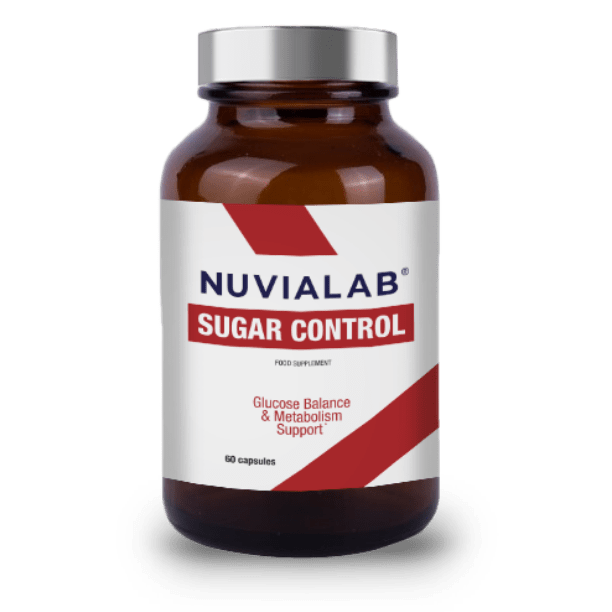
Our Recommendation — NuviaLab Sugar Control
Score: 5.2/10 · Best for: adults not on diabetes medication who know their numbers and want a fully disclosed formula they can judge with a follow-up blood test. Main caution: vitamin B6 at 14 mg a day exceeds EFSA's 12 mg upper limit, and the maker's panel warns people on insulin or oral hypoglycaemic drugs to consult a doctor first. Fair trial: three months — the three-bottle pack at $111.98 delivered covers one HbA1c cycle.
The Anderson 1997 Trial
Richard Anderson's 1997 trial (Diabetes) remains chromium's centrepiece nearly three decades later, and its design explains why. One hundred and eighty Chinese patients with type 2 diabetes were randomised to chromium picolinate 200 µg/day, chromium picolinate 1,000 µg/day, or placebo, over four months — a dose-ranging structure most supplement trials never attempt.
The HbA1c results, as reported in the subsequent review literature (including the World Journal of Diabetes 2014 assessment, PMC3990317), form a clean dose ladder: placebo stayed at 8.5%; the 200 µg arm fell from 8.5% to 7.5%; the 1,000 µg arm fell from 8.5% to 6.6%. Glucose and insulin measures moved in the same direction, more strongly at the higher dose.
A dose-response gradient inside one trial is the strongest internal evidence a single study can offer — biology usually respects ladders. It is also, so far, nearly the only one: chromium's subsequent history is the story of other researchers, in other populations, failing to climb the same ladder.
What the Pooled Literature Did to That Result
Balk et al. 2007, in Diabetes Care, performed the meta-analysis the field needed: randomised trials of chromium in diabetes, pooled. The headline estimate was an HbA1c improvement of −0.6% (95% CI −0.9 to −0.2) — significant, and roughly a drug-adjacent effect size if it were robust.
The catch is printed in the same paper's anatomy: 11 of the 14 interventions pooled were individually null or non-significant. A significant pooled effect built mostly of null trials means the estimate is carried by a minority of positive studies — prominently Anderson's — and is exactly as strong as they are. The World Journal of Diabetes 2014 review drew the blunt conclusion its title states: chromium does not belong in the diabetes treatment arsenal.
How Eleven Nulls and One Ladder Average Out
It is worth slowing down on the arithmetic of that pooling, because a significant average built from mostly null parts confuses readers in a predictable way. A meta-analysis does not count votes. It averages effect sizes, weighted toward the larger and more precise studies, so a minority of positive trials can carry the pooled figure above the significance line while most individual trials sit below it.
Picture the pool as this article's own numbers describe it: fourteen interventions, eleven returning null or non-significant results, and one famous trial returning a full-point HbA1c ladder. The average of that collection is not a typical result from it. It is a compromise between a striking result in one population and quiet non-results elsewhere — a number that describes no actual group of patients particularly well.
This is also why the heterogeneity footnote matters so much. When one pooling leaves Anderson out because its results differ too much from the rest to combine honestly, the remaining pool loses its carrier. The estimate that survives such surgery is the one a reader should picture as typical: small, uncertain, and compatible with the quiet results that made up most of the file all along.
None of this accuses the pooled figure of being fabricated. It is a correct average of the trials that exist. The question is what a correct average of a lopsided file entitles a buyer to expect, and the honest answer is: whatever the typical trial found, not whatever the average says. In this file the typical trial found nothing significant. That sentence and the −0.6% headline are both true.
Althuis and colleagues' earlier pooling in the American Journal of Clinical Nutrition adds the methodological footnote: Anderson's data were omitted from one analysis for heterogeneity — the trial's results were too different from everyone else's to pool honestly — and even within Anderson, the 200 µg arm's glucose changes versus control were equivocal, with the cleaner separation at 1,000 µg. The ladder is real in one trial and elusive everywhere else.
Why Populations Decide Chromium's Answer
The standard explanation for the split is nutritional. Chromium is a trace element; supplementation plausibly helps people whose status is low and does nothing for the replete. Anderson's 1997 Chinese cohort ate a diet and carried a chromium status unlike a modern Western supplement buyer's. If chromium corrects deficiency, trials in replete populations should be null — and mostly, they are.
Chromium in Food, and the Test Nobody Runs
Start with the unglamorous default: chromium arrives in ordinary food. It is a trace element distributed through a normal mixed diet — whole foods, grains, vegetables, the general traffic of eating — rather than a nutrient concentrated in a few famous sources. That distribution is part of the story. A nutrient that trickles in from everywhere is rarely missing in a dramatic, diagnosable way.
Status, meanwhile, is a measurement the system almost never makes. There is no routine chromium test in ordinary care, no familiar deficiency syndrome sending patients to be checked, and no standard panel line for it the way there is for the nutrients clinicians actually track. So the variable that the population logic says decides everything — the buyer's own status — is the variable nobody, buyer or seller, actually knows.
That ignorance is not neutral; it shapes what a purchase is. Buying chromium without a status measurement is not correcting a known gap — it is betting that a gap exists. The mostly-null pooled record is what that bet looks like when it is placed, in trial form, on populations eating ordinary diets: the bet usually loses, quietly, at the cost of the supplement rather than the health.
The food-first conclusion writes itself, and it is the same conclusion this series keeps reaching from different directions. A varied diet is the default chromium source the trials' logic assumes; supplementation is the correction for a shortfall, not an upgrade to adequacy. Where no shortfall has been shown, the supplement is solving a problem the buyer has not established they have.
One consequence deserves stating plainly, because sellers rarely state it. If status decides the answer and status goes unmeasured, then honest chromium marketing would have to be conditional — 'this may help if your status is low' — and conditional claims do not fit on a capsule panel. The unconditional claim on the label is not evidence that the condition was checked. It is evidence that it was skipped.
This is the same logic our zinc forms guide applies to that mineral: element supplementation is a deficiency-correction tool pretending to be a drug. It predicts small, population-dependent effects — and it means the buyer's own status, almost never measured, is the hidden variable in every chromium purchase.
Regulators have noticed the same pattern. Chromium's authorised claims in Europe are for the maintenance of normal blood glucose — a nutritional framing, at nutritional doses — not for treating elevated glucose in diabetics. The distance between those two sentences is the distance between Anderson's population and yours.
The Label in Front of You
Sugar Control's panel lists chromium at 200 µg per daily serving — and stops. The form is not published. This matters more than it might appear: chromium supplements are sold as picolinate, nicotinate, chloride, polynicotinate and others, with different absorption profiles, and Anderson's ladder was built specifically with picolinate. A panel that names the element and the mass but not the molecule has told you the dose of an unspecified substance.
Our product page records this precisely — see the full audit on our NuviaLab Sugar Control review — because the honest finding is double. On dose-matching, chromium joins gymnema as one of this formula's two defensible lines: 200 µg is a studied quantity, not label confetti like the 30 mg alpha lipoic acid audited in our ALA article. On form disclosure, the panel fails the standard its own dose invites.
The contrast is worth sitting with. This is the same label that publishes every other ingredient's amount — a genuinely transparent panel by category standards — and the one line where chemical identity carries the entire evidence base is the line left incomplete. Transparency is not a vibe; it is per-ingredient, and chromium is where this panel's runs out.
Three Questions for Any Mineral Line
Chromium's incomplete line suggests a test a reader can carry to any mineral on any panel, and it has exactly three questions. What is the element? What is its chemical form? How much of it is there? A mineral line that answers all three can be audited against whatever trial record exists. A line that answers two has located its own gap, precisely, for you.
Each question guards a different failure. The element question sounds too basic to ask, yet blends regularly blur it inside proprietary totals. The amount question is the dose audit this whole series performs: a quantity can be compared with what trials used, as 200 µg was compared here. The form question is the one most often skipped — and, as this article shows, sometimes the one carrying the evidence.
Apply the three questions to this panel and the pattern from earlier paragraphs sharpens. The element is named: chromium. The amount is named: 200 µg, and it matches a studied quantity. The form is missing — and with it goes the ability to connect the first two answers to Anderson's ladder, which was built with one specified form and has never been re-run, rung for rung, with the others.
The test costs nothing and generalises beyond minerals: any ingredient whose identity, form and amount are all printed can be checked; any ingredient missing one of the three is asking for trust at exactly the point where checking was possible. Makers choose which lines complete the test. On this panel, most lines pass it. Chromium's does not, and the exception is the finding.
Safety and the Wider Ledger
At 200 µg, chromium's safety record in trials is unremarkable in the good sense — the dose sits within ranges regulators have reviewed without alarm for the general population.
It is not the risk line of this formula; that position belongs to the vitamin B6 above its European limit, audited in our B6 explainer, and to the medication-combination question in our metformin and insulin guide — where chromium, as a glucose-active ingredient, sits under the same doctor-warning as everything else in the capsule.
High-dose chromium picolinate has its own historical debates (genotoxicity questions around the picolinate ligand at large doses in vitro), which never reached concern at dietary-supplement doses in regulatory reviews — but which are, again, form-specific. A buyer cannot even locate themselves in that debate when the label withholds the form.
Our Verdict
Is 200 µg of chromium a real dose? Yes — the only mineral question in this series with so clean an answer. Anderson 1997 tested exactly it, in a dose ladder, with a full HbA1c point of movement. Deliberate fairness matters in an audit series: after articles measuring 20-fold gaps and borrowed literatures, this ingredient's dose is what it claims to be.
And then the audit continues, because it must: the pooled record is mostly null, the flagship trial's population is not the typical buyer, one pooling excluded Anderson for heterogeneity, and this label does not state whether its chromium is even the picolinate Anderson used.
A real dose of an unspecified form, backed by a mostly-null literature, in a possibly-replete buyer — that is chromium's complete sentence, and it earns neither the hype nor the dismissal the category trades in.
Our Recommendation — NuviaLab Sugar Control
Score: 5.2/10 · Best for: adults not on diabetes medication who know their numbers and want a fully disclosed formula they can judge with a follow-up blood test. Main caution: vitamin B6 at 14 mg a day exceeds EFSA's 12 mg upper limit, and the maker's panel warns people on insulin or oral hypoglycaemic drugs to consult a doctor first. Fair trial: three months — the three-bottle pack at $111.98 delivered covers one HbA1c cycle.
Frequently Asked Questions
How much chromium did the Anderson study use?
Two doses, in a ladder: 200 µg/day and 1,000 µg/day of chromium picolinate, against placebo, in 180 Chinese patients with type 2 diabetes over four months. HbA1c was unchanged on placebo (8.5%), fell to 7.5% at 200 µg, and to 6.6% at 1,000 µg, as reported in the World Journal of Diabetes 2014 review (PMC3990317). It remains the strongest single chromium trial.
Does chromium lower blood sugar?
The pooled estimate (Balk et al. 2007) is −0.6% HbA1c — but 11 of the 14 interventions in that pooling were individually null or non-significant, and the World Journal of Diabetes concluded chromium does not belong in the diabetes treatment arsenal. The likeliest reconciliation is population: supplementation helps where chromium status is low and does little where it is adequate.
Why does the chromium form matter?
Because the evidence is form-specific. Anderson's trial used chromium picolinate; other forms (nicotinate, chloride, polynicotinate) have different absorption and no equivalent trial record. Sugar Control's label states "Chromium 200 µg" without a form, so whether the label contains the molecule behind the famous numbers is unknowable from its own panel — a disclosure failure on an otherwise transparent label.
Is 200 µg of chromium safe?
At 200 µg/day, trial and regulatory safety records are unremarkable — chromium is not this formula's risk line. The formula's real flags are its 14 mg vitamin B6 dose (above EFSA's 12 mg/day upper limit) and the additive-risk question for medicated users, under the maker's own panel warning. Form-specific debates around high-dose picolinate do not reach concern at this dose.
Should I take chromium for prediabetes?
If your chromium status is low, the logic of the literature says a studied dose might help modestly; if you are replete — the common case in Western diets — the mostly-null pooled record is the better prediction. Status is almost never measured, which makes any chromium purchase partly a guess. Measure what you can (baseline and three-month HbA1c), and treat a null result as the answer it is.
Last reviewed: October 2026. This article is educational and is not medical advice.
