
- Quick Answer
- Why Does the Cinnamon Literature Disagree With Itself?
- The umbrella review: a significant yes
- Why an Umbrella Cannot Clean What It Collects
- The dose-response analysis: a structured no
- Cochrane: −0.06%, interval through zero
- The Dose Story in One Sentence
- The Form Problem, Applied
- The Coumarin Ledger
- The Shopper's Species Problem
- What About Cinnamon in Food?
- Where Grams Actually Appear in a Day's Eating
- Our Verdict
- Frequently Asked Questions
- Does cinnamon lower blood sugar?
- How much cinnamon did the studies use?
- Is Ceylon or cassia cinnamon better?
- Can cinnamon replace my diabetes medication?
- Should I just eat a teaspoon of cinnamon a day?
- Read This Next
Disclosure: This article contains affiliate links. If you buy through them, we may earn a commission at no extra cost to you. It never changes our conclusions.
Quick Answer
Ask the cinnamon literature whether cinnamon lowers blood sugar and it gives three different answers. An umbrella review of 21 meta-analyses says yes, with the effect stronger above 1.5 grams a day. A dose-response meta-analysis in Nutrients says no overall effect on fasting glucose or HbA1c. Cochrane's subgroup analysis lands on −0.06% HbA1c with a confidence interval that includes zero — which is to say, nothing.
The reconciliation is boring and decisive: the trials used between 0.12 and 6 grams a day of cinnamon powder, and the effects, where they exist, live at the gram end. The label audited here — NuviaLab Sugar Control — contains 100 mg of a bark extract. Not a smaller version of the trial intervention; a different intervention wearing its name.
Best for: cooks — cinnamon at food doses is pleasant, safe for most, and free at the margin of a diet you already eat. Not for: capsule buyers expecting gram-scale trial effects from a 100 mg extract line on a nine-ingredient panel.
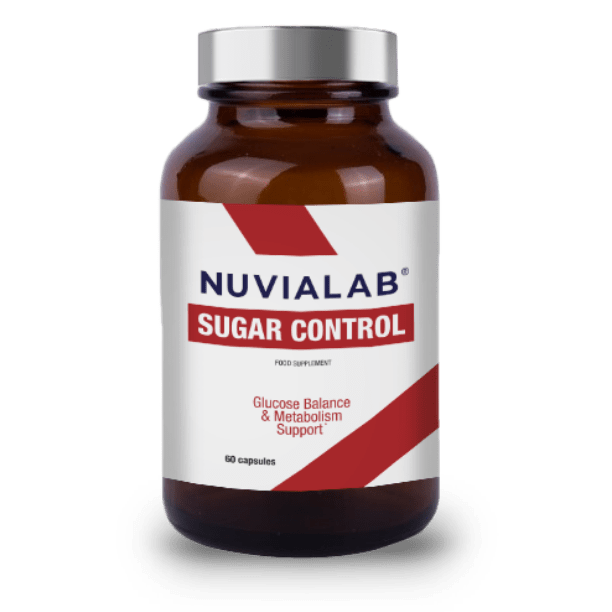
Our Recommendation — NuviaLab Sugar Control
Score: 5.2/10 · Best for: adults not on diabetes medication who know their numbers and want a fully disclosed formula they can judge with a follow-up blood test. Main caution: vitamin B6 at 14 mg a day exceeds EFSA's 12 mg upper limit, and the maker's panel warns people on insulin or oral hypoglycaemic drugs to consult a doctor first. Fair trial: three months — the three-bottle pack at $111.98 delivered covers one HbA1c cycle.
Why Does the Cinnamon Literature Disagree With Itself?
The umbrella review: a significant yes
The largest synthesis is an umbrella review in Frontiers in Nutrition 2025 (PMC12620228): 21 meta-analyses of cinnamon and glycaemic outcomes, re-pooled. Its headline: cinnamon significantly improves fasting blood glucose, with effects stronger in studies using more than 1.5 g/day and in shorter studies. Trial doses across the underlying literature ran from 0.12 g to 6 g a day.
An umbrella review is only as clean as its inputs, and cinnamon's inputs are famously messy — different species, different preparations, different populations, small trials throughout. A significant pooled fasting-glucose effect across that noise is a real signal. What kind of signal is the next question.
Why an Umbrella Cannot Clean What It Collects
An umbrella review sits at the top of the evidence pyramid in diagrams, and the position misleads. It does not re-run trials or re-examine patients; it re-pools other people's pools. Every decision those earlier reviewers made — which trials counted, which outcomes mattered, which species and preparations were lumped together — is inherited whole, along with every flaw in the trials underneath them.
Worse, the flaws do not dilute as they travel upward — they can amplify. If the same small, positive trials appear inside several of the underlying meta-analyses, the umbrella counts their agreement as independent confirmation when it is partly the same evidence wearing several coats. Agreement between pools that share their contents is not the same as agreement between separate bodies of research.
Heterogeneity compounds the problem. Cinnamon's inputs differ in species, preparation, dose and population, as this article has already noted; an average computed across unlike interventions describes none of them exactly. The pooled fasting-glucose signal may be real for some slice of that mixture and absent for the rest, and the umbrella format has no clean way to say which slice a given reader occupies.
None of this makes the umbrella review worthless; it makes it a map of a literature rather than a verdict on an ingredient. Read that way, its most useful finding may be its pattern rather than its headline: effects strengthening above 1.5 grams a day is a clue about dose, visible through the noise, and clues about dose are exactly what the stricter analyses below pursue.
There is also a quieter inheritance: publication patterns. Small trials with positive results are historically easier to publish than small trials with null ones, so the underlying meta-analyses may already over-represent good news before the umbrella gathers them. Each layer of synthesis then polishes the same tilt and presents it as convergence. The pyramid's top inherits the pyramid's lean, in full.
The dose-response analysis: a structured no
A 2023 dose-response meta-analysis in Nutrients asked the more precise question — not "any effect anywhere?" but "how does effect vary with dose?" — and found no significant overall association for fasting glucose or HbA1c. Null results from the methodologically stricter analysis are a recurring pattern in this literature: the more carefully the question is posed, the smaller cinnamon becomes.
Cochrane: −0.06%, interval through zero
The Cochrane review (Leach & Kumar) contributes the number that best deserves memorising: a subgroup HbA1c mean difference of −0.06%, with a 95% confidence interval from −0.29 to +0.18. An interval containing zero means the data are compatible with no effect at all — and even the point estimate, a six-hundredths-of-a-percent HbA1c shift, is clinically invisible.
A family-medicine evidence summary (FPIN) reading the trial file reached the practical version of the same verdict: at 1–3 g/day, expect HbA1c movement under 0.1%.
Mousavi et al.'s dose-response work in Nutrition supplies the connecting tissue: a threshold pattern, with credible fasting-glucose effects appearing at intakes of roughly 2 g/day and above. Below the threshold, the literature is mostly noise; above it, something small may be happening. All three answers are true — of different dose ranges.
The Dose Story in One Sentence
Everything the positive end of this literature describes happened at one to six grams of cinnamon powder a day — one to two teaspoons — sustained for weeks. Every null and near-null result clusters at lower doses, shorter runs, or both.
Set that beside real-world use. A capsule buyer's cinnamon exposure is whatever one line of a blend contains. A cook's exposure is whatever the porridge got. Neither resembles the trial intervention, but the cook is at least in the right unit — grams exist in kitchens. Milligrams of extract exist only on labels, and the literature has essentially nothing to say about them.
This is why our efficacy hub treats cinnamon as the category's teaching example: an ingredient can be simultaneously "studied", "significant in the largest synthesis", and absent at the dose in the product — with every word of that sentence true.
The Form Problem, Applied
Now the label. Sugar Control's panel lists 100 mg of cinnamon bark extract, standardised to 20% proanthocyanidins — 20 mg of that compound family per serving. The trials used whole powder: the full bark matrix, cinnamaldehyde, coumarin, fibre and all, in gram quantities. An extract standardised to one constituent family is not concentrated powder; it is a selected fraction of the bark, at one-twentieth to one-sixtieth of the trial mass.
No conversion exists, and we will not manufacture one. You cannot divide 3 g of powder by 100 mg of extract and announce a ratio, because the two materials share neither composition nor, probably, mechanism weighting. The correct statement is the uncomfortable one: the label's cinnamon has no literature of its own.
Its presence is explained by the powder literature's reputation, transferred across a change of material and a 10–60-fold change of scale — the full panel audit is on our NuviaLab Sugar Control page.
Species is the smaller version of the same problem. Trials mix Ceylon cinnamon (Cinnamomum verum) and cassia (C. cassia) without ceremony. The label says "cinnamon bark" and stops. For an ingredient whose trial identity is already blurred, an unidentified extract is a blur of a blur.
The Coumarin Ledger
Cassia cinnamon carries coumarin, a compound with a liver-safety ledger at sustained high doses — the reason European food-safety work set tolerable intakes for coumarin and why gram-a-day cassia habits deserve a thought. Ceylon cinnamon contains far less. This matters to the "just eat teaspoons of it" school of advice, which rarely specifies a species.
The Shopper's Species Problem
All of that assumes a shopper can tell which species they are holding, and mostly they cannot. A jar or packet that says only 'cinnamon' gives the buyer the category, not the species, and the two species discussed in this article are sold under that single word without ceremony. The distinction that organises the entire safety discussion is simply absent from the point of sale.
The practical reasoning follows from that absence. A buyer planning sustained gram-level use — the only use this literature discusses — is making a coumarin decision whether they know it or not, because the species decides the exposure. Choosing the species is therefore part of choosing the dose, and a label that will not name its species has quietly removed half of that decision from the buyer.
The same vagueness runs in the other direction, into the efficacy file. When trials themselves mix species without ceremony, a shopper cannot even use the literature to shop: the positive studies cannot be assigned to the jar in hand, because neither the studies nor the jar reliably say which cinnamon they contain. Two blurred records cannot sharpen each other, however often they are cited together.
What can a buyer actually do with this? Treat the Latin name as a minimum disclosure, the way this site treats a stated dose: its absence is itself information. A maker selling gram-intended cinnamon who names the species is answering the safety question; a maker who prints only 'cinnamon' is leaving the buyer to guess at the one variable the safety ledger turns on.
Sugar Control's own line illustrates the endpoint of this vagueness: 'cinnamon bark' with no species, in an extract, at 100 mg. At that scale the coumarin question is trivial, as noted — but the habit of accepting unnamed species at small scales is exactly what leaves buyers unpractised at asking the question at the gram scales where the answer starts to matter.
At the label's 100 mg of extract, coumarin exposure is trivial either way — the one safety dividend of a negligible dose. The risk ledger in this formula sits elsewhere, in the B6 line, as our side-effect file sets out. Cinnamon's own contribution to the product's risk profile is approximately its contribution to its efficacy: negligible, in both directions, at this scale.
What About Cinnamon in Food?
The sane conclusion of the whole literature is culinary. If you enjoy cinnamon, gram-scale amounts in food are the only form in which the studied doses are realistically reachable, the safety file at food levels is comfortable, and the cost of the experiment is the price of a spice you were using anyway.
Pair it with the dietary pattern evidence that dwarfs every ingredient in this series — the Mediterranean-style pattern summarised in our Mediterranean diet explainer — and the spice is a garnish on an intervention that actually has outcomes data.
Where Grams Actually Appear in a Day's Eating
It helps to picture what the studied range looks like as eating rather than as arithmetic. The gram amounts in this literature are teaspoon-scale quantities — the level at which a spice stops being a garnish and becomes an ingredient. Nobody drifts into that range by accident with a light dusting; reaching it means deliberately seasoning several things across the day, or one thing generously.
The realistic occasions are the ones where cinnamon already belongs. It disappears into warm breakfast dishes, into coffee and tea, into yoghurt and fruit, into the savoury cooking of several cuisines where the spice is structural rather than decorative. Spread across occasions like those, the lower end of the trial range is ordinary eating. Concentrated into a single spoonful, the same amount is a stunt.
That distribution matters beyond comfort. A habit built into meals arrives with food, in the matrix the trials' powder roughly resembled, and at a pace a person can sustain for the weeks the trials ran. A habit built on willpower — a dry spoonful endured each morning — usually ends within the fortnight, which is one more way real-world use quietly falls short of trial conditions.
The habit framing also keeps expectations in their place. Even sustained faithfully at the range where effects were reported, the expected prize on this literature is small — the sub-0.1% HbA1c territory the family-medicine summary assigns to gram intakes. A pleasant seasoning habit with a possibly tiny metabolic bonus is a fair description. A treatment is not, and no rearrangement of breakfast changes that arithmetic.
One more practical point follows from the dose story: consistency beats intensity. The trials sustained their intakes daily for weeks, so an occasional cinnamon-heavy day followed by weeks of none resembles no arm of any study in this file. A modest amount eaten most days is closer to the studied pattern than a heroic amount eaten rarely — another sense in which kitchens, not capsules, match the literature.
What food cinnamon cannot do is rescue a capsule claim. A maker's "contains cinnamon, which studies show…" sentence borrows gram-powder trials for a milligram-extract product, and the borrowing is the claim's entire substance. Readers who learn to ask "which form, how much, in whom?" will find this category becomes transparent — most of its claims are answers to questions nobody asked about doses nobody is taking.
Our Verdict
Cinnamon probably does something small to fasting glucose at intakes above roughly 1.5–2 grams of powder a day, sustained — on evidence that shrinks under methodological pressure and vanishes entirely at capsule scale. The three answers in the literature are a dose-response curve wearing disguises.
As a label ingredient at 100 mg of bark extract, cinnamon is decoration: safe, pleasant to print, and evidentiarily empty. Sugar Control's score does not rest on it, and neither should a purchase. Eat the spice if you like it. Do not buy it by the milligram and call the purchase evidence-based.
Our Recommendation — NuviaLab Sugar Control
Score: 5.2/10 · Best for: adults not on diabetes medication who know their numbers and want a fully disclosed formula they can judge with a follow-up blood test. Main caution: vitamin B6 at 14 mg a day exceeds EFSA's 12 mg upper limit, and the maker's panel warns people on insulin or oral hypoglycaemic drugs to consult a doctor first. Fair trial: three months — the three-bottle pack at $111.98 delivered covers one HbA1c cycle.
Frequently Asked Questions
Does cinnamon lower blood sugar?
At gram doses of powder, possibly slightly. An umbrella review of 21 meta-analyses (PMC12620228) found significant fasting-glucose improvement, stronger above 1.5 g/day; a dose-response meta-analysis found no significant overall effect; Cochrane's subgroup estimate was −0.06% HbA1c with an interval including zero. The answers reconcile as a dose story: effects, where real, live at 1–6 g/day of powder.
How much cinnamon did the studies use?
Between 0.12 g and 6 g a day of cinnamon powder, with credible effects clustering at roughly 2 g/day and above in dose-response analyses. Sugar Control's label contains 100 mg of bark extract standardised to proanthocyanidins — a different material at a fraction of the mass, with no published conversion. The trial literature does not describe the label's ingredient in any usable sense.
Is Ceylon or cassia cinnamon better?
The trials mix both species without ceremony, so the efficacy file cannot separate them. The safety file can: cassia carries substantially more coumarin, relevant at sustained gram-level intakes, while Ceylon carries little. Sugar Control's label says only "cinnamon bark" — species unstated — though at 100 mg of extract the coumarin question is trivial in either case.
Can cinnamon replace my diabetes medication?
No. Even taking the most generous reading of the literature — small fasting-glucose effects at gram doses — the effect size is a fraction of what prescribed drugs do, and Cochrane's HbA1c estimate is compatible with zero. Cinnamon is a food with interesting trial noise around it, not a therapy. Medication changes belong to your clinician.
Should I just eat a teaspoon of cinnamon a day?
If you enjoy it, food use is the only route that reaches studied doses, and at culinary levels the safety picture is comfortable — with cassia's coumarin worth a thought at sustained high intakes. Expect, on the evidence, an HbA1c effect under 0.1% if any. Put the effort where the outcomes data are: overall dietary pattern first, spice second.
Last reviewed: October 2026. This article is educational and is not medical advice.
