
- Quick Answer
- What the Trials Actually Reported
- Common Side Effects
- The Serious Risks
- Interactions: the Whole Formula, Not Just the Resin
- Who Should Avoid Shilajit
- The Blood-Pressure Question, Answered Specifically
- A Word for Older Users: Where the Interaction Table Matters Most
- Red Flags: Stop and Seek Care
- Who Should Buy Shilajit Extreme — and Who Should Skip It
- Frequently Asked Questions
- Is shilajit safe to take every day?
- What are the most common shilajit side effects?
- Does shilajit lower blood pressure?
- Who should not take shilajit?
- Is shilajit safe for women?
- Should I stop shilajit before surgery?
- Can shilajit cause a racing heart?
- Read This Next
Disclosure: This article contains affiliate links. If you buy through them, we may earn a commission at no extra cost to you. It never changes our conclusions.
Quick Answer
"Is shilajit safe?" has two different answers, and keeping them separate is the whole article. Purified, standardised extract — the material used in clinical trials — was generally well tolerated at 200–500 mg/day for up to 48 weeks, with few reported adverse events. Raw, unpurified shilajit is a different risk object entirely: the documented record (landmark JAMA surveys, a Canadian regulator's market action, a 2025 thallium analysis) shows meaningful heavy-metal contamination across Ayurvedic and shilajit products, and no trial safety data covers multi-year daily use, pregnancy, breastfeeding or children at all. Within the purified category, the realistic side effects are gastrointestinal upset, headache and dizziness; the serious risks concentrate in contaminated product, in drug interactions, and in the people listed under "who should avoid" below. Best for: adults not in the avoid-groups, using a purified branded extract at a trial-range dose, who have cleared the medication table below — not anyone reaching for raw resin because it looks more authentic.
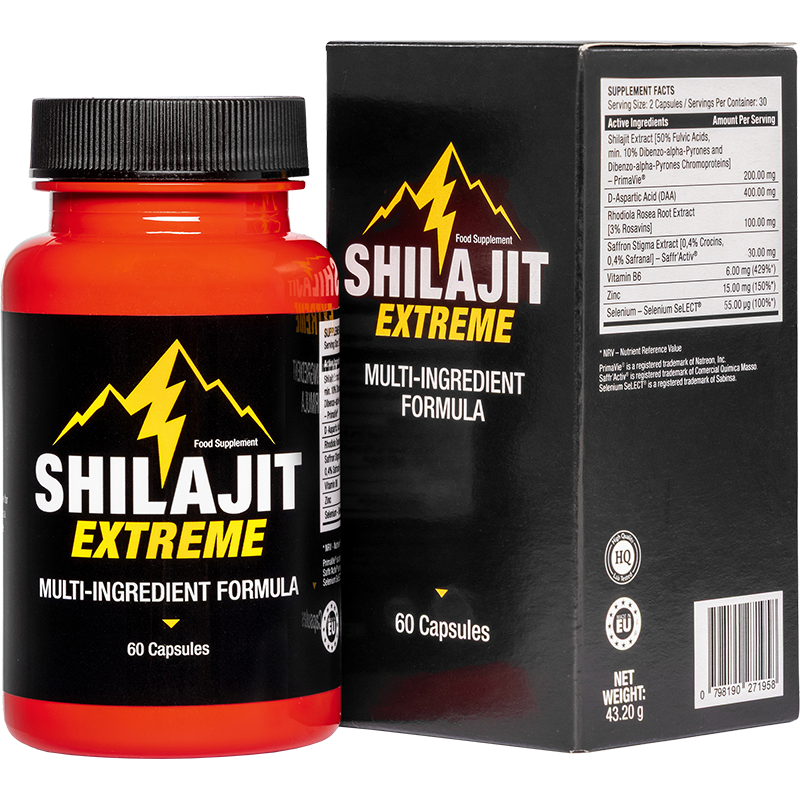
Our Recommendation — Shilajit Extreme
Score: 5.8/10 · Best for: men who want shilajit in the form the safety record actually covers — a purified, standardised extract at a studied-range dose — rather than the raw resin where this category's real risks concentrate Main caution: the purified extract was well tolerated in trials, but the serious risks sit in contaminated product and drug interactions — and this bottle ships 200 mg a day, below the testosterone trial's 500 mg, with no money-back guarantee published Fair trial: three bottles at $153.87 cover the maker's three-month minimum — with no guarantee published, that spend is committed up front.
What the Trials Actually Reported
Trial tolerability is the floor of any safety assessment, so it comes first and without decoration. In the testosterone trial (Pandit 2016, 500 mg/day, 90 days), no adverse events were attributed to the extract. In the fertility trial (Biswas 2010, 200 mg/day, 90 days), liver and kidney profiles were measured and unaltered — a detail worth more than a hundred "no side effects reported" label claims, because someone actually looked. Across the wider trial record, purified shilajit at 200–500 mg/day for 8 to 48 weeks was generally well tolerated with few reported adverse events; mainstream medical summaries accordingly describe processed shilajit as "possibly safe" at up to 500 mg/day for up to 48 weeks — the 48 weeks being the bone trial's duration, i.e. the longest anyone has been formally watched. Three boundaries on that reassurance, stated once and applying everywhere below: the trials were small (a rare harm affecting 1 in 500 users is invisible in studies of 28–96 people); they excluded pregnant women, children and the medically complex; and no trial establishes the safety of multi-year daily use. "Well tolerated for 90 days in healthy men" is a true sentence. It is not the sentence "safe", full stop, and this site does not let the first impersonate the second.
Common Side Effects
| Effect | What is known | What to do |
|---|---|---|
| GI upset — nausea, cramps, diarrhoea, reduced appetite | The commonest reported effects; usually on starting or dose-related; anecdotal and early-trial reporting tier | Take with food (the fertility trial dosed after meals), split the dose; if it persists, stop — persistence is information |
| Headache | Reported across brand and clinical summaries; mechanism unspecified | Hydrate, review dose and timing; persistent headache on any new supplement is a stop-and-review signal |
| Dizziness | Reported; also one of the mainstream stop-use signals (below) | Stop and assess — particularly important if you take blood-pressure medication |
| Flushing / skin redness | Actually observed in a 14-week trial of purified shilajit in middle-aged women — one of the few effects with trial provenance | Note and monitor; any rash with other symptoms moves to the red-flag pathway |
| Restlessness, feeling wired, faster pulse | Anecdotal in humans at higher doses; the underlying dose-dependent heart-rate effect is animal data (low dose slowed, high dose raised heart rate in animal models) and is labelled as such here | Reduce dose or move it to the morning; a racing heart is a red flag (below), not a nuisance |
A note on provenance, because safety pages rarely offer one: shilajit's common-effects list is built mostly from anecdote, case mentions and summaries of summaries — the trials were too small and too short to characterise common effects precisely. That cuts in both directions. The absence of a frightening trial safety signal is genuinely reassuring about purified extract at studied doses. It is not a licence to call the ingredient side-effect-free, and a maker page claiming "no recorded side effects" is claiming a negative that studies of this size cannot establish.
The Serious Risks
Heavy-metal contamination is the defining serious risk of this category, and it belongs to the raw and uncharacterised end of the market: in the landmark surveys, one in five Ayurvedic products tested carried lead, mercury or arsenic; a national regulator ordered specific shilajit capsules off the market; and a 2025 analysis found thallium — a metal older checklists omit — in natural shilajit and at higher levels in commercial supplements. The full documented record, with numbers, the limits that apply, and how to interrogate a product's paperwork, is our purity and heavy-metals guide, and it is required reading for anyone using raw resin. The short version for this page: purification and batch testing are not marketing garnish in this category; they are the difference between the trial material and the material that generated the case reports. Allergic reaction, including a published case report of exercise-induced anaphylaxis in which an Ayurvedic preparation was a cofactor — a single case report, which establishes possibility, not a rate. Iron loading: shilajit contains iron, which is a nutrient to most men and a hazard to the specific groups below. Unknown long-term effects: no multi-year data exist; humility is the correct posture, and it is free.
Interactions: the Whole Formula, Not Just the Resin
Most safety pages assess "shilajit" while the product in the reader's hand is a formula. The table below covers the shilajit component's cautions and then the companion ingredients in the product this set accompanies — because interactions belong to whatever you actually swallow.
| Medication / class | Concern | Tier |
|---|---|---|
| Blood-pressure medication | Possible additive blood-pressure lowering; dizziness reports reinforce the caution (see the blood-pressure section below) | Prudence — clinician first |
| Diabetes medication | Possible glucose effects; additive hypoglycaemia is the theoretical risk | Prudence — clinician first |
| Anticoagulants / antiplatelets | Listed among cautions in clinical summaries; bleeding-risk prudence around surgery applies as with most botanicals | Prudence — disclose to your clinician |
| Thyroid medication | Listed among interaction cautions in brand and clinical safety reviews | Prudence — clinician first |
| Iron supplements / iron-loading states | Shilajit itself contains iron; stacking adds load where load is the disease (see avoid-list) | Avoid combining without advice |
| Hormonal medication / other testosterone products | The testosterone trial's signal, however modest, argues against casual stacking of hormone-positioned products | Prudence — one variable at a time |
| Chemotherapy | Potentiation seen in animal data only — flagged here so oncology patients involve their team, not as a human finding | Clinician only |
Then the formula itself. Shilajit Extreme adds, per day: D-aspartic acid 400 mg — whose own safety file (small trials, no data beyond ~3 months, isolated reports of irritability, nervousness, fast heart rate and headache at gram doses) is set out in our dedicated D-aspartic acid article, the site's reference for that ingredient; rhodiola 100 mg and saffron 30 mg, adaptogen-class ingredients whose cautions (including rhodiola's stimulant-adjacent profile) are graded in our stress cluster — see rhodiola for stress and saffron for mood and stress; and zinc 15 mg with vitamin B6 6 mg and selenium 55 µg — sensible single-product doses that nonetheless count toward your totals if you stack a multivitamin or a dedicated zinc product (chronic excess zinc competes with copper absorption; the totals, not the single label, are what your body sees). The product's safety sub-score in our review is 7.0/10 — the set's most comfortable — reflecting exactly this profile: standard cautions, trial-tolerated headline ingredient, and a maker whose label carries the standard medication and pregnancy warnings rather than omitting them.
Who Should Avoid Shilajit
- Pregnant or breastfeeding women, and children/adolescents — no safety data exist; every credible source and the maker's own label agree.
- Iron-overload conditions — hemochromatosis, and caution in sickle cell disease and thalassemia: shilajit contains iron, and these are conditions where iron is the pathology.
- Gout or high uric acid — shilajit may raise uric acid.
- Hormone-sensitive cancers — a testosterone-raising signal, however modest and unreplicated, is a reason for oncology-guided decisions, not self-experimentation.
- Kidney disease — the category's contamination history and mineral load argue for clinician control.
- Active heart disease — listed among mainstream cautions; the heart-rate reports, though animal-tier, point the same way.
- Anyone whose medication appears in the table above, until a clinician has seen the combination.
The Blood-Pressure Question, Answered Specifically
Because it is asked constantly (it sits in this set's demand research as its own question), the blood-pressure file in one place. No human trial shows a clinically meaningful blood-pressure reduction from shilajit. The best direct counterweight to alarm is a small study (Sharma 2003) in which healthy volunteers took a much larger dose — 2 g/day for 45 days — with no change in blood pressure or pulse recorded. Set against that, the caution in the interaction table is not evidence of an effect; it is the logic of prudence — a substance with any vasoactive reputation, combined with dizziness reports, should not be layered onto antihypertensive medication without a clinician's knowledge, because additive effects are how preventable faints happen. Both halves, plainly: shilajit is not a blood-pressure supplement, and people treating blood pressure should not improvise with it. If you take it while medicated, home readings across the first fortnight are the minimum diligence, and dizziness is a stop signal, not a phase.
A Word for Older Users: Where the Interaction Table Matters Most
The trial population for purified shilajit was healthy men aged 45–55 taking no significant medication. The real-world shilajit buyer skews older — and older is precisely where the safety calculus changes, not because age itself is a contraindication but because medication lists lengthen. A 68-year-old on an antihypertensive, a statin, metformin and a daily aspirin intersects the interaction table at four rows simultaneously, none of them alarming alone, all of them together a reason the first conversation belongs to his clinician rather than to a checkout page. Polypharmacy also degrades attribution: with five products in play, a new dizziness has five suspects, and the supplement started last month is the one nobody mentions at the appointment. Mention it. The honest summary for older users is the same as for everyone, with the volume turned up: purified extract has a clean small-trial record, the avoid-groups and the medication table are where the actual risk lives, and both are knowable before the first capsule — which is what this article is for.
Red Flags: Stop and Seek Care
Mainstream medical guidance lists the stop-use signals for shilajit plainly, and we reproduce them as the close of this article because they outrank every other section: rash; increased or racing heart rate; dizziness; and any breathing difficulty or swelling (the anaphylaxis pattern) — stop the product and seek medical care, urgently for the last two categories. Add the general supplement red flags: jaundice, dark urine, severe abdominal pain, or symptoms that begin with a new product and escalate. Report what you were taking, at what dose, and for how long — and keep the product and its batch details, because in a category with a contamination record, the specific jar is part of the clinical picture.
Who Should Buy Shilajit Extreme — and Who Should Skip It
Buy it if you are an adult outside the avoid-groups, your medication list is clear of the table above (or cleared by your clinician), and you want the trial-tolerated form — a purified, standardised extract at a studied-range dose, from a maker whose safety labelling is complete. Skip it if you are pregnant, breastfeeding or under 18; if you carry an iron-overload condition, gout, kidney disease or a hormone-sensitive cancer; if your medication list intersects the interaction table and you have not discussed it; or if the alternative you are considering is raw resin at a lower price — in this category the discount is paid in exactly the risk this article documents.
Our Recommendation — Shilajit Extreme
Score: 5.8/10 · Best for: men who want shilajit in the form the safety record actually covers — a purified, standardised extract at a studied-range dose — rather than the raw resin where this category's real risks concentrate Main caution: the purified extract was well tolerated in trials, but the serious risks sit in contaminated product and drug interactions — and this bottle ships 200 mg a day, below the testosterone trial's 500 mg, with no money-back guarantee published Fair trial: three bottles at $153.87 cover the maker's three-month minimum — with no guarantee published, that spend is committed up front.
Frequently Asked Questions
Is shilajit safe to take every day?
Purified extract at 200–500 mg/day was tolerated in trials for up to 48 weeks. Beyond that span there is no safety record, and none for pregnancy, breastfeeding or children. "Safe daily" is therefore a claim with a 48-week evidence ceiling — and it applies to purified extract, never to raw product of unknown purity.
What are the most common shilajit side effects?
Gastrointestinal upset (nausea, cramps, diarrhoea, reduced appetite) leads the list, usually early and dose-related; then headache and dizziness. Skin redness was observed in one women's trial. Most of the common-effects list is anecdote-tier evidence — the trials were small — which is why the management advice is simple: with food, split doses, and stop if effects persist.
Does shilajit lower blood pressure?
No human trial shows a meaningful reduction; one study at 2 g/day for 45 days found no change in blood pressure or pulse. The caution about combining it with blood-pressure medication is prudence about possible additive effects — not a claim that it treats hypertension. It does not.
Who should not take shilajit?
Pregnant or breastfeeding women; children; people with hemochromatosis or other iron-overload states, gout, kidney disease or hormone-sensitive cancers; and anyone on blood-pressure, diabetes, anticoagulant, thyroid or hormonal medication who has not cleared it with their clinician. The full list and reasoning are above.
Is shilajit safe for women?
Purified extracts have been trialled in women (bone density over 48 weeks; skin outcomes over 14 weeks, where skin redness was the notable effect) without a serious safety signal — in those products, at those doses. The product reviewed on this site is nevertheless a men's formula, built around men's indications, and it is not suitable in pregnancy or breastfeeding, where no shilajit safety data exist for anyone. Women should use products formulated and studied for them, with the avoid-list above applied in full.
Should I stop shilajit before surgery?
Yes — the standard prudence for botanical supplements with any anticoagulant-adjacent or blood-pressure-adjacent profile is to stop before scheduled surgery and to disclose it to the surgical and anaesthesia team, who will give you their own interval. The same disclosure applies to dental procedures involving bleeding risk. A supplement you cannot mention to your surgeon is a supplement to reconsider entirely.
Can shilajit cause a racing heart?
A faster pulse is among the effects reported anecdotally at higher doses in humans, and a dose-dependent heart-rate effect exists in animal data (labelled as such wherever we cite it). In a human being, a racing heart on any new supplement is a stop-and-seek-care symptom, not a side effect to push through.
Last reviewed: October 2026. This article is educational and is not medical advice.
