
- Quick Answer
- Why Shilajit Is a Purity Problem by Geology, Not Just by Fraud
- The Documented Record
- Why the Paperwork Falls to You: the Regulatory Gap
- The Home Tests: What They Can and Cannot Do
- The Counterfeit End: Look-Alikes, Blends and Badge Archaeology
- How to Read a Certificate of Analysis (COA): the Walkthrough
- Fulvic Acid: What It Is, What Cleveland Clinic Says, and Why the Percentages Chaos
- "Is Shilajit a Hoax?"
- The Product's Position, Stated Without Invention
- Who Should Buy Shilajit Extreme — and Who Should Skip It
- Frequently Asked Questions
- Does shilajit contain heavy metals?
- How can I tell if shilajit is real or fake?
- What is fulvic acid, and how much should a product contain?
- Is a "third-party tested" badge enough?
- Is shilajit from a particular country safer?
- Does purification remove heavy metals?
- Read This Next
Disclosure: This article contains affiliate links. If you buy through them, we may earn a commission at no extra cost to you. It never changes our conclusions.
Quick Answer
Shilajit's purity problem is documented, not rumoured. In the landmark JAMA surveys, 20% of Ayurvedic products tested in 2004 — and 20.7% of internet-purchased products in 2008 — contained lead, mercury or arsenic; the 2008 survey's table includes a product named simply "Shilajit" with lead at 10.5 µg/g. In 2005, Health Canada warned consumers off specific Ayurvedic products including "Shilajit capsules, produced by Dabur India Ltd", ordered removed from the market. In 2025, analysts reported thallium — a highly toxic metal most checklists omit — in natural shilajit and at higher levels in commercial supplements. None of this means every shilajit product is contaminated; it means purity in this category is a paperwork question, answered by a batch-matched certificate of analysis from an accredited lab — not by colour, smell, altitude stories, or the water/flame/alcohol home tests, which can screen for gross fakes and cannot detect a single metal. Best for: any buyer, of any form — but especially capsule buyers, whose only instrument is exactly that paperwork.
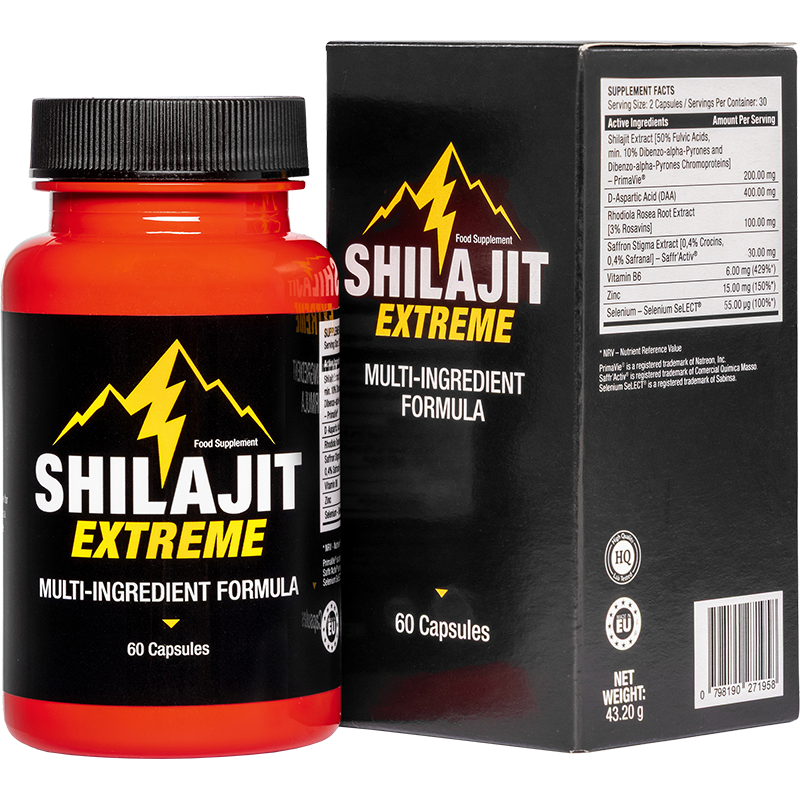
Our Recommendation — Shilajit Extreme
Score: 5.8/10 · Best for: buyers who put paperwork first — a purified branded extract whose maker states its batch-testing practice — in a category where one in five products in the landmark surveys carried lead, mercury or arsenic Main caution: the maker has not published a batch-matched certificate of analysis, so “purified” rests on the maker's stated practice rather than a checkable document — and no money-back guarantee is published Fair trial: three bottles at $153.87 cover the maker's three-month minimum — with no guarantee published, judge it as a paperwork purchase, not a refundable trial.
Why Shilajit Is a Purity Problem by Geology, Not Just by Fraud
Start with the framing the best purity guides get right: raw shilajit genuinely contains heavy metals before anyone cheats. The resin forms over centuries inside rock, concentrating whatever its geology holds — and review literature (Wilson 2011; Stohs 2014) lists arsenic, lead, mercury, nickel and cobalt among raw shilajit's inherent constituents. Contamination is therefore a geology-plus-purification problem: the mountain puts the metals in, and only processing takes them out. Layered on top of that baseline are the human contributions — deliberate metal addition in the rasa shastra tradition of Ayurvedic pharmacy (in the 2008 JAMA survey, rasa shastra products were the worst category at 40.6% contaminated), careless collection and handling, and outright fakes (look-alike substances, including bitumen-like materials, sold as resin). This framing matters because it kills the two lazy stories at once: "contamination is just counterfeits, buy genuine" (no — genuine raw material starts contaminated) and "all shilajit is poison" (no — purification exists precisely to remove what geology added, and the trial extracts are purified). The question is never shilajit or not. It is always this batch, purified how, tested by whom, showing what numbers.
The Documented Record
| Source | What was tested | What was found |
|---|---|---|
| Saper et al., JAMA 2004 | 70 Ayurvedic products bought in Boston-area stores | 14 products (20%) contained lead, mercury or arsenic |
| Saper et al., JAMA 2008 | 193 Ayurvedic products bought online (US- and Indian-made) | 20.7% contained detectable lead, mercury or arsenic; rasa shastra products 40.6%. The findings table includes a product named "Shilajit" (Banyan Botanicals): lead 10.5 µg/g, mercury/arsenic not detected in that sample |
| Health Canada advisory, 2005 | Ayurvedic products on the Canadian market | Consumers warned not to use listed products found with high levels of lead/mercury/arsenic — explicitly including "Shilajit capsules, produced by Dabur India Ltd", for removal from the market; advised against other shilajit products lacking market authorisation |
| Kamgar et al., BMC Chemistry 2025 | Natural shilajit and commercial shilajit supplements, analysed for thallium | Thallium up to 0.226 µg/g in natural shilajit and up to 0.5 µg/g in commercial supplements — supplements higher than crude material; roughly 0.095 µg per pill in the worst case |
| US case series (CDC, via hospital reviews) | Lead-poisoning cases linked to Ayurvedic products | 12 cases across five states in one series — the human end of the percentages above |
Read the record at its correct weight. It does not say that a given modern, purified, batch-tested product is contaminated — it cannot, because it predates or bypasses most of today's branded extracts. What it establishes is the base rate of the unregulated category: across two decades and three methods (retail survey, online survey, regulator action, fresh elemental analysis), roughly one product in five off the shelf carried toxic metals, and regulators have named shilajit specifically, by brand, at least once. A base rate like that converts purity from a marketing adjective into the buyer's first question — and it explains why this set's articles treat purification and testing as the centre of the safety story rather than a detail. It also explains the thallium lesson: a panel covering only lead, arsenic, mercury and cadmium can pass a product that a fuller panel would flag. Ask for the full panel, including thallium, or accept that your "tested" claim has a hole the size of a 2025 paper.
Why the Paperwork Falls to You: the Regulatory Gap
It is fair to ask why any of this is the buyer's job. The structural answer: in the United States, dietary supplements reach the market without pre-market approval of purity or potency — a regulator can act against a contaminated product after the fact, but no agency certifies the jar before you buy it, which is why the case reports and surveys above read the way they do. Canada's system is stricter on paper — Health Canada's 2005 advisory advised against shilajit products without market authorisation (a DIN/NPN number), effectively telling consumers to treat unauthorised shilajit as unverified by definition — and it still had to order named products removed. The lesson generalises beyond either system: in this category, the verification layer is thin by design, and the distance between "regulated" and "safe" is exactly the distance a batch COA covers. That is not a counsel of despair; it is a shopping instruction. The products whose paperwork survives the walkthrough below are verifiable in a way the category's base rate says most are not — and in a market with a one-in-five documented failure rate, verification is the feature worth paying for.
The Home Tests: What They Can and Cannot Do
Four folk tests circulate for resin, and the best purity guide in our research states the governing principle in one line: home tests screen; they don't certify. Each, with its verdict:
| Test | How it goes | Verdict |
|---|---|---|
| Warm-water solubility | Real resin dissolves in warm water over 5–10 minutes, colouring it dark | Screens out some crude fakes (fillers that won't dissolve). Says nothing about metals — lead dissolves invisibly too |
| Heat / cold consistency | Resin softens in warmth and in the hand; hardens and turns brittle in the cold | A physical property check. Consistent with real resin — and with several things that are not resin |
| Flame test | Real shilajit bubbles and turns to pale ash under flame; it does not catch fire | Screens out flammable adulterants. A metal-laden genuine resin passes it perfectly |
| Alcohol test | Real shilajit does not dissolve in alcohol (it clumps) | Another identity screen. Again: silent on every contaminant that matters |
Notice what all four share: they test identity — is this substance behaving like shilajit — while every documented harm in the record above is a failure of purity, which is invisible, tasteless and odourless at the levels involved. A jar can pass all four tests, be entirely genuine resin, and carry lead at the levels JAMA found, because the metals arrived from its mountain, not from a fraudster. And a final, structural point the resin guides never notice: none of these tests can be run on a capsule at all. You cannot dissolve, burn or squeeze a finished capsule product in any way that tells you anything. The capsule buyer's only instrument is paperwork — which makes the next section the most important one in this article for most of our readers.
The Counterfeit End: Look-Alikes, Blends and Badge Archaeology
Beyond contaminated-but-genuine resin sits the market's other failure mode: products that are not really shilajit, or not only shilajit. COA guides in our research name the look-alike problem directly — asphaltum-type bituminous substances and other dark resins that mimic shilajit's appearance and pass casual inspection — alongside the quieter frauds: genuine resin stretched with fillers, and low-grade material upgraded by a label. The home tests in the table above exist for this layer, and against crude versions of it they work, which is their proper use. The subtler modern problem is documentary rather than physical: what we can only call badge archaeology. A sales page accumulates the vocabulary of testing — "lab tested", "third-party verified", "heavy-metal screened" — without the artefacts (named lab, matched batch, method, numbers) that make the vocabulary mean anything; several layers down, a real certificate may exist for a different batch, a different year, or a raw material rather than the finished product. Independent retail testing programmes have found problems in shop-bought shilajit products in recent years (ConsumerLab's 2024 retail work is cited by the best purity guide in our research), which is the market telling you, from the outside, the same thing the JAMA record says from the inside: the badge layer and the product layer drift apart unless a buyer insists on the document. Insist on the document.
How to Read a Certificate of Analysis (COA): the Walkthrough
A certificate of analysis is the document that converts "trust us" into numbers. Sellers increasingly display one; the skill is knowing what a real one contains. Check, in order:
- Batch match. The COA's batch or lot number must match the batch on your product, exactly. A certificate for a different batch is evidence about a different jar — the single most common COA failure, and the easiest to check.
- A named, accredited lab. Look for an independent laboratory accredited to ISO/IEC 17025, named on the document. "Tested in our state-of-the-art facility" is not third-party testing; an unnamed "third party" is not either.
- A stated method. Metals should be measured by ICP-MS (inductively coupled plasma mass spectrometry) or a comparable elemental method, named on the report. Results without a method are numbers without a ruler.
- Numbers, not "Pass". A real panel prints the measured value for each metal next to its limit. The reference limits most often applied to supplements (USP <2232>, daily-exposure based) are: lead ≤10 ppm, arsenic ≤10 ppm, cadmium ≤3 ppm, mercury ≤1 ppm — present these as what they are, reference points for reading a panel, not as a grade we can award any specific product.
- The full panel — including thallium. Lead, arsenic, mercury and cadmium are the classic four; the 2025 thallium findings argue for asking whether thallium was measured too. A panel that omits it is not wrong — it is incomplete in a way the seller chose.
- A microbial panel. Metals are not the only contaminants: E. coli, Salmonella, and yeast/mould screening belong on a complete certificate for a natural resin product.
- A recent date. A COA should be under about 12 months old and correspond to current stock. Ancient certificates decorating a sales page are archaeology, not quality control.
If a seller cannot produce a document that survives this list, the correct inference is not "the product is dirty" — it is "the product is unverified", in a category with a documented one-in-five base rate. Unverified is a price-relevant fact: it should move the product down your list below any comparable product whose paperwork checks out, whatever its altitude story.
Fulvic Acid: What It Is, What Cleveland Clinic Says, and Why the Percentages Chaos
No purity article can skip fulvic acid, because it is both shilajit's headline constituent and its most abused number. What it is: when soil microorganisms break down plant material over long periods, they produce humic substances; fulvic acid is the small, water-soluble fraction of that family — soluble at any pH, where its larger sibling, humic acid, dissolves only in alkaline conditions. Fulvic acid is the fraction credited with shilajit's proposed carrier activity and much of its antioxidant behaviour in laboratory systems, which is why extracts are standardised to it: the branded extract in the trials, PrimaVie®, is standardised to at least 50% fulvic acids, and the product in this set carries the same 50% standardisation on its label.
What the sober medical centre says: the Cleveland Clinic's explainer on fulvic acid (Bradley, MD) finds "promising signs" for diabetes, Alzheimer's-related processes and inflammation — and concludes that there isn't enough research yet to conclusively say fulvic acid is safe or truly beneficial; that dosing is unregulated; that at higher doses fulvic acid can flip from antioxidant to pro-oxidant and increase oxidative damage; that unknown-purity sources risk ingesting mercury and arsenic; and that it is too early to tell — not something to take on internet claims. The human data behind fulvic acid alone are tiny (a 7-day pollen-allergy study, topical eczema work); almost everything else — including the tau-protein story behind the Alzheimer's mentions — is animal or test-tube work. We quote that position at length because it is the correct temperature: a genuinely interesting compound family, an unproven supplement, and a purity dependency that brings this whole article full circle.
Why the percentages are chaos: raw resin is variously claimed at 15–20% fulvic acid, at 40–60%, at "50–80% fulvic plus humic combined", and at "75%+" — offers one industry source itself calls scientifically suspect. The spread is not only dishonesty; it is method dependence. Fulvic content is measured by assay, and the assays disagree: the older Lamar method and the standardised ISO 19822:2018 method return different numbers for the same material. A percentage without its method is therefore not a fact but a numeral. When you compare two products' fulvic claims, you are very often comparing two rulers. The buyer's defence is the same as with the COA: ask "standardised to X%, by which method, on which batch document?" — a question a serious seller can answer and a marketing page cannot.
"Is Shilajit a Hoax?"
The question deserves a straight answer inside this article, because the purity record tempts people to it. No — the substance is real, geologically characterised, traditionally used for centuries, and the subject of at least one genuinely randomised trial with a positive result. What is hoax-adjacent is the marketing layer: results from purified extracts pasted onto raw resin; percentages without methods; altitude sold as specification; home tests presented as certification; and a contamination record this well documented treated as a rumour to be waved away. The hoax risk in shilajit is not that the resin is fake. It is that the story told about a given jar — its strength, its cleanliness, its evidence — is fictional while the jar is real. Purity paperwork is how you buy the jar without the fiction. And because the fiction is usually more expensive than the paperwork, checking costs you nothing but the minutes this article just spent.
The Product's Position, Stated Without Invention
The product this set accompanies, Shilajit Extreme (our score: 5.8/10), uses PrimaVie® — a purified, standardised, water-extracted branded preparation, standardised to 50% fulvic acids — rather than raw resin, and its maker states that all batches of the product undergo tests to guarantee quality, absence of contaminants, and safety of use. Those are maker facts, and we print them as such. What we will not do — because it is not in the verified record available to us — is state or imply a certificate of analysis, a parts-per-million result, or a "third-party tested" verdict for this specific product. None has been published in our source material, and inventing one is the exact offence this article exists to police. Apply the same standard to us that this page applies to everyone: here is the checklist we would want answered for any seller, including the one whose product this site sells:
- Can I see the COA for the batch in my hand — and does the lot number match?
- Which lab, accredited to what standard, using which method?
- Numbers for lead, arsenic, mercury, cadmium — and thallium — or the word "Pass"?
- Microbial results alongside the metals?
- How recent is the document, and does the fulvic percentage carry its assay method?
A seller who answers those questions has earned the purity claim. A seller who answers with altitude and adjectives has not — and the difference between those two sellers, in this category, is the whole game. It is also, not coincidentally, most of the difference between the products at either end of this market's enormous price range.
Who Should Buy Shilajit Extreme — and Who Should Skip It
Buy it if purity is your deciding concern and you want the purified-branded-extract route: a standardised capsule whose maker states its batch-testing practice in its own words, in a category where the alternative is often uncharacterised resin with a one-in-five category base rate behind it. Skip it if you need documentary proof beyond a maker's statement — a published, batch-matched COA is a legitimate requirement, this product's maker has not published one in the material available to us, and sellers who do publish theirs deserve your custom on exactly that ground; and skip raw-resin bargains entirely if the seller cannot produce paperwork, because in this category the cheap jar is where the documented record lives.
Our Recommendation — Shilajit Extreme
Score: 5.8/10 · Best for: buyers who put paperwork first — a purified branded extract whose maker states its batch-testing practice — in a category where one in five products in the landmark surveys carried lead, mercury or arsenic Main caution: the maker has not published a batch-matched certificate of analysis, so “purified” rests on the maker's stated practice rather than a checkable document — and no money-back guarantee is published Fair trial: three bottles at $153.87 cover the maker's three-month minimum — with no guarantee published, judge it as a paperwork purchase, not a refundable trial.
Frequently Asked Questions
Does shilajit contain heavy metals?
Raw shilajit inherently contains metals from its geology — arsenic, lead, mercury, nickel and cobalt among them — and surveys of the unregulated market found lead, mercury or arsenic in about one in five Ayurvedic products, with regulators naming shilajit capsules specifically. Purification exists to remove them; whether a given product's purification worked is a question only its batch testing answers.
How can I tell if shilajit is real or fake?
Home tests (water solubility, heat/cold behaviour, flame, alcohol) can screen out crude fakes — they test identity. They cannot detect metals or certify purity; only a batch-matched COA from an accredited lab does that. And none of the home tests can be performed on a capsule at all.
What is fulvic acid, and how much should a product contain?
It is the small, water-soluble fraction of humic substances and shilajit's headline active family; the trial extract is standardised to at least 50%. Market percentages range from 15–20% to implausible 75%+ claims, largely because different assays (e.g. Lamar vs ISO 19822) return different numbers — a percentage without its method is not comparable to anything.
Is a "third-party tested" badge enough?
No. Ask which lab, which batch, which method, and for the numbers. A badge with no document behind it is a claim about testing, not testing — and in this category, with its documented base rate, the document is the product's most important ingredient.
Is shilajit from a particular country safer?
Origin is a weak proxy, and the best survey cuts against the lazy version of the assumption: in JAMA 2008, US-made Ayurvedic products tested positive for metals at 21.7% and Indian-made at 19.5% — a problem on both sides of the ocean, at nearly the same rate. Contamination is a property of a batch and its processing, not a nationality. Judge the document, not the flag.
Does purification remove heavy metals?
That is its purpose, and the trial extracts are purified preparations. But "purified" is not a regulated claim with a guaranteed endpoint — outcomes depend on the process and the batch. Purification is a reason to ask for the COA, not a substitute for it.
Last reviewed: October 2026. This article is educational and is not medical advice.
