
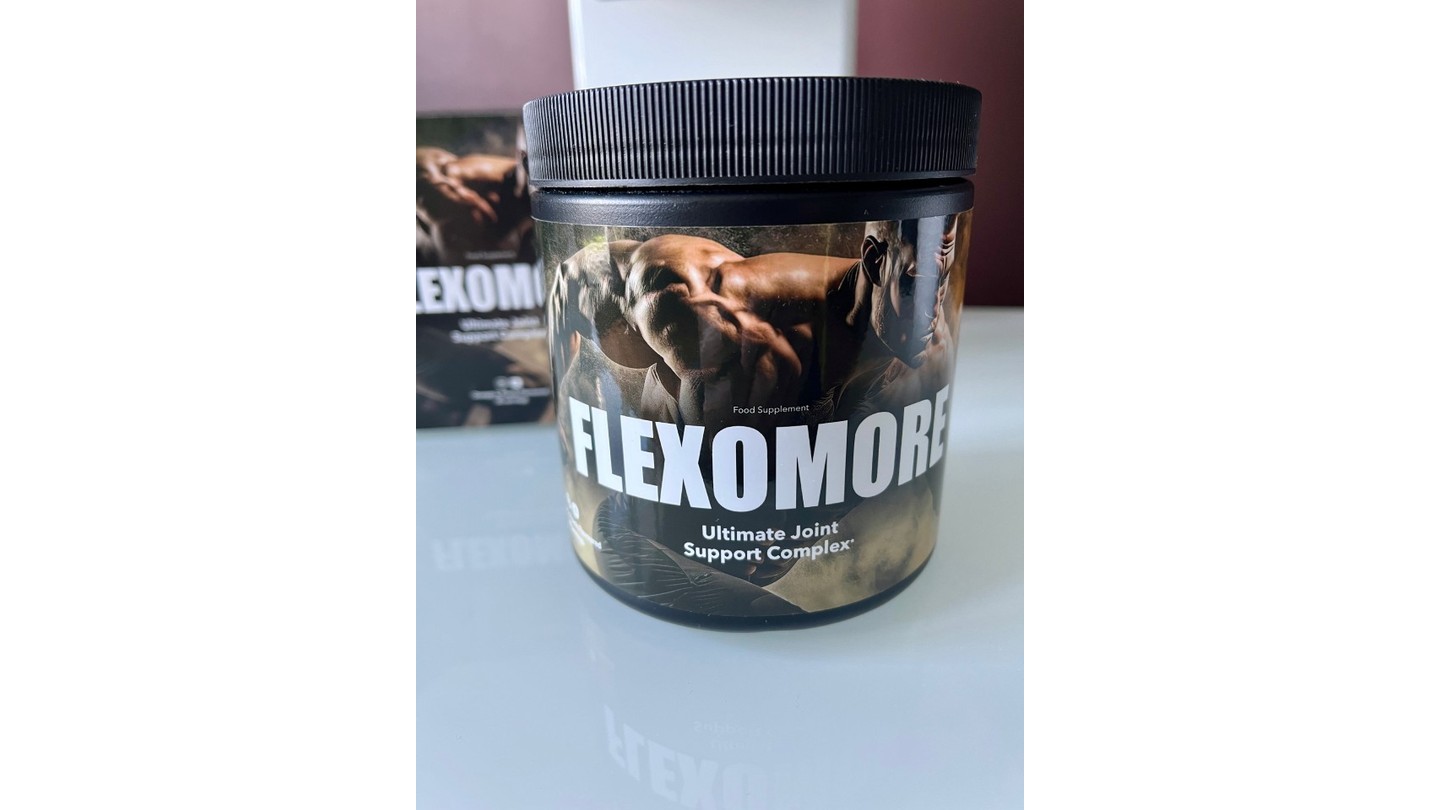
- Quick Answer
- Our Findings
- Why You Should Trust This Review
- Our Verdict
- How We Scored It
- What Is Flexomore?
- The Ingredients
- Tendoforte® Collagen Hydrolysate (2.5 g)
- Glucosamine Sulfate 2KCl (2 g, of which D-Glucosamine 1.5 g)
- Aquamin™ Mineral Complex (1.25 g, of which Calcium 150 mg)
- MSM (1 g)
- uC3 Clear® Turmeric Extract (200 mg → 20 mg curcuminoids)
- Ginger Rhizome Extract (200 mg)
- Boswellin® WS Boswellia Extract (100 mg → 30 mg boswellic acid)
- BioPerine® Black Pepper Extract (1 mg)
- Vitamin C (80 mg)
- Magnesium — Aquamin™ Mg (187.5 mg)
- The Dose Audit: Full Amounts, Read Against the Doses That Were Actually Studied
- The Lead Ingredient Sits at Half Its Studied Dose
- The Glucosamine Line Matches the Printed Standard — With Form Caveats
- The Small Extracts Deliver Light Active Amounts
- MSM Sits Below Multi-Gram Trial Designs
- What Is Not in the Tub
- The Evidence, Read Properly
- Tendoforte® Collagen Peptides — Praet et al. 2019
- Glucosamine Sulfate — Reginster et al. 2001
- Glucosamine Hydrochloride — The GAIT Trial (Clegg et al. 2006)
- Boswellia — Cochrane Review (Cameron & Chrubasik 2014)
- No Trial Tests the Finished Flexomore Formula
- How Long Does It Take to Work?
- Is It Safe?
- Side Effects: What Is Actually Known
- When Joint Pain Needs a Doctor, Not a Powder
- Is It a Scam?
- Price and Packs
- Purchase Options
- How It Compares
- Who Should Buy It — and Who Should Skip It
- Who should buy it
- Who should skip it
- Frequently Asked Questions
- Does Flexomore actually work?
- How much Tendoforte® is in a scoop — and how does it compare with the study?
- Is the glucosamine dose the full trial dose?
- How long does Flexomore take to work?
- Is Flexomore safe — and who should not take it?
- Does Flexomore have a money-back guarantee?
- Flexomore or NuviaLab Flex — which should I buy?
- Where can I buy Flexomore — and what does a month actually cost?
- Sources & Method
- Read This Next
SuppChecked is an independent supplement review site. When you buy a product through links on our pages, we may earn a commission at no extra cost to you. Every score, price, and product claim on this page is checked against the maker's official records and the published scientific literature, and brands never pay to change our scores.
Shoppers looking at joint powders tend to fall into two camps. One group wants gram-level joint ingredients in a single drink instead of swallowing a fistful of capsules every morning. The other group has seen too many joint powders hide behind proprietary blends, tiny dustings, and borrowed study doses.
This review tests Flexomore against both camps. We read the maker's published ingredient panel line by line, checked every amount against the doses human studies actually used, and priced a fair trial straight from the maker's own order page.
Quick Answer
Flexomore scores 6.8/10 — our highest score for a joint supplement, though with clear limits. Every one of its ten panel lines carries a published amount at gram level, which is genuinely rare in this category.
The catch sits right on the first line. The lead collagen, Tendoforte®, provides 2.5 g per scoop — half the 5 g daily dose its own human trial used. Reaching that studied dose takes two scoops a day, cutting a 30-serving tub to about 15 days.
The maker also publishes no money-back guarantee at all, so the trial risk sits entirely with you. Single tubs start at $59.99 plus $12 shipping, dropping to $39.99 a tub on the three-tub option.
Best for: active adults who want a transparent, gram-level joint drink powder and are willing to judge it over three months.
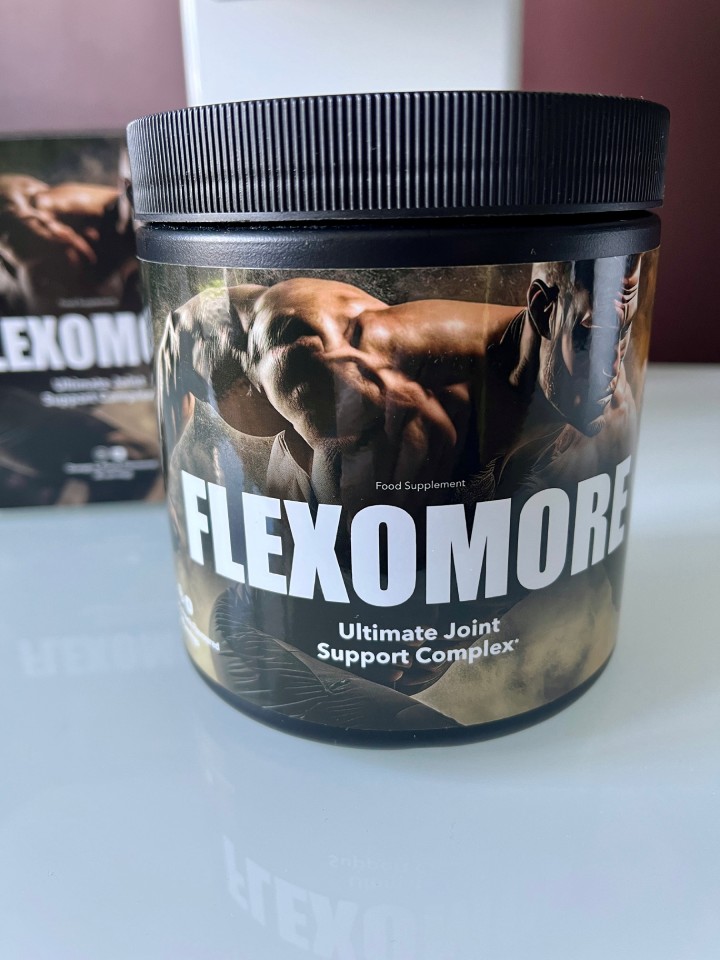
Flexomore — Our Score: 6.8/10
Score: 6.8/10 · Sub-scores: Ingredients 8.5 · Evidence 6.5 · Safety 7.0 · Value 6.0 · Best for: Active adults who want a joint powder with every amount published at gram level, judged over a full three months · Main caution: No money-back guarantee is published; the lead collagen is 2.5 g a scoop — half the 5 g its own study used, so the studied dose needs two scoops a day and a tub then lasts about 15 days; the glucosamine is crustacean-derived · Fair trial: Three months — the three-tub pack at $131.98 delivered
Our Findings
What we like
- Full gram-level disclosure: Every one of the ten ingredient lines publishes an exact amount per scoop, including the calcium and magnesium totals.
- A format built for real weights: Mixing an 11 g scoop into water lets the formula carry gram-level doses that standard capsules struggle to hold.
- Checkable glucosamine maths: The panel prints the "of which" breakdown on glucosamine sulfate 2KCl, confirming 1,500 mg of D-glucosamine per scoop.
- Manufacturer and origin on the box: The physical packaging names the manufacturer (Nuvialab LLC) and states the European Union as the country of origin.
What gives us pause
- Lead collagen at half its studied dose: Tendoforte® sits at 2.5 g per scoop against the 5 g daily dose used in its own study.
- No money-back guarantee: The maker publishes no refund guarantee anywhere; terms allow only a 10-day withdrawal on unused goods.
- Modest active totals in the small extracts: One scoop delivers 20 mg of curcuminoids, 30 mg of boswellic acid, and just 1 mg of BioPerine® black pepper extract.
- Unsourced 98% survey figure: The sales page claims 98% of those surveyed noticed better comfort and flexibility, with no sample size or survey method published.
- Conflicting delivery timelines: The FAQ promises delivery in 2–3 working days, while the maker's own terms state about 7 working days and possibly longer.
Why You Should Trust This Review
We read the maker's sales and order pages in full, checked the published ingredient panel line by line, and verified the physical packaging itself. We then checked the human trial record for the formula's ingredients at the doses actually used (Praet et al. 2019, PMID 30609761; Reginster et al. 2001, PMID 11214126). We report the findings that complicate the sales story, including the half-dose collagen scoop and the missing guarantee. Every product on SuppChecked is judged against those same primary records rather than promotional claims, and brands never pay to place or change a score.
Our Verdict
Flexomore earns 6.8/10, making it the strongest joint formula we have scored so far. It beats capsule rivals by putting real gram-level weights into a drink powder and printing every single amount on the panel.
Two issues keep the score from climbing higher. First, the lead ingredient, Tendoforte® collagen hydrolysate, sits at 2.5 g per scoop — half the 5 g daily amount its own human study used. Second, the maker publishes no money-back guarantee, leaving you to absorb the full cost of testing it.
Maker Credibility scores 5.0/10 in our scoring because of a clear identity split. The physical packaging names the manufacturer, Nuvialab LLC of Wilmington, Delaware, and states European Union origin. The official website names no company at all and runs its sales terms under Hong Kong law.
A fair trial takes three months at one scoop a day. That calls for the three-tub pack at $131.98 delivered, or $1.47 a day. Taking two scoops daily to hit 5 g of Tendoforte® halves each tub to about 15 days.
Doubling to two scoops raises your daily cost to $2.93 on the three-tub option. Because no refund guarantee is published anywhere on the site, your order size is your only risk control. Start with the three-tub trial rather than committing to six tubs upfront.
How We Scored It
Every product on SuppChecked is scored across the same core areas so you can compare formulas side by side. The table below breaks down how Flexomore reached its 6.8/10 overall score.
| Criterion | Score |
|---|---|
| Ingredients | 8.5 |
| Evidence | 6.5 |
| Safety | 7.0 |
| Value | 6.0 |
Ingredients (8.5/10): Flexomore earns its strongest mark here because all ten lines print exact amounts, including calcium, magnesium, and the D-glucosamine breakdown. Carrying 2.5 g of collagen, 2 g of glucosamine salt, 1.25 g of Aquamin™, and 1 g of MSM in one serving is a clear step above capsule blends. The score stops short of a nine because Tendoforte® sits at half its studied dose per scoop and the botanical extracts provide small active totals.
Evidence (6.5/10): No human clinical trial has tested the finished Flexomore powder. The score rests on published ingredient trials, chiefly Praet et al. 2019 (PMID 30609761) on Tendoforte® at 5 g daily with rehab exercise and Reginster et al. 2001 (PMID 11214126) on 1,500 mg of glucosamine sulfate. The half-dose collagen gap, the mixed broader glucosamine evidence, and mismatched boswellia and piperine profiles cap this mark.
Safety (7.0/10): The published label names crustaceans as the glucosamine allergen source and warns against use by children or pregnant and breastfeeding women. Human trials of the lead ingredients were generally well tolerated, and the collagen pilot reported no adverse events. Safety stops at 7.0 because the maker publishes no medication-interaction warnings — notably for warfarin — and has no finished-formula safety trial.
Value (6.0/10): At one scoop a day, the three-tub option delivers a reasonable $1.47 daily cost for a gram-level powder. Single-tub buyers face a steep $2.40 per day delivered because shipping is a flat $12 on every order. Two drags keep Value at 6.0: matching the 5 g collagen study dose doubles daily cost, and no money-back guarantee protects first-time buyers.
What Is Flexomore?
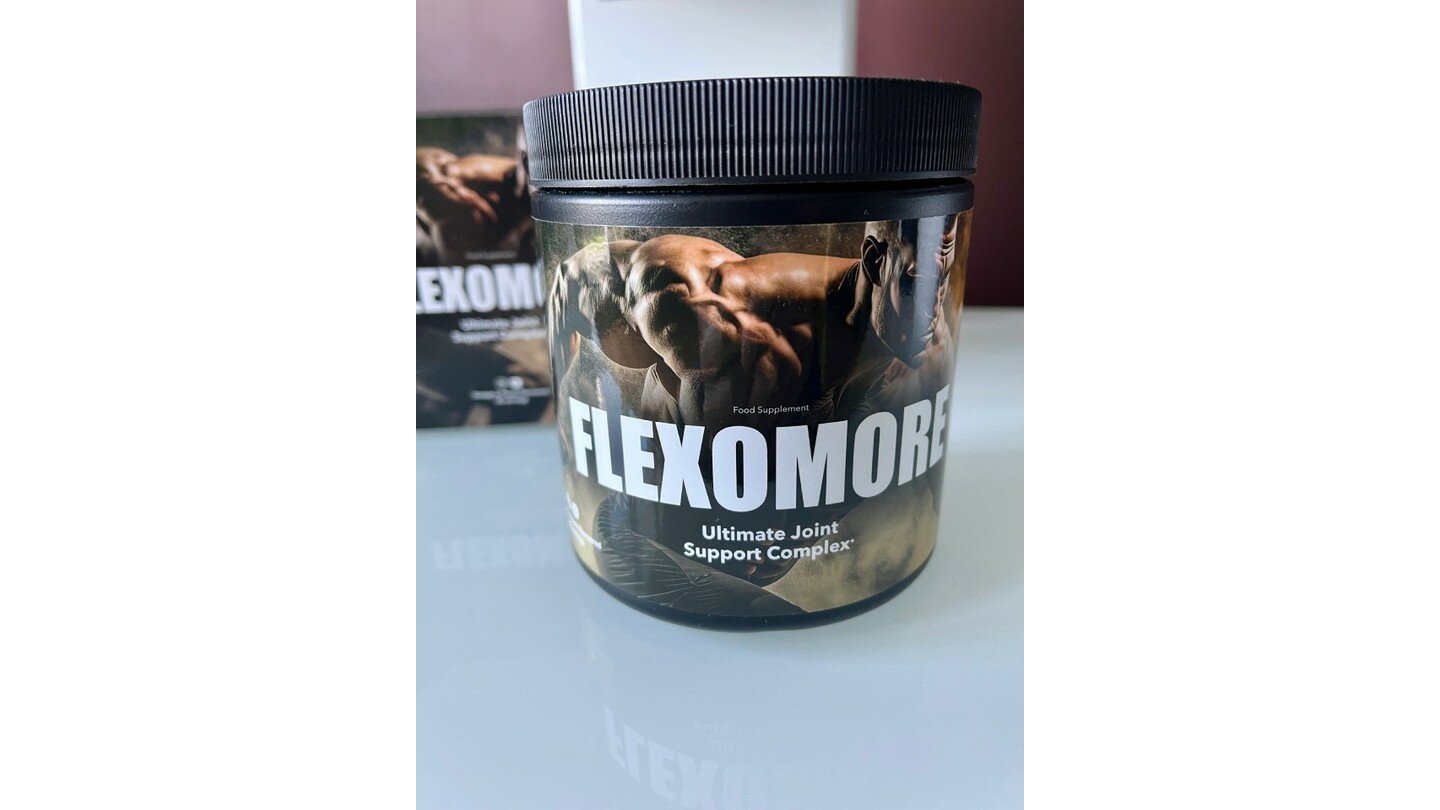
Flexomore at a Glance
- Our score: 6.8/10
- Brand: Flexomore
- Company: Nuvialab LLC (named on the packaging; the maker’s website sells as Flexomore.com and names no company)
- Product type: Joint and bone support powder — 330 g tub, 30 servings
- Primary purpose: Marketed for joint comfort, flexibility and training recovery in active adults
- Formula: 10 lines, every amount published, per 11 g scoop
- Clinical research: No trial of the finished formula; the lead ingredient was trialled at 5 g a day alongside a rehab programme
- Research limitation: That trial tested collagen peptides PLUS exercise in 20 patients with Achilles tendinopathy — not joint pain, and not this product
- Recommended use: 1 scoop daily; 2 scoops if training 5 or more times a week
- Money-back guarantee: None published (the maker’s terms allow a 10-day withdrawal on unused goods only)
Flexomore is a daily joint and bone support drink powder sold in a 330 g tub. Each tub provides 30 servings of an orange and peach flavoured powder designed to be mixed into water. The directions printed on both the website and the physical box tell you to dissolve 11 g — one heaping scoop — in 300 ml of water once daily, or twice daily if you complete five or more training sessions a week.
The maker positions Flexomore squarely at active adults and regular exercisers rather than older buyers managing severe joint wear. Its headline pitch — "TRAIN WITHOUT LIMITS!" — emphasizes joint comfort, flexibility, and support for tendons and ligaments during heavy training. The sales page also displays badges claiming "100% NATURAL INGREDIENTS", "100% SAFETY AND QUALITY", and "EUROPEAN STANDARD", alongside an unsourced survey claim that 98% of respondents noticed better comfort and flexibility.
One structural detail is worth knowing before you order: the company details differ between the box and the website. The physical packaging names the manufacturer as Nuvialab LLC, located at 501 Silverside Rd, Ste 105, Wilmington, DE 19809 in the United States, and prints the country of origin as the European Union. By contrast, the official website names no legal company, lists a Stanley Street address in Hong Kong, and states that Hong Kong law governs orders while excluding European Union consumer law.
The Ingredients
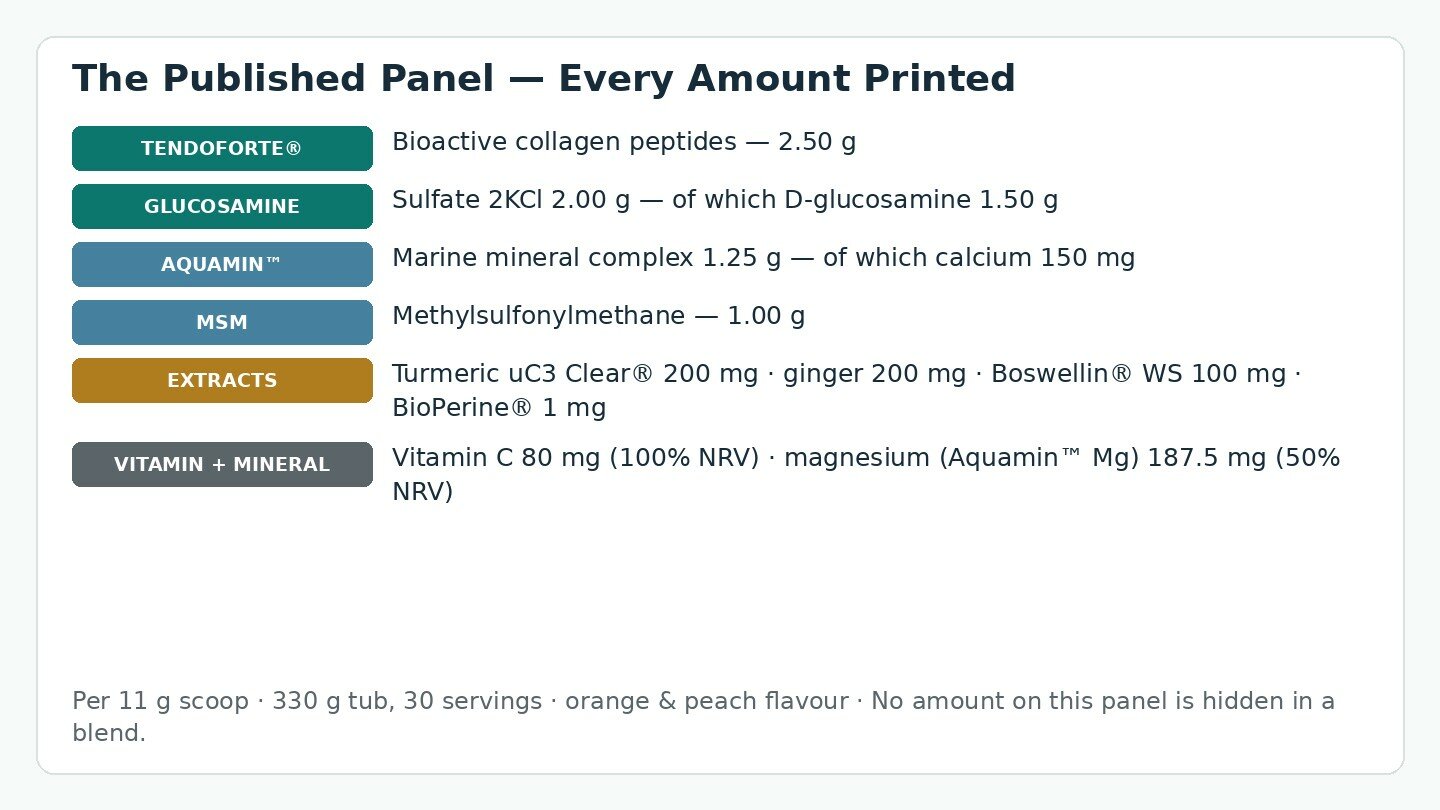
A fully published ingredient panel is still the exception in joint supplements, and Flexomore's label rewards reading closely. Every single one of the ten lines prints an exact weight per 11 g serving. The maker also prints a second column for two servings, doubling every figure cleanly without hiding behind proprietary blends.
Both mineral weights are printed in elemental milligrams alongside their European Nutrient Reference Values (NRVs), and the glucosamine line prints its exact D-glucosamine yield. The ingredients list also flags crustaceans as the allergen source for glucosamine. That openness makes a fair audit possible: every strength sits in plain sight, and so does every gap between a scoop and the published human trials.
| Ingredient | Amount per serving (11 g) | Standardisation / Details |
|---|---|---|
| Tendoforte® Collagen Hydrolysate | 2.50 g | Bioactive collagen peptides |
| Glucosamine Sulfate 2KCl | 2.00 g (of which D-Glucosamine 1.50 g) | From crustaceans |
| Aquamin™ Mineral Complex | 1.25 g (of which Calcium 150 mg) | Marine algae complex (19% NRV) |
| MSM (Methylsulfonylmethane) | 1.00 g | Single sulfur compound |
| uC3 Clear® Turmeric Extract | 200 mg | 10% curcuminoids (20 mg curcuminoids) |
| Ginger Rhizome Extract | 200 mg | 5% gingerols |
| Boswellin® WS Boswellia Extract | 100 mg | 30% boswellic acid (30 mg boswellic acid) |
| BioPerine® Black Pepper Extract | 1 mg | 95% piperine |
| Vitamin C | 80 mg | Ascorbic acid (100% NRV) |
| Magnesium (Aquamin™ Mg) | 187.50 mg | Marine-derived magnesium salts (50% NRV) |
Tendoforte® Collagen Hydrolysate (2.5 g)
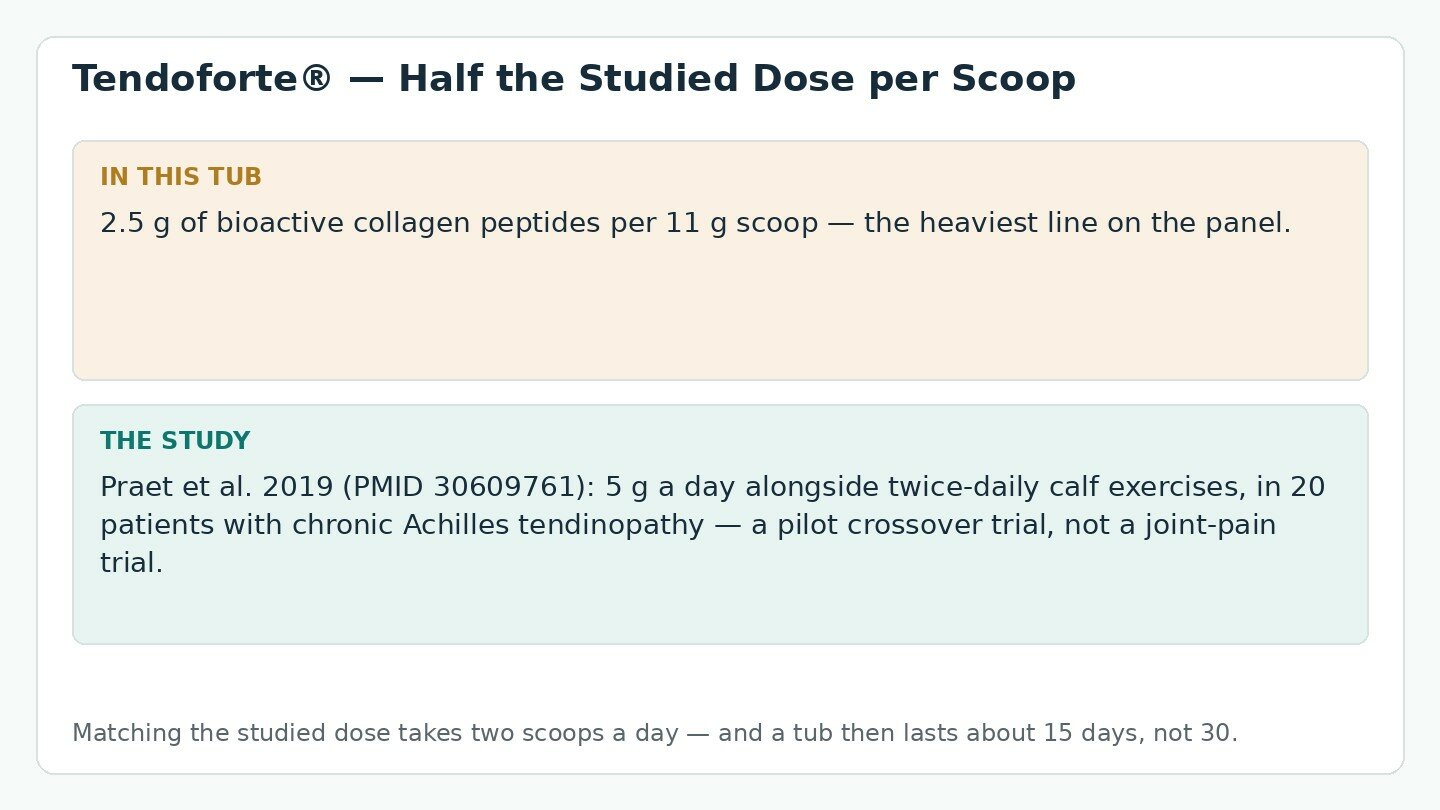
Tendoforte® is a branded bioactive collagen peptide hydrolysate and the heaviest single ingredient in Flexomore at 2.50 g per scoop. The maker pitches it as the centrepiece for tendon and ligament strength, joint flexibility, and training recovery. Its sales copy goes further, stating that it reduces the risk of injury and ligament or tendon rupture.
The published human trial behind Tendoforte® is much narrower than that sales claim. Praet et al. 2019 (PMID 30609761) ran a pilot double-blind crossover trial in 20 patients with chronic mid-portion Achilles tendinopathy. Both arms performed twice-daily calf-strengthening exercises for six months, crossing over at three months, with the active arm taking 5 g of Tendoforte® daily.
At three months, VISA-A tendon scores rose by 12.6 points on peptides-first versus 5.3 points on placebo-first. Crucially, one scoop of Flexomore delivers 2.5 g — half that 5 g dose. Matching the study requires two scoops a day. No adverse events were reported in Praet's pilot, though no safety trial tests this finished powder.
Glucosamine Sulfate 2KCl (2 g, of which D-Glucosamine 1.5 g)
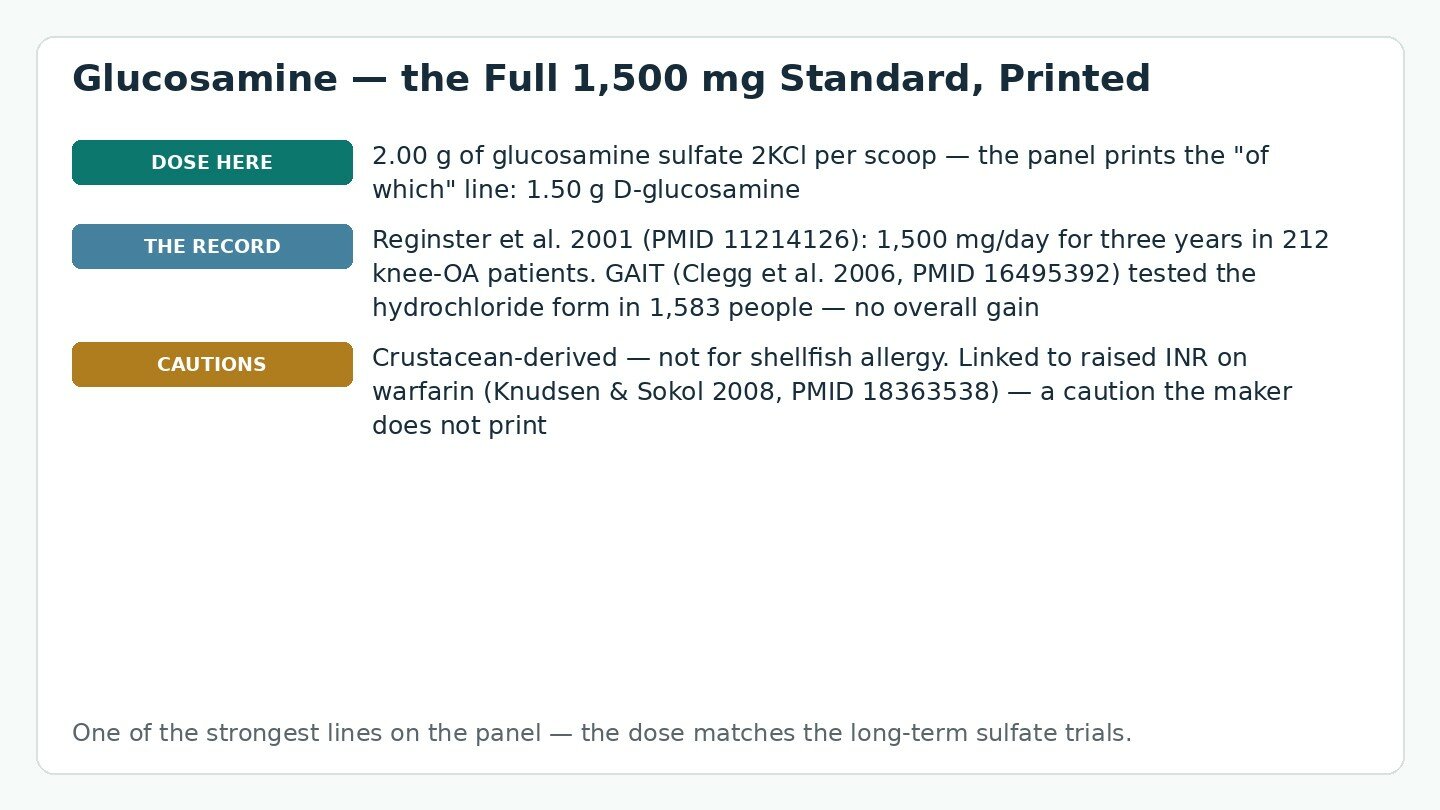
Glucosamine sulfate 2KCl is a potassium-chloride-stabilised salt form of glucosamine, a compound found naturally in joint cartilage. Flexomore supplies 2.00 g of this salt per scoop and prints the crucial "of which" line right underneath: 1.50 g (1,500 mg) of D-glucosamine. The maker includes it to support cartilage integrity and everyday joint comfort.
That 1,500 mg D-glucosamine amount is one of the strongest points on the panel. Reginster et al. 2001 (PMID 11214126) studied 212 knee osteoarthritis patients taking 1,500 mg of glucosamine sulfate daily for three years in a manufacturer-sponsored trial, reporting less joint-space narrowing (−0.06 mm vs −0.31 mm) and better symptoms than placebo. By contrast, the larger GAIT trial (Clegg et al. 2006, PMID 16495392) tested glucosamine hydrochloride in 1,583 people and found no overall gain over placebo.
Two cautions apply directly to this line. First, the label notes that the glucosamine comes from crustaceans, which rules Flexomore out for anyone with a shellfish allergy. Second, glucosamine has been linked to raised INR readings in people taking warfarin (Knudsen & Sokol 2008, PMID 18363538), a caution the maker does not print.
Aquamin™ Mineral Complex (1.25 g, of which Calcium 150 mg)
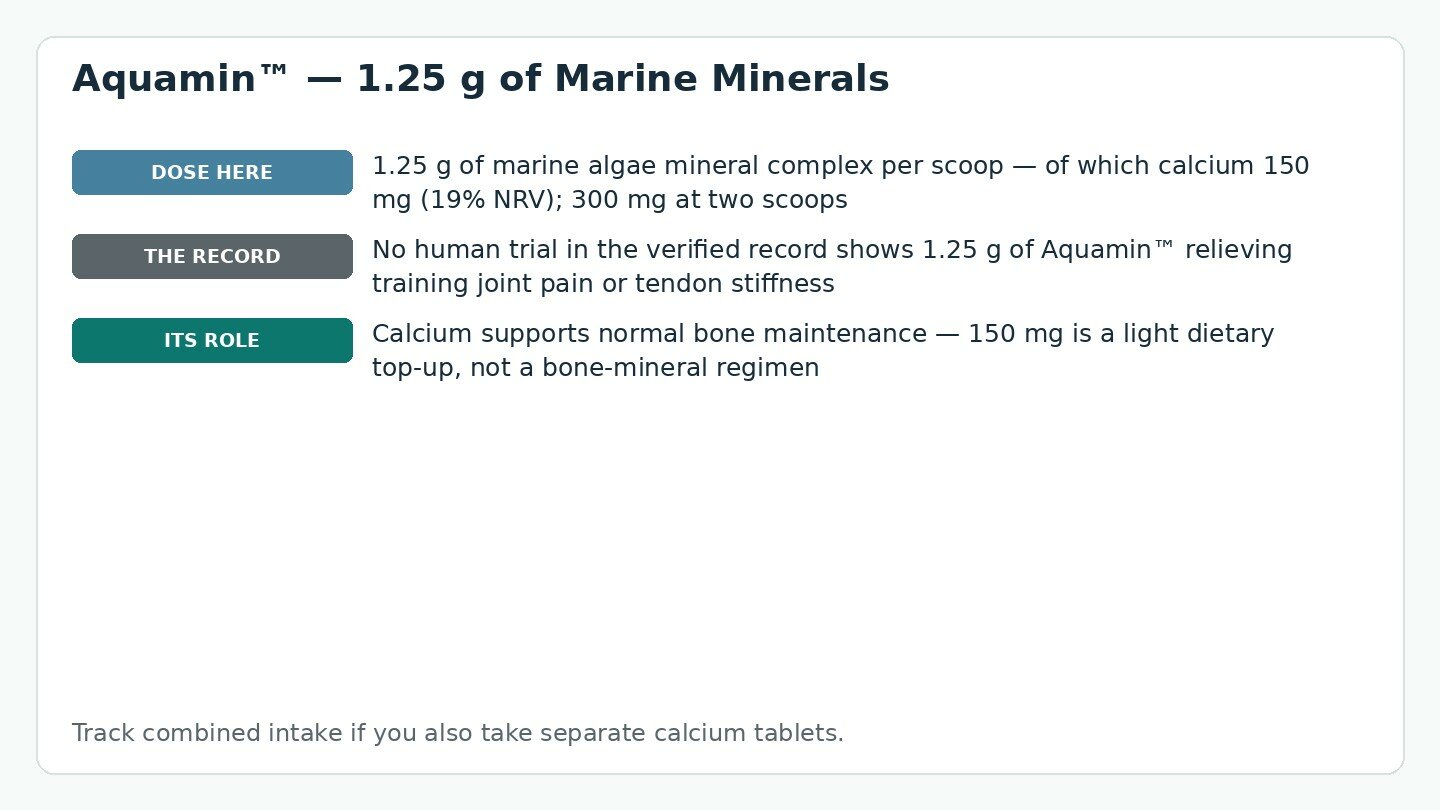
Aquamin™ is a branded marine algae mineral complex supplied at 1.25 g per scoop. The published panel explicitly breaks out the elemental calcium yield: 150 mg per serving, equal to 19% of the European NRV. At the two-scoop serving for frequent trainers, that rises to 2.50 g of the complex and 300 mg of calcium.
The maker uses Aquamin™ alongside magnesium to back the bone-support half of Flexomore's joint-and-bone claim. Printing the actual elemental calcium weight is a genuine transparency win, because many mineral-complex labels list only the bulk powder weight and leave buyers guessing how much calcium is inside.
As for joint pain, the evidence is thin at this role and dose. Calcium supports normal bone maintenance, yet 150 mg is a light dietary top-up rather than a full bone-mineral regimen. No human trial in our verified record shows 1.25 g of Aquamin™ relieves training joint pain or tendon stiffness. It is generally well tolerated, though people taking separate calcium tablets should track their combined daily intake.
MSM (1 g)
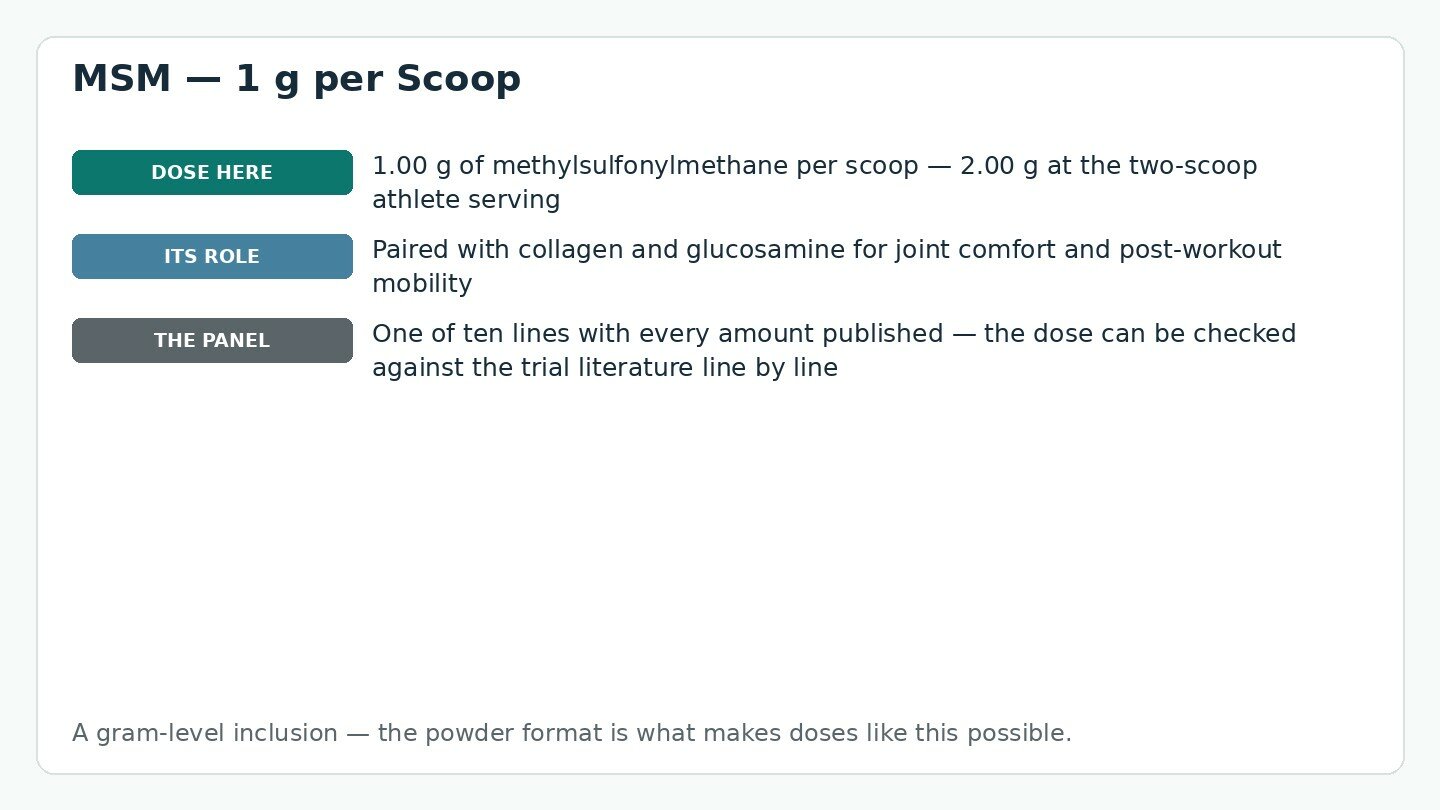
MSM stands for methylsulfonylmethane, an organosulfur compound widely used in joint formulas. Flexomore includes 1.00 g (1,000 mg) in each 11 g scoop, doubling to 2.00 g if you take two scoops a day. The maker pairs MSM with collagen and glucosamine to support joint comfort and post-workout mobility.
Putting a full gram of MSM into a multi-ingredient product is a practical advantage of the powder format. Capsule formulas often squeeze MSM down to a fraction of a gram simply because gelatin shells run out of space. Here, you get a clean gram without swallowing extra pills.
Even with that format advantage, one gram sits below the typical clinical dose range. Human joint trials of MSM generally use several grams per day rather than a single gram. At one scoop, MSM acts as a sensible supporting player rather than a standalone studied intervention. The maker lists no MSM-specific side effects beyond its standard exclusion for children and pregnant or lactating women, and no finished-formula safety study exists.
uC3 Clear® Turmeric Extract (200 mg → 20 mg curcuminoids)
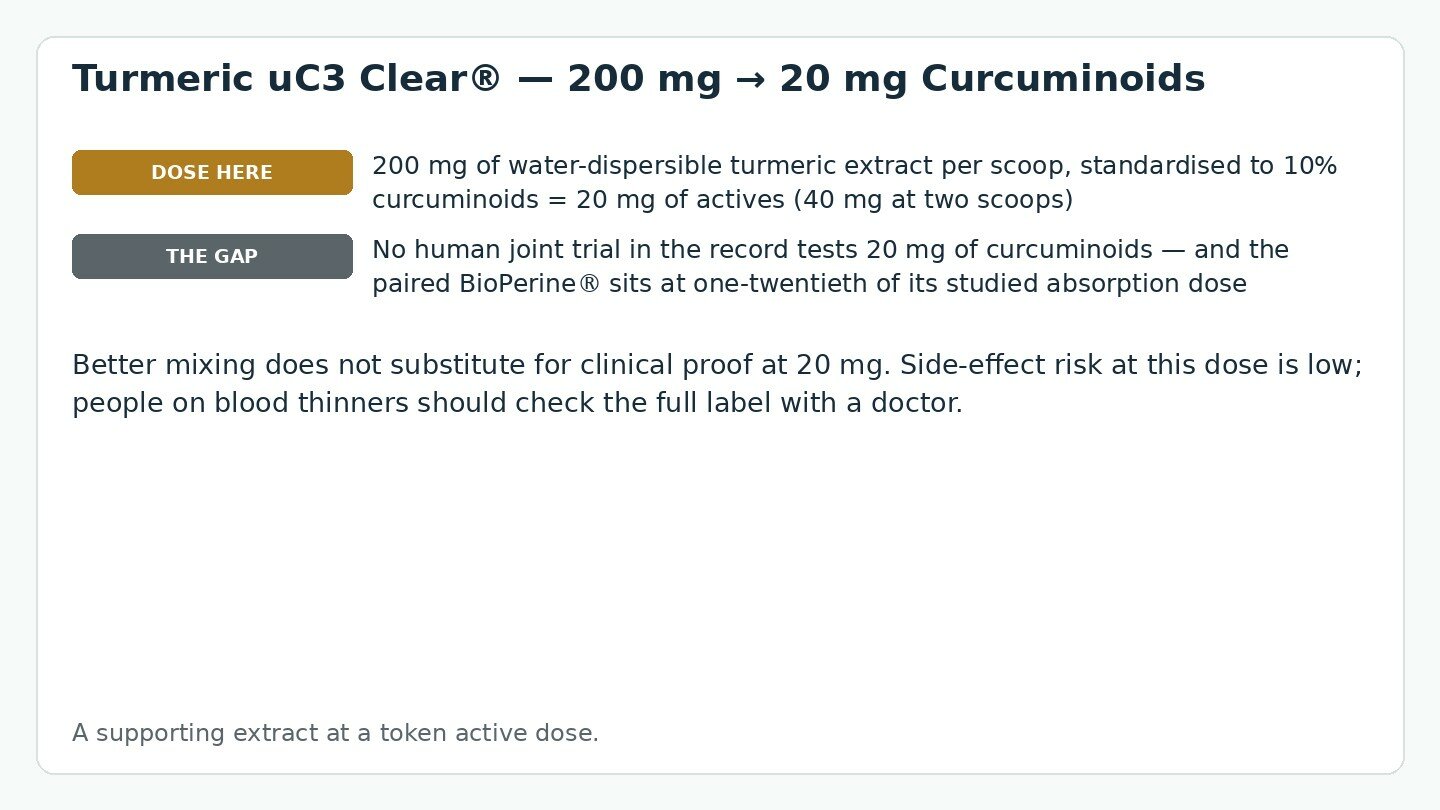
uC3 Clear® is a branded, water-dispersible turmeric extract included at 200 mg per scoop. The label states a standardisation of 10% curcuminoids, which yields 20 mg of active curcuminoids per serving — or 40 mg at two scoops. The maker includes turmeric for its familiar role in joint comfort and recovery after physical strain.
Printing both the extract weight and the 10% standardisation lets you see the real active dose immediately. Twenty milligrams of curcuminoids is a very modest amount compared with standalone curcumin joint supplements. Water-dispersible extracts are built to mix cleanly in a drink rather than clump at the bottom of the glass, which explains why the maker chose uC3 Clear® for a flavoured powder.
Still, better mixing does not substitute for clinical proof at 20 mg. No human joint trial in our record tests 20 mg of curcuminoids from this extract inside a multi-ingredient drink, and the paired black pepper extract sits far below its studied absorption dose. At 20 mg, side-effect risk is low, though people on blood thinners should check the full label with a doctor.
Ginger Rhizome Extract (200 mg)
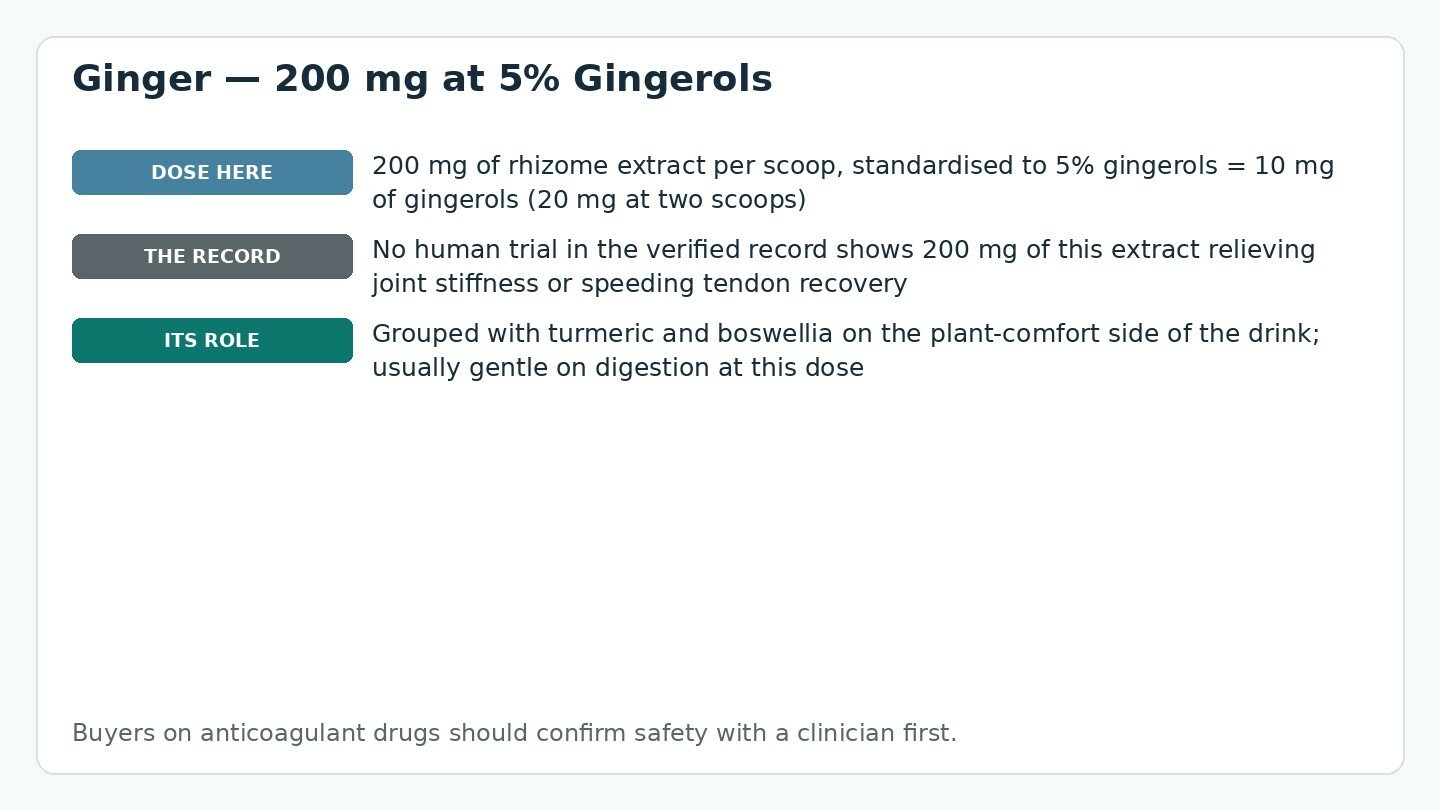
Flexomore contains 200 mg of ginger rhizome extract per scoop, standardised to 5% gingerols. That works out to 10 mg of gingerols per single serving, or 20 mg if you take two scoops daily. The maker groups ginger with turmeric and boswellia to reinforce the plant-based comfort side of the drink.
Naming the plant part (rhizome) and printing a 5% gingerol standardisation is cleaner than dumping unstandardised dried ginger root into a blend. Standardisation tells you the extract was measured for its primary active compounds rather than left to crop variation.
Even so, 200 mg of a 5% extract is a light supporting inclusion inside a ten-ingredient powder. Our verified literature record includes no human trial showing that 200 mg of this ginger extract relieves joint stiffness, speeds tendon recovery, or adds measurable benefit on top of collagen and glucosamine. Ginger at this dose is usually gentle on digestion, though buyers taking anticoagulant drugs should still confirm safety with a clinician before starting.
Boswellin® WS Boswellia Extract (100 mg → 30 mg boswellic acid)
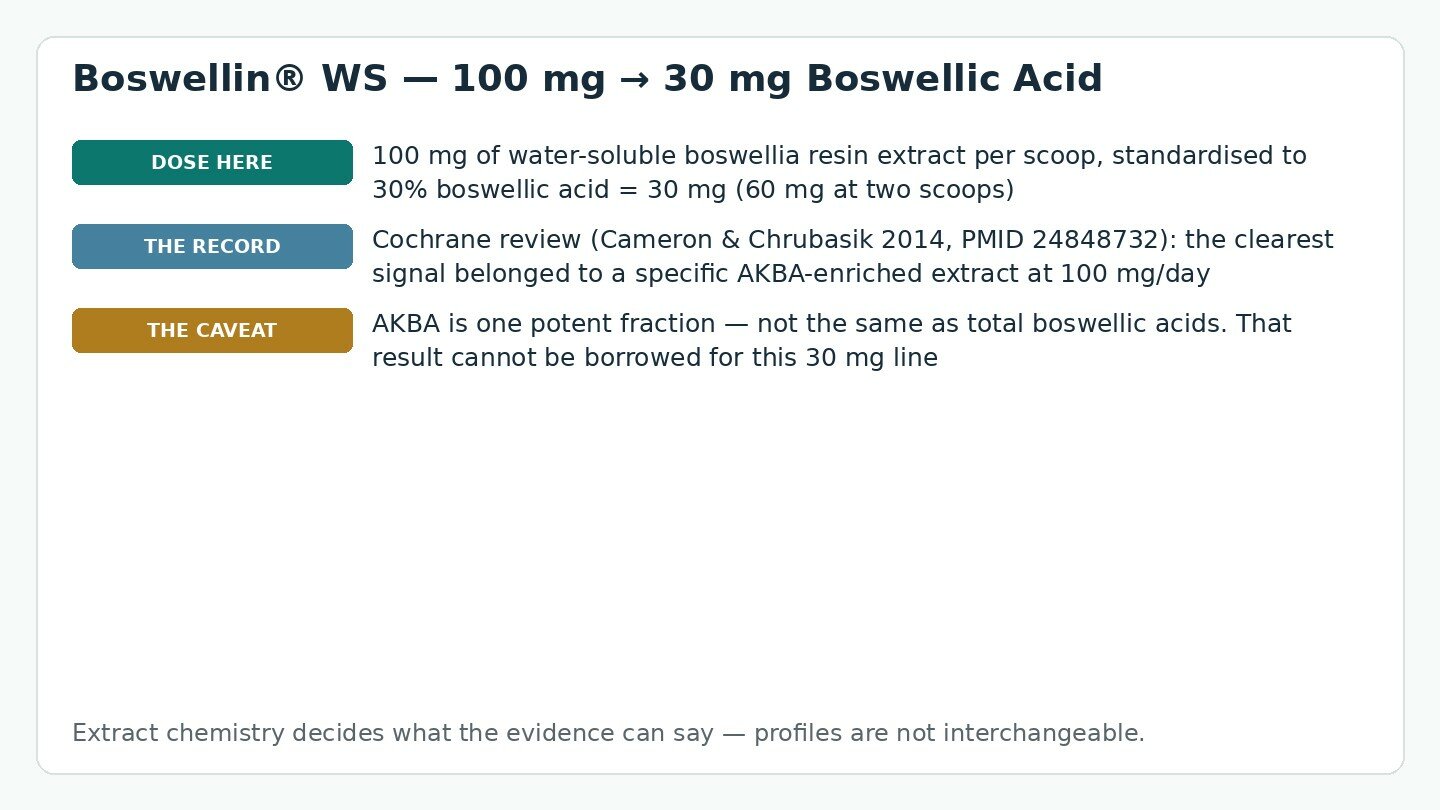
Boswellin® WS is a branded water-soluble extract of boswellia resin included at 100 mg per scoop. The panel standardises it to 30% boswellic acid, delivering 30 mg of boswellic acid per serving (60 mg at two scoops). The maker positions it to support joint mobility and ease stiffness after training.
Boswellia attracts serious interest in joint research, but the exact extract chemistry matters. In the Cochrane systematic review of oral herbal therapies for osteoarthritis (Cameron & Chrubasik 2014, PMID 24848732), the clearest positive signal belonged to a specific AKBA-enriched boswellia extract tested at 100 mg daily. AKBA is a single potent boswellic acid fraction, not the same thing as total boswellic acids.
Boswellin® WS is standardised to 30% general boswellic acid rather than an AKBA-enriched profile. Because those extract profiles differ, the Cochrane result cannot be borrowed to vouch for the 30 mg of boswellic acid in Flexomore. Tolerance is generally mild at 100 mg, though no safety trial tests this finished combination.
BioPerine® Black Pepper Extract (1 mg)
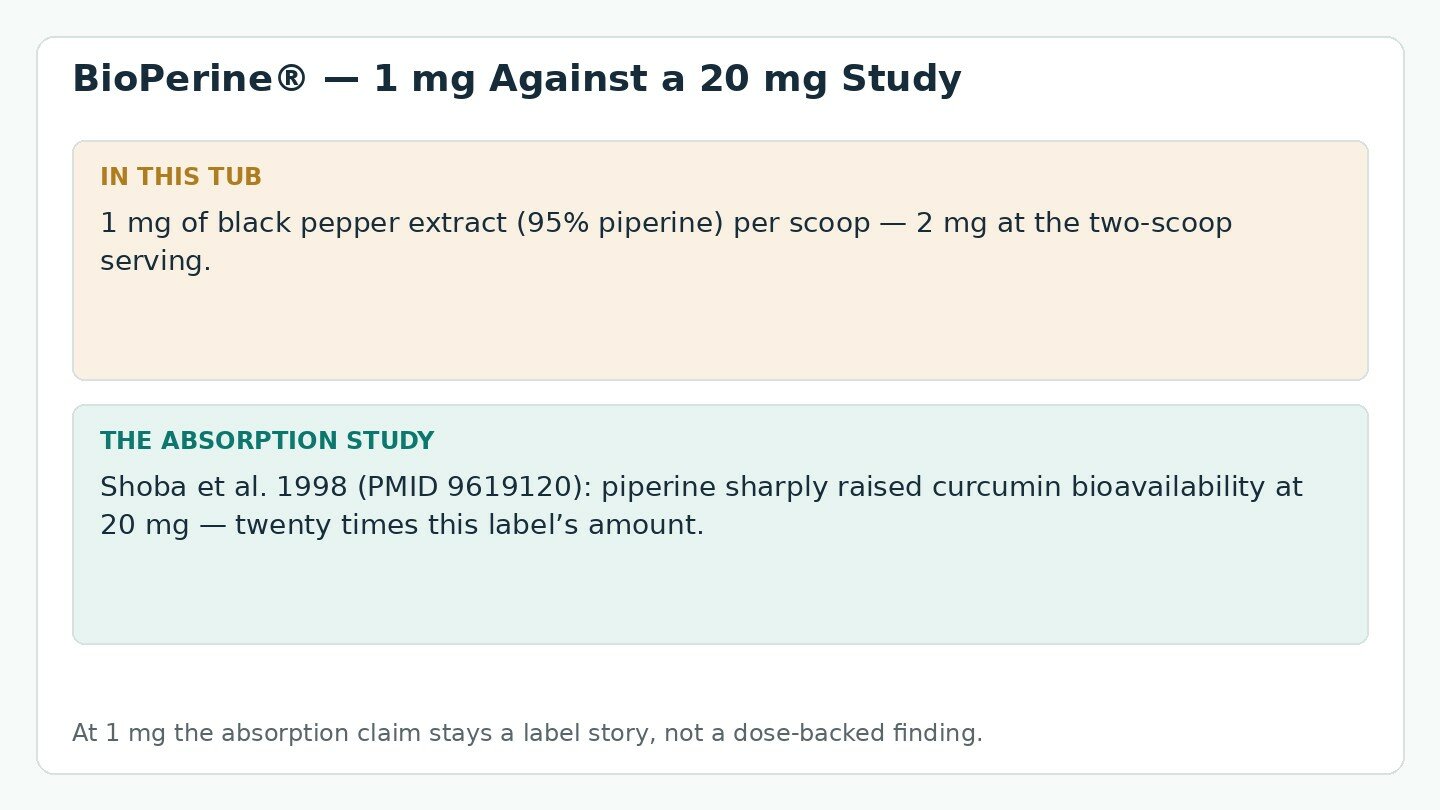
BioPerine® is a branded black pepper fruit extract standardised to 95% piperine. Flexomore puts 1 mg in a single 11 g scoop, rising to 2 mg at the two-scoop athlete serving. The maker adds BioPerine® to support absorption of the other plant extracts in the formula, especially the turmeric curcuminoids.
The problem is simple arithmetic against the clinical record. The classic human absorption study showing that piperine sharply increased curcumin bioavailability used 20 mg of piperine (Shoba et al. 1998, PMID 9619120). One milligram of BioPerine® is one-twentieth of that studied dose — and even two scoops delivers only one-tenth of it.
At 1 mg, the absorption claim stays a label story rather than a dose-backed finding. Readers should not assume that 1 mg of BioPerine® turns 20 mg of curcuminoids into a clinical-strength turmeric dose. On the safety side, 1 mg carries far less interaction potential than high-dose piperine capsules, though the maker publishes no medication cautions at all.
Vitamin C (80 mg)
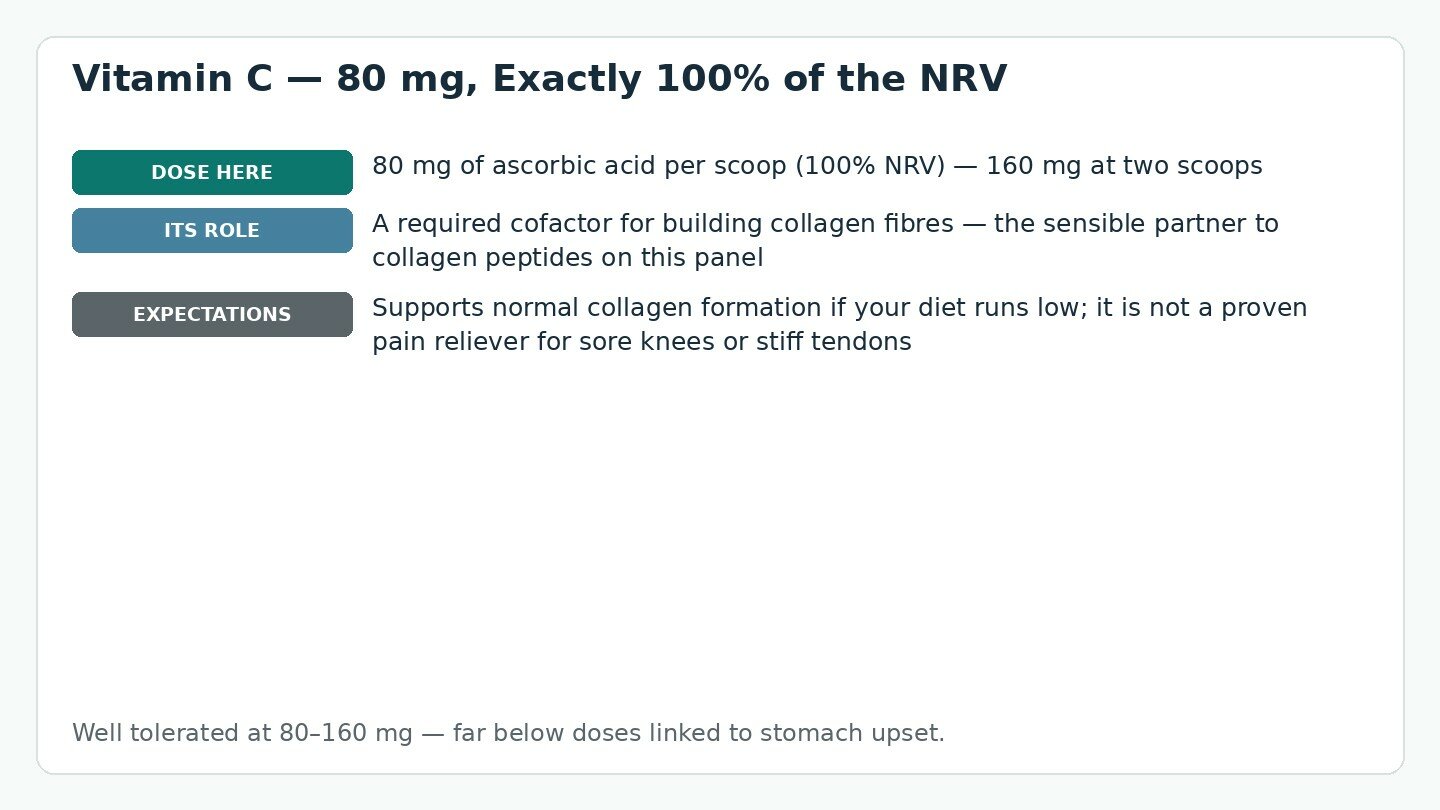
Flexomore supplies 80 mg of vitamin C (ascorbic acid) per scoop, meeting exactly 100% of the European NRV. Taking two scoops daily raises the total to 160 mg, or 200% of the NRV. The maker pairs vitamin C with Tendoforte® collagen peptides to support normal collagen formation in cartilage, tendons, and bones.
This is a sensible nutritional pairing. Your body relies on vitamin C as a required cofactor when building collagen fibres, so adding 100% of the daily reference intake alongside collagen peptides makes biological sense. Printing the exact 80 mg figure and NRV percentage keeps the mineral and vitamin side of the panel transparent.
Keep expectations realistic, however. Vitamin C supports normal collagen synthesis if your diet runs low, rather than acting as a proven pain reliever for sore knees or stiff tendons. At 80 mg to 160 mg daily, vitamin C is well tolerated by almost all healthy adults, well below doses linked to stomach upset.
Magnesium — Aquamin™ Mg (187.5 mg)
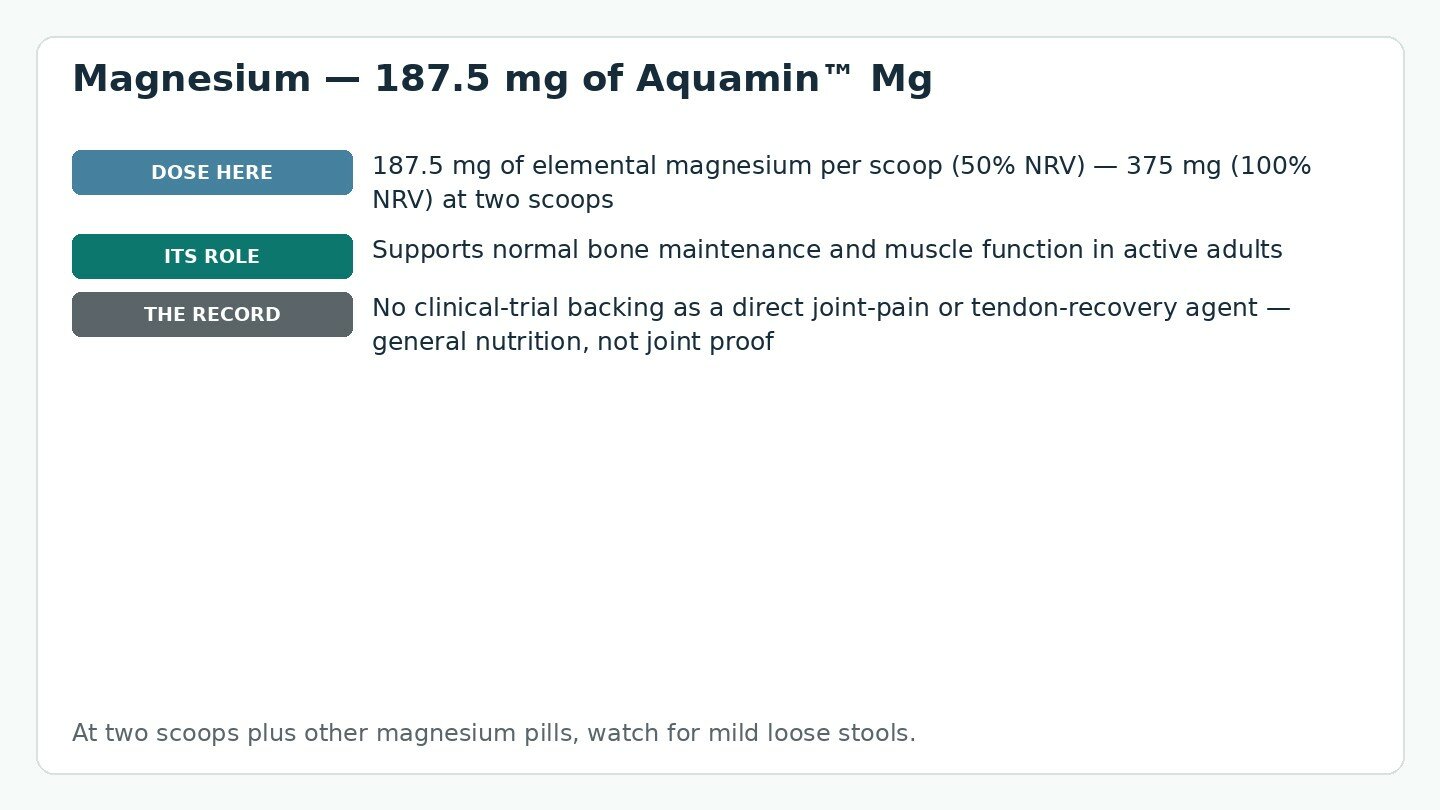
Aquamin™ Mg provides marine-derived magnesium salts delivering 187.50 mg of elemental magnesium per 11 g scoop. That equals exactly 50% of the European NRV at one scoop, and 375 mg (100% NRV) at two scoops. The maker pairs it with Aquamin™ calcium to support normal bone maintenance and muscle function in active adults.
Publishing the elemental magnesium weight rather than hiding it inside a salt total is a clear label win. Half the daily reference intake in one glass is a practical dose for people who train hard and want everyday bone and muscle nutrition bundled into their joint drink.
Just separate general nutrition from joint-pain proof. Magnesium helps maintain normal bones and muscles, yet it does not carry clinical trial backing as a direct joint-pain or tendon-recovery agent. At 187.5 mg, digestive tolerance is usually smooth; buyers taking two scoops (375 mg) on top of other magnesium pills should watch for mild loose stools.
The Dose Audit: Full Amounts, Read Against the Doses That Were Actually Studied
Publishing every ingredient weight is step one. Step two is checking those printed numbers against the doses human trials actually tested. When you run Flexomore's ten-line panel through that check, four clear findings emerge.
The Lead Ingredient Sits at Half Its Studied Dose
Tendoforte® collagen hydrolysate is the top ingredient on the panel at 2.5 g per scoop. Yet Praet et al. 2019 (PMID 30609761) — the human pilot trial cited for this branded collagen — gave participants 5 g a day alongside twice-daily calf-strengthening exercises.
In Flexomore, that 5 g studied dose exists only when you take two scoops a day. The maker's own directions recommend two scoops only for people doing five or more training sessions a week. Doubling the serving cuts a 30-serving tub to roughly 15 days and doubles your delivered daily cost from $1.47–$2.40 to $2.93–$4.80.
The Glucosamine Line Matches the Printed Standard — With Form Caveats
Unlike many rival labels that blur salt weight with active weight, Flexomore prints the exact breakdown: 2.00 g of glucosamine sulfate 2KCl per scoop, of which 1.50 g (1,500 mg) is D-glucosamine. That 1,500 mg figure matches the sulfate dose used in the positive three-year knee osteoarthritis trial (Reginster et al. 2001, PMID 11214126).
Context still matters. The large GAIT trial (Clegg et al. 2006, PMID 16495392) tested glucosamine hydrochloride and found no overall benefit over placebo. Flexomore uses the sulfate salt rather than hydrochloride, which places it on the stronger side of the form split — though the long-term sulfate trials were manufacturer-sponsored.
The Small Extracts Deliver Light Active Amounts
Look past the bulk extract weights and check the active fractions. Two hundred milligrams of uC3 Clear® turmeric extract at 10% curcuminoids delivers just 20 mg of curcuminoids. One hundred milligrams of Boswellin® WS at 30% boswellic acid delivers 30 mg of boswellic acid.
Those totals sit well below standalone joint-extract designs, and the boswellia chemistry does not match the clinical highlight. The Cochrane review's clearest boswellia signal came from an AKBA-enriched extract at 100 mg daily (Cameron & Chrubasik 2014, PMID 24848732) — a different profile from Boswellin® WS. Meanwhile, BioPerine® appears at 1 mg against the 20 mg of piperine used in the human absorption trial (Shoba et al. 1998, PMID 9619120).
MSM Sits Below Multi-Gram Trial Designs
One gram of MSM per scoop is far better than the token fractions squeezed into many capsule formulas. Even so, human joint trials of MSM typically test several grams per day rather than a single gram. One scoop leaves MSM as a modest contributor, and even two scoops reaches 2 g.
What Is Not in the Tub
Checking what is missing matters just as much as auditing what is printed. Neither chondroitin nor UC-II undenatured collagen appears anywhere on Flexomore's published ingredient panel or on the physical box.
That point is worth stressing because at least one rival review online invents both chondroitin and UC-II for Flexomore, alongside a capsule format that this drink powder does not have. Never trust second-hand summaries that rewrite a formula — read the maker's actual panel, not other people's reviews of the panel.
The Evidence, Read Properly
Checking joint supplements means separating ingredient research from finished-formula proof. Every study below tested a single ingredient under controlled conditions, often at a different dose or extract profile than one scoop of Flexomore delivers.
Tendoforte® Collagen Peptides — Praet et al. 2019
The primary human trial behind Flexomore's lead ingredient is a pilot double-blind crossover trial in 20 patients with chronic mid-portion Achilles tendinopathy (Praet et al. 2019, PMID 30609761). Both arms completed a twice-daily calf-strengthening programme for six months, crossing over at three months, with the active arm taking 5 g of Tendoforte® daily.
At three months, VISA-A tendon function scores improved by +12.6 points (95% CI 9.7; 15.5) in the peptides-first group compared with +5.3 points (95% CI 2.3; 8.3) in the placebo-first group. No adverse events were reported.
Read those limits carefully. The study tested collagen peptides paired with structured rehab, never peptides alone, and it studied Achilles tendinopathy rather than general joint pain. One scoop of Flexomore supplies 2.5 g — half the 5 g dose tested. Meanwhile, the maker's "18 runners, 12 returned to running" summary is its own presentation of this 20-patient paper, and its claim about reducing ligament and tendon rupture risk goes beyond the published findings.
Glucosamine Sulfate — Reginster et al. 2001
Flexomore supplies 1,500 mg of D-glucosamine from 2 g of glucosamine sulfate 2KCl per scoop. The long-term benchmark for that dose is a three-year randomised trial in 212 patients with knee osteoarthritis taking 1,500 mg of glucosamine sulfate daily (Reginster et al. 2001, PMID 11214126).
Participants on glucosamine sulfate showed less joint-space loss (−0.06 mm versus −0.31 mm on placebo) along with symptom improvements. That trial belonged to a manufacturer-sponsored programme, and that sponsorship is part of the record. Even taking the result at face value, the measured structural effect unfolded over three years rather than a few weeks.
Glucosamine Hydrochloride — The GAIT Trial (Clegg et al. 2006)
Broader glucosamine research is far more mixed. The landmark GAIT trial enrolled 1,583 participants to test glucosamine hydrochloride, alone and with chondroitin, against placebo (Clegg et al. 2006, PMID 16495392).
Overall, glucosamine hydrochloride did not beat placebo, and the placebo group alone showed a 60.1% response rate. The key caveat is the salt form: GAIT tested glucosamine hydrochloride, not the glucosamine sulfate form printed on Flexomore's panel. Still, that massive placebo response shows why personal impressions over a few weeks rarely prove an effect.
Boswellia — Cochrane Review (Cameron & Chrubasik 2014)
A Cochrane systematic review of oral herbal therapies for osteoarthritis found its clearest boswellia signal in trials using an AKBA-enriched extract at 100 mg a day (Cameron & Chrubasik 2014, PMID 24848732). Flexomore uses 100 mg of Boswellin® WS standardised to 30% boswellic acid (30 mg total boswellic acid), which is a different chemical profile from an AKBA-enriched extract. That Cochrane signal cannot be borrowed for this formula.
No Trial Tests the Finished Flexomore Formula
Nothing in the published scientific literature tests Flexomore itself. Alongside the half-dose collagen scoop and mismatched boswellia profile, BioPerine® sits at 1 mg against the 20 mg piperine absorption study (Shoba et al. 1998, PMID 9619120), and MSM sits at 1 g against multi-gram joint trials. Every claim for this drink rests on ingredient-level extrapolation rather than a finished-product trial.
How Long Does It Take to Work?
The maker's FAQ promises first results "within the first few weeks" and the best results after "about 3–4 months". That timeline sets expectations fast on the front end, yet even the maker's own guidance points to months for full assessment.
Published ingredient trials run longer still. In Praet et al. 2019 (PMID 30609761), each phase lasted three months before crossover, paired with daily calf-strengthening work. Glucosamine sulfate is conventionally judged at roughly three months of consistent daily use, while Reginster et al. 2001 (PMID 11214126) tracked joint-space outcomes over three full years.
Do the tub arithmetic before you start. One 330 g tub holds 30 servings, lasting 30 days at one scoop a day or about 15 days if you take two scoops daily for five or more weekly training sessions. A single tub is simply too short to judge collagen or glucosamine fairly.
A fair trial is three months at one scoop a day — the three-tub pack at $131.98 delivered. Because the maker publishes no money-back guarantee, you carry the full financial risk of that test. Order size is your only risk control, so commit to three months at most rather than buying six tubs upfront.
Is It Safe?
Start with the maker's own published caution, printed verbatim on both the physical box and the official ingredients panel: "Do not exceed the recommended daily dose. Not suitable for children, pregnant or lactating mothers. Do not take it as a substitute for a varied balanced diet or a healthy lifestyle. Balanced diet and healthy lifestyle are essential."
What the maker leaves out matters just as much. Neither the packaging nor the official website publishes a single medication-interaction warning. You have to check the active lines yourself if you take prescription drugs.
One exclusion is absolute. The ingredients list explicitly identifies the glucosamine as coming "(from crustaceans)". Anyone with a shellfish allergy must skip Flexomore completely.
Our own clinical caution — not printed by the maker — applies to blood thinners. Glucosamine has been reported to raise INR readings in people taking warfarin, increasing bleeding risk (Knudsen & Sokol 2008, PMID 18363538). If you take warfarin or another prescription anticoagulant, treat that as a mandatory doctor conversation before your first scoop.
Among healthy adults without those exclusions, the core ingredients have a reassuring safety record. Published glucosamine studies were generally well tolerated, and Praet et al. 2019 (PMID 30609761) reported no adverse events in its 20-patient Tendoforte® pilot. Still, no product-specific safety study has tested the finished ten-ingredient Flexomore powder, and buyers taking separate calcium or magnesium supplements should track their combined mineral intake.
Side Effects: What Is Actually Known
No adverse-event data is published for Flexomore itself, because no human trial has ever evaluated the finished powder. Everything known about tolerance comes from trials of its individual ingredients.
In human glucosamine trials, reported side effects are mostly mild digestive symptoms — such as stomach discomfort or bloating — occurring at rates close to placebo. In the six-month Tendoforte® pilot at 5 g daily (Praet et al. 2019, PMID 30609761), no adverse events were reported in either arm.
Practical tolerance also depends on whether you take one scoop or two. One scoop supplies 187.5 mg of elemental magnesium from Aquamin™ Mg (50% NRV), which most adults handle easily; doubling to two scoops delivers 375 mg (100% NRV) and may cause mild loose stools if you already take magnesium pills. Stop immediately if you notice any rash, itching, or allergic reaction.
When Joint Pain Needs a Doctor, Not a Powder
Flexomore is a dietary supplement, not a medical treatment for acute injury or inflammatory joint disease. A hot, swollen joint, fever alongside joint pain, pain following a fall or twist, a joint that locks or gives way, or pain that wakes you at night belong in a doctor's office — not in a shaker bottle.
Clinically tested routes beyond supplements exist and deserve a proper assessment first. Depending on the diagnosis, doctors use physiotherapy and structured strengthening exercise — note that the Tendoforte® trial itself paired peptides with a calf-strengthening programme — alongside prescription-strength anti-inflammatory medicines or corticosteroid injections. Persistent joint pain warrants a medical workup rather than ordering a second tub.
Is It a Scam?
No. Flexomore is a real supplement with a fully published ten-line ingredient panel, physical packaging that names its manufacturer (Nuvialab LLC in Wilmington, Delaware) and European Union origin, and written sales terms. You receive an actual 330 g tub of gram-dosed drink powder, not a mystery capsule.
The legitimate criticisms are real claim-to-record gaps, not signs of a fake product:
- Half-dose lead ingredient: One scoop delivers 2.5 g of Tendoforte® against the 5 g daily dose its own pilot trial used, while the sales page stretches that 20-person rehab study into broad claims about cutting ligament and tendon rupture risk.
- Unsourced survey headline: The sales page boasts that 98% of those surveyed noticed better comfort and flexibility, yet publishes no sample size, method, or timeframe alongside three unnamed five-star testimonials.
- Guarantee badges without refund terms: Badges on the page read "GUARANTEE OF QUALITY AND SAFETY" and "100% SAFETY AND QUALITY", yet no money-back guarantee exists anywhere in the checkout terms.
- Contradictory delivery promises: The maker's FAQ states delivery takes 2–3 working days, while Section 6 of its own terms states approximately 7 working days and notes that delivery may be extended. Both statements sit live on the same site.
Add the company-naming split — Nuvialab LLC and EU origin on the box versus an unnamed seller under Hong Kong law on the website — and you have classic promotional overreach wrapped around a real product. Flexomore is sold direct via the official website only, and its sole written returns route is a 10-calendar-day withdrawal on unused goods after submitting a written statement first.
Price and Packs
| Option | Total | Per tub | Cost per day |
|---|---|---|---|
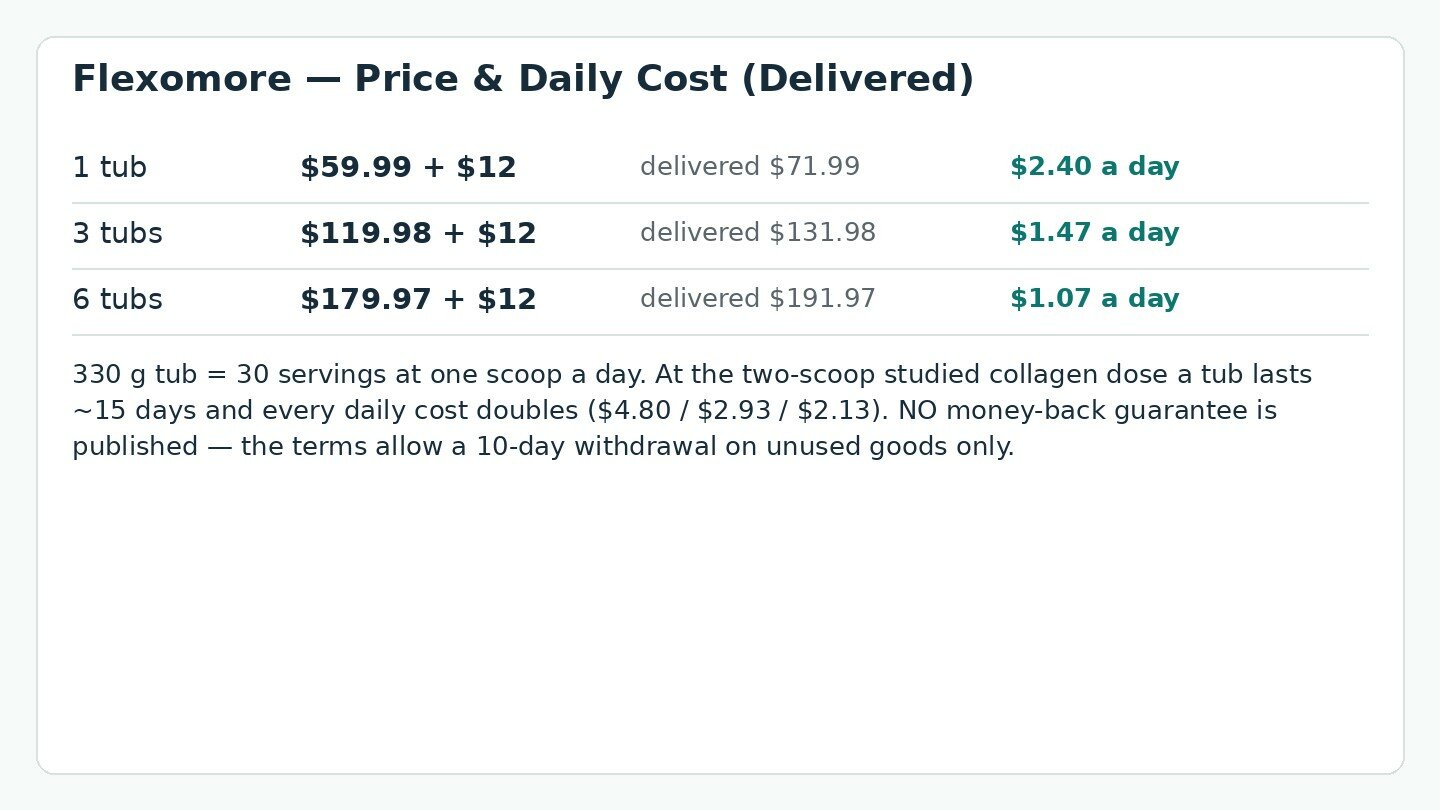
| 1 tub | $59.99 + $12 shipping ($71.99 delivered) | $59.99 | $2.40 |
| 3 tubs ("Buy 2 Items and Get 1 Free") | $119.98 + $12 shipping ($131.98 delivered) | $39.99 | $1.47 |
| 6 tubs ("Buy 3 Items and Get 3 Free!") | $179.97 + $12 shipping ($191.97 delivered) | $29.99 | $1.07 |
All figures above come directly from the maker's official order page, checked in November 2026. The daily costs in the table assume the standard one-scoop serving, which gives 30 days per 330 g tub.
Check the two-scoop maths before budgeting. If you train five or more times a week — or choose to take two scoops daily to reach the 5 g Tendoforte® dose from Praet et al. 2019 (PMID 30609761) — each tub lasts about 15 days and every daily cost doubles: $4.80 per day on one tub, $2.93 per day on three tubs, and $2.13 per day on six tubs.
A few checkout details stand out. The order page refers to the tubs as "bottles" in its per-unit pricing, even though Flexomore ships as a 330 g powder tub. There are no crossed-out anchor prices, no free-shipping threshold (shipping stays a flat $12 on every order), and no auto-ship subscription.
Purchase Options
Flexomore is sold direct through the official website, which is the only channel where the verified November 2026 tier prices and multi-tub offers apply. Keep three practical checks in mind before choosing an option:
- Three tubs match a fair trial: At one scoop a day, the three-tub pack ($131.98 delivered) covers three full months and drops your delivered daily cost from $2.40 to $1.47.
- Flat shipping penalises single tubs: Every order pays $12 shipping with no free-shipping threshold, making a single tub ($71.99 delivered) the steepest way to test the powder.
- Order size is your only safety net: Because no money-back guarantee is published and returns cover only unused goods within 10 days, never order more tubs than the trial you are ready to pay for outright.
How It Compares
| Product | Our score | Formula | Format |
|---|---|---|---|
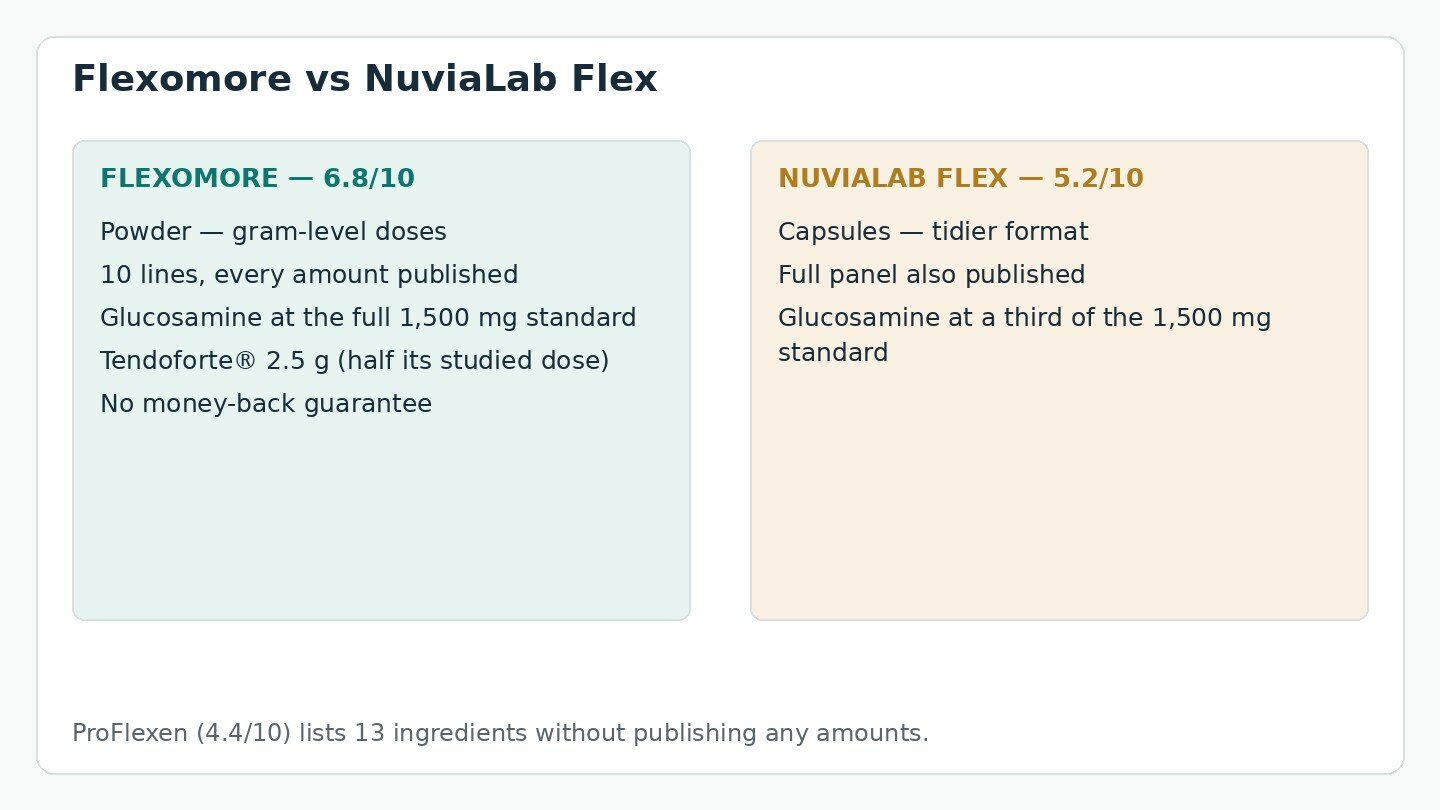
| Flexomore | 6.8/10 | 10 lines, every amount published | Powder |
| NuviaLab Flex | 5.2/10 | Full panel published, glucosamine at a third of the standard dose | Capsules |
| ProFlexen | 4.4/10 | 13-ingredient joint formula whose amounts are NOT published | Capsules |
The trade-off across these three joint products is clear. Flexomore uses a drink powder to carry gram-level weights — 2.5 g collagen, 2 g glucosamine sulfate salt, 1.25 g Aquamin™, and 1 g MSM — that capsules cannot comfortably hold, and publishes every single amount. NuviaLab Flex also publishes its full panel in a tidier capsule format, but trims glucosamine down to a third of the standard 1,500 mg dose. ProFlexen lists 13 ingredients without publishing their amounts, asking buyers to trust a list of names.
There is also a fourth column that does not come in a tub: the exercise-first route. Praet et al. 2019 (PMID 30609761) paired Tendoforte® peptides with a twice-daily calf-strengthening programme in both arms of its trial. That sets the honest frame for any supplement on this table — treat a joint powder as an optional addition to structured strengthening and smart load management, never a substitute for them.
Who Should Buy It — and Who Should Skip It
Who should buy it
- Active adults who train regularly and want a joint formula with every amount published at gram level.
- Buyers who would rather mix one orange-and-peach drink in 300 ml of water than swallow a handful of capsules every morning.
- People prepared to judge the formula consistently over a full three months at one scoop a day, alongside a structured training or rehab routine.
Who should skip it
- Anyone with a shellfish allergy: The glucosamine comes from crustaceans — this is a hard exclusion.
- Anyone taking warfarin who has not cleared it with a doctor: Glucosamine has been linked to raised INR readings on warfarin (Knudsen & Sokol 2008, PMID 18363538), and the label prints no warning.
- Children, and pregnant or breastfeeding women: Explicitly excluded by the maker's own caution.
- Buyers chasing the 5 g studied collagen dose on a tight budget: Hitting 5 g of Tendoforte® takes two scoops daily, halving each tub to about 15 days and doubling daily cost.
- Anyone who only buys behind a money-back guarantee: None is published anywhere on the site.
Frequently Asked Questions
Does Flexomore actually work?
No published clinical trial has tested the finished Flexomore powder, so expectations rest on ingredient studies. Its strongest points are 1,500 mg of D-glucosamine from glucosamine sulfate 2KCl — matching the dose in a three-year knee trial (Reginster et al. 2001, PMID 11214126) — and Tendoforte® collagen peptides. However, one scoop provides 2.5 g of Tendoforte®, half the 5 g tested alongside calf-strengthening rehab in 20 Achilles tendinopathy patients (Praet et al. 2019, PMID 30609761). View it as a transparent training support, not a proven cure.
How much Tendoforte® is in a scoop — and how does it compare with the study?
Each 11 g scoop of Flexomore delivers 2.50 g of Tendoforte® collagen hydrolysate. In the human crossover pilot by Praet et al. 2019 (PMID 30609761), 20 patients with chronic Achilles tendinopathy took 5 g of Tendoforte® daily alongside twice-daily calf-strengthening exercises for three months per phase. One scoop therefore delivers half the studied amount. Reaching the full 5 g dose takes two scoops a day — the serving the maker suggests for five or more weekly training sessions — which cuts each 30-serving tub to roughly 15 days.
Is the glucosamine dose the full trial dose?
Yes, as printed on the panel. Flexomore delivers 2.00 g of glucosamine sulfate 2KCl per scoop and prints the breakdown right underneath: 1.50 g (1,500 mg) of D-glucosamine. That matches the 1,500 mg daily glucosamine sulfate dose used in Reginster et al. 2001 (PMID 11214126), a manufacturer-sponsored three-year knee osteoarthritis study. Note that the larger GAIT trial (Clegg et al. 2006, PMID 16495392) found no overall benefit, though GAIT tested glucosamine hydrochloride rather than the sulfate form used here.
How long does Flexomore take to work?
The maker's FAQ states you may notice first results "within the first few weeks" and the best results after "about 3–4 months". Ingredient research aligns with the longer end of that range. Praet et al. 2019 (PMID 30609761) evaluated Tendoforte® plus strengthening rehab after three months per crossover phase, and glucosamine is conventionally judged at about three months (with Reginster et al. 2001, PMID 11214126, lasting three years). Plan on a three-month trial — three tubs at one scoop daily — before deciding.
Is Flexomore safe — and who should not take it?
The maker's caution states Flexomore is not suitable for children or pregnant and lactating mothers, and advises not exceeding the recommended daily dose. Because the glucosamine is crustacean-derived, anyone with a shellfish allergy must avoid it completely. Although the maker prints no medication warnings, glucosamine has been reported to raise INR in warfarin users (Knudsen & Sokol 2008, PMID 18363538), so anyone on warfarin must consult a doctor first. Component trials were generally well tolerated, though no finished-formula safety trial exists.
Does Flexomore have a money-back guarantee?
No money-back guarantee is published anywhere on the maker's sales or order pages. While promotional badges mention a "GUARANTEE OF QUALITY AND SAFETY", no refund terms back up an open-tub trial. Section 14 of the written terms allows only a 10-calendar-day withdrawal right on unused goods, and buyers must submit a written statement beforehand. Because there is no satisfaction guarantee once you open a tub, your initial order size is your only practical way to control trial risk.
Flexomore or NuviaLab Flex — which should I buy?
Flexomore scores 6.8/10 compared with NuviaLab Flex at 5.2/10, mainly because its powder format holds gram-level doses. One scoop of Flexomore delivers 2.5 g of Tendoforte®, 1.5 g of D-glucosamine, 1.25 g of Aquamin™, and 1 g of MSM with every amount published. NuviaLab Flex also prints its full panel and offers convenient capsules, yet its glucosamine line sits at only a third of the standard 1,500 mg dose. Pick Flexomore if you want full gram weights; pick capsules only if you dislike mixing drinks.
Where can I buy Flexomore — and what does a month actually cost?
Flexomore is sold direct through the official website. Checked in November 2026, one 330 g tub costs $59.99 plus a flat $12 shipping fee ($71.99 delivered), or $2.40 per day at one scoop daily. The three-tub option costs $119.98 plus $12 shipping ($131.98 delivered; $39.99 per tub; $1.47 per day), and six tubs cost $179.97 plus $12 shipping ($191.97 delivered; $29.99 per tub; $1.07 per day). At two scoops daily, every daily cost doubles and a tub lasts about 15 days.
Flexomore — Our Score: 6.8/10
Score: 6.8/10 · Sub-scores: Ingredients 8.5 · Evidence 6.5 · Safety 7.0 · Value 6.0 · Best for: Active adults who want a joint powder with every amount published at gram level, judged over a full three months · Main caution: No money-back guarantee is published; the lead collagen is 2.5 g a scoop — half the 5 g its own study used, so the studied dose needs two scoops a day and a tub then lasts about 15 days; the glucosamine is crustacean-derived · Fair trial: Three months — the three-tub pack at $131.98 delivered
Sources & Method
This review is based on the maker's official sales and order pages and its published ingredient panel (read November 2026), the product's physical packaging, and the published literature cited above — Praet et al. 2019 (PMID 30609761) on the collagen peptides, Reginster et al. 2001 (PMID 11214126) and Clegg et al. 2006 (PMID 16495392) on glucosamine, Cameron & Chrubasik 2014 (PMID 24848732) on boswellia, Shoba et al. 1998 (PMID 9619120) on piperine, and Knudsen & Sokol 2008 (PMID 18363538) on the warfarin caution — scored with the standard SuppChecked scoring method across ingredients, evidence, safety and value.
Last reviewed: November 2026
