
- Quick Answer
- What "Brain Fog" Is — and Why the Order of This Article Matters
- The Causes, One by One
- Sleep debt — and the apnoea hiding inside it
- Deficiencies: B12, iron, vitamin D
- Thyroid dysfunction
- Stress, burnout and mood
- Medications, alcohol and the rest of the differential
- Post-viral fog: the cause with the least to sell you
- Hormonal transitions: perimenopause and the fog nobody warned about
- The unglamorous remainder: water, movement, glucose, light
- The Workup, Concretely: What to Ask For
- The Red-Flag Box: When Fog Needs a Doctor, Not a Stack
- Brain fog in older adults: the fear to name, and the route it deserves
- Why this article won't grade the genre's favourite list
- Now the Supplements — Only This Formula's Ingredients, Audited Against the Causes
- Caffeine (150 mg): mask, not medicine
- Theacrine (125 mg): the subjective-energy bet
- Bacopa (187.5 mg): the wrong tool for fog, on two counts
- Magnesium (Aquamin™, 75 mg) and the B-vitamins: insurance, not treatment
- Gotu kola (50 mg) and rhodiola (100 mg): the tail of the label
- Cause × What Can and Cannot Help: The Table
- How Long Does Fog Take to Fix? Timelines by Cause
- Before You Spend Anything: The Two-Week Fog Diary
- Who Should Buy Brain Actives — and Who Should Skip It
- Frequently Asked Questions
- What is the best supplement for brain fog?
- Can low B12 really cause brain fog?
- Is magnesium good for brain fog?
- How long should I try a supplement for fog before deciding?
- When is brain fog a sign of something serious?
- Does Brain Actives help brain fog?
- Read This Next
Disclosure: This article contains affiliate links. If you buy through them, we may earn a commission at no extra cost to you. It never changes our conclusions.
Quick Answer
"Brain fog" is not a diagnosis — it is a description, and it has causes. The commonest are unglamorous and checkable: sleep debt and sleep apnoea, vitamin B12, iron or vitamin D deficiency, thyroid dysfunction, chronic stress and low mood, medication effects, and post-viral states.
A supplement can genuinely help in exactly two of those situations — when it corrects a deficiency that testing has actually found, and when a stimulant temporarily masks the fatigue component (which is relief, not treatment). Everything else a fog product promises should be priced as hope.
This article therefore works in the order a good clinician would: causes first, red flags plainly marked, and only then an audit of what the ingredients in one real formula — Brain Actives, the product this site sells — can and cannot do for a foggy brain, at the doses actually in the bottle.
Best for: adults with persistent fog who want the workup before the shopping — and who would rather fix a found cause than rent relief from an unfound one.
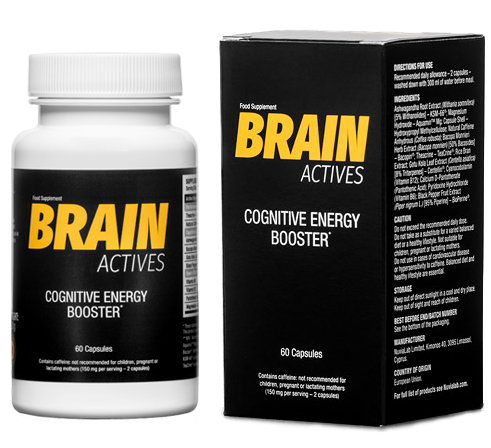
Our Recommendation — Brain Actives
Score: 5.5/10 · Best for: adults who want same-day focus from a transparent stimulant pairing, treating the memory ingredients as a slow, secondary experiment. Main caution: one serving's vitamin B6 (14 mg) exceeds EFSA's 12 mg/day upper level, the bacopa is underdosed, and no money-back guarantee is published. Fair trial: one bottle — a month is enough to judge the stimulant effect honestly, and no guarantee protects a bigger first order.
What "Brain Fog" Is — and Why the Order of This Article Matters
Brain fog is the everyday name for a cluster of experiences: thoughts that move slowly, words that will not arrive, reading the same paragraph three times, a sense of thinking through gauze.
It appears in no diagnostic manual, because it is not a condition but a final common output — the subjective result produced by many different systems failing in many different ways, from a short night's sleep to a failing thyroid.
That single fact determines everything about how fog should be approached, and it is why the supplement genre's standard article — a list of ten ingredients with a product at the end — is structured exactly backwards.
A list answers "what might I take?" before anyone has asked "what is wrong?", and for a symptom with medical causes, that order has a cost measured in more than money: every month spent trialling capsules for a fog caused by sleep apnoea, hypothyroidism or B12 deficiency is a month the actual cause went untreated.
So this article inverts the genre. The first half is causes — what produces fog, how each cause is checked, and who should do the checking. The second half audits supplements, and only the ingredients in one real formula, at their real doses, against the causes they could plausibly touch.
If you finish the causes section and recognise yourself in a red-flag row, the correct purchase is an appointment; the supplement sections will still be here when the workup is done.
The Causes, One by One
Sleep debt — and the apnoea hiding inside it
The commonest cause of fog in working adults is the least mysterious: not enough sleep, or sleep of poor quality.
Chronic partial sleep restriction degrades attention, working memory and processing speed in a dose-dependent way, and — the trap — subjective sleepiness plateaus while performance keeps falling, so people adapt to feeling "fine" at a level of impairment they would not accept from alcohol.
Inside this category hides the cause most often missed entirely: obstructive sleep apnoea, in which breathing pauses fragment sleep dozens of times a night. Its calling cards are loud snoring, witnessed pauses, morning headache, unrefreshing sleep despite adequate hours, and daytime fog in a person who insists they "sleep fine".
Apnoea is common, underdiagnosed, and consequential well beyond fog (cardiovascular risk rides along), and no supplement touches it; the check is a sleep study, arranged through a clinician, and the treatments are mechanical and effective. If your fog keeps company with snoring, start here — before a single capsule.
Deficiencies: B12, iron, vitamin D
Three deficiencies produce fog reliably enough to be routine exclusions. Vitamin B12 deficiency causes cognitive slowing, memory problems and, in advanced cases, neurological symptoms; risk concentrates in older adults, vegans, people on metformin or long-term acid suppression, and anyone with absorption disorders.
Iron deficiency — with or without full anaemia — produces fatigue and cognitive dullness, most often in menstruating women, endurance athletes and donors; ferritin is the test that matters, not haemoglobin alone.
Vitamin D deficiency is associated with fatigue and low mood in observational work, though its trial record for cognition is weak — it is worth measuring and correcting on general grounds, not as a promised fog cure. The shared discipline: test, then treat the result.
Each of these is a blood test and a targeted, dosed correction — a deficiency regimen is not the same thing as the insurance-level amounts in a general formula, a distinction the audit section below applies to this product's own B12 line.
Thyroid dysfunction
An underactive thyroid is the classic fog cause that patients discover late, because its onset is gradual and its symptoms — mental slowing, fatigue, weight gain, cold intolerance, low mood — are easily mistaken for stress or ageing. It is also one of the cheapest exclusions in medicine: a TSH blood test, with free T4 as indicated.
Fog with any of those companions deserves the test before it deserves a supplement trial, full stop. (The mirror condition, an overactive thyroid, fogs by a different route — anxiety, tremor, broken sleep — and the same blood test catches the direction.)
Stress, burnout and mood
Sustained stress degrades exactly the faculties fog names: working memory narrows, recall gets effortful, attention fragments.
Chronic stress and burnout are not character flaws or supplement deficiencies; they are load problems, and their evidence-based remedies are load-shaped — workload, recovery, sleep, and treatment where stress has tipped into anxiety or depression, both of which present with fog as a core complaint.
Our stress cluster exists for this territory — its coverage of rhodiola and of the adaptogen comparison grades what the supplement shelf can offer there (modest, slow, adjunctive) — and its L-theanine article covers the one acute calm-focus ingredient.
The routing rule for this article: if your fog arrived with a brutal quarter, a bereavement, or a mood that has been low for weeks, the fog is a symptom of that, and it should be treated there.
Medications, alcohol and the rest of the differential
A fog workup that skips the medicine cabinet is incomplete. Sedating antihistamines, some sleep aids, certain blood-pressure and pain medicines, gabapentinoids, and many psychiatric medications carry cognitive dulling as a listed effect; alcohol — even at socially normal evening levels — fragments sleep architecture and bills the next morning in exactly fog's currency.
Post-viral states, including long COVID, produce a recognisable fog that is real, common and still short on proven treatments (any product claiming otherwise is ahead of the science). Hormonal transitions — perimenopause prominently — bring fog that deserves its own conversation with a clinician.
And dehydration, inactivity and a chaotic glucose pattern from skipped meals and sugar spikes contribute their unglamorous share. None of these causes has a capsule-shaped solution, which is rather the point of listing them in a supplement article.
Post-viral fog: the cause with the least to sell you
A substantial minority of people who recover from COVID-19 — and smaller numbers after other viral illnesses — describe a persistent fog: slowed thinking, lost words, an exhaustion that is as much cognitive as physical.
Post-viral fog deserves its own paragraph in this article for one reason: it is the cause for which the supplement market's promises run furthest ahead of any evidence. There is, at the time of writing, no supplement with convincing trial evidence for post-viral cognitive symptoms.
The management approaches with clinical support are unglamorous — pacing (structuring activity to avoid the crash cycle that overexertion triggers in many post-viral patients), sleep protection, treatment of accompanying problems like orthostatic intolerance and mood, and time, across which many cases improve.
If your fog began with an infection and has not lifted, the route is a clinician who takes post-viral illness seriously, plus the red-flag awareness that "post-viral" is a diagnosis of exclusion — thyroid, anaemia and the rest of this article's list still have to be ruled out rather than assumed away.
Be especially wary of any product that names long COVID in its marketing: it is telling you it will sell to a group with no proven options, which is information about the seller, not the treatment.
Hormonal transitions: perimenopause and the fog nobody warned about
Women in their forties and early fifties form one of the largest and least well-served fog populations. Perimenopause — the years of fluctuating oestrogen before periods stop — commonly brings word-finding difficulty, forgetfulness and a sense of mental slowing, frequently alongside the sleep disruption of night sweats, which compounds it.
The pattern is real, it is not early dementia (the fear it most often carries), and for most women it stabilises after the transition. It also has a proper clinical pathway: a conversation about the full symptom picture, where hormone therapy and other treatments are medical decisions with real evidence behind them — not supplement decisions.
The fog-specific relevance for this article is routing: a 47-year-old trialling focus capsules for a hormonally driven symptom is spending money in the wrong aisle, and the B-vitamin and botanical content of a product like Brain Actives has no evidence in this picture at all. (Its caffeine, as always, can mask a tired morning — and can equally worsen the sleep fragmentation that is already half the problem. Timing discipline matters doubly here.)
The unglamorous remainder: water, movement, glucose, light
The last causes are the ones no article can sell, which is why they are usually missing. Mild dehydration measurably degrades short-term memory and attention in experimental settings; a foggy afternoon in a heated office is often partly a water problem.
Sedentary days produce an afternoon cognitive trough that a ten-minute walk reverses more reliably than a second stimulant dose — movement is among the best-evidenced acute "nootropics" in existence and the only one with no label.
Chaotic glucose — skipped breakfast, a large refined lunch — writes its signature across the early afternoon in a pattern sufferers often blame on their brain rather than their menu. Light sets the circadian alertness curve: a morning spent in dim indoor light flattens it, and daylight exposure is a legitimate part of any serious fog protocol.
None of this is a reason to feel scolded — it is a reason the causes section of an honest fog article is longer than its supplement section. Most fog is not a deficiency of an exotic molecule. It is the arithmetic of sleep, load, chemistry and habit, and it responds to being treated as arithmetic.
The Workup, Concretely: What to Ask For
If the causes section has done its job, some readers now need the practical version: what does the medical route actually involve? A first appointment for persistent fog is mostly history — onset, pattern, sleep, snoring, medications, mood, alcohol, workload — plus a basic examination.
The standard first-round blood panel for fog typically covers full blood count (anaemia), ferritin (iron stores), vitamin B12 (with folate), TSH (thyroid), and commonly vitamin D, blood glucose or HbA1c, and inflammatory markers, adjusted to your picture. Bring the two-week diary described later in this article; it genuinely changes the quality of that appointment.
Snoring plus witnessed apnoeas routes to a sleep study. Low mood routes to proper assessment and treatment, where fog is a tracked symptom. Abnormal bloods route to targeted correction with a re-test date — the discipline that separates treatment from supplementation is exactly that loop: measure, correct, re-measure.
What the workup is not: a scan, in most cases (imaging is for red-flag presentations), or a hormone "panel" sold direct-to-consumer without interpretation. Expect the process to take weeks, not a checkout. That timescale is precisely why the supplement shortcut tempts — and precisely why the shortcut so often fails: it is not faster at fixing anything, it is only faster at feeling like action.
The Red-Flag Box: When Fog Needs a Doctor, Not a Stack
| Pattern | Why it changes the route |
|---|---|
| Sudden onset (days), or fog after a head injury or illness with fever | Acute cognitive change is a medical presentation, not a supplement indication |
| Progressive worsening over weeks–months | Requires a diagnostic workup — the trajectory itself is the symptom |
| Fog with neurological signs: weakness, speech change, vision change, new severe headache | Same-day medical assessment |
| Fog with loud snoring, witnessed breathing pauses, morning headaches | Sleep apnoea pathway — sleep study, not stimulants (stimulants mask the sleepiness that should be investigated) |
| Fog with marked low mood, anxiety, or loss of interest lasting weeks | Mood disorders present as fog; they have effective treatments that are not in this article |
| Fog in a woman with heavy periods, or anyone with pallor, breathlessness, hair shedding | Iron/B12 pathway — blood tests first |
| New fog after starting or changing a medication | Review the medication with its prescriber before adding anything |
None of these patterns is rare, and none is a counsel of alarm — they are the standard branch points of a competent fog workup, printed here because supplement content almost never prints them, and because one reader routed correctly is worth more than a hundred bottles routed wrongly.
Brain fog in older adults: the fear to name, and the route it deserves
For readers over sixty, fog carries a specific fear — that it is the first sign of dementia — and that fear deserves a direct answer rather than a product.
The reassuring facts first: the commonest causes of fog in older adults are the same as at forty (sleep, medications, thyroid, B12, mood, apnoea), age-related slowing of recall speed is normal and distinct from dementia, and bacopa's trial population in this very cluster was healthy older adults — ordinary ageing brains, studied for ordinary support.
The genuinely distinguishing features of dementia are different in kind: getting lost in familiar places, losing the ability to manage finances or medications, word-finding failure that disrupts conversation rather than merely pausing it, and decline that others notice more than the person does.
Fog that is progressive, that family members flag, or that arrives with functional losses belongs to the red-flag route in this article, promptly — not because the outcome is predetermined (many workups find treatable causes), but because the workup is where the answer lives.
What an older reader should not do is self-prescribe reassurance in capsule form for a symptom whose differential includes conditions with real treatments and real timelines. The causes-first order of this article applies with doubled force here, and the diary-plus-appointment route is the kindest as well as the most rational next step.
Why this article won't grade the genre's favourite list
Open any competing brain-fog page and you will meet the same supporting cast: vitamin D, omega-3 fish oil, lion's mane, phosphatidylserine, magnesium threonate, a probiotic.
This article declines to grade them — not because each lacks any file (vitamin D deficiency is in our causes section, where it belongs, as a test-and-correct item), but because none of them is in the product this page audits, and borrowing their literature into a Brain Actives article would be the precise manoeuvre this site exists to refuse: letting unrelated ingredients' evidence cosign a formula that does not contain them.
If you want those ingredients graded, they deserve their own audits, at their own doses, in products that actually contain them. Here, the discipline is narrower and more useful: one formula, its real contents, its real doses, against the causes it could plausibly touch. The result is a shorter supplement section and a longer causes section than the genre's — which is, in miniature, the correct shape of fog advice itself.
Now the Supplements — Only This Formula's Ingredients, Audited Against the Causes
The supplement half of this article follows a rule no competitor we found observes: it discusses only the ingredients in the product this page is about — Brain Actives — because a fog article stuffed with vitamin D, omega-3 and fashionable mushrooms that the featured formula does not contain is not advice; it is a roundup wearing a workup's clothes.
(One borrowing is refused explicitly and early: Brain Actives' magnesium is Aquamin™, a marine mineral form at 75 mg. The brain-fog genre's magnesium data belongs overwhelmingly to magnesium L-threonate at 1,500–2,000 mg of compound — a different form at a different scale. None of it transfers, and none is claimed here.)
Caffeine (150 mg): mask, not medicine
Caffeine's fog role is precise: it blocks the adenosine signal of sleepiness and thereby rents back alertness that sleep debt took — the restore-not-enhance effect that anchors our whole nootropics set.
For fog whose cause is a short night, that is honest relief with a known price (tolerance in days to weeks; sleep cost if dosed within roughly eight hours of bed — the Drake et al. 2013 data put a number on it: 400 mg six hours before bed still cost over an hour of measured sleep).
For fog whose cause is apnoea, thyroid, deficiency or mood, caffeine does something more dangerous than nothing: it anesthetises the symptom that was supposed to send you to the workup. Grade: effective symptomatic relief for fatigue-type fog; zero causal value; use it, if you use it, in parallel with the causes section, never instead of it.
Theacrine (125 mg): the subjective-energy bet
Theacrine's file — audited in full in our theacrine-versus-caffeine article — is small pilots showing improved subjective energy and fatigue ratings, with objective cognition null in the one trial that measured it (Kuhman et al. 2015) and eight weeks of reassuring safety data (Taylor et al. 2016) at doses above this formula's 125 mg.
Translated to fog: theacrine might make a tired person feel less foggy for longer than caffeine alone; whether it changes anything measurable is unproven, and it shares caffeine's core limitation in stronger form — nothing in its file addresses a single cause in the first half of this article. Grade: plausible symptomatic adjunct, preliminary evidence.
Bacopa (187.5 mg): the wrong tool for fog, on two counts
Bacopa's evidence is for memory recall over twelve weeks at 300 mg — a slow, narrow effect, mostly in older adults, with a negative 2025 trial in the file (Lopresti & Smith 2025).
Fog is neither its outcome nor its timeline: nobody's trials measured "fog", and a person foggy today is not helped by an ingredient whose foundational trial was null at five weeks. At this formula's 187.5 mg the dose gap compounds the mismatch. Grade for fog: not applicable — a memory ingredient on the wrong clock, included here because buyers constantly misassign it.
Magnesium (Aquamin™, 75 mg) and the B-vitamins: insurance, not treatment
Magnesium participates in hundreds of enzymatic processes and low intake is genuinely common; the stress-literature doses, however, run to several hundred milligrams a day, and 75 mg of a marine form is best understood as a modest dietary top-up — sensible, unglamorous, and not a fog intervention.
Vitamin B12 (25 µg) follows the deficiency logic exactly: if your B12 is low, correcting it can lift the cognitive symptoms — with a clinician's regimen, which for true deficiency often involves doses or routes chosen for absorption, not a 25 µg line in a blend.
If your B12 is adequate, the same 25 µg does nothing measurable for fog; B12's benefit is a deficiency story, full stop. Pantothenic acid (15 mg) is a B-vitamin with no fog evidence of its own.
And vitamin B6 (14 mg) belongs to this article's safety column, not its benefit column — it exceeds the European Food Safety Authority's tolerable upper intake level of 12 mg/day (set in 2023 on peripheral-neuropathy evidence) while sitting far below the US upper limit of 100 mg/day.
A daily fog product is a long-term habit by definition, and a daily habit is exactly the exposure pattern an upper level governs; count your total B6 — food, multivitamin, this — before making any formula a fixture. Our safety article gives B6 the full treatment it deserves.
Gotu kola (50 mg) and rhodiola (100 mg): the tail of the label
Two lines, honestly priced. Gotu kola's meta-analysis (Puttarak et al. 2017) found no cognitive benefit in any domain — for fog purposes it is label decoration at any plausible dose, and 50 mg is not a plausible dose anyway.
Rhodiola is a fatigue-context ingredient whose record lives in our stress cluster, at 200–600 mg in stressed populations; at 100 mg here it is a supporting whisper. Neither changes the fog verdict on this formula, and neither should change a purchase.
Cause × What Can and Cannot Help: The Table
| Cause | What actually helps | What this formula can do | What it cannot do |
|---|---|---|---|
| Sleep debt | Sleep; caffeine discipline | Mask the morning (caffeine 150 mg) — relief, honestly labelled | Repay the debt; late dosing deepens it |
| Sleep apnoea | Sleep study; mechanical treatment | Nothing of value — may mask the warning symptom | Open an airway |
| B12 / iron / vitamin D deficiency | Blood test, then a dosed correction regimen | B12 25 µg as background insurance only | Diagnose, or treat a confirmed deficiency at these amounts |
| Thyroid dysfunction | TSH test; prescribed treatment | Nothing | Substitute for the test or the treatment |
| Stress / burnout / low mood | Load change, recovery, treatment where indicated; graded adjuncts in our stress cluster | Acute alertness only; rhodiola line is below its studied range | Treat the cause — and stimulants can worsen the anxiety variant |
| Medication effect | Prescriber review | Nothing appropriate | Outvote a prescribed drug's side effect |
| Post-viral fog | Time, pacing, clinician follow-up | Symptomatic masking at best | Anything proven — no product can, yet |
| Ordinary tired morning, no cause found | Routine, light, movement — and caffeine if wanted | This is its one honest use case: same-day alertness from a labelled dose | Become a diagnosis by default |
The table is the article in miniature: one row in eight is a genuine product use case, three rows are "nothing", and the rest are partial or hazardous substitutions. A fog page that cannot produce a table like this about its own featured product is not informing the purchase; it is laundering it.
How Long Does Fog Take to Fix? Timelines by Cause
One question the causes section implies but never answers directly: once a cause is found, how long until the fog lifts? The timelines differ by an order of magnitude, and knowing them prevents the commonest error in this whole territory — abandoning a working treatment inside its latency, or persisting with a useless one past its verdict date.
Sleep debt repays fastest: alertness improves within nights of restored sleep, though a deep chronic debt can take one to two weeks of consistent schedule to normalise. Caffeine chaos — the tolerance-and-late-dosing pattern — resolves on the withdrawal clock: three to nine rough days after a reset, with the cut-off discipline paying back within the first week.
Iron and B12 correction runs on haematology's clock: fatigue and fog typically improve across four to twelve weeks as stores rebuild, verified by the re-test rather than by feel. Thyroid treatment is titrated over six-to-eight-week cycles per dose adjustment; fog often lags the blood numbers by a further few weeks.
Apnoea treatment can change mornings within days of effective therapy, with fuller cognitive recovery trailing over weeks to months. Stress and mood causes move slowest and least linearly — load changes and treatment are measured in months, with fog lifting as a trailing indicator.
Notice the pattern a supplement has to beat: the genuine fixes mostly declare themselves inside a quarter. A product trialled indefinitely, without a cause found and without a verdict date, is not competing against these timelines — it is substituting for them. Set your dates from this table, and let them, not hope or habit, decide what continues.
Before You Spend Anything: The Two-Week Fog Diary
The cheapest diagnostic instrument in this article costs nothing and outperforms a month of capsule-trialling: a two-week log, kept in a notebook or phone note, with five lines a day. Sleep (hours, and a 1–5 quality score on waking). Fog (a 1–5 score at midday, plus one concrete example — the paragraph re-read, the name lost).
Caffeine (total milligrams, and the time of the last dose). Context (workload, alcohol the night before, exercise, any new medicine). Mood (1–5).
Two weeks of this separates the patterns that matter: fog that tracks short nights (a sleep problem wearing a supplement problem's clothes), fog that tracks caffeine timing (a tolerance-and-cut-off problem), fog that is flat regardless of everything (the pattern that most deserves the blood panel — B12, ferritin, vitamin D, TSH — and a clinician's hour), and fog that lifts on weekends (a load problem, and you already know its name).
Bring the diary to that appointment and you have converted a vague complaint into clinical data — the single most useful thing a fog sufferer can do, and the thing no checkout page will ever suggest.
Only after the diary, and after any red-flag or deficiency routes it points to, does a supplement trial become a rational line item — run then as the bounded experiment our focus ranking describes: one change, a verdict date, output scored rather than vibes.
Who Should Buy Brain Actives — and Who Should Skip It
Buy it if your fog has been through the causes section — sleep audited, red flags absent, deficiencies and thyroid checked or confidently unlikely — and what remains is the ordinary tired-morning row of the table: you want same-day alertness from a labelled stimulant pairing, you will respect the caffeine maths (150 mg inside, counted against your day, nothing within ~eight hours of bed), and you are not stacking B6 elsewhere.
Skip it if your fog is new, worsening, snoring-accompanied, mood-accompanied or deficiency-suspicious — your next step is the workup, and this product's caffeine can only muffle the signal that sends you there; skip it if you are pregnant, caffeine-sensitive or managing a cardiovascular condition (the maker's own cautions); and skip it as a fog treatment in all cases — it is, at its honest best, fog relief for one cause out of eight, priced at $59.99 a month with no published money-back guarantee.
Our Recommendation — Brain Actives
Score: 5.5/10 · Best for: adults who want same-day focus from a transparent stimulant pairing, treating the memory ingredients as a slow, secondary experiment. Main caution: one serving's vitamin B6 (14 mg) exceeds EFSA's 12 mg/day upper level, the bacopa is underdosed, and no money-back guarantee is published. Fair trial: one bottle — a month is enough to judge the stimulant effect honestly, and no guarantee protects a bigger first order.
Frequently Asked Questions
What is the best supplement for brain fog?
There isn't one until the cause is known — and that is an answer, not an evasion. If testing finds B12, iron or vitamin D deficiency, the "best supplement" is a dosed correction of that deficiency. If the cause is sleep debt, caffeine gives honest temporary relief and sleep gives the cure.
If the cause is apnoea, thyroid or mood, no supplement is the treatment. Fog-first shopping inverts the only order that works: causes, tests, then — narrowly — products.
Can low B12 really cause brain fog?
Yes — B12 deficiency is a well-established cause of cognitive slowing and memory problems, which is why it is a routine exclusion in a fog workup.
The nuance matters, though: supplementation helps when levels are low, with regimens a clinician chooses (absorption problems often need more than a standard oral dose), and shows no cognitive benefit in people whose levels are already adequate. Test first; the 25 µg in a general formula like Brain Actives is insurance, not treatment.
Is magnesium good for brain fog?
The popular claim borrows its data from magnesium L-threonate, a specific form studied at gram-level compound doses. Brain Actives contains Aquamin™ magnesium at 75 mg — a different form at a small fraction of those amounts — and we do not transfer threonate data to it. Correcting genuinely low magnesium intake is sensible general health; as a fog intervention at this dose and form, there is no evidence to grade.
How long should I try a supplement for fog before deciding?
Long enough to match its lane, and no longer than the diary justifies. A stimulant's relief is judgeable within days. A deficiency correction runs on the repletion schedule your clinician sets, with a re-test. Bacopa-type ingredients demand twelve weeks — and fog is not their indication anyway.
What has no lane at all is the open-ended subscription renewed on hope: set the verdict date when you start, score output and fog in the diary, and let the date decide.
When is brain fog a sign of something serious?
The red-flag table above is the checklist: sudden onset, steady worsening, accompanying neurological symptoms, fog with snoring and witnessed apnoeas, fog with weeks of low mood, or fog arriving with a new medication. Any of those converts fog from a shopping problem into a medical one — promptly, and before any supplement trial.
Does Brain Actives help brain fog?
Narrowly and temporarily: its 150 mg of caffeine can mask the fatigue component of a tired morning, and its theacrine may extend that subjective relief (preliminary evidence, at a below-pilot dose).
It addresses none of fog's causes, its bacopa is on the wrong timeline and dose for this use, and its B6 exceeds EFSA's daily upper level for a product a fog sufferer might take indefinitely. We score it 5.5/10 as a focus product; as a fog treatment it should not be bought at all.
Last reviewed: October 2026. This article is educational and is not medical advice.
