
- Quick Answer
- Two Molecules, One Family
- The Comparison Table — With a Source Column, Because That Is Where the Truth Lives
- The Theacrine File, Trial by Trial
- Claim by Claim: The Verdict Box
- Subjective vs Objective: The Distinction This Whole Comparison Turns On
- Mechanism: What the Shared Pharmacology Does and Does Not Predict
- Practical Doses: What People Actually Take
- Caffeine's Own File — the Dose and Timing Cluster, in Full
- The Pairing, Priced: Brain Actives as the Worked Example
- The Sleep Ledger: Adding Up Both Compounds
- What Would Change This Verdict
- Who Should Buy Brain Actives — and Who Should Skip It
- Frequently Asked Questions
- Is theacrine stronger than caffeine?
- Does theacrine really not build tolerance?
- What is theacrine's half-life?
- Will theacrine keep me awake at night?
- Can I take theacrine and caffeine together?
- Why is Brain Actives' theacrine dose (125 mg) lower than the trials'?
- Read This Next
Disclosure: This article contains affiliate links. If you buy through them, we may earn a commission at no extra cost to you. It never changes our conclusions.
Quick Answer
Theacrine is not a new caffeine, and the trials do not support the slogan version of it — "all the energy, none of the tolerance, jitters, crash or sleep cost".
What the small human literature actually shows is narrower and still interesting: subjective energy and focus ratings rise in tiny pilots; objective cognitive performance did not improve in the one trial that measured it; no habituation was detected over eight weeks in a single safety trial designed to look at safety, not performance; and its half-life is far longer than caffeine's — which is simultaneously the basis of its "no crash" story and the reason its "won't disturb sleep" claim fails on its own logic. Caffeine remains the proven acute performer with honest, quantified debits. The two are best understood as partners — caffeine measurably raises theacrine exposure — which is exactly how the product this site sells combines them (150 mg caffeine + 125 mg theacrine). Best for: caffeine users curious about a longer, possibly smoother arc, who will buy the pairing as an experiment with preliminary evidence — not as a proven upgrade.
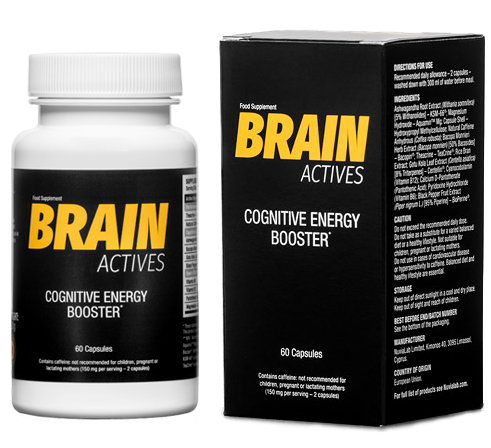
Our Recommendation — Brain Actives
Score: 5.5/10 · Best for: adults who want same-day focus from a transparent stimulant pairing, treating the memory ingredients as a slow, secondary experiment. Main caution: one serving's vitamin B6 (14 mg) exceeds EFSA's 12 mg/day upper level, the bacopa is underdosed, and no money-back guarantee is published. Fair trial: one bottle — a month is enough to judge the stimulant effect honestly, and no guarantee protects a bigger first order.
Two Molecules, One Family
Theacrine (1,3,7,9-tetramethyluric acid) is a purine alkaloid found in kucha tea (Camellia assamica var. kucha) and cupuaçu, and a structural cousin of caffeine: both interact with adenosine receptors, the brain's sleepiness-signalling system, and theacrine additionally shows dopamine-system activity in animal work. That family resemblance is the whole basis of the comparison genre — and of its central misunderstanding.
Sharing a receptor family does not make two compounds interchangeable, any more than sharing a surname makes two people the same height.
Caffeine arrives with the deepest evidence base of any legal stimulant: dose-response mapped from ~40 mg upward, a regulator-reviewed safety frame, a known average half-life of about four hours, and failure modes (tolerance, withdrawal, sleep cost) quantified in large literatures.
Theacrine arrives with a file you can read in an afternoon: a handful of small studies, mostly funded or supplied by the ingredient's commercial backers, mostly measuring how people rated their own energy on a line. The comparison below keeps those asymmetries visible in every row — because a versus-table that prints "caffeine: tolerance — yes; theacrine: tolerance — no" without printing "evidence: decades vs eight weeks" has rigged the match before it starts.
The Comparison Table — With a Source Column, Because That Is Where the Truth Lives
| Property | Caffeine | Theacrine | Evidence behind the row |
|---|---|---|---|
| Acute alertness effect | Reliable; mainly restores fatigue-lost performance | Subjective energy/focus ratings rise | Caffeine: hundreds of trials + EFSA review. Theacrine: small pilots, VAS outcomes |
| Objective cognitive performance | Vigilance/attention/reaction time improve, esp. when fatigued | Not significantly improved in the trial that measured it | Kuhman et al. 2015 (n=20): no effect on Trail Making, DSST or reaction time for the theacrine product — or for caffeine alone in that trial |
| Tolerance | Develops in days–~2 weeks; genuine withdrawal syndrome | No habituation signal over 8 weeks on pre-dose baseline ratings | Taylor et al. 2016 (n=60) — a safety trial; no head-to-head tolerance trial vs caffeine exists |
| Half-life | Mean ~4 h (range ~2–8 h) | Substantially longer; small PK studies suggest high-teens to mid-20s of hours; no settled figure | He et al. 2017 (n=8) confirms long persistence; the "30–33 hours" figure circulating online has no primary source we could find — rejected |
| Jitters / cardiovascular | Dose-dependent jitteriness; modest BP effects at higher doses | No significant HR/BP change up to 300 mg/day in trials; "jitters" never an endpoint | Taylor 2016 and pilot safety data — reassuring, small, short |
| Crash | A recognised offset experience, entangled with withdrawal and sleep debt | Never measured; "no crash" is inferred from the long half-life | No trial on either side of the claim for theacrine |
| Sleep impact | Quantified: 400 mg at −6 h cut measured sleep by >1 h | Unstudied adequately; long half-life implies a morning dose persists at bedtime | Drake et al. 2013 for caffeine; pharmacology, not trials, for theacrine |
| Interaction | Caffeine increases theacrine exposure (higher peak and total); theacrine does not alter caffeine's handling | He et al. 2017 (n=8, crossover) — the pairing's one elegant datum | |
The Theacrine File, Trial by Trial
Because the versus genre lives on selective citation, here is the entire relevant human file with its sizes attached — the audit no competitor of this article performs in full.
| Study | Design & size | What it can and cannot show |
|---|---|---|
| Habowski et al. 2014 | ISSN conference pilot; randomised crossover, n=15; single 200 mg dose, 3 hours | Subjective energy +8.6% vs −5.7% on placebo (p=0.049) and fatigue improved on rating scales; concentration only a trend (p=0.07). A conference abstract — hypothesis-generating, not a cognition trial |
| Ziegenfuss et al. 2017 | Part 1: open-label, n=9 (200/400 mg × 7 days). Part 2: double-blind crossover, n=15, single 200 mg | Subjective energy, focus, concentration rose; no dose-response; no HR/BP changes. All outcomes self-rated; no objective cognitive battery |
| Kuhman et al. 2015 | Randomised crossover, n=20; a theacrine-containing blend (with 150 mg caffeine) vs caffeine vs placebo, to 4 hours | Objective cognition: null for both actives. Subjective ratings favoured the combination. Because the theacrine arm contained caffeine and other ingredients, nothing here isolates theacrine — pages citing it as a pure-theacrine cognition trial are wrong twice over |
| Taylor et al. 2016 | Randomised, double-blind, n=60; placebo vs 200 vs 300 mg daily × 8 weeks | A safety trial: all clinical markers normal, no serious adverse events. Habituation read from stable pre-dose baseline self-ratings — it did not re-measure the acute effect weekly or compare against caffeine |
| He et al. 2017 | Pharmacokinetic crossover, n=8; theacrine 25/125 mg, caffeine 150 mg, and 125 + 150 mg combined | Caffeine raised theacrine exposure without changing its half-life; theacrine left caffeine's kinetics alone; no HR/BP differences. A PK signal at n=8 — not an efficacy result. Note the combined arm ≈ Brain Actives' own 125 + 150 mg pairing |
| Later negative trials (2019–2024) | Resistance-training crossover, n=12; high-dose crossover (3/6/9 mg/kg), n=19 | 300 mg theacrine alone improved nothing where caffeine improved subjective focus/energy; the high-dose study found no benefit for subjective energy or cognition (energy rose on placebo) with cortisol up at later timepoints. Small — but they break the "unanimous literature" story |
Step back from the table and the file's shape is unmistakable: fewer than 120 human participants across the positive literature, subjective outcomes throughout, industry linkage recurring, the single objective test null, and the longest exposure eight weeks.
That is a promising preliminary file — the correct scientific description — and it is three promotions away from the marketing description ("clinically proven caffeine upgrade") under which the ingredient is usually sold. The rodent work that launched the tolerance story (Feduccia et al. 2012: no locomotor tolerance after repeated dosing in rats, unlike caffeine) is a legitimate reason to run human tolerance trials. It is not a substitute for having run them.
Claim by Claim: The Verdict Box
| Claim | Verdict | The precise wording the evidence supports |
|---|---|---|
| "No tolerance — it never stops working" | Partly supported, narrowly | "No habituation was detected over 8 weeks in one n=60 safety trial, measured on pre-dose baseline self-ratings." Nothing beyond 8 weeks, nothing head-to-head vs caffeine, is known |
| "Half-life of 20–30+ hours" | Unsettled; partly invented | "Substantially longer than caffeine's; small studies suggest roughly the high-teens to mid-20s of hours." The 30–33-hour figure in circulation has no primary source — do not rely on it |
| "No jitters" | Plausible, unproven | "Trials to 300 mg/day show no significant heart-rate or blood-pressure effects and low adverse-event rates." No trial measured jitters as an outcome |
| "No crash" | Inference, not evidence | "A slower decline in blood levels makes a gentler offset plausible." No study has measured post-effect rebound for either compound head-to-head |
| "Won't interfere with sleep" | Rejected as stated | A compound still substantially present at bedtime cannot be certified sleep-neutral on current data; the small 2024 sleep data at 400 mg showed small (non-significant) reductions in sleep efficiency. Morning-only dosing is the defensible position |
| "The new caffeine — a replacement" | Refuted by the field's own data | The interaction study positions theacrine as caffeine's partner; the resistance-training trial found theacrine alone inert where caffeine worked. Replacement is a slogan; pairing is the pharmacology |
Subjective vs Objective: The Distinction This Whole Comparison Turns On
Every claim in the verdict box above reduces to one methodological distinction, and it deserves its own section because it is the most reliably exploited gap in supplement marketing. A subjective outcome is a rating: a participant marks a line between "no energy" and "maximum energy", or scores their focus from one to ten.
An objective outcome is a measurement: errors on a trail-making test, milliseconds on a reaction task, words recalled from a list. Subjective outcomes are real data — how a person feels at work matters — but they are exquisitely sensitive to expectation, and expectation is the one ingredient every supplement contains at full dose.
A participant who has swallowed a capsule sold for energy, in a study visit built around energy, rates energy with that story running in the background; placebo arms in this literature routinely improve on subjective scales too, and in the high-dose theacrine crossover the energy improvement appeared on placebo.
Objective tests are colder and harder to move — which is exactly why the field's honest papers report both, and why the theacrine file's shape (subjective movement, objective silence) should temper every conclusion drawn from it. Caffeine, by contrast, passes on both instruments: people feel more alert and their vigilance lapses measurably decrease, most clearly when fatigued.
When you read any future versus article — in this category or any other — the first question to ask of each cited study is which instrument it used. A claim built only on the warm instrument is a claim about how a product feels. Sometimes that is enough to justify a purchase. It is never enough to justify the word "proven".
Mechanism: What the Shared Pharmacology Does and Does Not Predict
Both compounds work primarily as adenosine-receptor antagonists, and that single fact predicts most of what is true in this comparison.
Adenosine accumulates across waking hours and generates sleep pressure; blocking its receptors does not add energy so much as mute the signal of its absence — which is why caffeine's benefits concentrate in the fatigued, why it cannot push a fully rested brain far past baseline, and why the debt reasserts itself when the blockade lifts.
Theacrine shares this mechanism and adds, in animal work, dopaminergic activity — a plausible route to its subjective motivation and mood ratings, and the proposed basis (from rodent locomotor studies, Feduccia et al. 2012) for its different tolerance behaviour: repeated theacrine dosing in rats did not produce the locomotor tolerance caffeine did. Two cautions discipline the mechanism story.
First, mechanism is a hypothesis generator, not a result: the human objective-cognition test of the combination was null despite the tidy pharmacology, and the history of this category is littered with mechanisms that predicted effects trials could not find.
Second, the same adenosine logic that makes the pairing attractive also predicts its shared debits — anything that mutes sleep pressure for longer will, in principle, tax sleep for longer, which is why the half-life section of this article is not a technicality but the comparison's centre of gravity. Buy mechanisms when they are cheap.
The trials are what cost money, and on trials the score stands: caffeine proven and priced in sleep; theacrine promising, subjective, and priced in uncertainty.
Practical Doses: What People Actually Take
For readers converting the audit into a decision, the dose landscape in one place. Caffeine: 75–200 mg is the ordinary working band for focus in adults; up to 200 mg in a single dose and 400 mg/day sit inside EFSA's no-concern frame for healthy adults; sensitive users, and anyone whose sleep is the priority, will rationally sit at the bottom of the band or below it.
Theacrine: the human literature clusters at 200–300 mg standalone (the pilot and safety-trial range) and at 125–150 mg in combination products alongside caffeine — Brain Actives' 125 mg is typical of the pairing format, not an aberration, but "typical of the format" and "tested at this dose for outcomes" remain different statements, and only the first is true.
The combination: no trial has optimised the ratio; the one pharmacokinetic study used 125 mg + 150 mg, and commercial formulas have largely standardised around it by imitation rather than by evidence.
Cost completes the practical picture: caffeine is among the cheapest active ingredients in the world (coffee, or pennies per caffeine tablet), while theacrine arrives only inside premium formulas — Brain Actives at $59.99 a month singly, $29.99 a bottle in the largest bundle, plus shipping, with no money-back guarantee.
A buyer is therefore not choosing between two molecules at equal price; they are choosing between a proven commodity and a premium experiment, and the experiment's burden of proof rises with its price. That framing — not any single trial — is what our 5.5/10 encodes.
Caffeine's Own File — the Dose and Timing Cluster, in Full
A versus article owes the incumbent the same rigour as the challenger, so here is caffeine's complete operating manual — the section that governs any product containing it, this site's included.
Doses: measurable vigilance effects begin around 40–75 mg in fatigued people; the working range across the attention literature is roughly 75–300 mg; the European Food Safety Authority's 2015 opinion frames safety at single doses up to 200 mg and habitual intakes up to 400 mg/day for healthy adults (200 mg in pregnancy).
Timing: effects begin within about 15–30 minutes; half-life averages ~4 hours with a 2–8-hour individual range — longer with pregnancy, oral contraceptives and some medicines, shorter in smokers — which is why one person's afternoon coffee is another person's insomnia.
Sleep: the quantified anchor is Drake et al. (2013) — 400 mg taken at bedtime, three hours before, and a full six hours before each significantly disrupted sleep on home monitors, with the six-hour dose still costing more than an hour of measured sleep that participants did not perceive losing.
The practical rule competitors converge on — no substantial caffeine within roughly eight hours of bed — is a practice rule built on that data, not itself a trial finding, and this article labels it as such.
Tolerance and withdrawal: adaptation to several effects develops within days to about two weeks of daily use; abrupt cessation in a habituated user produces headache, fatigue, irritability and low mood peaking around days one to two — the only genuine dependence-and-withdrawal profile among the ingredients this site covers, a point our long-term safety article develops in full.
None of this is an argument against caffeine. It is the complete shape of a proven tool: known power, known price. Theacrine's marketing asks to be compared against a flattened version of this file; compared against the real one, it is a smaller, longer, less-proven instrument whose best-documented property is that caffeine makes more of it available.
The Pairing, Priced: Brain Actives as the Worked Example
Brain Actives is the rare product that embodies this article's actual conclusion: its stimulant core is caffeine 150 mg with theacrine 125 mg — almost exactly the combination arm of He et al. 2017, in which caffeine raised theacrine exposure. If theacrine contributes anything beyond caffeine, this is the configuration in which it would do it.
The debits, stated with the same precision: 125 mg sits below the 200–300 mg range of the subjective-effect pilots and the safety trial, so even the preliminary file was not generated at this dose; the formula's theacrine cannot inherit Taylor's eight-week habituation observation at full strength; and the product is a morning-only tool twice over — caffeine's sleep arithmetic plus a partner whose levels persist into the night.
The rest of the label is graded in our full review (bacopa underdosed at 187.5 mg, B6 at 14 mg against EFSA's 12 mg upper level and the US 100 mg, no published money-back guarantee) and the score is 5.5/10: a rationally designed pairing at a slightly underpowered theacrine dose, sold at $59.99 a month (to $29.99 on the largest bundle) with no guarantee behind it.
For a caffeine user whose specific complaints are the afternoon trough and a suspicion that daily caffeine is doing less than it did, this formula is a coherent — preliminary, honestly labelled — experiment. For anyone seeking a proven replacement for caffeine, the evidence in this article says the product category has not built one yet, and any page claiming otherwise is selling the slogan this article just audited.
One practical protocol closes the comparison for switchers and stackers alike. If you trial a theacrine-containing product, substitute, do not add: let its 150 mg of caffeine replace your morning coffee rather than join it, take it before mid-morning, and keep the rest of the day's caffeine at zero for the first week so the comparison you are running — arc, offset, sleep that night — has one variable.
Judge the sleep honestly (a tracker or a partner's report beats your impression; caffeine's sleep theft was imperceptible to Drake's participants, and theacrine's persistence argues for the same humility).
And set the trial's end in advance: if, after two to three weeks of clean substitution, the arc is not visibly better for you than the coffee it replaced, the preliminary file has delivered its personal verdict, and the cheaper incumbent wins. That is how an adult should buy an ingredient at this evidence stage — as a bounded experiment with a pre-registered conclusion, not as a belief.
The Sleep Ledger: Adding Up Both Compounds
One piece of arithmetic belongs to anyone running the pairing, because the two compounds' sleep costs are usually discussed separately and paid jointly.
Caffeine's cost is a function of dose, timing and your personal half-life: the same 150 mg that is gone by bedtime for a fast metaboliser who took it at 7 a.m. is meaningfully present for a slow metaboliser who took it at noon.
Theacrine's cost is structural: with levels persisting across most of a day, there is no timing clever enough to make a morning dose absent by night — you can only make it smaller by then.
A combined product therefore asks its user to accept a low, all-night background of stimulation as the price of the daytime arc, which is precisely the trade the "no sleep interference" marketing denies exists.
The honest way to evaluate it is personal and empirical: give the substitution experiment in the previous section a fortnight, track sleep with the same instrument throughout (a wearable, a diary, a partner), and compare against your coffee baseline.
If your sleep is measurably lighter on the pairing, the longer arc is being bought with the following day's alertness — the one currency neither compound can print. Users with excellent, resilient sleep may find the trade trivially worth it. Users guarding fragile sleep should read the ledger before they sign it.
What Would Change This Verdict
A graded comparison should state its own update conditions, so here are ours.
Theacrine's grade rises if: an independently funded trial (no ingredient supplied by its seller, or supplied with funding declared and analysis pre-registered) tests theacrine alone against caffeine and placebo on objective cognitive outcomes, at 200 mg or above, with the acute effect re-measured across at least eight weeks of daily use — the design that would convert Taylor's habituation signal into a tolerance finding; or a properly powered sleep study shows a morning dose leaving objective sleep architecture intact, which would rescue the sleep claim from its current pharmacological implausibility. Its grade falls — toward the gotu kola precedent elsewhere in this set — if the next adequately powered objective trials repeat Kuhman's null at standalone doses. Caffeine's position changes only at the margins (its file is mature), most plausibly through better individual prediction: genetic and phenotypic markers that tell a user their personal half-life and sleep cost before they learn it the hard way. Until one of those studies exists, the verdict in the box above stands as written, and this article will be re-dated when the record moves — in either direction. That commitment, more than any single row of the comparison table, is the difference between an audit and an advertisement: advertisements do not publish the conditions under which they would change their minds.
Who Should Buy Brain Actives — and Who Should Skip It
Buy it if you are a caffeine user interested in the pairing hypothesis — longer subjective arc, possibly less habituation pressure — from a fully labelled product, and you will run it as the substitution experiment above, morning-only, with your sleep as the referee.
Skip it if you want a caffeine replacement (it contains caffeine; and replacement is refuted by the data anyway), if you are caffeine-sensitive or your sleep is fragile (a long-half-life stimulant partner is the opposite of your brief), if you already stack caffeinated products (the totals govern, per the section above), or if a 125 mg dose of a preliminary ingredient at a premium price fails your personal value test — a defensible verdict this article's own audit makes easy to reach.
Our Recommendation — Brain Actives
Score: 5.5/10 · Best for: adults who want same-day focus from a transparent stimulant pairing, treating the memory ingredients as a slow, secondary experiment. Main caution: one serving's vitamin B6 (14 mg) exceeds EFSA's 12 mg/day upper level, the bacopa is underdosed, and no money-back guarantee is published. Fair trial: one bottle — a month is enough to judge the stimulant effect honestly, and no guarantee protects a bigger first order.
Frequently Asked Questions
Is theacrine stronger than caffeine?
No — on current evidence it is weaker where it counts and longer where it lasts. Caffeine has reliable, objectively measured effects on vigilance and attention; theacrine's demonstrated effects are subjective ratings in small pilots, and the one objective cognition test was null. Theacrine's distinction is duration and a possible habituation advantage, not potency.
Does theacrine really not build tolerance?
The supported statement is narrow: in Taylor et al. 2016 (n=60, up to 300 mg/day), eight weeks of daily use produced no habituation signal in pre-dose baseline self-ratings, inside a trial designed primarily for safety.
That is encouraging and genuinely different from caffeine's fast adaptation — but it is one trial, eight weeks, baseline ratings rather than re-measured acute effects, and no comparison against caffeine. "Proven never to build tolerance" is the marketing expansion of that sentence.
What is theacrine's half-life?
Long — substantially longer than caffeine's ~4-hour average — but the precise figure is unsettled: small pharmacokinetic studies put it roughly in the high-teens to mid-20s of hours. A "30–33 hour" figure circulates in marketing content with no primary source behind it; we could not verify it and do not use it. Plan on a morning dose remaining substantially present at bedtime.
Will theacrine keep me awake at night?
It might, and the honest answer is that the question is under-studied. Its long half-life argues for morning-only dosing and against the "sleep-neutral" claims made for it; at 400 mg in small 2024 data, sleep efficiency dipped slightly (not significantly). If your sleep is precious or fragile, treat theacrine like a longer caffeine, not like a loophole in caffeine.
Can I take theacrine and caffeine together?
They are routinely combined, and the combination is the studied configuration: He et al. 2017 found caffeine increased theacrine exposure with no adverse heart-rate or blood-pressure differences in eight subjects. "Routinely combined" is not "proven synergistic for cognition" — the one objective test of a combination product was null — and the combination's caffeine counts fully toward your daily total and your bedtime cut-off.
Why is Brain Actives' theacrine dose (125 mg) lower than the trials'?
Formulators dose for a combined product — 125 mg alongside 150 mg of caffeine mirrors the combination arm of the pharmacokinetic study — rather than for the standalone pilots at 200–300 mg. Whether the pairing compensates for the lower theacrine dose is precisely what the current literature cannot yet answer; we flag the gap rather than assume it closed, and it is one reason the product scores 5.5/10 rather than higher.
Last reviewed: October 2026. This article is educational and is not medical advice.
