
- Quick Answer
- Three Words the Category Uses Loosely: Tolerance, Dependence, Withdrawal
- The Duration Table: How Long Each Ingredient Has Actually Been Studied
- Caffeine Long-Term: The Complete Ledger
- Theacrine After Week Eight: The Edge of the Map
- Bacopa Long-Term and the Permanence Question
- The B6 Section: This Formula's One Concrete Long-Term Problem
- Cycling: Community Practice, One Mechanism, and One Ingredient It Would Sabotage
- Interactions: The Long-Term Variable Nobody Trials
- When "Focus Problems" Are Not a Supplement Question at All
- Who Should Buy Brain Actives — and Who Should Skip It
- Frequently Asked Questions
- Are nootropics addictive?
- Can you take nootropics every day?
- Should you cycle nootropics?
- Do bacopa's effects last after you stop taking it?
- What are the warning signs that a supplement habit has gone wrong?
- Is it safe to take Brain Actives long-term?
- Read This Next
Disclosure: This article contains affiliate links. If you buy through them, we may earn a commission at no extra cost to you. It never changes our conclusions.
Quick Answer
The honest answer is per ingredient, and it is mostly a statement about how long anyone has actually looked. Caffeine has decades of habitual-use data and a regulator-reviewed frame — safe for healthy adults within roughly 200 mg per dose and 400 mg per day — balanced by real tolerance and a real withdrawal syndrome.
Bacopa's human record runs about twelve weeks deep and then thins to almost nothing. Theacrine's stops at eight weeks: beyond that, long-term safety is not "proven" or "disproven" — it is unstudied.
And one ingredient in the product this site sells carries the set's most concrete long-term flag: vitamin B6 at 14 mg a day exceeds the European Food Safety Authority's upper limit of 12 mg/day, set on nerve-damage evidence, even though it sits far below the US limit of 100 mg. "Natural" and "synthetic" predict none of this.
Durations and doses do. Best for: daily users — the readers for whom long-term is not a hypothetical — who want the safety file organised by what is actually known, per ingredient, with the unknowns labelled as unknowns.
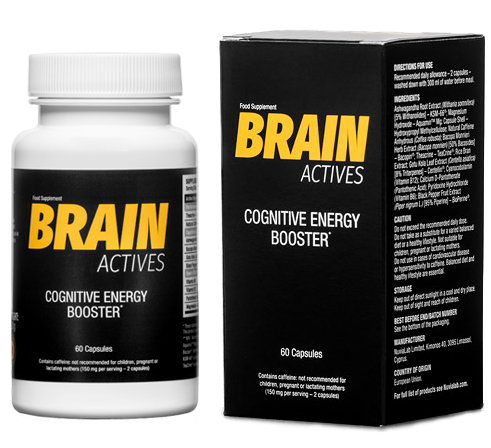
Our Recommendation — Brain Actives
Score: 5.5/10 · Best for: adults who want same-day focus from a transparent stimulant pairing, treating the memory ingredients as a slow, secondary experiment. Main caution: one serving's vitamin B6 (14 mg) exceeds EFSA's 12 mg/day upper level, the bacopa is underdosed, and no money-back guarantee is published. Fair trial: one bottle — a month is enough to judge the stimulant effect honestly, and no guarantee protects a bigger first order.
Three Words the Category Uses Loosely: Tolerance, Dependence, Withdrawal
Long-term safety talk fails first at vocabulary, so the definitions come first — and then, unlike most pages, they get applied. Tolerance means the same dose produces a smaller effect over time, so the user escalates or accepts maintenance. Dependence means the body has adapted to the substance's presence such that stopping produces a deficit state.
Withdrawal is that deficit state: a defined, time-limited syndrome on cessation. A fourth thing — psychological reliance, the felt inability to face a workday without the ritual — is real, common, and belongs to behaviour rather than pharmacology, but it is the form of "dependence" most supplement users actually experience.
Now the application, for the formula this article audits: of Brain Actives' ten ingredients, exactly one — caffeine — earns all three pharmacological words.
It builds measurable tolerance within days to about two weeks, it produces genuine dependence in habitual users, and its withdrawal syndrome (headache, fatigue, irritability, low mood, difficulty concentrating) is characterised well enough to appear in diagnostic manuals, typically peaking one to two days after the last dose and resolving within about a week.
Theacrine earns none of the three words yet — not because it has been proven innocent, but because the one relevant trial ran eight weeks and measured habituation only through baseline self-ratings.
Bacopa, rhodiola, gotu kola, magnesium and the B-vitamins show no tolerance or withdrawal phenomena in their (shorter) files — with B6 carrying a completely different kind of long-term risk, toxicity rather than dependence, covered in its own section below. Any page that spreads the word "addictive" across a whole formula, or absolves a whole formula with the word "natural", has skipped this paragraph's work.
A related rhetorical move deserves naming, because a major competitor's addiction page performs it: defining the problem away — "if it were addictive, it wouldn't be a true nootropic". Definitions do not change pharmacology. Caffeine is in the category, caffeine has a withdrawal syndrome, and no founder's 1970s definition amends either fact. Safety is a property of molecules, doses and durations, not of labels; this article proceeds on that basis throughout.
The Duration Table: How Long Each Ingredient Has Actually Been Studied
| Ingredient (Brain Actives dose) | Human data extends to | Long-term picture |
|---|---|---|
| Caffeine (150 mg) | Decades of population-level habitual use; regulator-reviewed | Safe within EFSA frame (≤200 mg/dose, ≤400 mg/day) for healthy adults; tolerance in days–weeks; real withdrawal; sleep cost is the chronic tax |
| Theacrine (125 mg) | 8 weeks (Taylor 2016, ≤300 mg/day) | Beyond 8 weeks: unstudied. No tolerance signal within the window, on baseline ratings; no long-term organ-safety data at all |
| Bacopa (187.5 mg) | ~12 weeks in cognition trials; safety summaries to ~12 weeks at ≤600 mg/day | Well tolerated in-window (GI effects lead); multi-month and multi-year use is extrapolation |
| Rhodiola (100 mg) | ~12 weeks in the fatigue literature (Set L coverage) | Similar shape: a quarter's data, then inference |
| Gotu kola (50 mg) | Short trials inside a null meta-analysis | No cognitive benefit to protect; long-term file thin — an argument about value, not danger |
| Magnesium (75 mg) | Nutrient frame — lifetime dietary exposure | At this dose, a nutritional non-issue for people with healthy kidneys |
| Vitamin B12 (25 µg) / pantothenic acid (15 mg) | Nutrient frame | Water-soluble, wide safety margins at these amounts |
| Vitamin B6 (14 mg) | Nutrient frame — with a hard ceiling | Exceeds EFSA's 12 mg/day UL; US UL 100 mg/day; chronic excess is the panel's one established long-term toxicity story |
Read the middle column as the article's thesis: for the botanical and novel ingredients in a typical nootropic, "long-term" in the data means eight to twelve weeks. Everything a daily user does past the first quarter is self-experimentation past the edge of the map.
That does not make it reckless — the in-window safety data are generally reassuring, and traditional use adds weak supporting evidence — but it fixes the epistemics: claims of proven long-term safety for these ingredients (one competitor asserts 12–24-month bacopa safety data; the published cognition-trial record tops out near twelve weeks) are not summaries of the literature. They are decorations on its absence.
Caffeine Long-Term: The Complete Ledger
Caffeine is the panel's benchmark precisely because its long-term story is fully written — assets and liabilities alike.
On the asset side: the European Food Safety Authority's 2015 assessment of the total literature found no safety concern for healthy adults at habitual intakes up to 400 mg/day, across cardiovascular, bone, behavioural and reproductive endpoints; few substances humans consume daily have been audited as thoroughly. On the liability side, three chronic costs are documented rather than speculative.
Tolerance: adaptation to pressor, alerting and some performance effects emerges within days to ~two weeks, converting the daily user's dose partly into habit maintenance — the mechanism behind our focus ranking's advice to keep doses stable and rehearsed rather than escalating.
Withdrawal: the syndrome described above is the proof of dependence, and its practical lesson is scheduling — a caffeine break or a quit should be timed away from exams, deadlines and travel, because days one to three are a predictable cognitive trough. Sleep: the cost with the longest shadow.
Caffeine taken even six hours before bed cut measured sleep by over an hour in Drake et al. (2013) at a 400 mg dose, without the sleepers noticing — and chronic partial sleep loss is itself a cognitive and metabolic liability, meaning a badly timed caffeine habit can net out negative for the very faculty it is bought to serve.
The ledger's bottom line is genuinely reassuring for moderate, early, stable use — and it is the standard of completeness against which the next section's thin file should be measured.
Theacrine After Week Eight: The Edge of the Map
Theacrine's entire chronic-use file is one trial: Taylor et al. (2016), sixty adults, 200 or 300 mg daily for eight weeks, with clinical markers (heart rate, blood pressure, lipids, liver, kidney and immune markers) remaining normal throughout and no serious adverse events.
Within its window, that is a clean safety result, and the stable pre-dose baseline ratings are a fair habituation signal.
Everything past week eight — month six, year two, the timescale on which a daily focus product is actually used — is unmeasured in humans: no organ-safety follow-up, no tolerance re-test, no withdrawal observation after long use, no data in older users, users with conditions, or users combining it with the medications real adults take. Two honest conclusions follow.
First, the risk is probably low — the molecule is a dietary constituent of a traditional tea, its acute and eight-week profiles are calm, and nothing in its pharmacology suggests a cliff edge at week nine. Second, "probably low, unmeasured" is the accurate grade, and any seller upgrading it to "proven safe long-term" is spending evidence that does not exist.
A daily user of a theacrine product — including Brain Actives at 125 mg, below Taylor's doses, which cuts both ways (less exposure; also less studied territory) — should understand their position precisely: inside a reassuring eight-week window, standing on their own observation thereafter. Our theacrine-versus-caffeine article holds the full trial-by-trial audit.
Bacopa Long-Term and the Permanence Question
Bacopa's file is a quarter deep: the cognition trials gathered by Pase et al. (2012) all ran twelve weeks at 300–450 mg, tolerability across them was good (gastrointestinal effects — stool frequency, cramps, nausea — being the standard complaint), and safety summaries extend the "appears safe" verdict to about twelve weeks at up to 600 mg/day.
Beyond that, the record is silence, not alarm: no multi-year cohort, no chronic-toxicity signal in humans, and one interaction caution with pharmacological grounding — bacopa shows enzyme-inhibition signals that make "check your medicines first" the correct advice for anyone on regular prescriptions. The permanence question — do the gains last after stopping?
— has exactly one real datum in the literature: a follow-up tradition stemming from Roodenrys et al. 2002 reported bacopa's memory effects persisting for some weeks after discontinuation, which is biologically coherent (a slow-building effect plausibly decays slowly) and evidentially thin.
Our graded answer to "is it permanent?": no evidence supports permanent enhancement from any ingredient in this panel, and none supports permanent harm at studied doses either; the defensible expectation is effects that fade over weeks after stopping, for the ingredients that had effects at all.
At Brain Actives' 187.5 mg — below the studied range — the long-term bacopa question is largely academic: the uncertainty is whether anything was happening to persist in the first place, which is why our bacopa article routes committed bacopa buyers to the full studied dose.
The B6 Section: This Formula's One Concrete Long-Term Problem
Every other section of this article trades in uncertainty; this one trades in a number. Vitamin B6 in chronic excess causes peripheral neuropathy — sensory nerve damage presenting as tingling, numbness and burning in hands and feet — documented across decades of case literature, usually at high supplemental doses but with enough lower-dose reports that regulators have tightened.
In 2023, the European Food Safety Authority set the tolerable upper intake level for B6 at 12 mg/day for adults, derived from the neuropathy evidence; the US upper limit remains 100 mg/day, set in an earlier era on a different reading.
Brain Actives provides 14 mg per serving — above the European ceiling before food contributes anything, in a product designed to be taken daily, indefinitely.
Both numbers belong in the sentence forever (14 mg is also barely a seventh of the US limit, and nobody should panic over either framing), but the European figure is the one a long-term daily user should plan around, for three reasons: it is the more recent assessment; the harm it guards against is specifically a chronic-accumulation harm, matching a daily product's exposure pattern; and the user's true total includes diet (typically 1–2 mg) plus any multivitamin, B-complex or energy product riding along — stacks in which B6 quietly appears several times are exactly how ordinary users drift into genuinely high totals. The symptoms that mean stop-and-see-a-doctor are the neuropathy prodrome: new persistent tingling, numbness or burning in the extremities. This is, in our scoring, the main reason Brain Actives sits at 5.5/10 rather than higher: a stimulant pairing can be used episodically, but a formula carrying an over-ceiling vitamin penalises the daily habit it invites. If you use it daily, do the arithmetic across your whole shelf — and if your shelf already includes a B-complex, this product's B6 is the argument for choosing one or the other.
Cycling: Community Practice, One Mechanism, and One Ingredient It Would Sabotage
Cycling — scheduled breaks from a supplement — is the long-term practice the category talks about most and evidences least. Stated plainly: no cycling protocol for any ingredient in this panel has been tested in a trial. What exists is community practice, of varying coherence, plus one mechanism with real support.
The coherent case is caffeine: because tolerance is adenosine-receptor adaptation, a break of roughly one to two weeks genuinely restores much of the original responsiveness — at the price of the withdrawal days at its start — and periodic breaks are the rational response for a daily user who wants the effect back rather than the dose up.
The incoherent case is bacopa: its entire evidence base is continuous twelve-week dosing, so a folk cycle (weeks on, weeks off) systematically interrupts the only regimen ever shown to work, in service of a tolerance bacopa has never been shown to develop.
Cycling theacrine is a shrug in both directions — no tolerance has been demonstrated to cycle against, and no break has been studied. Rhodiola cycling inherits the adaptogen community's customs and our stress cluster's verdicts.
The operating rules this article endorses: cycle stimulants if you cycle anything, on a calendar rather than on vibes; never cycle a slow botanical mid-course and call the interruption a protocol; and treat the need to escalate any dose as information — about tolerance, about sleep, or about a problem the supplement was masking — rather than as a shopping instruction.
One scheduling refinement separates a competent caffeine break from a miserable one: taper rather than stop where the dose is high.
Halving intake for two to three days before the full stop converts the withdrawal peak from a cliff into a slope for most users, and placing the break across a low-demand stretch (a holiday week, a quiet project phase) protects both the experiment and the work it would otherwise tax.
Judge the break at its end by the test that matters — the first ordinary dose afterwards, at the original amount: if the response feels like the product's first week, the reset worked and the maintenance dose can stay where it was; if nothing has changed, tolerance was never the binding constraint, and the next lever is sleep or the causes workup, not a stronger capsule.
Interactions: The Long-Term Variable Nobody Trials
Chronic use rarely happens in a pharmacological vacuum — the typical long-term nootropic user is also, by their forties, a person with a prescription or two — and the interaction file for this panel is thinner than its safety file, which is saying something. The documented and plausible points, in order of solidity.
Caffeine's clearance is drug-sensitive: oral contraceptives and several medicines (fluvoxamine and ciprofloxacin among them) slow caffeine metabolism substantially, stretching its half-life and its sleep cost; smoking accelerates it — which is why a quit-smoking attempt often feels like a caffeine overdose at an unchanged dose.
Bacopa carries an enzyme caution: laboratory and pharmacology references report inhibition signals across several drug-metabolising (CYP) enzymes, the system that clears a large share of prescription medicines; no clinical interaction catastrophe is documented, but the correct posture for anyone on regular medication is disclosure to a clinician or pharmacist before a daily bacopa habit, not after a surprise.
Stimulant-system ingredients and blood pressure argue for basic monitoring in anyone with hypertension, even though the theacrine trials found no pressure signal at their doses and durations.
Sedating medicines and alcohol sit on the other side of the ledger: using stimulants to override prescribed sedation — or an evening's drinking — is a pattern problem, not an ingredient interaction, and it belongs to the reliance discussion above.
The general rule that survives all of this: a supplement taken daily for months graduates from "food-like" to "medication-like" in every way that matters for interactions, and it should be listed wherever your medications are listed. The trials underpinning this article enrolled largely unmedicated volunteers; your household is not a trial population, and long-term safety in your stack is a question for the professional who can see the whole list.
When "Focus Problems" Are Not a Supplement Question at All
A long-term-safety article owes one closing section to the readers for whom duration itself is the symptom. Needing a stimulant product daily for months to feel cognitively normal is a pattern with differential diagnoses — sleep apnoea, thyroid disease, depression, deficiency, burnout — that our brain-fog article works through causes-first, with its red-flag table.
Nootropics used to outrun an undiagnosed cause are not unsafe in the pharmacological sense; they are unsafe in the diagnostic sense, by postponing the workup. If your use has become structural rather than occasional, that transition — not any ingredient in the bottle — is the long-term risk most worth acting on.
Who Should Buy Brain Actives — and Who Should Skip It
Buy it if you will use it episodically or in bounded runs (exam seasons, project blocks) rather than as an indefinite daily fixture, you have done the B6 arithmetic across your other supplements and the total stays sane, and you accept the theacrine position honestly: eight weeks of reassuring data, your own observation thereafter.
Skip it if your plan is open-ended daily use alongside a multivitamin or B-complex (the B6 stack is this article's clearest avoid), if you are pregnant or managing a cardiovascular condition (the maker's cautions), if daily caffeine already costs you sleep, or if " needing it to feel normal" describes your last three months — in which case the causes-first route will serve you better than a refill.
Our Recommendation — Brain Actives
Score: 5.5/10 · Best for: adults who want same-day focus from a transparent stimulant pairing, treating the memory ingredients as a slow, secondary experiment. Main caution: one serving's vitamin B6 (14 mg) exceeds EFSA's 12 mg/day upper level, the bacopa is underdosed, and no money-back guarantee is published. Fair trial: one bottle — a month is enough to judge the stimulant effect honestly, and no guarantee protects a bigger first order.
Frequently Asked Questions
Are nootropics addictive?
One common ingredient is dependence-forming in the strict sense: caffeine, with documented tolerance and a diagnostic-manual withdrawal syndrome. The botanicals and theacrine show no addiction phenomena in their (short) files — which is a statement about eight-to-twelve-week windows, not a lifetime guarantee.
Psychological reliance — feeling unable to work unassisted — is common with any daily ritual and is managed by scheduled breaks and honest self-observation, not by ingredient swaps. Beware any page that answers this question by definition ("a true nootropic can't be addictive"); pharmacology outranks definitions.
Can you take nootropics every day?
For caffeine, yes within the regulator's frame, accepting tolerance and protecting sleep. For bacopa, daily use is the studied pattern — for twelve weeks; beyond that the map ends. For theacrine, daily use is studied to eight weeks only.
For a multi-ingredient product, the binding constraint is its least-forgiving line — in Brain Actives' case, B6 at 14 mg against EFSA's 12 mg/day upper level — which is why the daily-use answer for this formula is "bounded runs, totals checked" rather than an unqualified yes.
Should you cycle nootropics?
Cycle caffeine if anything: one to two weeks off restores responsiveness, with a few withdrawal days as the toll. Do not cycle bacopa mid-course — its evidence is continuous twelve-week dosing, and interruptions sabotage the only regimen ever tested. Everything else called cycling in this category is community practice without trial support; harmless in most cases, but it should be labelled practice, not protocol.
Do bacopa's effects last after you stop taking it?
One follow-up line in the literature (Roodenrys et al. 2002) reported memory effects persisting some weeks after stopping — coherent with a slow-building effect decaying slowly, and far too thin to promise permanence. The defensible expectation for every ingredient here is the same: benefits fade over weeks after cessation; nothing in the panel has evidence of permanent enhancement, or of permanent harm at studied doses.
What are the warning signs that a supplement habit has gone wrong?
Dose escalation to chase a fading effect; sleep deteriorating while daytime doses rise; new tingling, numbness or burning in hands or feet (the B6 neuropathy prodrome — stop and see a doctor); anxiety climbing in step with stimulant intake; and the structural sign — an inability to face ordinary workdays unassisted, which deserves the causes-first workup in our brain-fog article rather than a stronger product.
Is it safe to take Brain Actives long-term?
Its stimulant core rests on caffeine (well-mapped) and theacrine (eight weeks of data), its bacopa is underdosed rather than dangerous, and its B6 line exceeds EFSA's daily upper level — the concrete reason we advise bounded runs over indefinite daily use, with your total B6 counted across all supplements. The maker publishes no money-back guarantee, so the long-term experiment is funded by the buyer; run it with the arithmetic done.
Last reviewed: October 2026. This article is educational and is not medical advice.
