
- Quick Answer
- First, Define "Focus" — Because the Trials Measure Different Things
- The Focus Ranking, Graded
- 1. Caffeine: The Focus Ingredient Everything Else Is Compared Against
- 2. Caffeine + L-Theanine: The Best-Evidenced Stack — and the One This Product Doesn't Contain
- 3. Theacrine: The Product's Actual Answer, Graded as It Deserves
- 4. Bacopa and Rhodiola: Focus Adjacent, Not Focus Ingredients
- The Caffeine-Free Focus Pathway: What Actually Remains
- Taking Focus Supplements With Coffee: The Caffeine Maths Nobody Prints
- Natural vs Synthetic: A Marketing Axis, Not an Evidence Axis
- 5. Creatine: The Muscle Supplement With a Cognitive Side-File
- 6. Tyrosine, Citicoline and the Supporting Cast
- How to Test a Focus Supplement on Yourself Without Fooling Yourself
- Stacking, Blends and the Ways Focus Products Hide Weakness
- Focus by Situation: The Ranking Changes With the Job
- The Practical Dose Table: Timing a Focus Day
- A Necessary Note on ADHD and Diagnosed Attention Problems
- Where Brain Actives Actually Sits in This Ranking
- Who Should Buy Brain Actives — and Who Should Skip It
- Frequently Asked Questions
- What is the best nootropic for focus?
- Can I take a focus supplement with my morning coffee?
- Is theacrine better than caffeine for focus?
- What is the best caffeine-free option for focus?
- How fast do focus supplements work?
- Does Brain Actives contain L-theanine?
- How long does a focus supplement's effect last?
- Why do focus supplements seem to stop working after a few weeks?
- Read This Next
Disclosure: This article contains affiliate links. If you buy through them, we may earn a commission at no extra cost to you. It never changes our conclusions.
Quick Answer
For focus today, the best-evidenced nootropic is caffeine — and the best-evidenced combination is caffeine with L-theanine, which improved attention-task performance beyond caffeine alone in small crossover trials. Theacrine is the credible understudy: a caffeine-relative whose small trials show subjective energy and focus ratings holding up over eight weeks, though objective cognitive tests have not confirmed an effect.
Bacopa belongs in a different conversation — it is a memory ingredient with a 12-week timeline, not a focus tool for this afternoon. Almost everything else marketed for focus is either a deficiency-correction nutrient, a fatigue ingredient borrowed from the stress literature, or marketing.
One honesty note that shapes this whole ranking: the product this site sells, Brain Actives, does not contain L-theanine — its answer to the stack question is theacrine — and we grade it accordingly below rather than letting it inherit the stack's evidence. Best for: adults choosing a focus aid by evidence grade and onset time — stimulant for today, theanine pairing for smoothness, bacopa only if the real goal is memory over months.
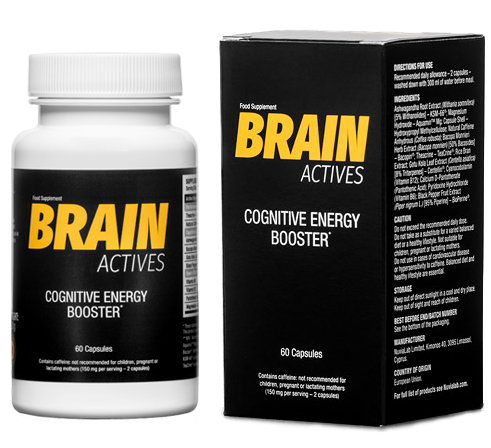
Our Recommendation — Brain Actives
Score: 5.5/10 · Best for: adults who want same-day focus from a transparent stimulant pairing, treating the memory ingredients as a slow, secondary experiment. Main caution: one serving's vitamin B6 (14 mg) exceeds EFSA's 12 mg/day upper level, the bacopa is underdosed, and no money-back guarantee is published. Fair trial: one bottle — a month is enough to judge the stimulant effect honestly, and no guarantee protects a bigger first order.
First, Define "Focus" — Because the Trials Measure Different Things
"Focus" is not one measurable thing, and the gap between what buyers mean by it and what trials measure explains half the disappointment in this category.
When researchers test a focus ingredient, they measure some combination of: vigilance (staying alert on a monotonous task without lapses), sustained attention (keeping performance from decaying over an hour of work), task-switching accuracy (moving between tasks without errors), reaction time, and subjective alertness — how focused a person feels. These do not move together.
An ingredient can improve vigilance while leaving task-switching untouched; it can raise felt focus while objective scores stay flat — theacrine's record is exactly that shape — and it can do nothing measurable at all while the user, primed by the purchase, reports a great work session.
There is also the confounder that towers over the whole field: most adults seeking "focus" are, in measurable terms, tired. Sleep restriction degrades vigilance and attention more than any supplement improves them, which is why the strongest focus ingredient we have — caffeine — works mainly by pharmacologically masking that specific deficit.
This article therefore ranks ingredients on what they demonstrably do to attention measures, states the onset and duration honestly, and keeps a separate column for the thing rankings usually hide: whether the effect survives daily use, or tolerance eats it.
One more framing decision before the table. This ranking includes stimulants, and ranks them first — deliberately. Most "best nootropics for focus" lists are written by brands whose flagship product is stimulant-free, and they handle caffeine the way a teetotal bartender handles whisky: briefly, apologetically, and near the end. That is a commercial decision wearing an editorial costume.
The evidence order is what it is — caffeine and its theanine pairing sit at the top — and a ranking that buries them to flatter a sponsor's formula is not a ranking. Where our own linked product falls short of the evidence order, this article says so in the product's own section. You are entitled to the grades before you are entitled to our commission.
The Focus Ranking, Graded
| Ingredient / stack | Evidence grade for focus | Studied dose | Onset | Tolerance | In Brain Actives? |
|---|---|---|---|---|---|
| Caffeine | Strong | ~40–300 mg | 15–45 minutes | Develops in days–weeks; real withdrawal | Yes — 150 mg |
| Caffeine + L-theanine | Moderate (best combination evidence) | 150 + 250 mg; 40 + 97 mg | 30–60 minutes | Caffeine's tolerance applies | No — see the theanine section |
| Theacrine | Preliminary (subjective outcomes) | 200–300 mg in pilots | Hours; long duration | No habituation signal over 8 weeks in one safety trial | Yes — 125 mg (below pilot range) |
| Bacopa | Moderate — for memory, not acute focus | 300–450 mg/day × 12 weeks | Weeks (nothing at 5 weeks) | Not a stimulant; no tolerance issue | Yes — 187.5 mg (below trial dose) |
| Rhodiola | Moderate — for fatigue, cross-linked | 200–600 mg/day | Days–weeks in fatigue contexts | — | Yes — 100 mg (below range) |
| Creatine | Preliminary–Moderate (stress/sleep-loss contexts) | ~5 g/day | Weeks (saturation) | None known | No |
| L-theanine alone | Preliminary | 100–250 mg | 30–60 minutes | None established | No |
| Gotu kola | Null for cognition | Hundreds of mg | — | — | Yes — 50 mg |
The table's right-hand column is the one no competitor prints about the product it promotes.
Keep it in mind through the sections that follow: the formula this site sells contains the #1 ingredient at a proper dose, the understudy below its studied range, the memory ingredient below its trial dose, a fatigue ingredient below its range, and a null ingredient — and does not contain the #2 stack at all.
That is what a 5.5/10 focus product looks like from inside an honest ranking, and it is still, on transparency, ahead of most of the shelf.
1. Caffeine: The Focus Ingredient Everything Else Is Compared Against
Caffeine's focus effect is the most replicated result in this entire field. It blocks adenosine receptors — adenosine being a accumulating by-product of wakefulness that generates sleep pressure — and thereby restores vigilance, sustained attention and reaction time, with effects beginning within about 15–30 minutes and peaking inside the first hour or so.
The dose-response is forgiving at the low end: measurable vigilance benefits appear from around 40–75 mg in tired people, and the working range across the literature is roughly 75–300 mg.
The European Food Safety Authority's 2015 caffeine opinion — the regulator's read of the total literature — set the safety frame that this site uses throughout: single doses up to 200 mg and habitual daily intakes up to 400 mg raise no safety concern for healthy adults.
Within that frame, caffeine is not merely the cheapest focus aid; it is the benchmark against which every "focus ingredient" below is implicitly promising to be "like caffeine, but…" — smoother, longer, without tolerance, without the crash. Those "buts" are where the marketing lives, and they are graded one by one in this article.
Caffeine's own debits belong in its section, not in a footnote. It restores more than it enhances: the largest effects are in the fatigued, the sleep-restricted and the withdrawn, and a rested person at baseline gains less.
Tolerance is real and fast — measurable adaptation to several effects within days to about two weeks of daily intake — so the daily user's capsule is partly servicing the habit it created. Withdrawal is a recognised syndrome (headache, fatigue, irritability, low mood), typically peaking one to two days after cessation.
And the sleep cost is quantified, not hypothetical: in Drake et al. (2013), 400 mg taken a full six hours before bed still cut objectively measured sleep by more than an hour — and the sleeper did not notice, which is why "caffeine doesn't affect my sleep" is one of the least reliable sentences in self-experimentation.
None of this demotes caffeine from first place. It defines first place honestly: a powerful, well-understood, fatigue-masking stimulant with a tolerance curve and a sleep invoice. Ingredients that claim to beat it must beat that description, not a caricature.
2. Caffeine + L-Theanine: The Best-Evidenced Stack — and the One This Product Doesn't Contain
If caffeine is the benchmark, caffeine plus L-theanine is the benchmark's refined form, and the pairing has the best combination evidence in the focus literature.
In Haskell et al. (2008), a double-blind crossover trial, 150 mg of caffeine with 250 mg of L-theanine improved aspects of attention and reaction time and self-rated alertness beyond what caffeine achieved alone; theanine on its own, interestingly, increased headache ratings in the same study — a reminder that "calming amino acid" is not a synonym for "side-effect free".
Giesbrecht et al. (2010) found the same direction at a fraction of the doses — 40 mg caffeine with 97 mg theanine improved task-switching accuracy and subjective alertness in 44 young adults.
The proposed logic is coherent: caffeine supplies the alerting push, theanine — an amino acid from tea that promotes alpha-wave activity — takes the jittery edge off the push. Two small trials do not make a settled science, and the grade stays Moderate; but nothing else in the supplement world has a better acute-focus file.
Now the disclosure this ranking owes you. Brain Actives contains no L-theanine. A page less interested in your trust could have ranked "caffeine combinations" first, gestured at the product, and let you assume the stack was inside. It is not.
The formula's answer to the smoothness question is a different molecule — theacrine, graded next — chosen by its maker, and the two answers are not interchangeable: the theanine pairing has the better trial record for attention tasks; theacrine has the longer duration story and the thinner file.
If the caffeine-plus-theanine stack itself is what you want, it is inexpensive as separate ingredients, and our stress cluster's L-theanine article covers the ingredient's full record — including its stress and sleep evidence and the 2024 trial in which theanine's perceived-stress advantage was matched almost exactly by placebo.
We would rather lose this sale to an honest paragraph than win it with a borrowed stack. That is the deal this site makes, and this section is where it costs us the most — which is exactly why it is written this plainly.
3. Theacrine: The Product's Actual Answer, Graded as It Deserves
Theacrine is a purine alkaloid from kucha tea, structurally a cousin of caffeine, and Brain Actives pairs 125 mg of it (as KuchaCore®) with its 150 mg of caffeine.
The pairing has one genuinely elegant piece of science behind it: in He et al. (2017), a pharmacokinetic crossover study, caffeine increased theacrine's exposure in the blood (higher peak and total exposure) without theacrine altering caffeine's handling in return — the two are pharmacological partners, and the combination arm in that study (125 mg theacrine with 150 mg caffeine) is almost exactly this formula's stimulant core.
The subjective-effects literature points the same hopeful direction: in the small pilots — Habowski et al. 2014 (n=15, conference report) and Ziegenfuss et al. (2017) (n=9 open-label, n=15 crossover) — energy, focus and concentration ratings rose on 200 mg doses, with no heart-rate or blood-pressure signal.
And in Taylor et al. (2016), 60 adults taking 200–300 mg daily for eight weeks showed no habituation signal in their pre-dose baseline ratings — the origin, much inflated in retelling, of the "no tolerance" claim.
Against that, the debit column, in full. The one trial that measured actual cognitive performance — Kuhman et al. (2015), n=20 — found no significant objective benefit for a theacrine-containing supplement on Trail Making, Digit Symbol Substitution or reaction time; the wins were subjective ratings again.
The dose in this product, 125 mg, sits below the 200–300 mg range of the pilots that produced even those subjective results. The trials are small, short and largely industry-linked.
Later, less-quoted studies are negative: a resistance-training crossover found 300 mg of theacrine alone improved nothing where caffeine worked, and a high-dose crossover found no benefit for subjective energy or cognition.
And the celebrated half-life cuts both ways — at roughly the high-teens to mid-20s of hours (small studies, unsettled figure), a morning dose is still substantially in your system at bedtime, which makes the "won't affect sleep" version of the claim untenable as stated.
The graded summary: theacrine is a reasonable bet for smoother, longer subjective energy alongside caffeine — a Preliminary-grade ingredient with a coherent pairing logic — and anyone selling it as a proven focus enhancer or a caffeine replacement is ahead of the evidence. Our theacrine-versus-caffeine article audits every trial behind this section.
Brain Actives' stimulant design is the best-aimed part of its formula; it is also, on the record, a bet — and at 125 mg, a slightly underpowered one.
4. Bacopa and Rhodiola: Focus Adjacent, Not Focus Ingredients
Two of Brain Actives' botanicals appear in nearly every focus ranking on the internet, and both are miscast there — including, we should say, by implication in formulas that list them under a focus banner.
Bacopa's evidence is for memory, not focus: the systematic review by Pase et al. (2012) found improvement confined to memory free recall across six 12-week trials at 300–450 mg a day, and the meta-analysis by Kongkeaw et al. (2014) added only a small attention-speed effect — milliseconds on timed tasks, pooled over nine trials — after the same 12-week timeline.
A person buying bacopa for this afternoon's focus is buying the wrong lane entirely; a person buying it for next quarter's memory is at least shopping in the right aisle, provided the dose is ~300 mg, which Brain Actives' 187.5 mg is not. Our bacopa article reads the whole record, including its negative 2025 trial.
Rhodiola's evidence, covered in depth in our stress cluster, is a fatigue literature — 200–600 mg a day in tired, stressed populations — and fatigue-resistance can certainly feel like focus when fatigue was the problem. At Brain Actives' 100 mg it is below even that literature's floor. Neither ingredient is a scam; both are simply playing away matches in a focus ranking, and the honest ranking says so rather than counting them as focus assets.
The Caffeine-Free Focus Pathway: What Actually Remains
A large share of focus shoppers are specifically looking for the caffeine-free route — because of anxiety, blood pressure, pregnancy planning, medication, or a hard-won knowledge of what caffeine does to their sleep. Competitor lists serve this reader badly, usually by re-ranking the same stimulant-adjacent ingredients with the caffeine quietly removed from the description.
Here is the caffeine-free shelf, graded without varnish. Sleep is the first caffeine-free nootropic, and it is not close: sleep restriction is the most common reversible cause of poor vigilance and attention in adults, and no legal supplement outperforms the night of sleep it is usually bought to compensate for.
If focus is the goal and sleep is short, the evidence-based purchase is a schedule, not a capsule. L-theanine alone (100–250 mg) has a preliminary file — alpha-wave and calm-alertness signals, a small stress literature, and one caution from Haskell 2008, where theanine alone increased headache ratings; it is a mild tool, honestly graded, and cheap.
Bacopa is the slow lane: no acute focus effect exists to buy, but its 12-week memory record (at 300 mg) is real, and for a caffeine-free buyer whose true goal is memory support it is the best-evidenced botanical in this article.
Rhodiola, for fatigue-driven fogginess, belongs to our stress cluster's coverage, at 200–600 mg — again, not the 100 mg in the audited formula. And deficiency correction — B12, iron, vitamin D, thyroid — outperforms every item on this list when a deficiency is the actual cause, which is why our brain-fog article insists on causes and blood tests before products.
What the caffeine-free pathway does not contain is a capsule that reproduces caffeine's acute effect without caffeine. Theacrine is sometimes sold into that slot; its file is subjective, small and — at Brain Actives' dose — underpowered, and it is in any case paired with caffeine in this formula, so the product is not a caffeine-free option at all.
Taking Focus Supplements With Coffee: The Caffeine Maths Nobody Prints
The most practically important question in this category is asked constantly and answered almost nowhere: I already drink coffee — what happens when I add a focus supplement? The answer is arithmetic.
Caffeine does not care which product it arrived in; your total is the sum, and the frames that matter are EFSA's: up to ~200 mg in a single dose and ~400 mg across the day raise no safety concern for healthy adults, with sleep damage possible from substantial doses within roughly eight hours of bed.
Now the sums for a Brain Actives user. One serving contains 150 mg of caffeine. A typical mug of filter coffee carries roughly 90–140 mg; a standard energy drink about 80 mg; a double espresso around 120–150 mg; black tea 40–60 mg; cola 30–45 mg.
So: Brain Actives plus one ordinary coffee puts you at roughly 240–290 mg for the morning — inside the daily frame, above the single-dose comfort figure if taken together, and before any second cup, pre-workout, or afternoon energy drink enters the day.
Brain Actives plus two coffees reaches roughly 330–430 mg — at or past the daily frame, with the excess bought entirely in jitters and shortened sleep. The product's own maker's cautions say the same thing in blunter language: do not combine with other caffeine products.
Our practical protocol: if you take Brain Actives, let it be the morning's caffeine — replace the coffee rather than stacking on it, keep any additional caffeine small and before midday, and treat the eight-hours-before-bed line as a hard boundary for the whole day's total.
The same maths, reversed, is the cheapest focus upgrade available to many readers: if you currently drink three coffees, a 150 mg capsule plus one coffee is not an addition to your regimen; it is a reorganisation of it, and should be judged — and paid for — as one.
Natural vs Synthetic: A Marketing Axis, Not an Evidence Axis
Focus lists often sort ingredients into "natural" and "synthetic" as though the distinction carried information about effect or safety. It carries almost none. Caffeine is caffeine — the molecule in a capsule of caffeine anhydrous is identical to the molecule in coffee; the differences are dose precision and the company it keeps (coffee's chlorogenic acids, tea's theanine), not naturalness.
Theacrine occurs in kucha tea and is also manufactured nature-identically; the trials used the branded manufactured form. Bacopa is unambiguously natural and has the category's most honest set of side effects (gastrointestinal upset is common); modafinil is unambiguously synthetic and sits outside the supplement world entirely.
What actually predicts whether an ingredient deserves your money is the boring trio used throughout this article: human trials at a stated dose, an outcome measured objectively, and a label that prints enough milligrams to match. "Natural" on a focus product tells you about the copywriter's brief. Synthetic-versus-natural is a shelf-talker; dose-versus-trial is the evidence.
Judge accordingly — and be doubly wary when the natural framing is used to imply safety for combinations (a stack of five "natural" stimulant-adjacent ingredients is a pharmacological intervention regardless of the adjective) or to waive the arithmetic in the previous section.
5. Creatine: The Muscle Supplement With a Cognitive Side-File
Creatine appears in focus rankings for a defensible reason: the brain uses the same phosphocreatine energy-buffering system as muscle, and the hypothesis that saturating it helps cognition under metabolic stress has been tested rather than merely asserted.
A 2018 review of the experimental literature (six trials, 281 participants) concluded that oral creatine may improve short-term memory and intelligence/reasoning measures — with the important texture that effects looked most plausible in stressed, sleep-deprived or older brains rather than in rested young adults at baseline.
Read that pattern again, because by now it should be familiar: it is the restore-versus-enhance profile. Creatine monohydrate at roughly 5 g a day is inexpensive, heavily studied for safety in the sports literature, and takes weeks to saturate tissue stores — it is not an exam-week tool and not an acute focus tool at all.
It earns its Preliminary–Moderate grade as background support, particularly for vegetarians (whose dietary creatine intake is lowest) and the sleep-deprived. It is not in Brain Actives, and its absence is no mark against the formula: it belongs to a different regimen logic — daily saturation, judged over months — than a morning focus capsule.
We include it at this length because focus rankings that omit it are incomplete, and because it demonstrates the house rule from the other side: an ingredient can have a real file and still not belong in every product.
6. Tyrosine, Citicoline and the Supporting Cast
Three further names recur in competitor rankings often enough to deserve graded paragraphs rather than silence.
L-tyrosine is a dopamine precursor whose human studies cluster in a specific situation: acute stress, cold, sleep loss and heavy cognitive load, where catecholamine depletion is plausible and tyrosine (studied acutely at gram-level doses, quite different from the few hundred milligrams in most capsules) has shown working-memory protection in some military and laboratory studies.
That is a depletion-context effect — the restorer pattern again — and the evidence does not support it as a general daily focus enhancer for comfortable office conditions.
Citicoline (CDP-choline) has a more conventional supplement profile: small trials, including in adolescents and older adults, report attention and psychomotor-speed signals, and it is a reasonable ingredient with a moderate-at-best file that deserves neither the hype of its brand pages nor dismissal; dose in positive studies is typically 250–500 mg.
Phosphatidylserine and lion's mane complete the usual list with thinner records — phosphatidylserine's better studies are in older adults and often paired with omega-3s; lion's mane's human cognition file is a handful of small, short trials, promising and preliminary. None of the four is in Brain Actives.
We grade them here because a focus ranking that covers only the audited product's ingredients is a product page in disguise — and because their collective lesson matters: the supporting cast of this category is a set of narrow, context-bound, mostly small-trial files. There is no shame in that; there is shame only in the listings that present each as established.
How to Test a Focus Supplement on Yourself Without Fooling Yourself
Because subjective focus is so expectation-sensitive, the honest buyer's last tool is a personal protocol stricter than the average trial's marketing.
Fix the context first: hold sleep, coffee and workload pattern as steady as life allows for the test window — a supplement trialled during a week of deadline panic and short nights is being tested as a fatigue mask, which may be exactly what you want, but know that is the test.
Score output, not vibes: pick one repeatable proxy before you start — pages revised, problems completed, a timed task you repeat — and record it on supplement days and non-supplement days alike; a focus rating written at 11 a.m. measures hope as reliably as pharmacology.
Alternate and blind if you can: an ABAB pattern (on, off, on, off across comparable days) exposes tolerance and expectancy better than a month of continuous use; a partner swapping identical-looking capsules is the gold standard few will bother with, and even the attempt clarifies what you actually feel.
Set the verdict date by the lane: stimulant lanes can be judged within days; bacopa cannot be judged before twelve weeks at all, and judging it at two is how good ingredients get bad reviews and bad ones get testimonials. Price the verdict: at the end, ask the only commercial question that matters — would I notice if this stopped?
If the honest answer requires concentration, the subscription should stop first. This protocol will talk many readers out of many products, including, on their numbers, possibly the one below. That is its purpose: a ranking you can verify beats a ranking you must trust.
Stacking, Blends and the Ways Focus Products Hide Weakness
Two labelling practices account for most of the gap between this category's evidence and its advertising, and both are visible from the label alone. The first is the proprietary blend: ingredients grouped under a total weight, individual doses undisclosed.
A blend lets a manufacturer list bacopa, theacrine and three other researched names while delivering each at a fraction of its studied dose — pixie-dusting — and it makes the audit performed throughout this article impossible by design. Treat an unquantified blend the way you would treat a restaurant that lists ingredients but not prices: the concealment is the information.
The second is claim inheritance, in which a finished product advertises the trial result of its strongest ingredient at that ingredient's studied dose, while the label quietly carries half or a third of it. The tell is arithmetic: find the headline claim's study, find its dose, find the label dose.
Brain Actives, whatever its debits, passes the first test completely — every amount is printed, which is why this article can name its bacopa gap to the milligram — and its marketing's distance from the trials is at least measurable. When you compare it against the shelf, compare auditability first: the product whose weaknesses you can compute is safer than the product whose strengths you must assume.
Focus by Situation: The Ranking Changes With the Job
A single ranking serves an abstraction; readers have situations, and the evidence reads differently in each. Knowledge work and study are the ranking as written: caffeine or caffeine-plus-theanine for the session, with sleep protected as the long-term strategy, and bacopa irrelevant to anything due this month.
Shift work and long drives are caffeine's home ground in the trial literature — vigilance under sleep pressure is precisely what it restores — with the governing rule that caffeine schedules must be built backwards from the next real sleep opportunity, not forwards from the shift's start; an ingredient that masks fatigue without restoring capacity is a safety tool only inside that discipline.
Competitive gaming and esports add reaction time to the attention stack and attract the category's most aggressive marketing; the honest position is that caffeine's reaction-time data apply, theacrine's do not extend beyond subjective ratings, and combinations sold for gaming (often caffeine plus theacrine plus sugar-delivery formats) inherit the same grades as their ingredients — no synergy has been demonstrated on objective performance.
Creative work is the situation where the stimulant logic is weakest: divergent thinking is not vigilance, the trial record for any supplement improving it is essentially empty, and several writers and researchers anecdotally prefer lower arousal for ideation; the evidence-based creative stack is sleep, a walk, and a deadline, in some order.
Focus problems with a mood or anxiety component change the question entirely: stimulants can amplify anxiety, caffeine reduction is itself an intervention for some people, and the theanine article in our stress cluster is a better door than this ranking.
A focus product that ignores situation is selling to everyone, which in practice means it is optimised for no one — another reason the per-situation reading above, and not a single crowned winner, is the honest output of the evidence.
The Practical Dose Table: Timing a Focus Day
Grades decide what; timing decides whether it works. The acute ingredients in this ranking obey simple clocks.
Caffeine begins acting within roughly 15–30 minutes, peaks in effect inside the first hour or two, and clears with a half-life averaging about four hours in healthy adults — with a wide individual range (roughly two to eight hours) driven by genetics, smoking, pregnancy and medicines such as oral contraceptives.
Theacrine, per its small pharmacokinetic literature, is the opposite shape: slower, longer, with levels persisting across most of a day. A workable focus day built from this ranking looks like this:
| Time | Move | Why |
|---|---|---|
| Wake + 0–60 min | Optional: delay the first caffeine slightly if you are testing your baseline; most people simply take it with breakfast | Lets you learn what your un-assisted alertness actually is — the control condition most users never meet |
| 45–60 min before the deep-work block | Caffeine 100–200 mg, or the caffeine + theanine pairing; Brain Actives (150 mg) belongs here if used | Dose lands at peak effect as the demanding work starts, not during the commute |
| Midday | Last realistic caffeine window for a ~23:00 bedtime (≈8+ hours prior); keep any top-up small (≤75 mg) | The Drake sleep data: even six hours was not enough at 400 mg; the eight-hour rule is practice built on that finding |
| Afternoon | No stimulant top-ups; theanine alone, a walk, or a nap are the graded options | Afternoon caffeine buys evening alertness with night sleep — the currency focus runs on tomorrow |
| Evening | Protect the wind-down; remember a morning theacrine dose is still partly present | The long half-life is the product's selling point at 9 a.m. and its caveat at 9 p.m. |
Two discipline notes complete the protocol. First, do not stack a second stimulant system on a bad night and call it a strategy: the day after short sleep is when caffeine's restoration is most valuable and most limited, and escalating doses to chase baseline is the first step of the tolerance spiral described in our long-term safety article.
Second, judge the schedule, not the capsule: most readers who "find" a focus routine that works have actually found a timing routine — dose placed before the hard block, cut-off respected, sleep defended — and the ingredient inside it matters less than the discipline around it. That is an unfashionable conclusion for a supplement site to print, and it is the truest one in this article.
A Necessary Note on ADHD and Diagnosed Attention Problems
Many people arrive at a focus ranking carrying a harder question than "what helps a tired adult concentrate?" — they suspect, or have been told, that their attention problems are clinical.
This section is the ranking's boundary, stated as plainly as the grades above: no supplement in this article is a treatment for ADHD, and neither Brain Actives nor any product like it is positioned, dosed or evidenced for that purpose.
ADHD is a diagnosed neurodevelopmental condition with its own evidence-based treatments; supplement research occasionally wanders near it (small bacopa studies in children exist in a separate literature, for example), and that proximity is routinely abused in marketing aimed at worried adults and parents.
If your attention difficulties are longstanding, pervasive across settings, and impairing your work or life — as distinct from the situational fog of a tired, overloaded adult — the evidence-based next step is a clinical assessment, not a stronger stack.
The same applies when focus problems arrive with low mood, anxiety, snoring or marked daytime sleepiness: those are diagnostic signposts, and our brain-fog article maps the routes. A supplement site telling you this earns nothing from the sentence, which is precisely why you can trust the sentences around it.
Where Brain Actives Actually Sits in This Ranking
Assembled honestly, Brain Actives is a caffeine product with a theacrine modifier and a long tail of underdosed botanicals — and the first half of that sentence is worth more than most competitors' whole formulas. Its caffeine is at a real dose (150 mg, squarely in the studied working range).
Its theacrine pairing follows the one good pharmacokinetic rationale in the combination literature, even at a below-pilot dose. Its label is fully printed — every ingredient, every amount, branded extracts named — which in this category is a genuine distinction, because it makes the audit in this article possible at all.
The debits are equally concrete: no theanine, so the best-evidenced stack is not on offer; bacopa at 187.5 mg against a 300 mg trial standard; rhodiola and gotu kola lines that contribute little and nothing respectively; vitamin B6 at 14 mg, above the European Food Safety Authority's 12 mg/day upper level though well below the US limit of 100 mg; a $59.99 monthly price (bundles to $29.99) for what is, on effect, principally a stimulant product; and no published money-back guarantee. Score: 5.5/10. For a buyer whose goal is today-focus from a transparent label and who will let the capsule replace — not join — their morning coffee, that is a defensible purchase. For a buyer shopping the ranking itself, the top of the table is available more cheaply and with better evidence — and this article would rather you bought that with open eyes than this with borrowed ones.
Who Should Buy Brain Actives — and Who Should Skip It
Buy it if you want same-day focus from a fully labelled stimulant pairing, you are comfortable treating its 150 mg of caffeine as your morning's caffeine rather than an addition to it, you do not stack B-vitamin supplements, and you value a label you can audit over a guarantee you cannot (none is published).
Skip it if your target is the caffeine-plus-theanine stack itself — buy the stack, or start with our theanine coverage — if you need a caffeine-free pathway (this product is not one, whatever its marketing neighbours imply), if your real goal is memory (bacopa at a full 300 mg dose is the honest purchase, judged over 12 weeks), or if focus problems are new, worsening or paired with poor sleep, low mood or snoring — in which case the causes-first route in our brain-fog article will serve you better than anything in this ranking.
Our Recommendation — Brain Actives
Score: 5.5/10 · Best for: adults who want same-day focus from a transparent stimulant pairing, treating the memory ingredients as a slow, secondary experiment. Main caution: one serving's vitamin B6 (14 mg) exceeds EFSA's 12 mg/day upper level, the bacopa is underdosed, and no money-back guarantee is published. Fair trial: one bottle — a month is enough to judge the stimulant effect honestly, and no guarantee protects a bigger first order.
Frequently Asked Questions
What is the best nootropic for focus?
On evidence: caffeine for acute alertness and attention (roughly 40–300 mg, effects within the hour, mainly by reversing fatigue), and caffeine combined with L-theanine for the smoothest version of that effect — the pairing improved attention-task performance in Haskell et al. 2008 and Giesbrecht et al. 2010. Everything else in this ranking is either slower (bacopa, for memory), more preliminary (theacrine), or a deficiency story.
Can I take a focus supplement with my morning coffee?
Only after doing the maths. Brain Actives alone contains 150 mg of caffeine; adding one typical coffee (~90–140 mg) takes the morning to roughly 240–290 mg, and a second coffee can carry the day past the 400 mg frame EFSA considers unproblematic for healthy adults. The maker's own cautions say not to combine it with other caffeine products.
The workable pattern is substitution, not stacking: the capsule replaces a coffee, and total caffeine stops about eight hours before bed.
Is theacrine better than caffeine for focus?
Not on current evidence. Theacrine's trials show improved subjective energy and focus ratings in small pilots; the one trial measuring objective cognitive performance (Kuhman et al. 2015) found no significant effect. Its genuine points of interest are duration and the absence of a habituation signal over eight weeks in one safety trial.
The pharmacology positions it as caffeine's partner, not its replacement — which is how Brain Actives uses it, and how our comparison article grades it.
What is the best caffeine-free option for focus?
First, sleep — the most common cause of poor focus is a short night, and nothing outsells it because nothing outperforms it. After that: L-theanine alone (preliminary, mild, inexpensive), bacopa at ~300 mg if the goal is actually memory over 12 weeks, rhodiola for fatigue-driven fogginess per our stress cluster, and a deficiency workup (B12, iron, vitamin D, thyroid) before any of them. There is no capsule that reproduces caffeine's acute effect without caffeine.
How fast do focus supplements work?
Stimulants within the hour — caffeine peaks early and theacrine's subjective effects were measured over the first hours. Bacopa showed nothing at five weeks and effects at twelve in its foundational trial. Any focus product promising a botanical effect this afternoon is describing its stimulant content, its placebo content, or its copywriter.
Does Brain Actives contain L-theanine?
No. The best-evidenced focus stack — caffeine plus L-theanine — is not in this formula; Brain Actives pairs its caffeine with theacrine instead. If the theanine stack is what you want, it is cheap as separate ingredients, and our L-theanine article covers the evidence in full. We state the absence here because the stack's evidence must not be allowed to rub off on a product that does not contain it.
How long does a focus supplement's effect last?
By ingredient, not by product. Caffeine's useful window is roughly three to five hours per dose, with a half-life averaging about four hours (wide individual range) — long enough to cover a work block, short enough to threaten sleep if the dose is late.
Theacrine's levels persist far longer, into the following night, which is duration as both feature and caveat. Bacopa has no per-dose window at all: its effects, where they exist, are cumulative over weeks. When a product advertises "eight hours of focus", ask which ingredient is supposed to be providing hour seven — the answer, or its absence, grades the claim for you.
Why do focus supplements seem to stop working after a few weeks?
Usually tolerance — for caffeine, measurable adaptation begins within days to about two weeks of daily use — layered over expectation settling to baseline. The supplement has not changed; your brain's adenosine system has adjusted, and part of the daily dose is now servicing the habit.
Options are a planned caffeine break (about one to two weeks restores much of the responsiveness, at the cost of a few withdrawal days), deliberate non-daily use, or accepting the maintenance effect for what it is. Our long-term safety article covers tolerance, dependence and cycling ingredient by ingredient.
Last reviewed: October 2026. This article is educational and is not medical advice.
