
- Quick Answer
- The Four Forms at a Glance
- NMN vs NR: The Question With No Trial Answer
- Where Niacin Fits — and Why It Was Forgotten
- Trigonelline: The New Route
- So Which Precursor Should You Choose?
- The Pathways, Mapped Properly
- Tryptophan: the Fifth Route Nobody Sells
- The NR File, in Full
- The NMN File, in Full
- The Niacin File, in Full — Including Its Best Trial
- The Trigonelline File, in Full — Small, New, Interesting
- Choosing by Reader: the Decision Table
- Frequently Asked Questions
- Is NAD better than NMN?
- What is the difference between niacin and niacinamide?
- Why choose NMN instead of NR — or the reverse?
- Read This Next
Disclosure: This article contains affiliate links. If you buy through them, we may earn a commission at no extra cost to you. It never changes our conclusions.
Quick Answer
All four precursors raise NAD+, but they are not interchangeable. NR and NMN feed the salvage pathway and have the most modern human trial attention — with no head-to-head trial between them. Niacin (nicotinic acid) is the oldest precursor, proven to raise NAD+ in humans, cheapest by far, and held back mainly by flushing.
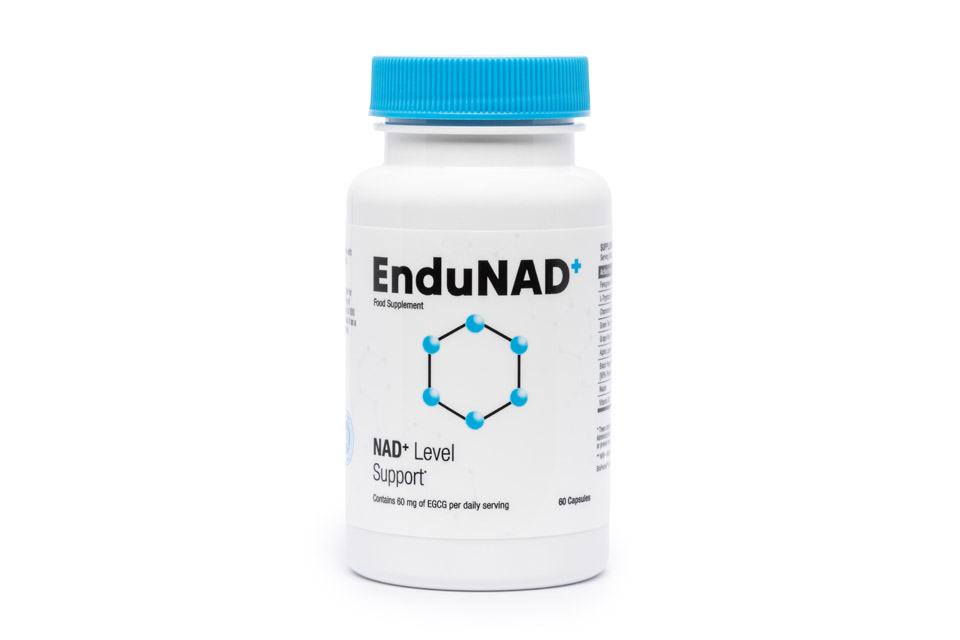
Trigonelline — the fenugreek/coffee compound used in EnduNAD. Is the newest: an NAD+ precursor in 2024 preclinical research, with human supplementation trials still to come. Which is "best" depends on whether you prioritise evidence, comfort or cost.
The Four Forms at a Glance
| Precursor | Pathway | Human NAD+ evidence | Main drawback | Typical monthly cost |
|---|---|---|---|---|
| NMN | Salvage (via NR step or direct transport — debated) | Several trials show raised NAD+; outcome results mixed | Price; stability/quality varies by brand | Higher ($50–90+) |
| NR (nicotinamide riboside) | Salvage (NRK enzymes) | Multiple trials show raised blood NAD+ | Price; outcomes in healthy adults still unproven | Higher ($45–80) |
| Niacin (nicotinic acid) | Preiss–Handler pathway | Proven — raised blood and muscle NAD+ in human studies, including a 2020 trial in mitochondrial myopathy patients | Flushing at effective doses; high chronic doses need liver awareness | Low (often under $20; formulas ~$54) |
| Trigonelline | Preiss–Handler-related route (identified 2024) | Preclinical only so far — raised NAD+ and improved muscle function in aged animals | Least human evidence of the four | Mid (in formulas like EnduNAD, $53.99) |
NMN vs NR: The Question With No Trial Answer
The internet's favourite fight has no referee: no published human trial has compared NMN directly against NR. Both raise NAD+ in blood. Both have produced mixed outcome results; the differences argued online (tissue targeting, transporters) are largely extrapolated from animal and cell work.
We covered this pair in depth in NMN vs NR — the honest conclusion there stands: pick on price, label quality and tolerance, not on a proven superiority that does not exist.
Where Niacin Fits — and Why It Was Forgotten
Niacin was raising NAD+ decades before NMN had a brand name, and a 2020 human study confirmed it raises NAD+ in blood and muscle.
It fell out of fashion for two reasons: the flush (a real, if harmless-for-most, wave of skin heat and redness from immediate-release nicotinic acid) and the fact that a cheap generic vitamin is hard to build a premium brand around.
Two cautions keep it honest: sustained high doses deserve liver awareness, and its cousin niacinamide is not the same thing. Niacinamide does not flush, but it feeds a different step and can, in principle, compete with the salvage pathway at high doses.
Trigonelline: The New Route
Trigonelline is a compound found in fenugreek and coffee. In 2024, researchers reported that it acts as an NAD+ precursor, that its levels track with muscle health in older people, and that supplementing it improved muscle function in aged animals. That is genuinely interesting. And it is animal-stage evidence.
Products built on it, like EnduNAD (which pairs 300 mg of a 2%-trigonelline fenugreek extract with 250 mg of niacin), are effectively hedging: a novel precursor plus a proven one. Our product review scores that hedge, and its unpublished guarantee status, in full.
For the full audit — the niacinamide correction, the trigonelline maths and the missing guarantee — see our EnduNAD review.
So Which Precursor Should You Choose?
Prioritise human evidence and comfort: NR or NMN from a transparent brand, accepting the price. Prioritise evidence per dollar: niacin, accepting the flush (start low. See our safety guide). Curious about the newest science and happy to be an early adopter: a trigonelline formula. And if the whole category still feels like a bet — it is one.
Our evidence overview explains exactly how much of one.
The Pathways, Mapped Properly
Your cells make NAD+ three ways, and each precursor in this article enters through a different door. The salvage pathway is the workhorse: nicotinamide (NAM) released when NAD+ is consumed is recycled back via the enzyme NAMPT — the rate-limiting step, and the one exercise upregulates (see the natural-methods article).
NR enters salvage via its own kinases (NRK1/2), bypassing NAMPT. NMN is salvage's penultimate molecule, one step from NAD+ itself. The Preiss–Handler pathway builds NAD+ from nicotinic acid (niacin) in three steps — older, well-mapped, and the route niacin has used in human bodies since long before supplements existed.
Trigonelline's 2024 identification placed it on a Preiss–Handler-related route: chemically converted toward the niacin stream. And the de novo pathway builds NAD+ from the dietary amino acid tryptophan. Inefficient, liver-centred, and the reason tryptophan appears in formulas like EnduNAD's supporting cast (200 mg) as background rather than headline. The practical moral: "precursor" is not a commodity label.
Door choice determines tissue distribution, side effects (flushing is a nicotinic-acid-receptor event, unique to niacin) and the evidence file each product can legitimately quote.
Tryptophan: the Fifth Route Nobody Sells
Completeness demands the precursor with no brand: dietary tryptophan — from protein foods — is converted through the kynurenine pathway into NAD+ in the liver.
It is real biochemistry and a useless supplement strategy: the conversion is inefficient (dozens of milligrams of tryptophan per milligram of niacin equivalent), most tryptophan goes to protein and serotonin duties, and no trial proposes tryptophan dosing as an NAD+ intervention.
Its value in this article is calibration: the body maintains four input routes plus recycling, which is why single-precursor marketing ("the only way to raise NAD+") is always false, and why deficiency of NAD+ in a fed, healthy person is a recycling story (NAMPT decline) more than a supply story.
Ingredients that support the background — adequate protein, B-vitamin sufficiency — are nutrition, not products.
The NR File, in Full
Nicotinamide riboside is the category's best-studied modern precursor: multiple randomised human trials confirm it raises blood NAD+ dose-dependently, with an extensive safety programme (including dedicated tolerability studies up to gram-level doses).
Its outcome file is the disappointment the whole category shares: in healthy middle-aged and older adults, trials measuring blood pressure, arterial stiffness, metabolic markers, exercise capacity and cognition have produced scattered small signals amid mostly null primaries. Populations with something to correct fare better in early work, consistent with this site's correction-vs-enhancement rule.
NR's honest identity: the most characterised precursor — known safety, known biomarker effect, unproven benefits. Sold at a premium its patent history explains and its outcome data does not yet justify.
The NMN File, in Full
NMN's human file is younger and more fragmented: several trials (largely in Japan and China, plus US studies) confirm NAD+ increases. Outcome studies are genuinely mixed — a walking-distance improvement in one trial of middle-aged adults, insulin-sensitivity signals in a specific female population in another, nulls elsewhere — with small samples throughout.
Two NMN-specific practicalities matter to buyers: stability (the molecule degrades under heat and humidity, so manufacturing and storage quality are efficacy variables, and our NMN buying guide treats batch testing as mandatory) and regulatory turbulence in the US, where its supplement status has been contested in recent years.
NMN vs NR remains, as the earlier section states, an unrefereed fight: choose on label quality, tested purity and price — not on mechanism folklore.
The Niacin File, in Full — Including Its Best Trial
Niacin's modern NAD+ evidence peaks with Pirinen and colleagues (Cell Metabolism, 2020): patients with mitochondrial myopathy — a genuine NAD+-relevant disease — and healthy controls received niacin in escalating doses up to 1,000 mg/day. Blood and muscle NAD+ rose in both groups, and the patients showed functional improvements.
That study does three things for this comparison: it proves the Preiss–Handler route raises human tissue NAD+ (not just blood). It demonstrates the correction pattern (benefits where deficiency lives); and it sets niacin's dose context — the NAD+ effects were achieved at doses far above a vitamin tablet's, in flushing territory, under medical supervision.
Below that apex sits decades of lipid-era niacin use (gram doses for cholesterol, largely superseded by modern drugs) which supplies unusually deep human exposure data for a "supplement". Niacin is simultaneously the cheapest precursor, the most human-tested, and the least comfortable — the comparison's most instructive row.
The Trigonelline File, in Full — Small, New, Interesting
Trigonelline's file, complete as of late 2026, is: an established natural occurrence (fenugreek, coffee — regular coffee drinkers have consumed it for centuries at dietary levels). Declining blood levels with age and muscle decline in cohort data. A 2024 Nature Metabolism paper establishing precursor status and aged-animal muscle benefit. And no published human supplementation trial.
Anyone writing more than that about trigonelline is writing fiction. Its commercial logic, as in EnduNAD, is the hedge: pair the novel precursor (~6 mg of trigonelline inside 300 mg of 2%-standardised extract) with niacin's proven route, so the formula raises NAD+ today on niacin's evidence while the trigonelline thread matures.
Graded as a precursor alone, trigonelline ranks last of the four on human evidence and first on novelty — and both halves of that sentence belong on its label.
Choosing by Reader: the Decision Table
| If you are… | The rational pick | Why |
|---|---|---|
| Evidence-first, budget-flexible | NR (tested brand) or NMN (batch-tested) | Deepest modern characterisation; biomarker certain, benefits a fair bet |
| Evidence-per-dollar | Niacin (immediate-release) | Proven human NAD+ raising at the lowest price; cost = the flush |
| Flush-averse | NR, NMN, or nicotinamide | No nicotinic-acid receptor activation, no flush — at higher prices or different evidence |
| Early-adopter, science-watching | A trigonelline formula (with niacin doing the proven work) | Novelty with a hedge; judge it as a bet, per our evidence overview |
| Sceptical, basics uncovered | None yet | Exercise defends the salvage pathway itself; revisit supplements after the base is built |
Frequently Asked Questions
Is NAD better than NMN?
Taking NAD+ itself orally is not an effective route — it is broken down during digestion. Precursors like NMN exist precisely because the body must build NAD+ from parts.
What is the difference between niacin and niacinamide?
Both are vitamin B3, but they enter NAD+ synthesis differently: niacin (nicotinic acid) uses the Preiss–Handler pathway and can flush. Niacinamide feeds the salvage pathway and does not flush. They are not interchangeable on a label.
Why choose NMN instead of NR — or the reverse?
There is no evidence-based reason yet: no head-to-head human trial exists. Cost, published amounts and brand testing are the rational tie-breakers.
Last reviewed: November 2026. This article is educational and is not medical advice.
