
- Quick Answer
- Trial Doses by Precursor
- Why "500 mg" Became the Famous NMN Number
- When Should You Take It — Morning or Night?
- Can You Stack NAD+ Precursors With Other Supplements?
- Can You Take Too Much?
- The 250 mg Niacin Question (the Dose Inside Real Formulas)
- Splitting, Titrating and the First Two Weeks
- Liposomal, Sublingual and Other Delivery Claims
- Dose Creep: Why More Keeps Looking Better Online
- TMG, Resveratrol and the Stacking Shelf
- Frequently Asked Questions
- What is the recommended dosage for NAD supplements?
- Should I avoid taking a NAD-boosting supplement at night?
- How much NMN do people actually take?
- Read This Next
Disclosure: This article contains affiliate links. If you buy through them, we may earn a commission at no extra cost to you. It never changes our conclusions.
Quick Answer
There is no official recommended dose for any NAD+ precursor — only the ranges human trials have used: roughly 250–1,000 mg/day for NMN, 300–1,000 mg/day for NR, and 250–1,000 mg/day for niacin in NAD-focused research (with flushing the practical limit). Trigonelline formulas are new.
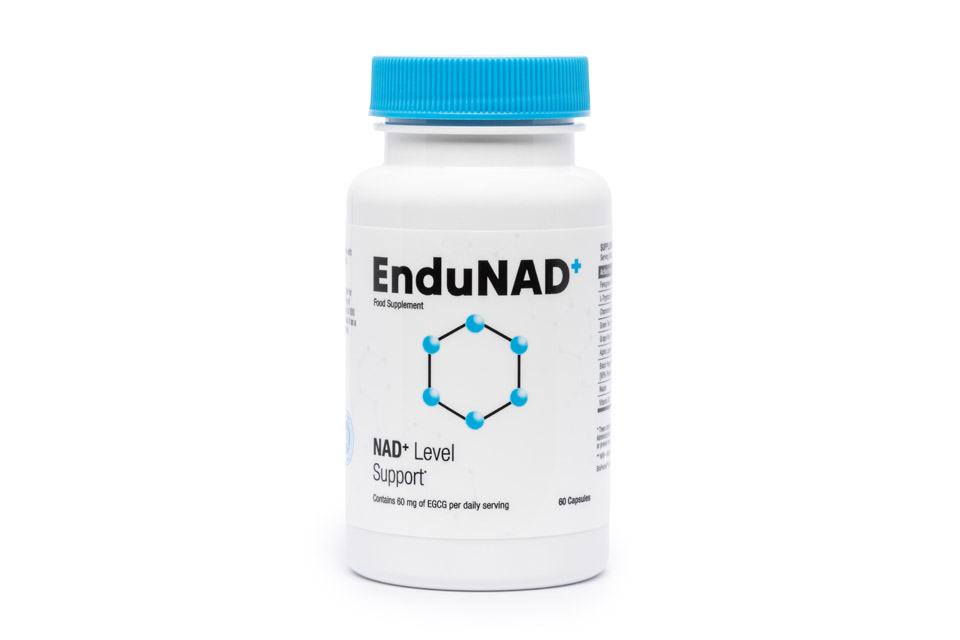
A representative one, EnduNAD, doses its fenugreek extract at 300 mg plus 250 mg niacin across 2 capsules a day. Take precursors in the morning, not at night, and more is not better — past the trial ranges you are self-experimenting.
Trial Doses by Precursor
| Precursor | Range used in human trials | Common product dose | Notes |
|---|---|---|---|
| NMN | 250–1,250 mg/day | 250–500 mg/day | Higher trial doses showed NAD+ rises without clear added outcomes |
| NR | 300–2,000 mg/day | 300 mg/day | Well tolerated at 1,000 mg+ in safety trials |
| Niacin | 250–1,000 mg/day (NAD studies) | 100–500 mg/day | Flushing usually starts at 30–50 mg immediate-release in sensitive users |
| Trigonelline (as fenugreek extract) | No human dose established | 300 mg extract (2% trigonelline) in EnduNAD | Animal-stage evidence; product doses are maker-set |
Why "500 mg" Became the Famous NMN Number
The 500 mg figure circulating online comes from a handful of mid-range trial doses and a lot of repetition. Trials below it (250 mg) still raised NAD+. Trials above it did not show proportionally better outcomes. Treat 500 mg as a convention, not a threshold — and be suspicious of any brand that implies otherwise.
Our NMN buying guide covers dose-and-purity maths in detail.
When Should You Take It — Morning or Night?
Morning, for two practical reasons. NAD+ metabolism follows a circadian rhythm, and some users find precursors mildly activating. An evening dose is the one most often blamed for lighter sleep in user reports. There is no trial proving morning superiority — it is a low-cost precaution.
Formulas with food instructions differ: EnduNAD, for instance, is directed not on an empty stomach, so breakfast is its natural slot. Niacin flush is also generally milder with food.
Can You Stack NAD+ Precursors With Other Supplements?
Common sense rules apply. Stacking two precursors (say, NMN plus a niacin formula) mostly duplicates a pathway — legal, but you pay twice for one mechanism. Resveratrol is the classic pairing (the sirtuin story), though its human evidence is thinner than its reputation. Note EnduNAD includes a small 50 mg grape-extract resveratrol source in-formula.
Avoid stacking multiple high-dose B3 forms without counting the total. Niacin's cautions are dose-driven, and our safety guide lists who should not stack at all.
Can You Take Too Much?
Yes — "it's just a vitamin pathway" is not a safety argument at gram doses. Excess nicotinamide can, paradoxically, inhibit sirtuins in preclinical work. High-dose niacin stresses the liver; and no precursor has long-term safety data at multiples of trial doses. The trial ranges in the table above are the sensible ceiling for self-directed use.
The 250 mg Niacin Question (the Dose Inside Real Formulas)
Niacin dosing has three distinct territories, and confusing them is the most common error in this category. Nutritional territory (14–35 mg/day): vitamin sufficiency — prevents deficiency, does nothing measurable to NAD+ beyond repletion.
NAD-research territory (250–1,000 mg/day): the doses that raised blood and muscle NAD+ in human studies, including the 2020 myopathy trial's escalation toward 1,000 mg — firmly in flushing range for immediate-release forms, and used under supervision at the top end.
Lipid-era territory (1,000–3,000 mg/day): the historical cholesterol doses, now largely superseded in medicine, whose liver and glucose cautions define niacin's safety reputation. A formula like EnduNAD, at 250 mg/day, sits at the floor of the research territory.
A defensible design choice (enough B3 to sit inside the studied range — and because the form is niacinamide, not nicotinic acid, without the flushing that caps nicotinic-acid doses) whose honesty check is the label itself: it prints 250 mg, so you can place it on this map. Judge any niacin product by first locating its dose on the three territories.
A 50 mg "niacin" inclusion is nutritional decoration wearing research language.
Splitting, Titrating and the First Two Weeks
Practical dosing craft, within trial ranges: start partial. For niacin-containing formulas, half the directed dose for the first 5–7 days lets flush tolerance begin building before the full amount arrives.
Split the day. Two smaller doses flush less than one large one and suit formulas directed as 2 capsules daily (EnduNAD's pattern: one with breakfast, one with a later meal — never, per its label, on an empty stomach). Anchor to meals. Food blunts both flush and the GI complaints that head the mild side-effect list.
Hold caffeine and alcohol steady during the first fortnight — both interact with how a flush feels and how sleep responds, and both corrupt your attribution of every other effect. Do not chase the flush. A folk belief in some corners holds that flushing means "it's working".
The flush is a skin blood-vessel event (prostaglandin-mediated, via the nicotinic acid receptor), neither required for nor proportional to NAD+ synthesis. Nicotinamide raises NAD+ with no flush at all. Dose to the trial ranges, not to the sensation.
Liposomal, Sublingual and Other Delivery Claims
Longevity marketing periodically discovers delivery technology, so the grading rule belongs in this guide: a delivery claim (liposomal, sublingual, buccal, "enhanced absorption") is worth credit only when a human study shows that formulation raising NAD+ more than the standard form at equal dose. For NAD+ precursors, no such comparative human dataset exists for the fashionable formats.
Standard oral capsules are the form the entire trial literature used — including every positive biomarker result quoted on the fancy formats' sales pages. Price the claim accordingly: a delivery premium buys a hypothesis. The one bioavailability enhancer in this set that is pharmacologically real is piperine (BioPerine, 2 mg in EnduNAD), which genuinely increases absorption of many compounds.
A fact that cuts both ways, and the reason our safety guide flags BioPerine formulas for a pharmacist check when medication is involved.
Dose Creep: Why More Keeps Looking Better Online
Search this category and a gradient appears: forum doses exceed label doses, which exceed trial doses, which exceed what outcomes justify. The mechanism is testimonial economics — the users who escalate and feel something post.
The users who escalate and feel nothing (or flush miserably) quietly leave — compounded by a genuine biochemical half-truth: higher precursor doses do push blood NAD+ metabolites higher, so the biomarker rewards escalation even where outcomes do not follow. Against that gradient, this article's ceiling rule stands: trial ranges are the limit of evidence-guided use.
Beyond them you are an unmonitored experiment of one, with niacin's dose-driven cautions (liver, glucose, uric acid) as the specific price of excess and no outcome data promising anything in return.
If a standard dose "isn't working", the evidence-based moves are: judge over the full 8–12 weeks first, consider a different precursor (see the comparison), or accept the category's current verdict — not multiplying a dose whose benefits were never demonstrated at the original amount.
TMG, Resveratrol and the Stacking Shelf
Two companions follow precursors everywhere online, and each gets its honest grade. TMG (trimethylglycine) is stacked on a methylation theory — high-dose nicotinamide consumption produces methyl-group by-products, and TMG donates methyl groups back. The theory is coherent biochemistry. The human outcome evidence for the stack is absent, and at ordinary precursor doses the methylation concern itself is theoretical.
Grade: an optional, cheap, unproven add-on — not a requirement, and not a reason to raise the precursor dose it supposedly protects. Resveratrol's sirtuin story made it the original NAD+-adjacent celebrity.
Two decades on, its human data remain thin, its bioavailability poor, and its presence in formulas (EnduNAD carries 50 mg of a grape extract standardised at 2% resveratrol — i.e. ~1 mg of actual resveratrol) is best read as a nod to the story rather than a dose of the substance.
The stacking hierarchy this guide endorses is dull and defensible: one precursor, at a trial-range dose, judged fairly — then, and only then, additions that must argue their own case.
Frequently Asked Questions
What is the recommended dosage for NAD supplements?
No official recommendation exists. Use the trial ranges: NMN 250–1,000 mg, NR 300–1,000 mg, niacin 250–1,000 mg daily — and follow the specific product's label if it sits inside those ranges.
Should I avoid taking a NAD-boosting supplement at night?
Most users do better with a morning dose; evening doses are occasionally linked to lighter sleep in user reports. There is no hard contraindication — it is a comfort choice.
How much NMN do people actually take?
Most commonly 250–500 mg a day, matching the lower half of trial ranges. The 1,000 mg+ regimens seen online exceed what outcome data supports.
Last reviewed: November 2026. This article is educational and is not medical advice.
