
- Quick Answer
- The Levers, Graded by Evidence
- Can I Increase NAD+ Naturally — Enough to Matter?
- A Practical Weekly Pattern
- Exercise, Mechanism First: NAMPT and the Recycling System
- Aerobic vs Resistance: What Each Contributes
- Sleep and the Circadian NAD+ Cycle
- Alcohol: the Direct Drain
- Fasting and Time-Restricted Eating: What the Human Data Actually Shows
- Heat, Cold and the Hormesis Shelf
- The Food Question, Answered With Discipline
- Combining the Natural Base With a Supplement, Honestly
- Frequently Asked Questions
- How do you increase NAD+ without supplements?
- How long do natural methods take to work?
- If I exercise, do I still need a NAD+ supplement?
- Does fasting raise NAD+ levels?
- Read This Next
Disclosure: This article contains affiliate links. If you buy through them, we may earn a commission at no extra cost to you. It never changes our conclusions.
Quick Answer
Yes, NAD+ can be supported without supplements — and the strongest lever is not a food or a hack, it is exercise. Training upregulates NAMPT, the rate-limiting enzyme of the body's own NAD+ recycling system, in muscle. Sleep regularity and limiting alcohol support the same system.
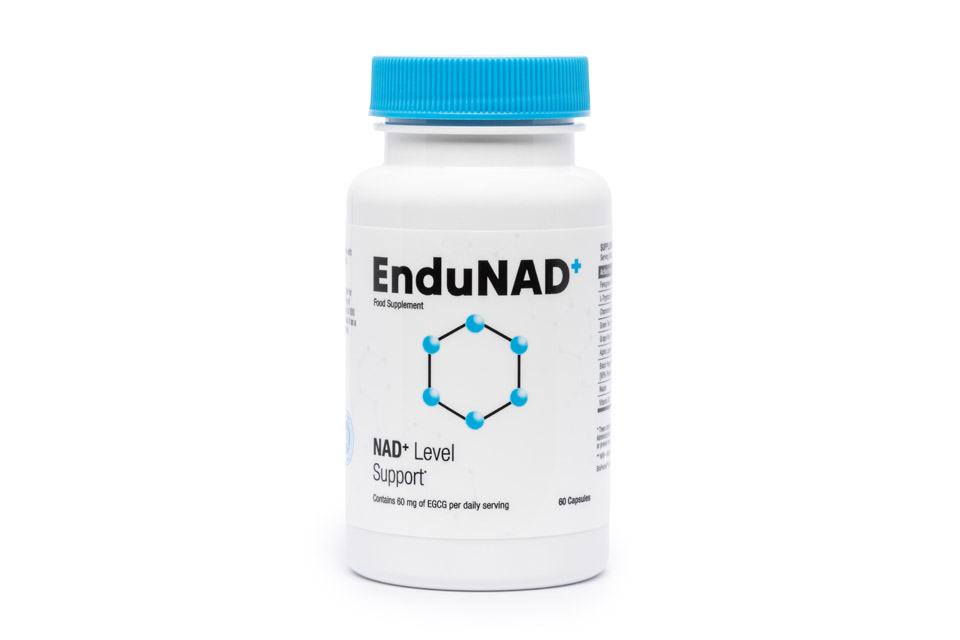
Fasting and sauna have plausible, thinner evidence; "NAD-boosting foods" contain precursors in amounts too small to matter. None of this is as effortless as a capsule — which is the honest trade behind products like EnduNAD — but the lifestyle effects come with outcome evidence supplements cannot yet claim.
The Levers, Graded by Evidence
| Lever | Mechanism | Evidence grade |
|---|---|---|
| Regular exercise (aerobic + resistance) | Raises NAMPT expression in muscle; counters the age-related decline in the salvage pathway | Strongest — human data, plus every other health benefit |
| Sleep regularity | NAD+/sirtuin activity is circadian; chronic disruption suppresses the cycle | Moderate — mechanistic + observational |
| Limiting alcohol | Alcohol metabolism consumes NAD+ directly | Moderate — established biochemistry |
| Time-restricted eating / fasting | Raises the NAD+/NADH ratio in animal and some human metabolic studies | Early — promising, not NAD-specific in humans |
| Heat (sauna) | Stress-response pathways overlap NAD+ metabolism | Weak for NAD+ specifically |
| "NAD foods" (milk, edamame, mushrooms) | Contain NR/niacin equivalents in trace amounts | Negligible at dietary doses |
Can I Increase NAD+ Naturally — Enough to Matter?
The lifestyle route does not spike NAD+ the way a gram of precursor can on a blood test. What it does is defend the production system itself — the enzymes that recycle NAD+. Which is arguably the more relevant target as the decline with age is partly a recycling failure, not just a supply failure.
This is also why the supplement story and the lifestyle story are not enemies: our evidence overview makes the same point from the trial side.
A Practical Weekly Pattern
Four to five training sessions mixing resistance work and zone-2 cardio. A consistent sleep window (the regularity matters as much as the hours). Alcohol kept occasional rather than nightly; and, if it suits your life, a simple 12-hour overnight eating pause. That pattern is the entire "protocol". Anything more elaborate is selling complexity the evidence does not support.
If you do add a supplement, do it on top of this base, at trial-range doses (dosage guide), and judge it over a full bottle (realistic timelines).
Exercise, Mechanism First: NAMPT and the Recycling System
The reason exercise tops the table is mechanistic, not moral. Most of your NAD+ is not eaten or swallowed — it is recycled: when NAD+ is consumed by sirtuins, PARPs and other enzymes, it breaks down to nicotinamide, and the salvage pathway rebuilds it, at a rate set by the enzyme NAMPT.
Ageing degrades this loop — NAMPT expression falls, recycling slows, and NAD+ declines even if dietary precursors stay constant. Human training studies show aerobic and resistance exercise raise NAMPT expression in muscle — in some work, older trained adults show muscle NAMPT levels resembling much younger sedentary adults.
That is a systems repair no capsule currently offers: precursors push more raw material into a slowing loop. Training speeds the loop itself. It also explains the supplement category's structural limit, and why our evidence overview keeps returning to the same asymmetry.
The intervention with outcome data (strength, metabolic health, mortality curves) is the one that fixes production, not the one that tops up supply.
Aerobic vs Resistance: What Each Contributes
The NAD+-specific evidence leans aerobic (the NAMPT studies are largely endurance-training work), while the ageing outcomes people actually care about — muscle mass, strength, bone, glucose control — are defended by resistance training through partly separate pathways.
The practical answer is therefore both, in the proportions general health guidance already converged on: roughly 150 minutes a week of moderate aerobic work (or 75 vigorous) plus two or more resistance sessions covering the major muscle groups.
For this article's specific question, note the dose honesty: the NAMPT changes are training adaptations, measured over weeks to months of consistent work. There is no single-session NAD+ "boost" to chase, and no benefit to heroic one-off efforts. Consistency is the dose.
Sleep and the Circadian NAD+ Cycle
NAD+ is a circadian molecule: its synthesis enzyme NAMPT is under clock-gene control, NAD+ levels oscillate across the day, and the sirtuins it feeds feed back into the clock itself. Chronic sleep disruption and irregular schedules therefore hit the system twice — directly (a flattened NAD+ rhythm) and indirectly (every downstream system the rhythm organises).
The actionable version is unglamorous: a consistent sleep window kept within about an hour day to day, morning light exposure to anchor the clock, and caffeine timed early enough not to tax the night's depth. No trial assigns an NAD+ number to good sleep hygiene — the grade in our table is "moderate, mechanistic".
But the intervention costs nothing, interacts with everything else on this page positively, and is the lever supplement users most commonly skip while shopping for the pathway it regulates.
Alcohol: the Direct Drain
Alcohol's entry in the table is the most literal biochemistry in this article: metabolising ethanol consumes NAD+ — both steps of ethanol breakdown (via alcohol and aldehyde dehydrogenases) convert NAD+ to NADH, shifting the cell's NAD+/NADH ratio and competing with every other NAD+ duty for as long as the drinking and recovery last.
Occasional modest drinking is a temporary withdrawal from the account. A nightly habit is a standing overdraft on the exact molecule this page is about. No supplement strategy outruns it.
A precursor taken in the morning does not neutralise an evening drain, and the combination of high-dose niacin with heavy alcohol is additionally the liver pairing our safety guide warns against. Reducing alcohol is, per unit of effort, among the highest-yield NAD+ decisions available to the people it applies to.
Fasting and Time-Restricted Eating: What the Human Data Actually Shows
Fasting raises the NAD+/NADH ratio in animal models and shifts human metabolism in directions consistent with the story (fat oxidation up, sirtuin-pathway activity markers moving in some studies) — but no human trial has demonstrated that a fasting regimen raises tissue NAD+ levels as a primary endpoint, and the popular leap from "ratio" to "levels" to "longevity" outruns the data at both steps.
What fasting patterns do have human evidence for — weight and metabolic improvements in people they suit. Is reason enough for those people. Grading it as an NAD+ intervention specifically earns the table's "early" stamp.
A simple overnight pause (12 hours) captures most of the practical pattern without the adherence cost of aggressive windows, and anything beyond that is a personal metabolic experiment to be judged on its own results, not on NAD+ language.
Heat, Cold and the Hormesis Shelf
Sauna, cold exposure and similar deliberate stressors are marketed into this pathway via hormesis — mild stress upregulating repair systems, some of which consume and then stimulate NAD+ production. The honest grades: sauna use has genuinely interesting (observational, largely Finnish) cardiovascular associations and no direct human NAD+ trial. Cold exposure's NAD+ claims are extrapolations stacked on extrapolations.
Both may be worth doing for their own files. Neither currently earns a row above "weak" in an NAD+ table, and this site will upgrade them the day a human trial measures the molecule rather than the metaphor. Until then, treat hormesis content as the category's poetry — sometimes beautiful, never dosage.
The Food Question, Answered With Discipline
Which foods "contain NAD+ precursors" is true and nearly meaningless: milk carries NR in trace amounts, edamame and mushrooms carry B3-family compounds, and ordinary protein supplies the tryptophan the liver can slowly convert.
The discipline is amounts: dietary precursor intakes sit orders of magnitude below supplement trial doses, and no meal plan closes that gap — which is fine, because the fed state was never the deficiency.
The food advice that actually serves this pathway is foundational rather than targeted: adequate protein (the tryptophan and general repair substrate), a B-vitamin-sufficient diet (deficiency genuinely does impair NAD+ production — the one food-related correction that matters), and the vegetable-rich pattern whose benefits need no NAD+ framing at all.
Food is the base layer of the system, not a dosing route — and any page selling a specific "NAD superfood" is selling the framing.
Combining the Natural Base With a Supplement, Honestly
Some readers will do both, so the combination gets its protocol. Sequence matters: build the natural base first (8–12 weeks of the training/sleep/alcohol pattern) — it carries proven outcomes, and it establishes the honest baseline against which any supplement must then prove an increment.
Add one precursor at a trial-range dose (our dosage guide), judge it with the written-score protocol over the following 8–12 weeks, and let it earn renewal against your trained baseline rather than against your sedentary memory. That ordering is also the answer to the category's deepest question.
Whether supplements add anything to a well-run system: today, nobody knows, because the trials were not run in that population. Running the experiment in this order at least guarantees that the part with evidence was never skipped for the part without it.
Frequently Asked Questions
How do you increase NAD+ without supplements?
Primarily through exercise, which raises the NAMPT recycling enzyme in muscle. Supported by regular sleep and limited alcohol. No food or drink raises NAD+ meaningfully on its own.
How long do natural methods take to work?
Training adaptations to the NAD+ system are measured over weeks to months of consistent exercise — slower than a supplement's biomarker rise, but accompanied by proven functional benefits.
If I exercise, do I still need a NAD+ supplement?
Need is the wrong frame — no one needs these supplements. An active person has defended the core pathway already. A precursor becomes a discretionary extra, judged by the standards in our buying guide.
Does fasting raise NAD+ levels?
In animals, fasting shifts NAD+ metabolism favourably; in humans, the NAD+-specific endpoint has not been demonstrated directly. Fasting patterns may help weight and metabolic health for people they suit — judge them on that evidence, not on NAD+ claims.
Last reviewed: October 2026. This article is educational and is not medical advice.
