
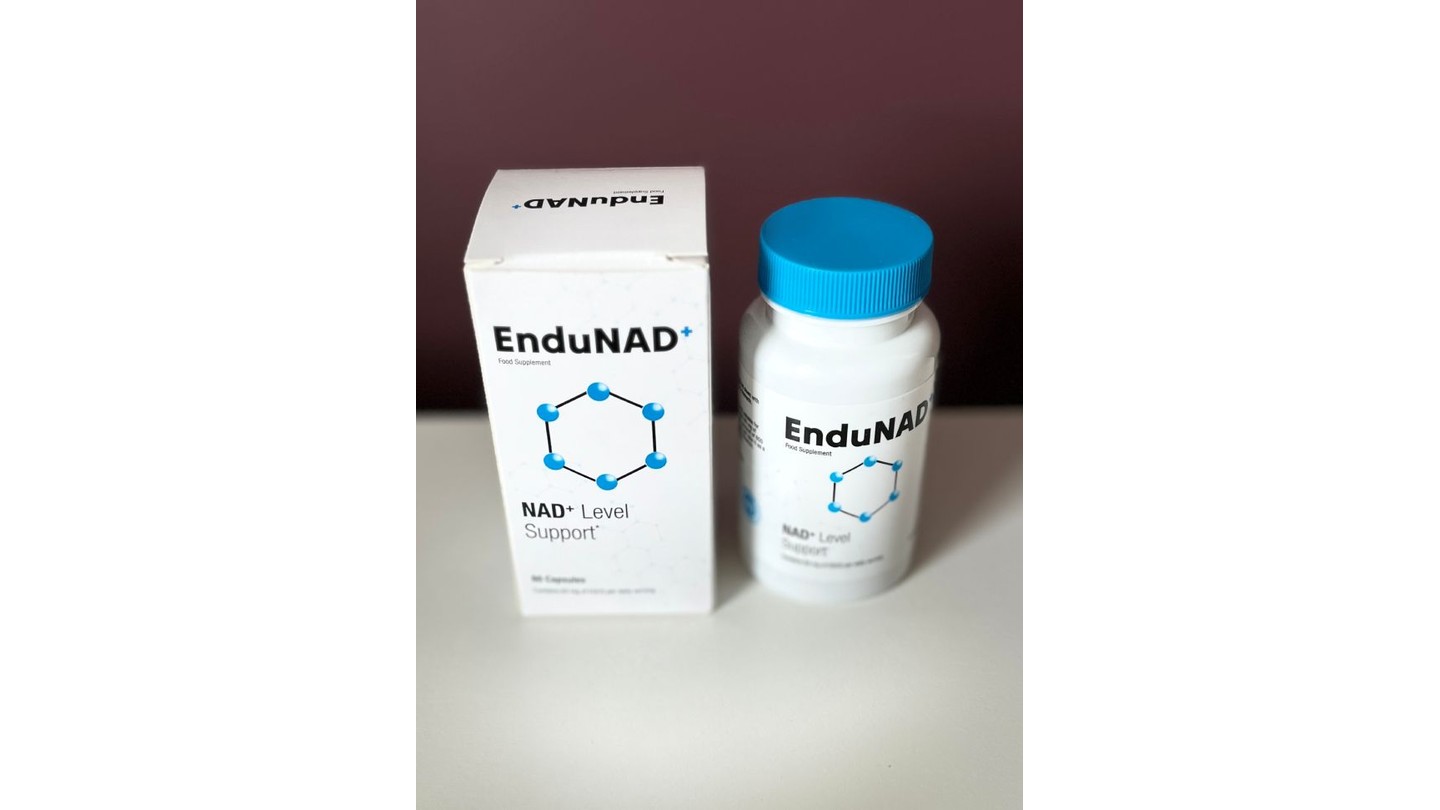
- Quick Answer
- Our Findings
- Why You Should Trust This Review
- Our Verdict
- How We Scored It
- What Is EnduNAD?
- The Ingredients
- Fenugreek Seed Extract (300 mg)
- L-Tryptophan (200 mg)
- Chamomile Flower Extract (150 mg)
- Green Tea Leaf Extract (150 mg)
- Grape Vine Fruit Extract (50 mg)
- Alpha Lipoic Acid (50 mg)
- Black Pepper Fruit Extract — BioPerine® (2 mg)
- Niacin (250 mg)
- Vitamin B6 (2.8 mg)
- The Form Audit: What 'Niacin' Actually Is Here, and What 6 mg of Trigonelline Can Claim
- The Form Decides the Safety Story
- Trigonelline Maths: 6 mg and Zero Human Trials
- The Supporting Cast Is Token-Dosed
- What Is Genuinely Good — and Why the Order Is Backwards
- The Evidence, Read Properly
- Trigonelline: Animal Data and a Human Association
- Niacin (Nicotinic Acid): Different Form, Higher Dose, Disease Population
- NMN in Prediabetic Women: A Human Clinical Benchmark
- NMN in Older Men: Biomarker Shifts and Modest Signals
- NMN Dose-Response: Raised Blood NAD+, Mixed Metabolic Results
- Resveratrol: 150× More Than EnduNAD Supplies
- How Long Does It Take to Work?
- Is It Safe?
- Side Effects: What Is Actually Known
- When Fatigue and Ageing Symptoms Need a Doctor, Not a Precursor
- Is It a Scam?
- Price and Packs
- Purchase Options
- How It Compares
- A Stronger Alternative in This Category
- Who Should Buy It — and Who Should Skip It
- Who should buy it
- Who should skip it
- Frequently Asked Questions
- Does EnduNAD actually work?
- Is trigonelline proven to raise NAD+ in humans?
- Will EnduNAD make me flush like niacin does?
- How long should I take EnduNAD before judging it?
- Is EnduNAD safe — what about the niacin dose and the EGCG?
- EnduNAD or NMN — which is the better NAD+ bet?
- Does EnduNAD have a money-back guarantee?
- Where can I buy EnduNAD — and what does a month actually cost?
- Sources & Method
- Read This Next
SuppChecked is an independent supplement review site. When you buy a product through links on our pages, we may earn a commission at no extra cost to you. Every score, price, and product claim on this page is checked against the maker's official records and the published scientific literature, and brands never pay to change our scores.
Shoppers looking at NAD+ supplements split into two camps. One group wants an alternative to another NMN or NR bottle — a formula built instead on niacinamide and the newer precursor trigonelline, with every milligram printed openly on the box. EnduNAD is built directly for that buyer.
The other camp asks harder questions before paying. They want to know which precursor in the capsule has actually been tested in humans, and at what dose. This review reads EnduNAD's printed box panel against the maker's full ingredients list, works out what each published amount delivers — including the 6 mg of trigonelline inside the 300 mg fenugreek extract — and prices a fair three-month trial straight from the maker's order page.
Quick Answer
EnduNAD scores 6.4/10. All nine ingredient amounts appear on the printed box panel, with no proprietary blend. The 250 mg "niacin" line is niacinamide per the maker's full ingredients list — the non-flushing form with genuine NAD+ precursor credentials.
The catch sits in the headline. Trigonelline delivers just 6 mg a day, backed by a 2024 animal study and a human association rather than a human trial. Supporting botanicals arrive at token doses, including only 1 mg of resveratrol from the grape extract. No money-back guarantee is published, and bottles start at $53.99 plus $12 shipping.
Best for: buyers who want a published-amount NAD+ supplement outside NMN and NR, understand that niacinamide carries the formula rather than trigonelline, and plan to judge it over three full months.
EnduNAD — Our Score: 6.4/10
Score: 6.4/10 · Sub-scores: Ingredients 7.0 · Evidence 5.5 · Safety 7.0 · Value 7.0 · Best for: Buyers who want a published-amount NAD+ formula built on niacinamide and trigonelline rather than NMN or NR, and who will judge it over a full three months · Main caution: The headline trigonelline arrives at just 6 mg a day and its NAD+ evidence is animal data plus a human association — there is no human trial of trigonelline, of this formula, or of its 250 mg nicotinamide dose · Fair trial: Three months — three bottles at $157.77 delivered
Our Findings
What we like
- Full dose disclosure on the box: Every one of the nine ingredient amounts is printed on the box panel, with no proprietary blend hiding the split.
- A real, non-flushing main precursor: The 250 mg niacin line is niacinamide (nicotinamide), a genuine salvage-pathway NAD+ precursor in the form that does not cause skin flushing.
- Front-of-box EGCG transparency: The maker prints the exact 60 mg daily EGCG amount right on the front of the box — far below the 800 mg daily level European regulators flag for green tea extracts.
- Lower daily cost at multi-bottle tiers: Free shipping on the six-bottle option brings the delivered cost down to $1.44 a day, undercutting most NMN and NR capsules.
What gives us pause
- Headline trigonelline is untested in humans: The 300 mg fenugreek extract delivers just 6 mg of trigonelline a day. Its NAD+ case rests on animal experiments and a human association from a largely industry-authored 2024 paper — no human supplementation trial exists.
- One-word "Niacin" hides the form on the panel: The printed panel says only "Niacin," leaving out whether it is nicotinic acid or niacinamide. Buyers need the form to know which safety profile applies.
- Token-dosed supporting cast: The grape extract supplies just 1 mg of resveratrol, alpha lipoic acid sits at 50 mg against roughly 600 mg study doses, and L-tryptophan sits at 200 mg against about 1 g in sleep studies.
- No money-back guarantee: The maker's website publishes no satisfaction guarantee, leaving the full cost of a three-month trial on the buyer.
- Unnamed seller: The product is made in the European Union, but the official website does not name the company behind it.
Why You Should Trust This Review
For this review, we read the maker's sales and order pages in full, inspected the printed box panel from EnduNAD's own packaging, and checked the maker's full ingredients list to verify the exact nutrient forms behind the panel's short names. We also read the primary scientific literature cited for the formula's key precursors, including the 2024 trigonelline paper (Membrez et al. 2024, PMID 38504132) and the human nicotinic-acid study (Pirinen et al. 2020, PMID 32386566). Every product on SuppChecked is scored against those primary records using one consistent scoring method rather than sales copy, and brands never pay to change a score.
Our Verdict
EnduNAD earns 6.4/10. It is a fully disclosed nine-ingredient NAD+ capsule that avoids proprietary blends and prices below most NMN competitors. The main drag on the score is an inverted formula story: the proven-in-humans ingredient is the quiet one (niacinamide), while the marketed headline — trigonelline — is the least-proven precursor in the category, delivered at 6 mg a day.
Maker Credibility scores 5.5/10 in our evaluation. Printing every ingredient amount on the box panel and placing the 60 mg EGCG figure on the box front show real label openness. However, the company behind EnduNAD is not named anywhere on the website, the panel's one-word "Niacin" hides the exact form buyers need for safety decisions, and no money-back guarantee stands behind the claims.
The fair-trial maths matter before you buy. Published NAD+ precursor trials typically measure changes over about 4 to 12 weeks, so a single 30-day bottle cannot judge this formula fairly. A proper test takes three months — three bottles at $157.77 delivered ($1.76 a day) — with no refund safety net.
The bottom line is plain. EnduNAD gives you a solid, non-flushing 250 mg niacinamide base at a competitive daily cost. Buy it only if you see it for what it is: niacinamide plus an untested 6 mg trigonelline bet and token-dosed extras.
How We Scored It
EnduNAD's overall score of 6.4/10 reflects four core areas shown in the table below, alongside the 5.5/10 Maker Credibility assessment explained in our verdict. Each sub-score weighs the printed box panel, the maker's full ingredients list, and the published human research.
| Criterion | Score |
|---|---|
| Ingredients | 7.0/10 |
| Evidence | 5.5/10 |
| Safety | 7.0/10 |
| Value | 7.0/10 |
Ingredients — 7.0/10. All nine lines carry published amounts on the box panel, with clear standardisations for every botanical extract. The 250 mg niacinamide base is a genuine, sensibly dosed NAD+ precursor, and Vitamin B6 sits at a restrained 2.8 mg. The score stops short of the top tier because the supporting botanicals — especially 1 mg of resveratrol and 50 mg of alpha lipoic acid — are token-dosed, and the box panel omits the niacin form.
Evidence — 5.5/10. No clinical trial has tested the finished EnduNAD formula. Its headline precursor, trigonelline (6 mg a day), has animal data and a human sarcopenia association but zero human supplementation trials. Nicotinamide has well-established salvage-pathway biochemistry, yet this 250 mg dose has no human NAD+-outcome trial here, and the supporting lines fall far below human study doses.
Safety — 7.0/10. Confirming the niacin form as niacinamide clears the flushing risk tied to nicotinic acid, and 250 mg sits well inside the 900 mg European daily upper level. EGCG is capped at 60 mg a day — one-thirteenth of the 800 mg threshold European regulators flag — and the maker advises taking capsules with water and food. Points stay held back for the absent finished-product safety study and interaction cautions around fenugreek, L-tryptophan, and piperine.
Value — 7.0/10. At $2.20 a day for a single bottle, $1.76 a day for the three-bottle fair trial, and $1.44 a day with free shipping on six bottles, EnduNAD costs less per day than most single-precursor NMN capsules. The absence of any money-back guarantee prevents a higher value score, because buyers absorb the full $157.77 risk of a three-month test.
What Is EnduNAD?
EnduNAD at a Glance
- Our score: 6.4/10
- Brand: EnduNAD
- Company: Not named on the maker's website (product made in the European Union)
- Product type: NAD+ level support capsules — 60 per bottle
- Primary purpose: Marketed to support NAD+ levels, cellular energy and healthy ageing
- Formula: 9 lines with amounts published, per 2-capsule daily serving
- Clinical research: No trial of the finished formula
- Research limitation: The headline precursor (trigonelline, 6 mg a day) has animal and association data only; the proven-in-humans precursor here is niacinamide, whose own dose in this product has never been trialled for NAD+ outcomes
- Recommended use: 2 capsules a day with 300 ml of water, not on an empty stomach
- Money-back guarantee: None published
EnduNAD — also branded as EnduNAD+ on its packaging — is a daily NAD+-support capsule formula sold via the official website. Each bottle holds 60 capsules (net weight 43.20 g), supplying 30 daily servings of two capsules for one month of use. The product is made in the European Union, though the website never names the corporate seller behind the brand.
The maker pitches EnduNAD under the headline "The Energy of Youth in Every Capsule," positioning it for NAD+ level support, cellular energy, and healthy ageing. Those are the maker's claims, not measured clinical outcomes. No human study has ever tested the finished EnduNAD blend to see whether it raises blood NAD+ or changes energy, strength, or ageing markers.
Some category context helps place this bottle. Cellular NAD+ levels decline with age, and supplement makers try to replenish them through several precursor routes: NMN, NR, vitamin B3 niacin forms, and trigonelline. EnduNAD skips NMN and NR entirely and bets on two of the less-trialled options — niacinamide and trigonelline. Even where a precursor raises blood NAD+, a higher biomarker in a lab test is not the same as a proven ageing outcome.
The Ingredients
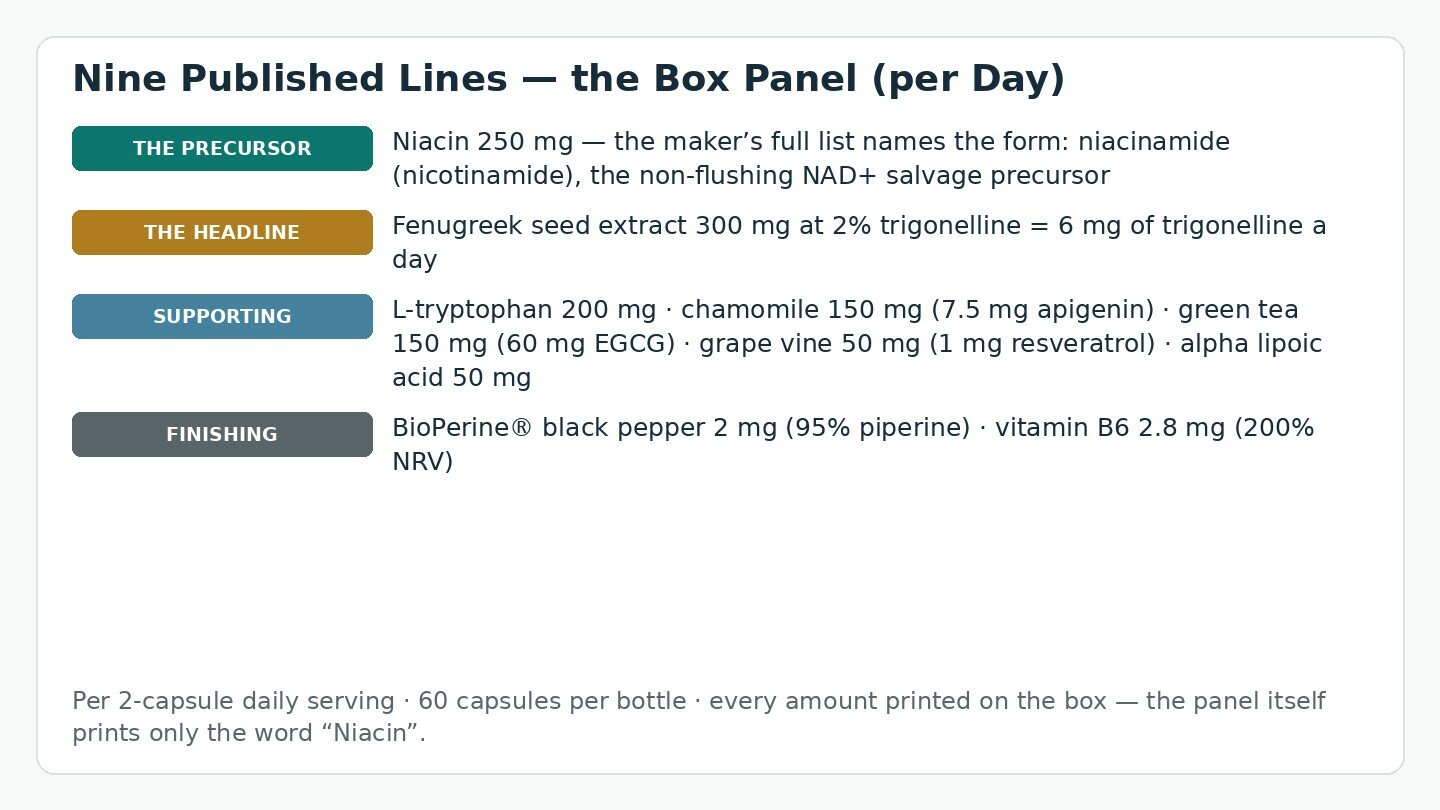
Every amount in EnduNAD is published openly on its physical box panel, with no proprietary blend. Because this is a European Union product, it does not appear in the US Dietary Supplement Label Database (DSLD). We read the physical box panel firsthand and checked it against the maker's website panel; both match line for line, and the table below follows the exact order printed on the box per two-capsule daily serving.
Open amounts do not answer every label question on their own. The printed panel uses short names that leave out chemical forms, most importantly printing just "Niacin" for the 250 mg line. Reading the maker's full ingredients list settles that point: the niacin is niacinamide (nicotinamide), while Vitamin B6 is listed simply as Vitamin B6 without specifying a coenzyme form. The box front also prints the exact daily EGCG figure (60 mg), and the panel notes BioPerine® as a registered trademark of Sabinsa.
| Ingredient | Amount per daily serving | Standardisation |
|---|---|---|
| Fenugreek Seed Extract | 300 mg | 2% trigonelline (6 mg) |
| L-Tryptophan | 200 mg | — |
| Chamomile Flower Extract | 150 mg | 5% apigenin (7.5 mg) |
| Green Tea Leaf Extract | 150 mg | 40% EGCG (60 mg) |
| Grape Vine Fruit Extract | 50 mg | 2% resveratrol (1 mg) |
| Alpha Lipoic Acid (ALA) | 50 mg | — |
| Black Pepper Fruit Extract — BioPerine® | 2 mg | 95% piperine |
| Niacin | 250 mg (1,563% NRV) | Niacinamide (per full ingredients list) |
| Vitamin B6 | 2.8 mg (200% NRV) | — |
Fenugreek Seed Extract (300 mg)
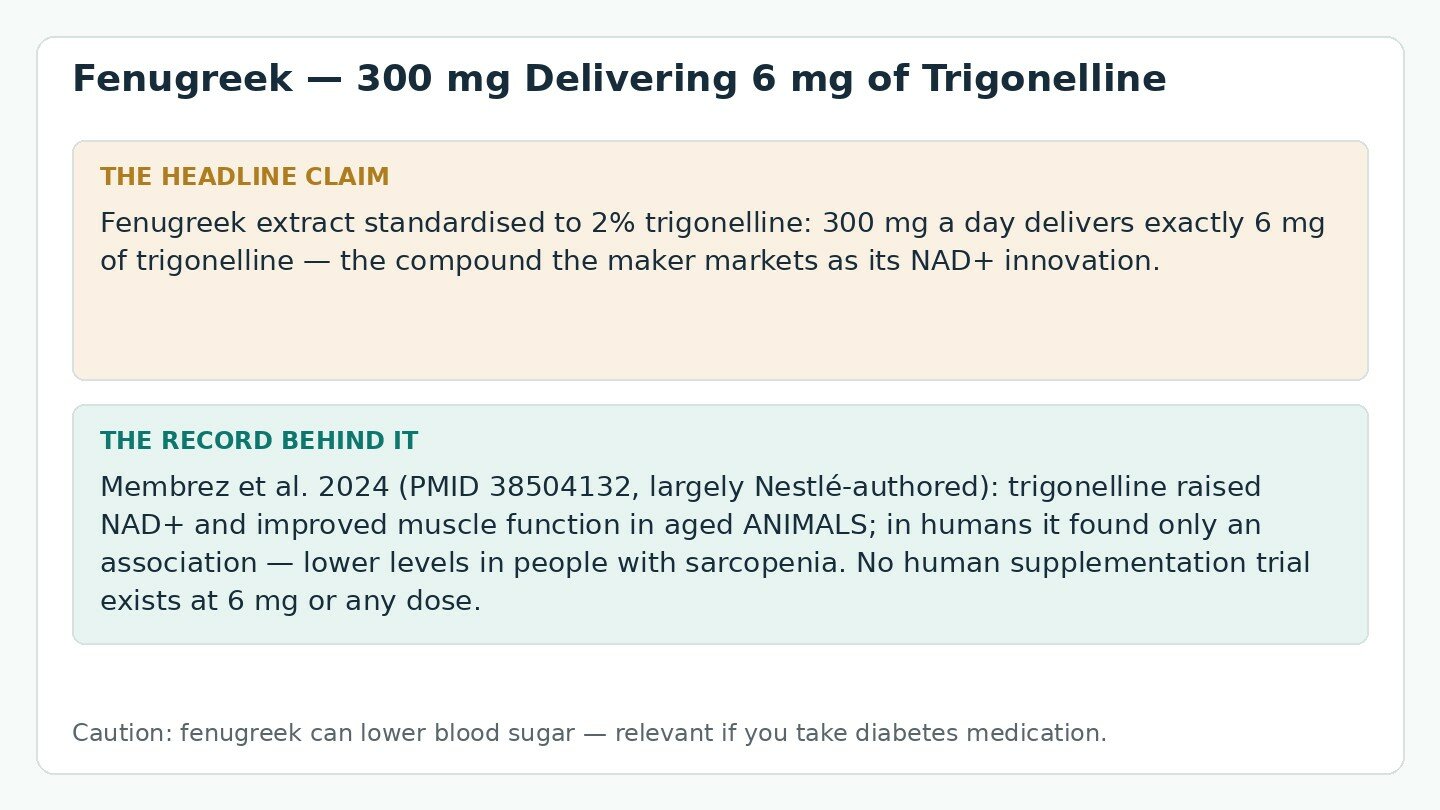
Fenugreek seed extract sits at the top of the box panel as EnduNAD's source of trigonelline. Standardised to 2% trigonelline, the 300 mg daily serving delivers exactly 6 mg of trigonelline per day. The maker treats this compound as the headline NAD+ hook that sets EnduNAD apart from NMN and NR capsules.
The science behind that pitch is still preclinical. A 2024 Nature Metabolism paper from a largely Nestlé-authored research team showed that trigonelline acts as an NAD+ precursor and improved muscle function in aged animals, while also finding lower circulating trigonelline levels in humans with sarcopenia (Membrez et al. 2024, PMID 38504132). That human finding is an observational association, not a clinical trial. No human has been trialled taking supplemental trigonelline at 6 mg or any other dose. Caution: fenugreek can lower blood sugar, which matters if you take diabetes medication.
L-Tryptophan (200 mg)
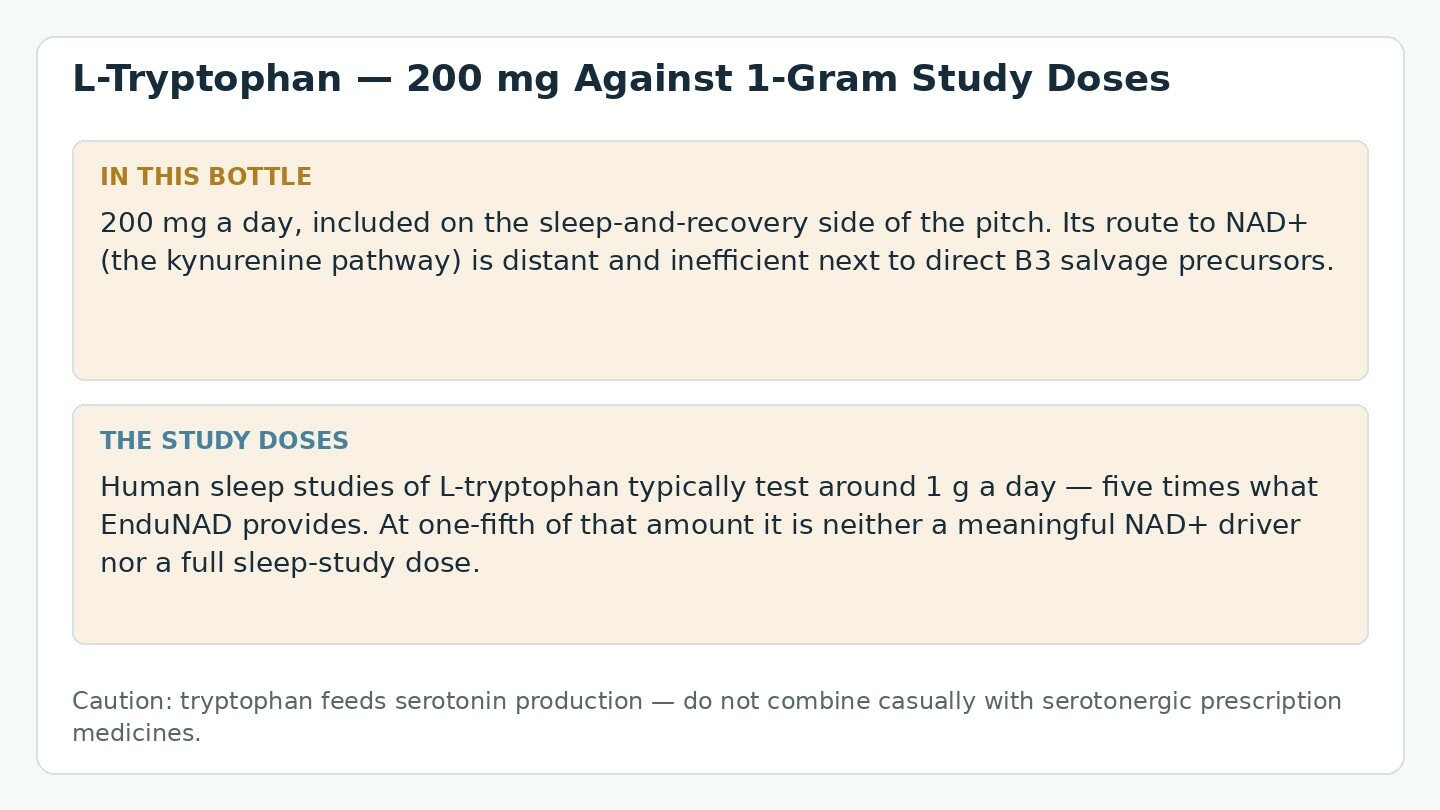
L-tryptophan is an essential amino acid that the body uses to build serotonin and melatonin. In EnduNAD, the maker includes it on the sleep-and-recovery side of the healthy-ageing pitch. Tryptophan can also convert into NAD+ through the kynurenine pathway, though that is a distant, inefficient route compared with direct vitamin B3 salvage precursors.
At 200 mg per daily serving, the dose falls well short of human clinical benchmarks. Human sleep studies using L-tryptophan typically test doses around 1 g — five times what two capsules of EnduNAD provide. At one-fifth of that amount, it is neither a meaningful NAD+ driver nor a full sleep-study dose. Caution: because L-tryptophan feeds serotonin production, do not combine it casually with serotonergic prescription medicines without checking with your doctor.
Chamomile Flower Extract (150 mg)
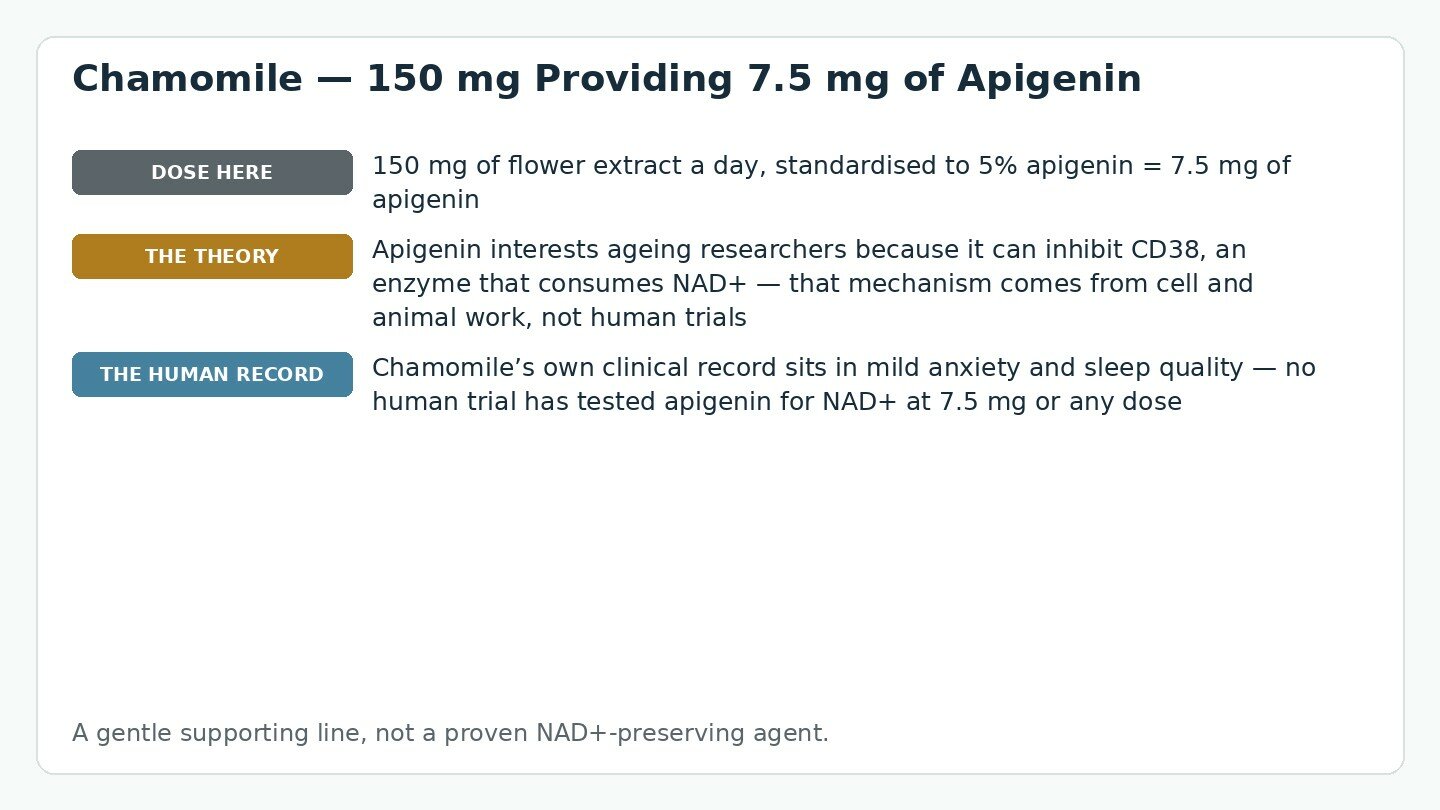
Chamomile flower extract is included at 150 mg per daily serving, standardised to 5% apigenin. That arithmetic delivers 7.5 mg of apigenin a day. Researchers studying cellular ageing take an interest in apigenin because it can inhibit CD38, an enzyme that breaks down and consumes NAD+ inside cells.
That mechanism comes from cell and animal work, not human clinical trials. No published human trial has tested apigenin for raising NAD+ levels at 7.5 mg or at any higher dose. Outside NAD+ theory, chamomile's own human clinical record sits mostly in mild anxiety and sleep quality rather than healthy ageing or cellular energy. At 150 mg of extract, it acts as a gentle supporting line rather than a proven NAD+-preserving agent.
Green Tea Leaf Extract (150 mg)
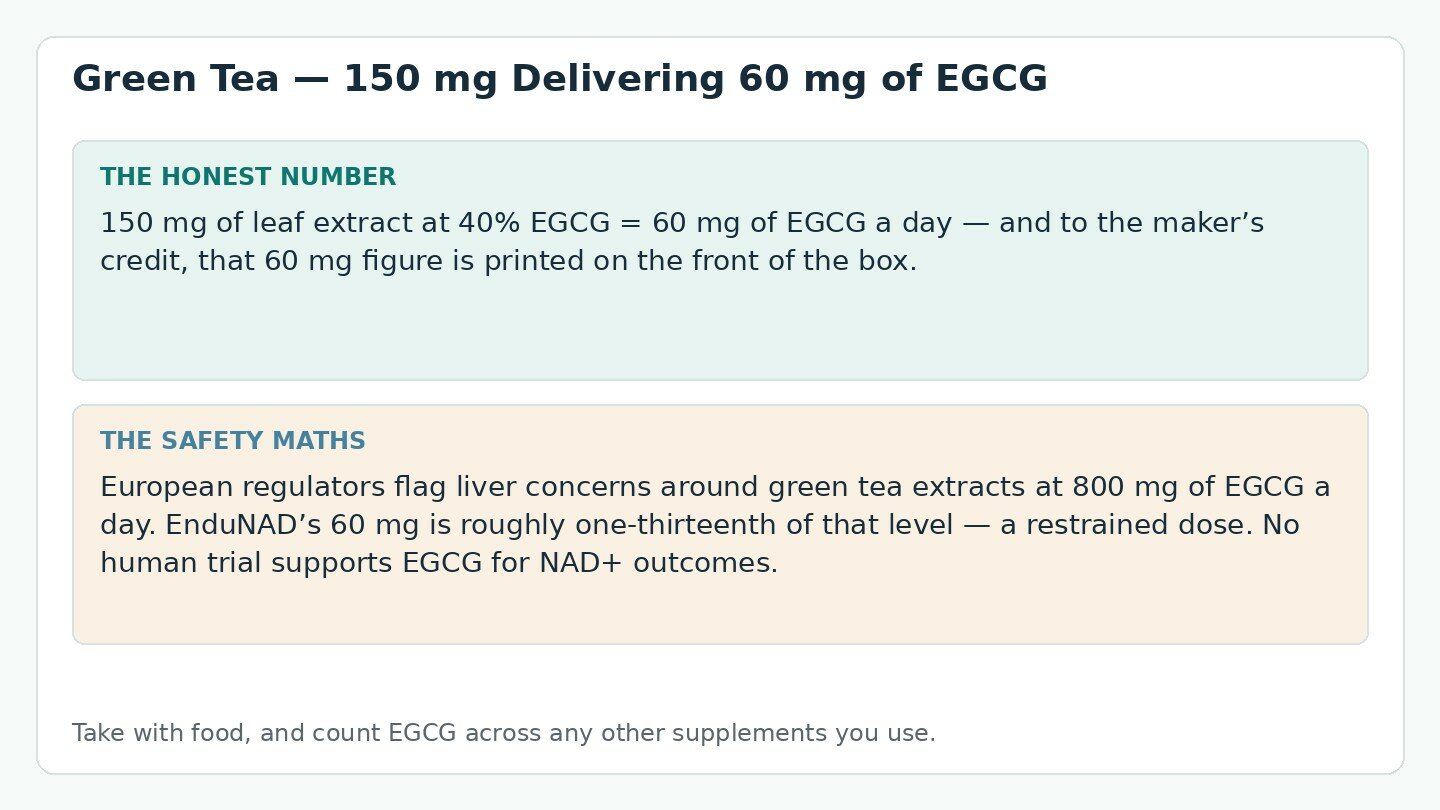
EnduNAD provides 150 mg of green tea leaf extract standardised to 40% EGCG, which works out to 60 mg of EGCG per day. To the maker's credit, that 60 mg figure is printed right on the front of the box. In this formula, green tea extract sits as a general antioxidant and cellular-protection line.
EGCG is a well-studied catechin with a wide general literature, but no human trial supports it for NAD+ outcomes in this context. Where the 60 mg figure does earn credit is safety maths. European food-safety regulators flag liver concerns around green tea extracts at 800 mg of EGCG per day. At 60 mg, EnduNAD sits at roughly one-thirteenth of that flagged level — a restrained dose, though buyers should still take capsules with food and count EGCG across other supplements.
Grape Vine Fruit Extract (50 mg)
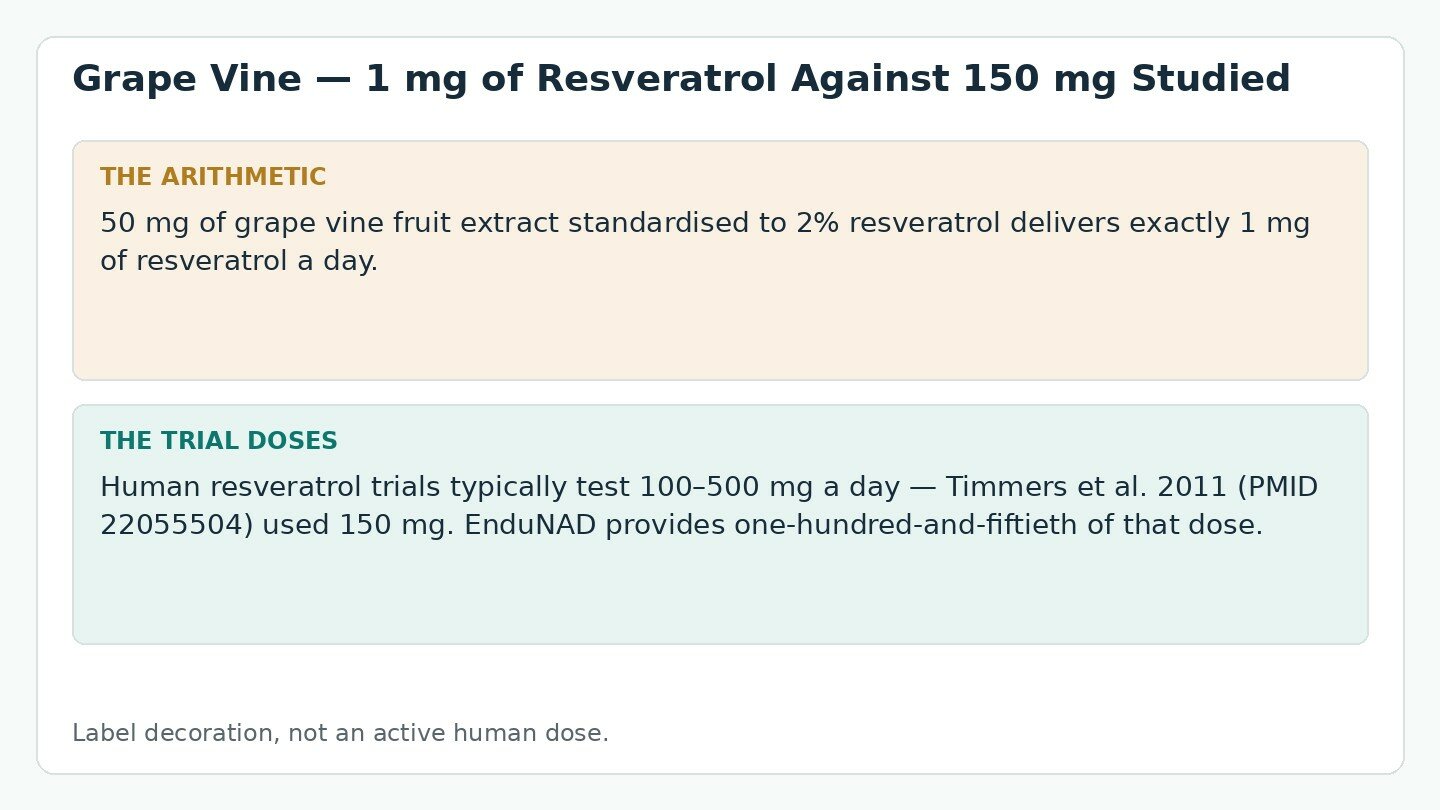
Grape vine fruit extract appears at 50 mg per daily serving, standardised to 2% resveratrol. Doing the multiplication shows the problem right away: two capsules deliver exactly 1 mg of resveratrol a day. Resveratrol is a familiar longevity-label staple often paired with NAD+ precursors in anti-ageing formulas.
The dose gap here is extreme. Human resveratrol trials typically test 100 mg to 500 mg per day; for example, one well-known metabolic trial used 150 mg daily (Timmers et al. 2011, PMID 22055504). EnduNAD provides one-hundred-and-fiftieth of that study dose. Stated plainly, 1 mg of resveratrol is label decoration, not an active human dose. It adds a recognizable name to the panel without carrying real clinical weight.
Alpha Lipoic Acid (50 mg)
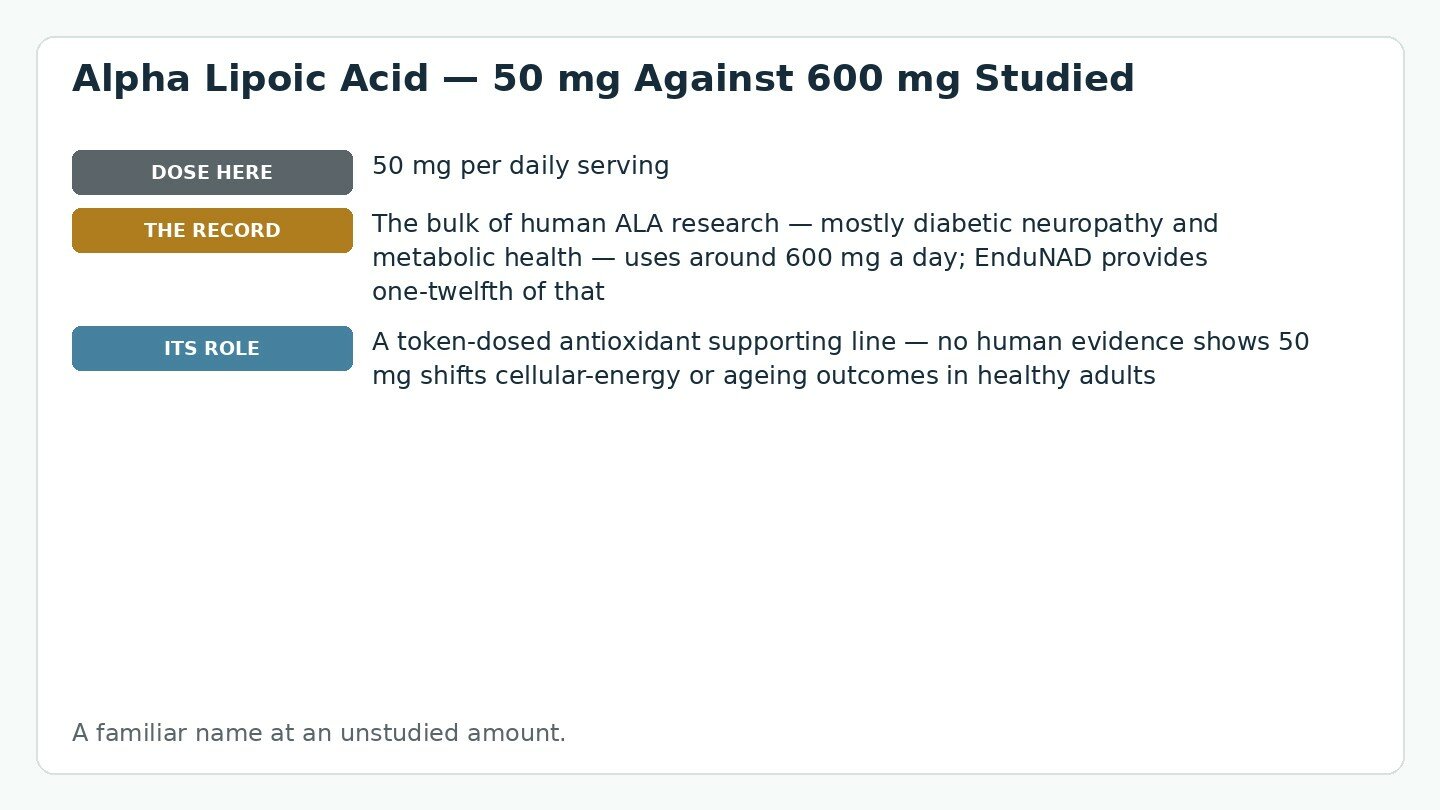
Alpha lipoic acid (ALA) is a sulphur-containing antioxidant involved in mitochondrial energy metabolism. Makers often add it to cellular-energy and healthy-ageing blends to support the pitch around mitochondrial function and oxidative stress.
Again, the printed milligram count tells the real story. The bulk of human clinical research on alpha lipoic acid — most of it in diabetic neuropathy and metabolic health — uses doses around 600 mg per day. EnduNAD's 50 mg daily serving is one-twelfth of that studied amount. There is no human evidence showing that 50 mg of ALA shifts cellular energy or ageing outcomes in healthy adults. It sits in this formula as a token-dosed supporting line.
Black Pepper Fruit Extract — BioPerine® (2 mg)
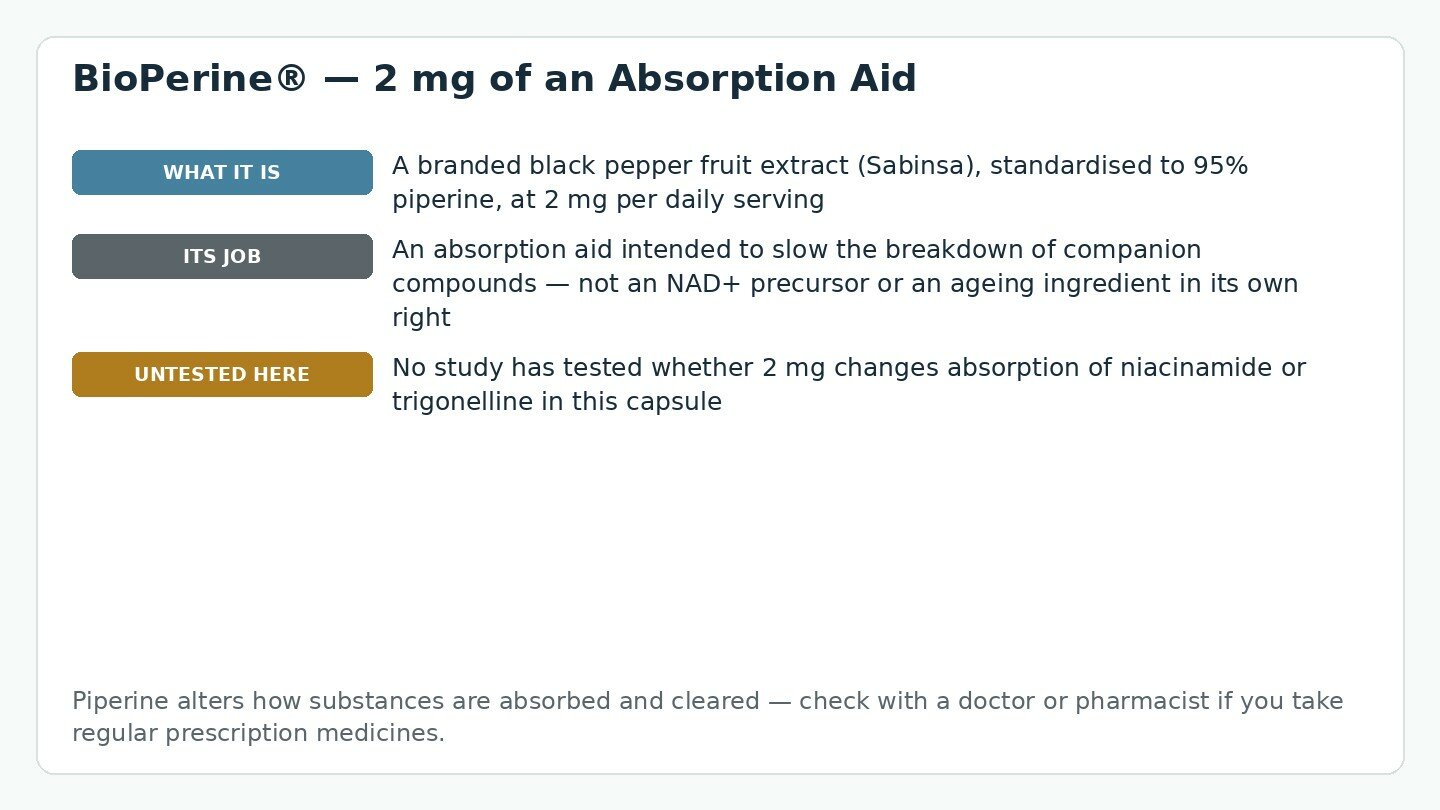
BioPerine® is a branded black pepper fruit extract registered by Sabinsa, standardised here to 95% piperine at 2 mg per daily serving. It is not an active NAD+ precursor or an ageing ingredient in its own right. Makers add piperine as an absorption aid intended to slow the breakdown of companion compounds in the gut and liver.
Two milligrams is a modest piperine amount compared with heavier multi-ingredient blends, and no study has tested whether it changes absorption of niacinamide or trigonelline in this specific capsule. Even at 2 mg, piperine's whole purpose is altering how substances are absorbed and cleared. If you take regular prescription medicines, check with a doctor or pharmacist before adding a piperine-containing supplement.
Niacin (250 mg)
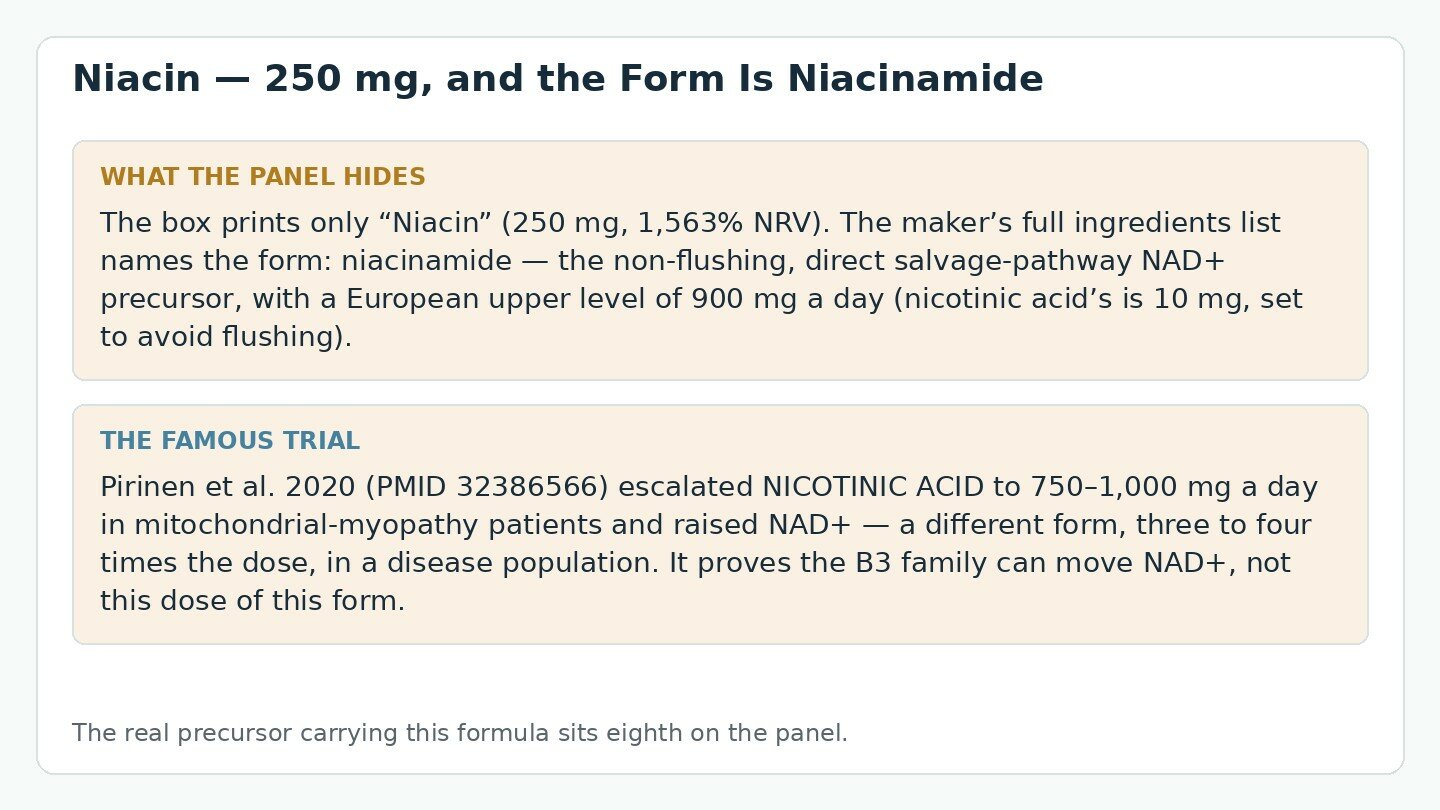
Niacin is the real NAD+ precursor carrying EnduNAD, even though it sits eighth on the printed box panel at 250 mg (1,563% NRV). The panel prints only "Niacin," but the maker's full ingredients list specifies the form as niacinamide (nicotinamide). Unlike nicotinic acid, niacinamide is a direct salvage-pathway NAD+ precursor that does not cause flushing, and 250 mg sits comfortably inside the 900 mg European daily upper level.
The famous human niacin-NAD+ trial used nicotinic acid escalated to 750–1,000 mg a day in patients with adult-onset mitochondrial myopathy, raising blood and muscle NAD+ (Pirinen et al. 2020, PMID 32386566). That proves the vitamin B3 family can move NAD+, not this form or this 250 mg dose. High-dose nicotinamide raises methylation questions because the body methylates it for clearance, yet at 250 mg the safety record is reassuring.
Vitamin B6 (2.8 mg)
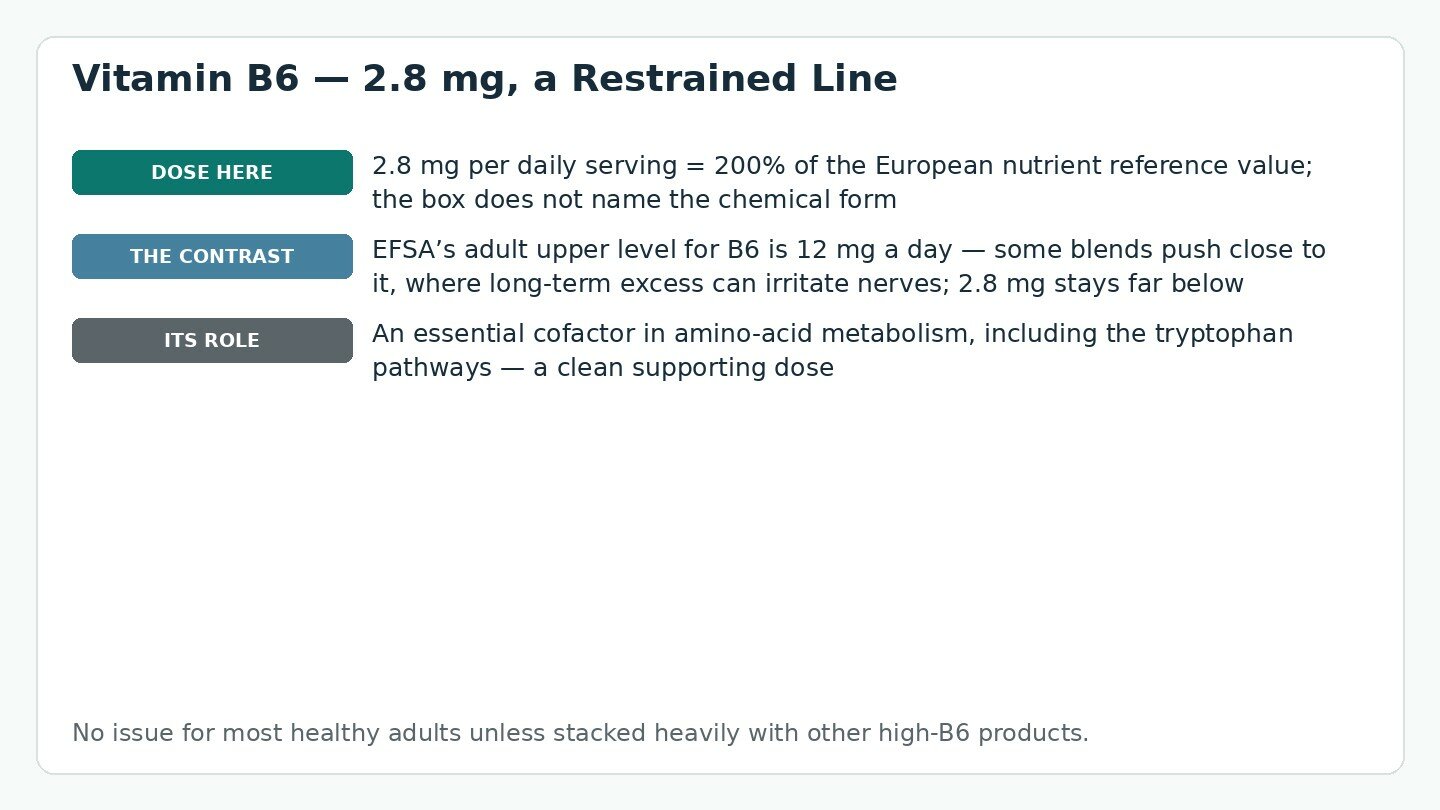
Vitamin B6 closes out the printed panel at 2.8 mg per daily serving, equal to 200% of the European nutrient reference value. It acts as an essential cofactor in amino-acid metabolism, including pathways linked to tryptophan and cellular energy turnover. The box panel lists it simply as "Vitamin B6," without naming a specific chemical form.
From a safety and formulation standpoint, this is a sensible line. Some multi-ingredient supplements push vitamin B6 much closer to regulatory upper ceilings, where long-term overuse can cause nerve irritation. At 2.8 mg a day, EnduNAD avoids that excess completely. It is a clean, restrained cofactor dose that poses no issue for most healthy adults unless stacked heavily with other high-B6 products.
The Form Audit: What 'Niacin' Actually Is Here, and What 6 mg of Trigonelline Can Claim
Reading the physical box panel alongside the maker's full ingredients list and the primary papers reveals four core findings that define what you actually get in a bottle of EnduNAD.
The Form Decides the Safety Story
The box panel and the website table print the single word "Niacin" beside 250 mg. In supplement safety, that one word covers two very different molecules. Nicotinic acid routinely causes intense skin flushing at 250 mg and carries a European upper level of just 10 mg a day, set specifically to avoid flushing.
Niacinamide (nicotinamide) behaves completely differently. It does not cause flushing, and its European upper level is 900 mg a day — ninety times higher than nicotinic acid's limit. The maker's full ingredients list settles the question by naming the ingredient "Niacinamide (Niacin)."
Leaving the form off the box panel creates real confusion for buyers trying to judge safety from the label alone. Summaries of EnduNAD across the web — including, until now, our own product page — have warned buyers about niacin flushing that this non-flushing form does not cause. Knowing the form is niacinamide changes the safety verdict from a flushing risk to a well-tolerated dose.
Trigonelline Maths: 6 mg and Zero Human Trials
EnduNAD markets trigonelline as its standout NAD+ innovation, supplied via 300 mg of fenugreek seed extract standardised to 2%. Simple multiplication gives the actual daily intake: 6 mg of trigonelline.
The 2024 paper behind this pitch is a solid piece of early research, but it is not a human supplement trial (Membrez et al. 2024, PMID 38504132). Written largely by a Nestlé Research team, it showed that trigonelline raises NAD+ and improves muscle function in aged animals, and it reported lower blood trigonelline levels in humans with sarcopenia. An association in people with muscle loss does not prove that swallowing capsules reverses it.
Because no human supplementation trial of trigonelline exists, there is no human dose-response curve and no established effective daily dose to measure 6 mg against. The honest verdict is not that 6 mg is proven "underdosed" — it is that trigonelline supplementation is completely untested in humans at any dose.
The Supporting Cast Is Token-Dosed
Beyond niacinamide and fenugreek, EnduNAD's remaining botanical and antioxidant lines pad the panel without approaching studied human doses. The grape extract delivers 1 mg of resveratrol against the 100–500 mg range used in human trials, including the 150 mg daily dose tested by Timmers et al. 2011 (PMID 22055504).
The rest of the supporting cast follows the same pattern. Alpha lipoic acid lands at 50 mg against roughly 600 mg in human clinical studies. L-tryptophan arrives at 200 mg against about 1 g in sleep studies, and chamomile supplies 7.5 mg of apigenin with zero human NAD+ data at any dose. These lines make a nine-ingredient box look busy, but they do not carry the formula.
What Is Genuinely Good — and Why the Order Is Backwards
Stripped of sales hype, EnduNAD does several things right. Every ingredient amount appears openly on the box panel, the 60 mg EGCG content is printed cleanly on the front of the box, and the main precursor — 250 mg of niacinamide — is a real, established, non-flushing NAD+ salvage precursor at a sensible daily dose.
The audit's complaint is the upside-down way the formula is presented. The least-proven ingredient in the NAD+ category leads the headline at 6 mg, while the established vitamin B3 precursor carrying the actual biochemical workload sits eighth on the panel behind an incomplete one-word label.
The Evidence, Read Properly
No clinical trial has tested the finished EnduNAD formula. Judging what these capsules can realistically do means reading the primary studies behind each precursor route — and keeping the study design attached to every result.
Trigonelline: Animal Data and a Human Association
EnduNAD's headline claim leans on a 2024 Nature Metabolism study authored largely by a Nestlé Research team (Membrez et al. 2024, PMID 38504132). In preclinical experiments, the researchers confirmed that trigonelline acts as an NAD+ precursor and improved muscle function in aged mice.
The paper also included human observational data showing lower circulating trigonelline levels in people with sarcopenia. That is a correlation, not proof that swallowing capsules raises human NAD+ or restores muscle strength. No human supplementation trial of trigonelline exists at EnduNAD's 6 mg daily dose or at any higher intake.
Niacin (Nicotinic Acid): Different Form, Higher Dose, Disease Population
When NAD+ shoppers look up vitamin B3 trials, they usually find a landmark Cell Metabolism study in adults with adult-onset mitochondrial myopathy (Pirinen et al. 2020, PMID 32386566). Researchers escalated nicotinic acid to 750–1,000 mg a day, raising blood NAD+ up to roughly eightfold in patients and increasing muscle NAD+, with healthy controls responding as well.
Those results prove the vitamin B3 family can move human NAD+, not what EnduNAD delivers. EnduNAD uses niacinamide rather than nicotinic acid, at 250 mg — one-third to one-quarter of that study's dose — and targets healthy buyers rather than a clinical myopathy group. While nicotinamide is an established salvage-pathway NAD+ precursor biochemically, no human trial we rely on tests 250 mg of nicotinamide for NAD+ outcomes in healthy adults.
NMN in Prediabetic Women: A Human Clinical Benchmark
To see what human NAD+ precursor evidence actually looks like, compare EnduNAD's ingredients with the NMN literature. In a human clinical trial of prediabetic women taking 250 mg of NMN a day, researchers reported improved muscle insulin sensitivity (Yoshino et al. 2021, PMID 33888596).
That study does not prove anti-ageing effects in healthy people, and EnduNAD contains no NMN. It simply marks the standard of human testing that the better-trialled route in this category has already begun to clear.
NMN in Older Men: Biomarker Shifts and Modest Signals
A separate human trial tested NMN supplementation in older men (Igarashi et al. 2022, PMID 35927255). Participants showed raised blood NAD+ biomarkers alongside some physical function signals.
Again, the findings remain modest rather than transformative. Still, they represent direct human supplementation data on the molecule itself — a step trigonelline has not yet taken.
NMN Dose-Response: Raised Blood NAD+, Mixed Metabolic Results
A human dose-response trial examined how different NMN intakes affect blood NAD+ and metabolic health markers (Yi et al. 2023, PMID 36482258). Blood NAD+ rose cleanly across tested doses, while broader metabolic endpoints came back mixed.
Across the wider category, no head-to-head human trial has directly compared NMN against NR either. That leaves every buyer weighing how much human biomarker data they require before spending.
Resveratrol: 150× More Than EnduNAD Supplies
EnduNAD includes 50 mg of grape vine fruit extract standardised to 2% resveratrol, which supplies 1 mg of resveratrol a day. By contrast, human resveratrol studies typically use 100 mg to 500 mg daily, including a metabolic trial testing 150 mg a day (Timmers et al. 2011, PMID 22055504).
Delivering one-hundred-and-fiftieth of a studied human dose puts this line outside the clinical evidence entirely. The same gap applies to alpha lipoic acid at 50 mg against roughly 600 mg in human neuropathy trials, L-tryptophan at 200 mg against about 1 g in sleep studies, and apigenin at 7.5 mg with no human NAD+ trials at all.
Taken together, the record sets clear limits. No trial of EnduNAD itself exists, and no human trial proves that raising NAD+ with any precursor reverses ageing outcomes in healthy adults.
How Long Does It Take to Work?
Nothing in the NAD+ precursor category works in days. Across published human precursor studies, researchers generally measure blood NAD+ and metabolic changes over roughly 4 to 12 weeks of consistent daily use.
Because EnduNAD has never been tested in a human trial, we cannot give a product-specific timeline. Using the wider precursor evidence as the guide, a single 30-day bottle stops short of the window where clinical trials look for measurable shifts. A fair trial takes three full months — three bottles — taken consistently at two capsules a day.
Set your expectations by the published data rather than bold anti-ageing headlines. Even in the better-studied NMN trials, outcomes beyond higher blood NAD+ levels remain modest and mixed. You should not expect a sudden energy surge in week one, and mild day-to-day shifts in how you feel rarely reflect cellular NAD+ biology.
There is also no consumer NAD+ blood test that can reliably grade this product for an individual buyer at home. Judge EnduNAD only across a complete three-month window, taken as directed with water and food alongside solid sleep and regular exercise.
Is It Safe?
Start with the maker's own directions and exclusions from the official website. Take two capsules a day washed down with 300 ml of water, and do not take them on an empty stomach. The maker's written terms exclude children as well as pregnant or breastfeeding women.
From our own review of the printed panel and full ingredients list, six safety points deserve attention before you buy.
- Niacinamide form and daily ceiling: Because EnduNAD's 250 mg niacin line is niacinamide rather than nicotinic acid, skin flushing is not expected. At 250 mg a day, the dose sits comfortably inside the 900 mg European daily upper level for nicotinamide. Do not import nicotinic-acid flushing warnings here, yet avoid stacking multiple high-dose vitamin B3 supplements without adding up your total daily intake.
- Green tea EGCG limit: Each daily serving supplies 60 mg of EGCG — printed on the front of the box — which is about one-thirteenth of the 800 mg daily threshold European regulators flag for green tea extracts. That margin is wide, but you should still count EGCG across any other green tea or fat-burner supplements you take.
- Fenugreek and blood sugar: The 300 mg fenugreek seed extract can lower blood sugar. Anyone taking diabetes medication should speak with a doctor before combining the two.
- L-tryptophan and serotonergic medicines: L-tryptophan is a direct serotonin precursor. Even at 200 mg, it does not belong alongside serotonergic prescription medicines without medical advice.
- Black pepper extract (BioPerine®): Two milligrams of 95% piperine is included specifically as an absorption aid. Because piperine can alter how substances are absorbed and cleared, anyone on regular prescription medicines should check with a doctor or pharmacist first.
- Cancer treatment and NAD+ supplements: People currently being treated for cancer should discuss any NAD+-focused supplement with their oncologist before starting it. NAD+ metabolism is an active area of cancer research, and that safety decision belongs strictly to your care team.
Vitamin B6 sits at a sensible 2.8 mg (200% NRV), avoiding the high-B6 risks seen in heavier formulas unless you stack several B-vitamin products. Keep one final limit in mind: no product-specific safety study has ever been published for EnduNAD.
Side Effects: What Is Actually Known
No adverse-event data or post-market safety tracking is published for the finished EnduNAD formula. What we can report comes from the known tolerability profile of its individual ingredients at these printed doses.
- Stomach upset from green tea extract: Even at 150 mg of extract (60 mg EGCG), green tea catechins can irritate the stomach lining. Taking capsules on an empty stomach raises that risk, which is why following the maker's own food-and-water directions matters.
- Digestive effects from fenugreek: Fenugreek seed extract commonly causes mild gastrointestinal effects such as bloating or loose stools in sensitive users. At higher intakes, fenugreek is also known for producing a faint maple-syrup body odour.
- Drowsiness from L-tryptophan: Although 200 mg is a fifth of the 1 g dose used in sleep trials, L-tryptophan can still cause mild drowsiness in some people. If you notice daytime sleepiness, timing your serving with an evening meal is worth discussing with a clinician.
- Good tolerability from niacinamide: Niacinamide at 250 mg is generally well tolerated and does not trigger the skin flushing tied to nicotinic acid.
When Fatigue and Ageing Symptoms Need a Doctor, Not a Precursor
EnduNAD is a dietary supplement, not a medical treatment for fatigue, weakness, or age-related health decline. Persistent tiredness, falling strength, poor sleep, or low mood often stem from treatable medical causes that no NAD+ capsule can fix — including thyroid disease, anaemia, sleep apnoea, depression, or diabetes.
Progressive muscle loss accompanied by falls or noticeable weakness — the exact sarcopenia picture examined in the trigonelline paper — calls for a proper clinical workup and targeted medical care, not a supplement purchase. If these symptoms are disrupting daily life, get checked by a doctor before spending money on cellular-ageing capsules.
Is It a Scam?
No. EnduNAD is a real, European Union–made supplement with a fully published nine-line box panel, clear standardisations, front-of-box EGCG disclosure, and written directions and exclusions. At its core sits 250 mg of niacinamide — a genuine, non-flushing NAD+ salvage precursor delivered at a sensible dose.
Calling it legitimate does not mean the presentation is beyond criticism. Four specific issues hold the score at 6.4/10:
- An untested headline precursor: Trigonelline leads the product story at 6 mg a day despite being the least-proven precursor in the NAD+ category, with zero human supplementation trials at any dose.
- An incomplete niacin line on the box: Printing only "Niacin" on the panel hides the exact chemical form that decides the safety story, forcing buyers to dig into the full ingredients list to discover it is niacinamide.
- Token-dosed supporting lines: Supplying 1 mg of resveratrol against 100–500 mg human trial doses is label decoration, alongside 50 mg of alpha lipoic acid and 200 mg of L-tryptophan.
- Missing commercial reassurance: The official website names no company behind the brand and publishes no money-back guarantee.
That adds up to an honest ingredient panel paired with an inverted headline — not a fake product. Buyers who know they are paying mainly for 250 mg of niacinamide plus an early-stage trigonelline bet will not be misled.
Price and Packs
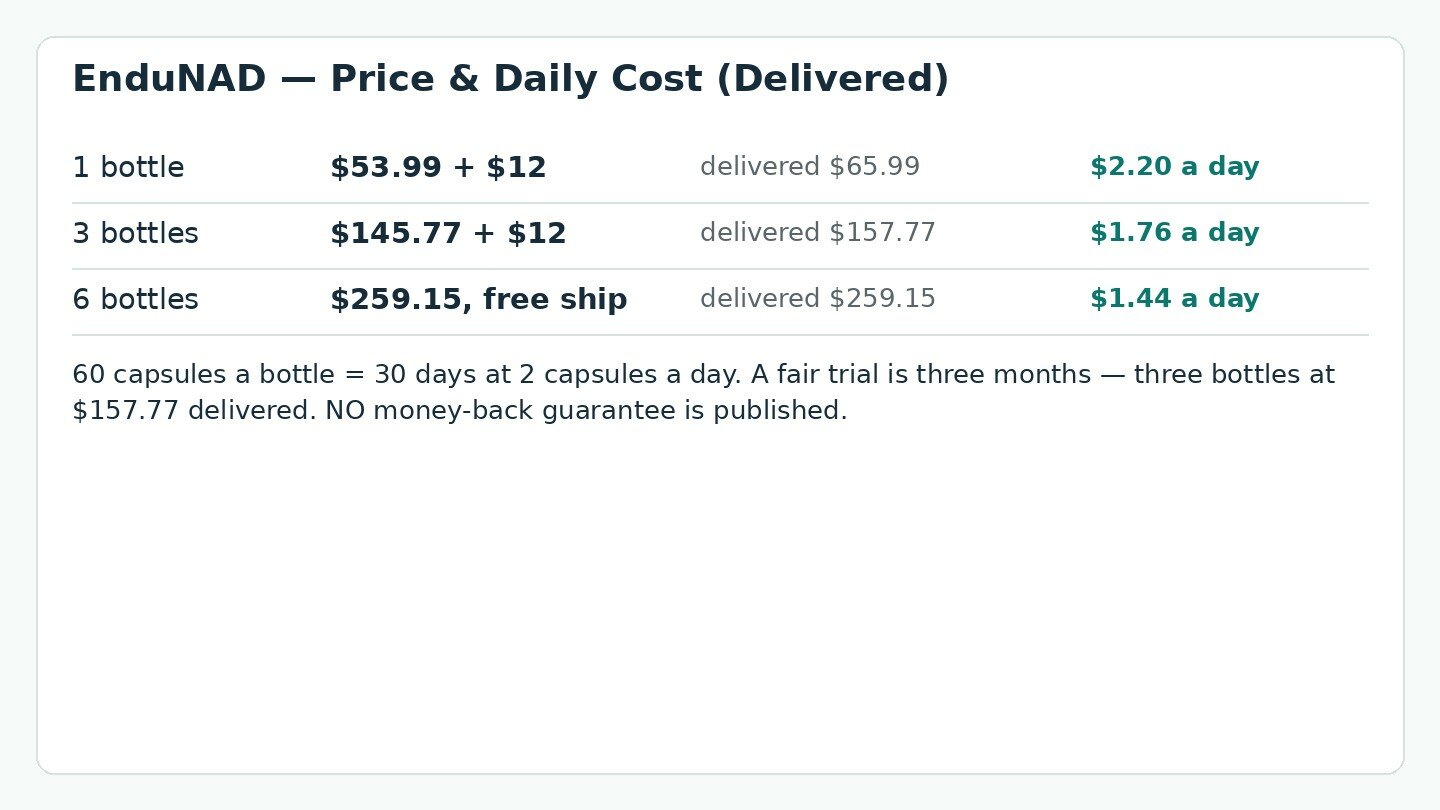
EnduNAD is priced across three multi-bottle tiers on the maker's official order page. Each bottle contains 60 capsules, covering 30 days at the directed serving of two capsules a day.
| Option | Total | Per bottle | Cost per day |
|---|---|---|---|
| 1 bottle | $53.99 + $12 shipping ($65.99 delivered) | $53.99 | $2.20 |
| 3 bottles | $145.77 + $12 shipping ($157.77 delivered) | $48.59 | $1.76 |
| 6 bottles | $259.15 with free shipping | $43.19 | $1.44 |
Source note: prices read directly from the maker's official order page in November 2026. Delivered cost per day assumes two capsules daily across 30 days per bottle.
Shipping makes a visible dent on smaller orders. Adding $12 to a single bottle raises the effective cost to $2.20 a day, whereas free shipping on the six-bottle option brings the rate down to $1.44 a day — lower than most single-ingredient NMN supplements. Remember that none of these three tiers carries a published money-back guarantee.
Purchase Options
EnduNAD is sold direct via the maker's official website, and that is the only channel where the verified November 2026 prices above apply. Because there is no money-back guarantee, choosing the right order size matters more than usual.
- Skip the single bottle as a test: One bottle lasts 30 days — shorter than the 4–12 week window in which precursor studies measure NAD+ shifts. At $65.99 delivered ($2.20 a day), it costs the most per serving while ending too early to judge fairly.
- Treat three bottles as the fair trial: The three-bottle tier covers three full months at $157.77 delivered ($48.59 per bottle, $1.76 a day). It matches the realistic clinical window without locking you into half a year upfront.
- Wait before buying six bottles: Six bottles cut the daily rate to $1.44 ($259.15 total) with free shipping. Without a refund policy, save that tier for a repeat order only after a judged three-month trial shows you want to keep taking it.
How It Compares
In SuppChecked's anti-ageing catalogue, EnduNAD competes most directly against NMN-based NAD+ formulas that cost more per day but stand on human clinical data and published guarantees.
| Product | Our score | Formula |
|---|---|---|
| EnduNAD | 6.4/10 | A nine-line stack — niacinamide 250 mg plus trigonelline 6 mg and a token-dosed supporting cast |
| GenuinePurity NMN | 7.0/10 | One published precursor, beta-NMN 250 mg a day, with human trials behind the ingredient |
| GenuinePurity Longevity+ | 6.5/10 | A five-line stack (NMN 250 mg, CoQ10 200 mg, resveratrol 100 mg, cycloastragenol, selenium) with a 97-day guarantee |
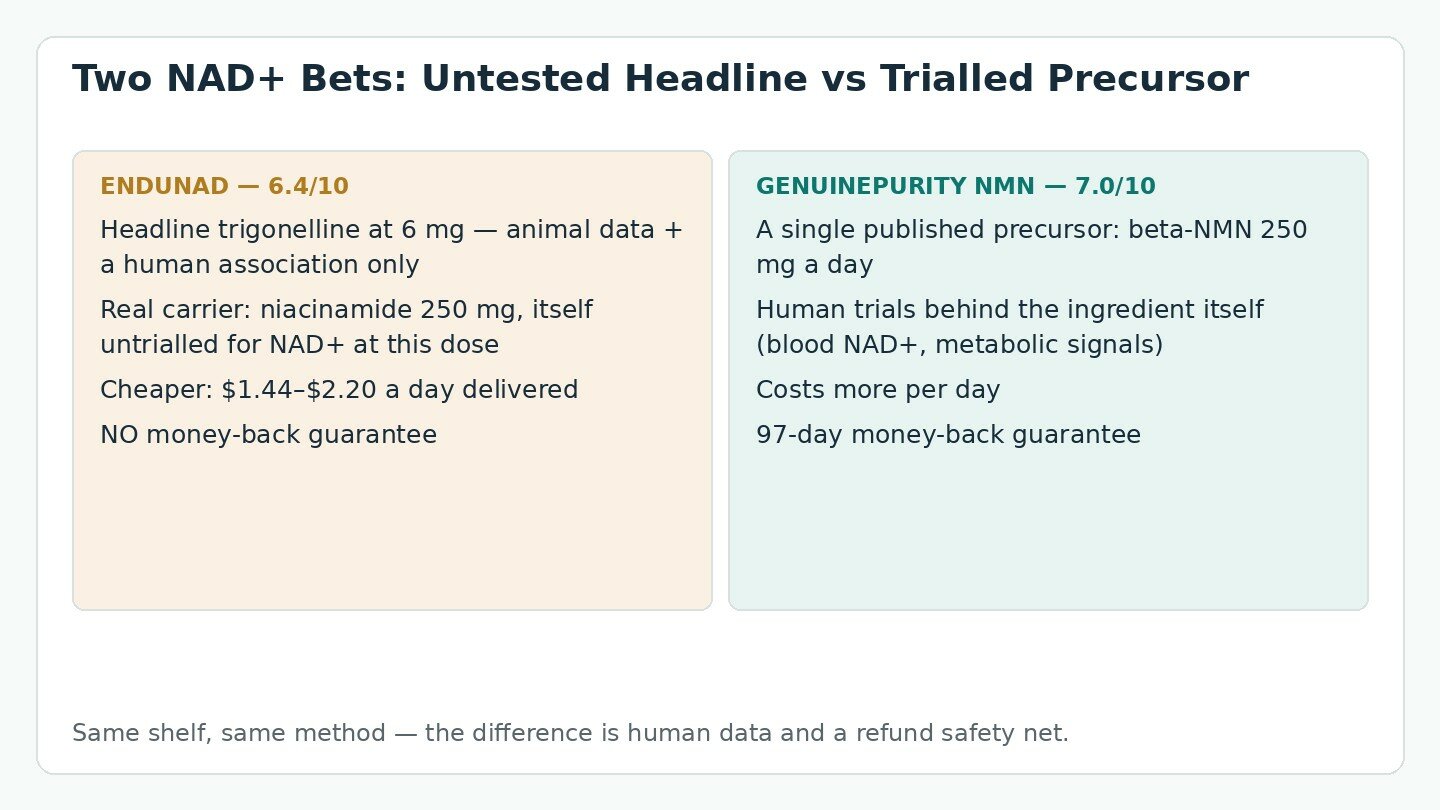
The trade-off between these three bottles is clear. EnduNAD is the cheapest route per day and the only formula betting on trigonelline — a bet no human trial has yet graded. Both NMN formulas cost more daily, yet they stand on published human trials behind beta-NMN, and GenuinePurity Longevity+ pairs 250 mg of NMN with 100 mg of resveratrol (against EnduNAD's 1 mg) plus a 97-day guarantee that EnduNAD does not offer.
A Stronger Alternative in This Category
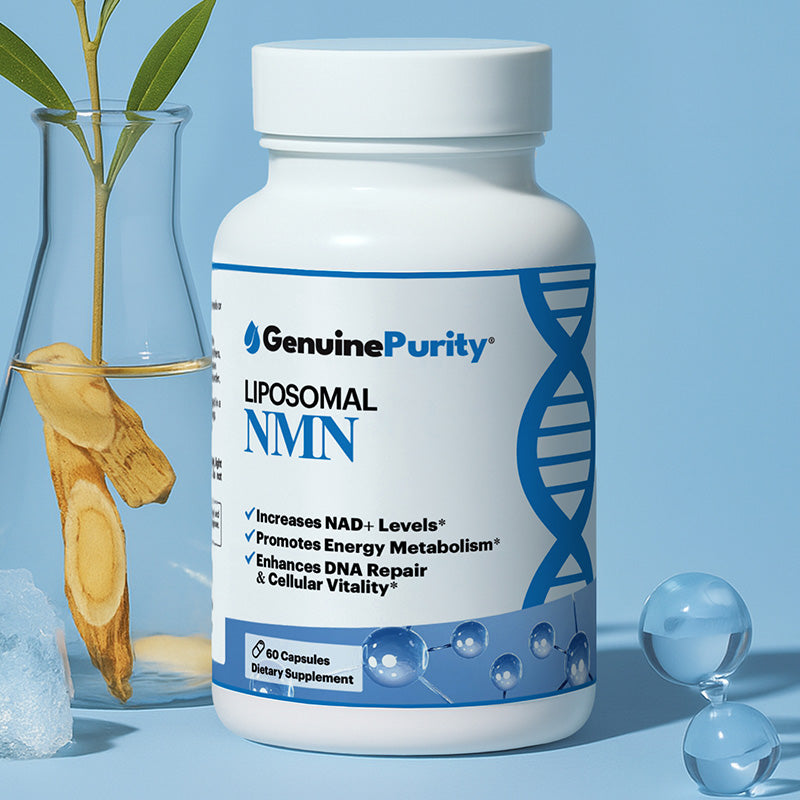
GenuinePurity NMN — Our Score: 7.0/10
A single published precursor at 250 mg a day, with human trials behind the ingredient itself and a 97-day guarantee: GenuinePurity NMN is the NAD+ formula we score highest in this catalogue.
Who Should Buy It — and Who Should Skip It
Who should buy it
- Shoppers looking outside NMN and NR: Buyers who specifically want a published-amount NAD+ supplement built around vitamin B3 and fenugreek rather than standard NMN or NR capsules.
- Cost-conscious NAD+ buyers: Readers looking for a lower daily cost ($1.44 to $2.20 delivered) without hidden proprietary blends.
- Realistic, patient evaluators: Buyers who accept that niacinamide 250 mg is the established precursor here, view the 6 mg trigonelline line as an early-stage bet, and plan to judge the bottle across a full three months.
Who should skip it
- Anyone expecting human-proven trigonelline results: No human supplementation trial of trigonelline exists at 6 mg or any other dose.
- Buyers who want a refund safety net: The official website publishes no money-back guarantee behind a $157.77 three-month trial.
- People on interacting medicines without medical clearance: Anyone using serotonergic drugs (due to L-tryptophan), diabetes medication (due to fenugreek), or regular prescriptions sensitive to absorption aids (due to BioPerine® piperine).
- Anyone undergoing cancer treatment without oncologist approval: NAD+ supplements belong in a conversation with your oncology care team first.
- Excluded groups: Children and pregnant or breastfeeding women, per the maker's own written terms.
Frequently Asked Questions
Does EnduNAD actually work?
No clinical trial has tested the finished EnduNAD formula. Its realistic case rests on 250 mg of niacinamide, an established salvage-pathway NAD+ precursor, rather than its headline 6 mg of trigonelline, which has never been trialled in humans. Even with better-studied precursors like NMN, raising blood NAD+ has not been proven to reverse ageing outcomes in healthy humans. Treat EnduNAD as a sensibly dosed niacinamide capsule with an untested trigonelline addition, not a proven anti-ageing intervention.
Is trigonelline proven to raise NAD+ in humans?
No. A 2024 Nature Metabolism paper from a largely Nestlé Research team showed that trigonelline acts as an NAD+ precursor and improved muscle function in aged mice, while reporting lower blood trigonelline levels in humans with sarcopenia (Membrez et al. 2024, PMID 38504132). That human finding is an observational association, not a clinical trial. No human supplementation trial exists yet, so neither 6 mg nor any other oral dose is proven to raise human NAD+.
Will EnduNAD make me flush like niacin does?
Flushing is not expected from EnduNAD. Although the printed box panel lists only the single word "Niacin" beside 250 mg, the maker's full ingredients list identifies the exact form as niacinamide (nicotinamide). Skin flushing comes from nicotinic acid, not niacinamide. Niacinamide is the non-flushing form of vitamin B3, and 250 mg sits comfortably inside the 900 mg European daily upper level. If you combine other niacin supplements, still check their labels for form and total dose.
How long should I take EnduNAD before judging it?
Give EnduNAD three full months — three bottles — before making a final call. Published human precursor trials generally measure NAD+ changes across roughly 4 to 12 weeks, meaning a single 30-day bottle finishes before that window closes. Nothing in this category works within days, and no consumer blood test reliably grades results for one buyer. Take two capsules daily with 300 ml of water and food, and judge by the full three-month trial rather than early impressions.
Is EnduNAD safe — what about the niacin dose and the EGCG?
No safety study exists for the finished EnduNAD blend, though its two headline doses stay well within European limits. The 250 mg niacin line is niacinamide, far inside its 900 mg daily upper level. The green tea extract provides 60 mg of EGCG — printed on the box front — which is one-thirteenth of the 800 mg threshold regulators flag. Still, avoid empty-stomach dosing, skip it if pregnant, breastfeeding, or under 18, and check with a doctor regarding diabetes drugs, serotonergic medicines, prescriptions, or cancer treatment.
EnduNAD or NMN — which is the better NAD+ bet?
Your choice comes down to human clinical evidence versus daily cost. Single-precursor beta-NMN formulas such as GenuinePurity NMN (7.0/10) cost more per day, yet beta-NMN at 250 mg has human trials measuring blood NAD+ and metabolic signals, backed by a 97-day guarantee. EnduNAD (6.4/10) lowers the daily spend to $1.44–$2.20 delivered, but bets on niacinamide plus an untested 6 mg trigonelline dose with no refund policy. For human data and guarantee protection, NMN is the stronger choice.
Does EnduNAD have a money-back guarantee?
No money-back guarantee is published on the maker's official website. Aside from standard legal boilerplate in the site terms, no satisfaction guarantee covers opened bottles or a multi-month trial. That gap directly affects how you should order. Because a fair trial of an NAD+ precursor takes three months, ordering the three-bottle option puts $157.77 delivered at your own risk, and the six-bottle tier ($259.15) should wait until a judged first order proves worthwhile.
Where can I buy EnduNAD — and what does a month actually cost?
EnduNAD is sold direct via the maker's official website, where our verified November 2026 prices apply. One 60-capsule bottle lasts one month at two capsules daily and costs $53.99 plus $12 shipping, or $65.99 delivered ($2.20 a day). The three-bottle option totals $145.77 plus $12 shipping, or $157.77 delivered ($48.59 per bottle, $1.76 a day). Six bottles cost $259.15 with free shipping, dropping the price to $43.19 per bottle ($1.44 a day).
EnduNAD — Our Score: 6.4/10
Score: 6.4/10 · Sub-scores: Ingredients 7.0 · Evidence 5.5 · Safety 7.0 · Value 7.0 · Best for: Buyers who want a published-amount NAD+ formula built on niacinamide and trigonelline rather than NMN or NR, and who will judge it over a full three months · Main caution: The headline trigonelline arrives at just 6 mg a day and its NAD+ evidence is animal data plus a human association — there is no human trial of trigonelline, of this formula, or of its 250 mg nicotinamide dose · Fair trial: Three months — three bottles at $157.77 delivered
Sources & Method
This review is based on the maker's sales and order pages, the maker's full ingredients list, and the printed box panel (read November 2026), alongside the published literature cited above — Membrez et al. 2024 (PMID 38504132) on trigonelline, Pirinen et al. 2020 (PMID 32386566) on niacin and NAD+, Yoshino et al. 2021 (PMID 33888596), Igarashi et al. 2022 (PMID 35927255), and Yi et al. 2023 (PMID 36482258) on NMN, and Timmers et al. 2011 (PMID 22055504) on resveratrol dosing — scored with the standard SuppChecked scoring method across ingredients, evidence, safety and value.
Last reviewed: November 2026
