- Quick Answer: Is NMN Better Than NR?
- Why This Is the Most-Asked Question in the Category
- What the Two Molecules Are — From the Material We Can Audit
- What a Real Answer Would Require
- What Can Actually Be Compared Today: The Paperwork
- Where Does That Leave the Choice?
- Frequently Asked Questions
- Our Verdict
Affiliate disclosure: This article contains affiliate links. If you buy through a link on this page, we may earn a commission paid by the manufacturer, at no extra cost to you. That never changes what we publish — and on this question it requires an unusual disclosure up front: this store stocks an NMN product and no NR product at all. We cannot score an NR label alongside the NMN one, because there is no NR label in our catalog to audit. What we can do is answer the question the way our rubric answers everything — from published material — and show you exactly where that material runs out. The NMN example throughout is GenuinePurity NMN, which earns an Our Score of 7.5/10 in our review.
Quick Answer: Is NMN Better Than NR?
On the evidence available in makers' published material: nobody's paperwork settles it. NMN and NR are both NAD+ precursors — molecules your body converts into NAD+, the coenzyme involved in cellular energy that, per the NMN maker, falls to half of youthful levels by middle age. But we found no head-to-head human trial of NMN against NR in any maker's material we audit — no study that gives one group NMN, another NR, and compares NAD+ levels or outcomes. Until that trial exists in published form, "which is better" is a marketing question, not an answered one. What can be compared today is documentation: the NMN product we sell discloses its dose (250 mg per capsule), states a 96% purity, is third-party tested with a published batch report, and carries a 97-day guarantee. That is the standard any NR product should be held to before you pay for it — and the rest of this page explains how to hold it there.
Why This Is the Most-Asked Question in the Category
When we researched this batch, "Is NMN better than NR for raising NAD+?" appeared as a standalone FAQ heading on at least five different sites — the single strongest comparison signal in the entire research, stronger than any product-versus-product pairing. The reason is structural: NMN and NR are the two commercial answers to the same idea. NAD+ declines with age; both molecules are sold as raw material to rebuild it. A buyer standing between two bottles with two different molecule names on the front reasonably asks which one wins. The honest problem is that the supplement industry has answered that question with pathway diagrams and absorption claims, not with a comparative trial.
What the Two Molecules Are — From the Material We Can Audit
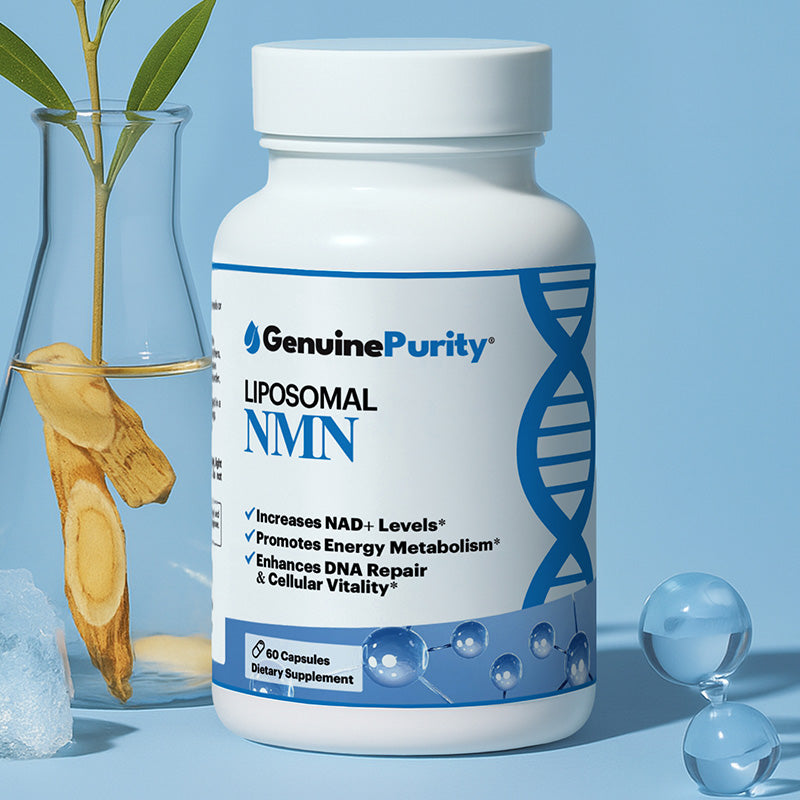
Here is what the audited material actually establishes. NMN (β-Nicotinamide Mononucleotide) is, in the maker's own framing, "a precursor your body uses to make NAD+." The GenuinePurity version is a single-ingredient liposomal capsule: 250 mg of NMN per capsule at a stated 96% purity, in a phospholipid complex the maker says protects it from stomach acid. NR (nicotinamide riboside) is the other NAD+ precursor sold in this category — it appears in the research record alongside NMN wherever NAD+ boosters are discussed, including reader questions about "yet to be proved by science" anti-aging practices, where the answers centre on both molecules. Beyond that shared destination — NAD+ — the makers whose pages we audit publish nothing that ranks them: no comparative absorption study, no comparative NAD+ measurement, no comparative outcome. Anyone quoting you a winner is quoting material that does not exist in the paperwork we can check, or material published by a seller of one side.
These statements have not been evaluated by the Food and Drug Administration. This product is not intended to diagnose, treat, cure, or prevent any disease. This article is educational and is not medical advice.
What a Real Answer Would Require
It is worth spelling out what settling this question would take, because it tells you how to read every "NMN vs NR" page on the internet, including this one. A real answer needs a head-to-head human trial: both precursors, at stated doses, in comparable people, measuring blood NAD+ (or a validated marker) over the same period — and ideally measuring something a person can feel or a clinician can track, not just a blood number. Set against that standard, look at what the NMN side's own evidence file contains, because we audited it for our review: the maker calls its 250 mg dose "clinically studied" without publishing trial details — no design, no participants, no duration; it prints journal quotations about NMN in general; and its headline lifespan figure ("boosting NAD extended lifespan by an astonishing 30%") comes from a study in mice, as the maker itself states. That is the strongest documentation position on our anti-aging shelf, and it still contains no comparison with NR. If the best-documented side of the argument has no head-to-head data, the argument has no head-to-head data.
What Can Actually Be Compared Today: The Paperwork
Since the molecules can't be ranked on audited evidence, rank the products on what can be checked. This is the standard we applied to GenuinePurity NMN, and it transfers to any NR bottle you are considering:
- A stated dose per capsule. GenuinePurity prints 250 mg per capsule. A product that hides its per-capsule amount inside a proprietary blend cannot be compared with anything — that is the point of hiding it.
- A stated purity, as a number. This maker states 96% purity and quotes a batch potency of 96.4% on its offer page. "High purity" with no number is not a specification.
- Third-party testing you can see. The maker states every batch is tested for identity, purity and heavy metals, with the Certificate of Analysis published on its site. A certificate you can open beats a badge you can't.
- A guarantee that covers the maker's own trial window. GenuinePurity's 97-day guarantee outlasts its own 90-day evaluation framing — the only product in this batch whose refund window fully covers its stated trial period.
- Honesty about the product's own flaws. This maker's pages conflict on the daily dose — the landing page directs one capsule daily (250 mg) while its store pages describe two (500 mg). We follow the landing page, and we print the conflict rather than smoothing it over. A seller whose paperwork contradicts itself on something as basic as dose has told you something real about its quality control — factor it in, for NMN and NR alike.
Where Does That Leave the Choice?
Practically: if you have already decided to experiment with an NAD+ precursor, the auditable differences today are not NMN-versus-NR — they are documented-versus-undocumented. On our shelf, the documented option is GenuinePurity NMN at $69 for one bottle (falling to $59 per bottle at six, or $49 on subscription), scored 7.5/10 — Ingredients 9.0, Evidence 6.0, Safety 7.5, Value 6.0. The evidence sub-score is the honest headline: it reflects an ingredient-level file, partly from mice, with no finished-product trial. Readers comparing the wider anti-aging shelf should also know the alternative theory sitting next to it: GenF20 Plus is a multi-ingredient "releaser" system — a completely different claimed pathway, and the subject of our full anti-aging comparison. And for the dose, timing and legality questions that sit underneath this one, our companion post NMN, Answered works through the dose ladder (250 vs 500 vs 1000 mg), when to take it, and how long the maker says results take.
Frequently Asked Questions
Has NMN ever been tested against NR in humans?
Not in any trial published in the makers' material we audit. The comparison question is everywhere — it appeared as a standalone FAQ heading on at least five sites in our research — but the head-to-head human trial that would answer it is not in the paperwork. Treat any source that declares a winner without citing one as marketing.
Does this store sell an NR product you would recommend instead?
No — we currently stock no NR product, so there is no NR label here for us to score. If that changes, it will be audited to the same standard used on this page: stated dose, stated purity, visible third-party testing, and a guarantee that covers its own claimed timeline.
Does the liposomal delivery settle the argument for NMN?
No. The maker contrasts liposomal absorption ("up to ~95%") with standard capsules ("closer to ~10%"), and labels those figures itself as comparative absorption figures — a maker's comparison, not a measured outcome, and not a comparison against NR at all. Delivery claims are not head-to-head evidence.
Is NMN legal to buy?
As the maker's pages present it: it is sold openly as a dietary supplement, with the standard FDA disclaimer printed on the maker's pages noting the statements have not been evaluated by the Food and Drug Administration. The maker publishes no legal-status discussion of its own, and its pages carry real cautions — ask your physician first if you take prescription medication, blood thinners, or are pregnant.
Our Verdict
The question "Is NMN better than NR?" currently has no evidence-based winner, and this page won't manufacture one. What the audited record supports is narrower and more useful: NMN's best-documented retail example — a single molecule at a disclosed 250 mg, 96% stated purity, published batch testing, and a 97-day guarantee — sets the paperwork standard for the whole precursor shelf, while its evidence file (an unpublished "clinically studied dose" claim and a mouse lifespan headline) shows how far even the best-documented side is from proving outcomes. Choose on documentation you can open and read, whichever molecule you pick — and be suspicious of anyone, on either side, who tells you the race has already been run.
Disclaimer: This article is for general information only and is not medical advice. Always consult a qualified healthcare professional before starting any supplement, especially if you have a medical condition or take prescription medication. Individual results vary, and no result is guaranteed.
Last reviewed: October 2026