
- Quick Answer
- Before or After a Workout?
- Matcha as a Pre-Workout
- Morning or Afternoon?
- The Evening Cutoff, Calculated
- A 1–2 Serving Schedule for a Real Product
- The Empty-Stomach Tension, Flagged Honestly
- Frequently Asked Questions
- Can I drink matcha before bed for calm?
- Is matcha with breakfast a good time?
- Should I drink matcha first thing on waking, or after food?
- What is the latest I can drink matcha and still sleep?
- Read This Next
Disclosure: This article contains affiliate links. If you buy through them, we may earn a commission at no extra cost to you. It never changes our scores or conclusions.
Quick Answer
The only timing with trial support is before exercise: matcha taken ahead of steady activity increased fat oxidation during the activity itself in the Chichester trials. Mornings suit most people for simple caffeine reasons. Evenings are where timing stops being preference and becomes arithmetic.
Caffeine has a half-life of roughly five to six hours in most adults. That means a meaningful share of an afternoon serving is still circulating at bedtime, so the last serving belongs at least six hours before bed — earlier for slow metabolisers.
Best for: anyone fitting one or two daily servings around training and sleep. We score the worked example in this article, Matcha Extreme, at 4.8/10: a fully declared panel, but caffeine is never declared and no money-back guarantee is published.
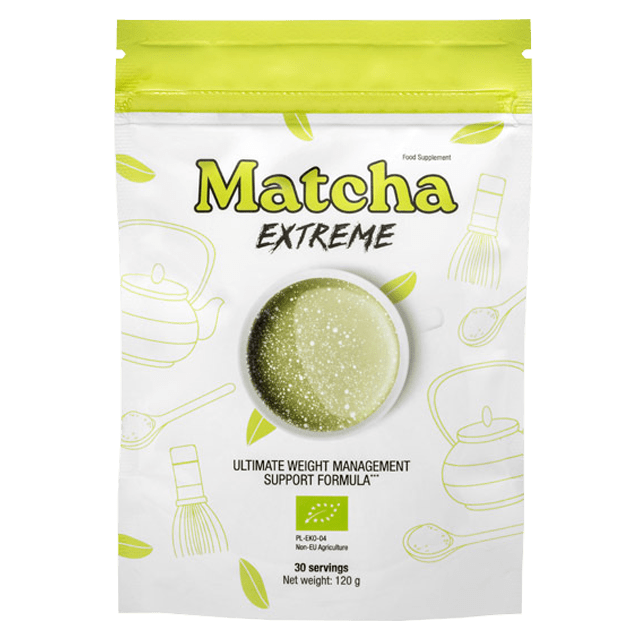
Our Recommendation — Matcha Extreme
Score: 4.8/10 · Best for: tea drinkers who would swap a caloric drink for an unsweetened matcha-style tea and want a fully declared panel, not a proprietary blend. Main caution: no money-back guarantee is published, the pouch lasts 15 days at the maker's full dose, and caffeine is never declared. Fair trial: two months at one serving a day — the three-pouch pack at $35.99 a pouch covers it.
Before or After a Workout?
Before — for the use the trials actually tested. The Chichester research group gave women matcha drinks ahead of a 30-minute brisk walk and measured what changed during the walk itself. Timing was part of the design, not a marketing afterthought.
In Willems et al.'s matcha research, fat oxidation during brisk walking rose from 0.31 grams per minute on the control condition to 0.35 grams per minute with matcha, in 13 healthy women walking at a moderate, individualised pace.
Read that number at its real size. It is a small shift in fuel use during half an hour of walking, measured in young women. It is not a weight-loss result, and no matcha trial has shown that the acute shift becomes scale weight over time.
After a workout is a different claim, and it has no matcha trial behind it. "Recovery" framing for post-workout matcha — antioxidants mopping up exercise stress — is practitioner language you will find across tea blogs. We found no trial that tested matcha for recovery outcomes.
That distinction matters because the two claims ask for opposite schedules. A pre-workout serving has to land before training, inside the caffeine cutoff. A recovery serving could go anywhere, which is exactly why it is the easier claim to sell and the harder one to check.
There is also a practical point the trials quietly assume. Their participants drank matcha on a schedule across the day before testing, not in one heroic dose at the gym door. Consistency across the day was part of the protocol that produced the result.
So the honest ordering is simple. If you drink matcha for the exercise effect, drink it before training. If you drink it after training, drink it because you like it — the evidence file for that timing is empty, and we will not dress it up.
Matcha as a Pre-Workout
The studied pattern is modest: drinks made with about 1 gram of matcha each, several across the day before testing and one about two hours before the walk in the 2018 trial. Later Chichester work used 3 grams a day over three weeks in women.
Those are tea-sized doses, not supplement-sized ones. A standard serving of 1–2 grams of powder sits inside the studied pattern. Doubling or tripling it does not double the measured effect — no dose-response trial for matcha and exercise exists to say that it would.
Practitioner and competitor guides commonly advise drinking matcha 30–45 minutes before a workout, so the caffeine is rising as the session starts. Treat that window as practice guidance from the tea community, not as a trial finding — the trials used longer lead times.
Caffeine pharmacology makes the window plausible without proving it. Blood caffeine levels typically peak somewhere between 30 minutes and two hours after drinking, depending on the person and what else is in the stomach. A 30–45 minute lead lands most people near that rise.
What matcha is not is a pre-workout of the stimulant class. There is no beta-alanine tingle, no 300-milligram caffeine hit, no pump ingredients. Its estimated caffeine per serving — tens of milligrams, not hundreds — belongs to a different category of product entirely.
That lower dose cuts both ways. It will not rescue a session you are too tired to start, and it will not give you the wired, tunnel-vision feeling stimulant pre-workouts are bought for. Readers who want that effect are shopping in the wrong aisle.
What it can do, on the trial record, is nudge fuel use during steady, moderate work — walking, easy cycling, the kind of session you can sustain. The trials did not test sprinting, heavy lifting, or high-intensity intervals, and we do not extend their result there.
Work an evening session through the rule. Training at 18:00 with a pre-workout serving at 17:15 puts caffeine directly against a 23:00 bedtime — under six hours of clearance. For evening trainers, the morning serving is usually the honest compromise: the habit survives, the workout keeps its ritual, sleep keeps its margin.
One more expectation check. Fat oxidation during exercise is a rate, not a result. Burning slightly more fat during a walk while eating the same total calories proves little about body composition, which is set by energy balance across weeks, not minutes.
Morning or Afternoon?
Practitioner guides that structure a matcha day usually put the prime window in the morning, shortly after waking, and place a second serving in the early-afternoon dip around 14:00–15:00. That day-structure is practice guidance from the tea community, not a finding from any trial.
The morning slot has ordinary logic behind it. Caffeine taken early has the longest runway to clear before bed. A morning serving also replaces something for many people — a milky coffee, a sweetened tea — and substitution is where matcha's clearest daily benefit actually lives.
You will also meet a cortisol rationale: that caffeine should wait until the morning cortisol peak passes. That argument circulates widely in practitioner writing, but no matcha trial tests it, and cortisol timing in healthy adults is more variable than the slogan suggests. We label it framing, not fact.
The afternoon slot is real but narrower than it looks. A second serving at 14:00 can carry a long workday, yet it starts the half-life clock late. For a 23:00 bedtime, a 14:00 serving leaves roughly nine hours of clearance — workable for most, tight for some.
Push that second serving to 16:00 or 17:00 and the maths changes character. Now the cutoff rule, not the dip, decides. Many readers who believe matcha "does not affect their sleep" are drinking their last cup inside the window where caffeine measurably shortens it.
Weekend schedules deserve the same honesty. Sleeping later shifts the whole structure: a first serving at 10:00 and a second at 16:00 can be reasonable when bedtime is 01:00, and unreasonable on a work night. Anchor servings to your bedtime, not to the clock on the wall.
Our working summary: one serving in the morning covers most people. A second serving belongs in the early afternoon at the latest. Anything later is a sleep decision being made by a beverage, whether the drinker notices it or not.
The Evening Cutoff, Calculated
Start with the controlled evidence. In Drake et al. 2013, in the Journal of Clinical Sleep Medicine, 400 mg of caffeine taken even six hours before bed reduced objectively measured total sleep by more than an hour in 12 healthy sleepers, compared with placebo.
That dose — 400 mg — is far larger than a serving of matcha. The study's lesson is about timing, not about matcha being dangerous: caffeine's disruption does not end when the alert feeling does. Participants themselves barely noticed the sleep they had lost.
Now run the half-life arithmetic on a realistic serving. Say a strong matcha carries an estimated 80 mg of caffeine, and you drink it at 15:00. With a half-life near five and a half hours, roughly half of it — about 40 mg — remains at around 20:30.
By a 23:00 bedtime, eight hours after that serving, roughly 29 mg is still circulating. That is close to the caffeine in a cup of green tea, delivered at the exact hour your body is trying to power down. Many people sleep through it; their sleep is still lighter.
Move the same serving to 17:00 and the picture worsens. At 23:00, only six hours have passed, so roughly 38 mg remains — and slow metabolisers, whose half-life can stretch well beyond six hours, will be carrying more than that into the night.
The FDA's consumer guidance on caffeine cites about 400 mg a day as the amount not generally associated with negative effects for most healthy adults. That is a daily-total reference. It says nothing that rescues a late dose, because timing is a separate variable.
"But matcha feels calm" is the objection we hear most, and it deserves a straight answer. Matcha's L-theanine may soften how caffeine feels while you are awake. It does not shorten caffeine's half-life, and it does not move the cutoff. Feeling relaxed is not the same as clearing a stimulant.
Two servings stack, and the cutoff applies to the second one. A 09:00 serving is fully cleared by bedtime; a 15:30 second serving is the one doing the damage. Readers troubleshooting poor sleep should audit the last serving first — in our experience it explains more afternoons than the first serving ever will.
Our rule, stated plainly: last matcha at least six hours before bed. If you know you are caffeine-sensitive, or your sleep is already fragile, make it eight. An evening craving for something warm and green is a job for a genuinely caffeine-free drink.
A 1–2 Serving Schedule for a Real Product
Now apply all of this to a product people actually buy. The maker of Matcha Extreme directs one 4-gram scoop in 150–200 ml of hot, not boiling, water, once or twice a day. Its panel declares 2,250 mg of matcha leaf per scoop.
That leaf weight lets us estimate the caffeine the panel never declares. Matcha leaf runs about 19–44 mg of caffeine per gram in published analyses, so one scoop carries an estimated 43–99 mg. Label that an estimate every time — the maker prints no caffeine figure of its own.
A workable one-scoop schedule is simple: mid-morning, or 30–45 minutes before a late-morning training session as practice guidance suggests. One serving keeps the caffeine estimate modest, keeps the evening cutoff effortless, and stretches the pouch across a full month of daily use.
A two-scoop schedule needs the clock's cooperation. Scoop one mid-morning or pre-training; scoop two in the early afternoon, finished by about 15:00 for a 23:00 bedtime. That puts an estimated 86–198 mg of caffeine into the day from this product alone, before any coffee.
The honest consequence follows from the pouch. It holds 30 servings. At two servings a day it empties in 15 days, whatever the order page's "one-month supply" language implies. The 15-day pouch at full dose is the set's standing arithmetic, and it doubles the real monthly cost.
At the maker's prices, one pouch costs $53.99 plus $12 shipping. A two-scoop month therefore means two pouches — $107.98 before shipping — bought against a product with no money-back guarantee published. Timing your servings well does not change that value file; it just makes the habit workable.
The Empty-Stomach Tension, Flagged Honestly
Here is the tension this article will not hide. The best-supported timing — before exercise — often means a fasted stomach, especially for morning trainers. Yet the commonest real-world complaint about matcha is nausea when it is drunk on an empty stomach.
Both things are true at once. The fat-oxidation trials were not designed around sensitive stomachs, and their conditions do not oblige anyone to feel ill for a small, acute effect. A protocol you abandon in week two delivers less than a comfortable routine you keep for months.
Our summary rule: if matcha on an empty stomach nauseates you, move the pre-workout serving to after a small meal. You may trade a sliver of the trial setup. You keep the habit, the substitution benefit, and the caffeine timing — the parts of the file that actually compound.
The full safety treatment — why tannins and catechins unsettle an unlined stomach, and who should be careful — sits in our matcha side-effects article. The short version here is that tolerance is personal, it is not a character flaw, and it outranks protocol purity.
Water temperature plays a small supporting role. The maker directs hot, not boiling, water, and scalding water makes any green tea harsher and more bitter. A drink you find harsh is a drink you will sweeten, milk, or quietly stop making — adherence again, arriving by another door.
Our Recommendation — Matcha Extreme
Score: 4.8/10 · Best for: tea drinkers who would swap a caloric drink for an unsweetened matcha-style tea and want a fully declared panel, not a proprietary blend. Main caution: no money-back guarantee is published, the pouch lasts 15 days at the maker's full dose, and caffeine is never declared. Fair trial: two months at one serving a day — the three-pouch pack at $35.99 a pouch covers it.
Frequently Asked Questions
Can I drink matcha before bed for calm?
No. Matcha's calm reputation comes from L-theanine softening caffeine's edge during waking hours. The caffeine itself is unchanged, with the same five-to-six-hour half-life, and a bedtime serving puts a stimulant dose directly against your sleep. Choose a caffeine-free drink at night.
Is matcha with breakfast a good time?
Yes — for most people it is the easiest slot of all. Food blunts empty-stomach nausea, and a morning serving has the longest clearance before bed. One caution: tea tannins reduce iron absorption from a meal, so readers with low iron should keep matcha an hour or two away from iron-rich meals.
Should I drink matcha first thing on waking, or after food?
Tolerance decides. If a fasted serving sits comfortably, first thing is fine and fits the morning window. If it nauseates you, eat first — the difference in any fat-oxidation effect is small, unproven at that margin, and worth far less than a routine you actually keep.
What is the latest I can drink matcha and still sleep?
Work backwards from bedtime, not forwards from the afternoon dip. Six hours before bed is the minimum gap the caffeine-timing evidence supports; eight hours is the safer margin for sensitive sleepers. For a 23:00 bedtime, that means a last serving between 15:00 and 17:00 at the very latest.
Last reviewed: October 2026.
