
- Quick Answer
- What a Pre-Workout Actually Does in Your Body
- The Caffeine-Alone Comparison Nobody Puts on the Tub
- What 200 mg of Caffeine Means for Your Body Weight
- The Dose Audit: Studied Dose vs Label Dose
- Acute Ingredients vs Loader Ingredients
- The "Fat-Burner Pre-Workout" Claim, Audited
- Honest Expectations: Strength, Muscle, Endurance
- The Supporting Cast, One by One
- How to Run Your Own Four-Week Test
- Do You Need One? A Decision in Four Questions
- A Note on Placebo — Which Is Not Nothing
- Who Should Buy a Pre-Workout Like This — and Who Should Skip It
- Frequently Asked Questions
- How long does pre-workout take to kick in?
- Does pre-workout build muscle?
- Is pre-workout just expensive caffeine?
- Why does my pre-workout feel weaker than it used to?
- Should I feel my pre-workout working?
- Can I take pre-workout on an empty stomach?
- Are some pre-workouts stronger than others, or is it all marketing?
- Do pre-workouts show up on drug tests?
- Is a proprietary blend a dealbreaker?
- Read This Next
Disclosure: This article contains affiliate links. If you buy through them, we may earn a commission at no extra cost to you. It never changes our conclusions.
Quick Answer
Yes — pre-workouts work, but mostly for a less glamorous reason than the tub suggests. The one ingredient with strong, replicated evidence behind the acute "it works" feeling is caffeine, and when researchers compare multi-ingredient pre-workouts against the same dose of caffeine alone, the blends generally do not outperform it. Everything else on the label either works on a delay (creatine and beta-alanine build up over weeks of daily use, so a single pre-workout serving does almost nothing by itself), works only at doses many labels don't reach (citrulline), or rests on thin evidence. A pre-workout is best understood as a caffeine delivery system with a supporting cast — and the honest way to judge any tub is a dose audit: ingredient by ingredient, label dose against studied dose. Best for: lifters who want caffeine's proven effect plus the convenience of an all-in-one serving, and who read the panel before paying for it.
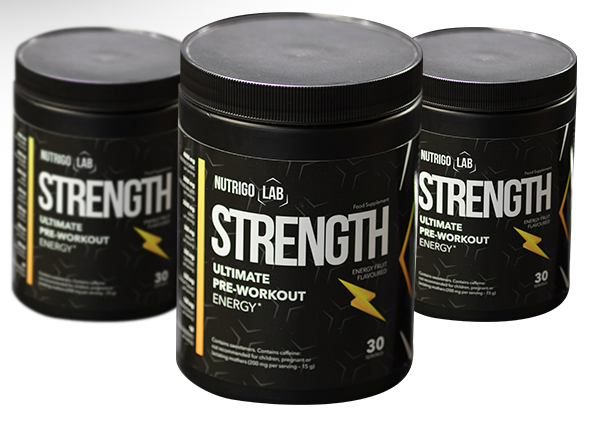
Our Recommendation — Nutrigo Lab Strength
Score: 6.1/10 · Best for: lifters who judge a tub the way this article does — dose by dose — and want the worked example whose 18-ingredient panel prints every amount Main caution: caffeine and creatine are genuinely dosed, but beta-alanine (1,000 mg) and citrulline (about 2 g actual) sit below their studied marks — and no money-back guarantee is published Fair trial: one tub at $68.99 covers about a month of training days — long enough for the creatine half to saturate and the caffeine half to be judged honestly.
What a Pre-Workout Actually Does in Your Body
Strip away the flavour names and a pre-workout does four jobs, on four different timescales. Caffeine blocks adenosine receptors, which is why tiredness lifts and perceived effort drops within 30–60 minutes — this is the acute effect you feel, and it is real: the International Society of Sports Nutrition's position stand (Guest et al. 2021) puts the effective range at 3–6 mg of caffeine per kilogram of body mass, taken about an hour before exercise, for improvements in strength, power and endurance. Citrulline feeds the nitric-oxide pathway and may add repetitions late in high-rep sets — at the right dose. Beta-alanine and creatine do nothing meaningful on day one: both are saturation ingredients that raise muscle carnosine and muscle creatine respectively over weeks of daily intake. And the long tail of extracts, vitamins and branded blends mostly contributes label breadth. Any honest answer to "does it work?" has to separate those four jobs, because a product can be genuinely good at job one and decorative at jobs two to four.
The Caffeine-Alone Comparison Nobody Puts on the Tub
The most uncomfortable evidence in this category comes from head-to-head comparisons. Anglia Ruskin University's published summary of the research states it plainly: when pre-workout supplements are directly compared with the same dose of caffeine on its own, the supplements generally do not outperform caffeine — sometimes caffeine alone works as well or better. The meta-analytic picture agrees in outline: Southward et al. (2018) found multi-ingredient pre-workouts produced small benefits for strength and power measures, no endurance benefit, and identified the caffeine content as the likely driver of what benefit exists. This does not make pre-workouts pointless — convenience, taste, ritual and the extra ingredients at proper doses are real things — but it resets the baseline. The question is never "pre-workout or nothing?" It is "pre-workout or its own caffeine content, bought cheaper?" — and the blend has to earn the difference with its other ingredients, at their actual doses.
What 200 mg of Caffeine Means for Your Body Weight
Caffeine evidence is dosed per kilogram, so a fixed serving is a different drug for different lifters. Nutrigo Lab Strength — the formula this site reviews, used throughout this article as the worked example because its label prints every amount — carries 200 mg of caffeine per serving:
| Your body weight | 200 mg caffeine equals | Against the ISSN 3–6 mg/kg range |
|---|---|---|
| 60 kg | ~3.3 mg/kg | Inside the proven range |
| 70 kg | ~2.9 mg/kg | Just below the bottom edge |
| 85 kg | ~2.4 mg/kg | Below the studied range |
| 100 kg | ~2.0 mg/kg | Below — habitual users will feel this least |
Two consequences follow. Smaller and caffeine-naive lifters get a genuinely evidence-dosed serving from a standard tub; large, coffee-habituated lifters are taking a sub-study dose of the one proven ingredient — which is why "this pre-workout does nothing for me" and "this pre-workout blew my head off" are both common, honest reports about the same product. And doses above the range are not better: at 9 mg/kg and beyond, the position stand is clear that side effects multiply without added performance.
The Dose Audit: Studied Dose vs Label Dose
This is the table the category avoids printing. It audits one real, fully-labelled formula — Nutrigo Lab Strength, 18 ingredients, every amount published — against the doses the research actually used:
| Ingredient | Studied dose | Nutrigo serving | Audit verdict |
|---|---|---|---|
| Caffeine | 3–6 mg/kg (~210–420 mg at 70 kg) | 200 mg | Bottom edge of the range — adequate for most, light for heavy/habituated lifters |
| Creatine (actual) | 3–5 g/day maintenance | 3,012 mg actual creatine (from 4,000 mg of creatine compounds) | In the maintenance band — but only on days you take it |
| Citrulline malate | 6–8 g before training | 3,000 mg | Roughly half the low end of the studied range (~2 g actual citrulline) |
| Beta-alanine | 3.2–6.4 g/day, daily, for weeks | 1,000 mg | About a third of the lowest studied daily dose — and only on training days |
| Beetroot nitrate (RedNite™ extract) | ~300–500 mg nitrate | 250 mg extract ≈ 4–7 mg nitrate | A label ingredient, not a nitrate dose — see our beetroot article |
| enXtra™ (galangal extract) | 300 mg in its own studies | 300 mg | At its studied dose — though its evidence file is far thinner than caffeine's |
Read the table the way an auditor would: the formula's functional core (caffeine, creatine) is honestly dosed, two famous names (citrulline, beta-alanine) sit well below their trial doses, and one (beetroot extract) is present at a small fraction of the studied amount of the active compound. That pattern — a real core, a discounted supporting cast — is typical of the category, and it is invisible unless the label prints amounts. Most don't. A proprietary blend would have hidden every row of this table.
Acute Ingredients vs Loader Ingredients
The second audit is about time. Acute ingredients — caffeine, and citrulline in principle — act on the day, within the hour. Loader ingredients — creatine and beta-alanine — act on the month: muscle creatine saturates over roughly four weeks of daily 3 g-class dosing, and muscle carnosine rises over 2–4+ weeks of daily beta-alanine. A pre-workout taken three or four times a week delivers its loaders intermittently, which is why the arithmetic matters: creatine at 3,012 mg on four training days averages ~1.7 g/day across the week, below the 3–5 g maintenance band, and beta-alanine at 1 g on training days never approaches the studied daily totals. The practical fix is boring and cheap — plain creatine monohydrate on rest days — and the honest expectation is that the tub alone under-delivers its two best-evidenced long-term ingredients. Our article on whether the creatine in a pre-workout is enough works that maths in full.
The "Fat-Burner Pre-Workout" Claim, Audited
A branch of the category sells thermogenesis — pre-workouts that supposedly burn fat while you lift. The claim leans on stimulant ingredients such as bitter orange (synephrine), cayenne and caffeine itself. The honest position: stimulants raise energy expenditure slightly and acutely, and no pre-workout ingredient has human evidence of meaningful fat loss at label doses; the fat-loss effect of a pre-workout is the training it helps you do, full stop. Nutrigo Lab Strength carries 100 mg of bitter orange extract standardised to 6% synephrine — about 6 mg of synephrine, low against the 10–50 mg doses used in synephrine studies — plus 10 mg of cayenne extract. Treat those as what they are: minor stimulant support for the session, not a fat-burning mechanism. Any product that promises otherwise is selling the workout's results as the powder's.
Honest Expectations: Strength, Muscle, Endurance
Set the ceiling correctly and pre-workouts stop disappointing people. Strength and power: small, real improvements, attributable mostly to caffeine — a few percent on a good day, enough to matter at the margin of a programme, not enough to transform one. Endurance: caffeine helps; the blends as a whole showed no endurance benefit over comparators in the meta-analysis. Muscle growth: no pre-workout builds muscle directly — growth comes from progressive training, protein and time, the territory of our guide to how long muscle actually takes to build and our rundown of what supplements can genuinely support it. The felt effect — energy, focus, willingness to train hard on a flat day — is the product's most reliable deliverable, and for many lifters it is the entire point. It is also, per the head-to-head evidence, mostly purchasable as caffeine.
The Supporting Cast, One by One
The audit table covered the famous names; the remaining panel deserves the same treatment in brief, because a long ingredient list is itself a marketing device — length reads as thoroughness. AAKG (arginine alpha-ketoglutarate), 2,000 mg: an arginine-family nitric-oxide ingredient whose own human evidence is thin, and whose oral-arginine route is the inefficient one citrulline exists to bypass; arginine-family trial doses also run higher than 2 g. Taurine, 750 mg: a plausible cellular-hydration and endurance supporting player with an unsettled file, present at a modest dose. N-acetyl-L-tyrosine, 750 mg: a focus ingredient borrowed from the stress-and-sleep-deprivation literature, where it helps cognition under duress; a normal gym session is not the studied duress, but the dose is in a sane range and the acute pairing with caffeine is at least coherent. Rhodiola, 100 mg: an adaptogen with a mixed sports file at doses usually above this. Cayenne, black pepper extract, B-vitamins, niacin: absorption aids, thermogenic garnish and nutritional completeness, respectively — none is a performance ingredient at these amounts. The aggregate verdict matters more than any line: of 18 printed ingredients, the acute effect is carried by one (caffeine), the chronic effect by one (creatine, if calendared properly), two are real ingredients at discounted doses, and the remaining fourteen are support, theory and label architecture. That ratio — roughly two workers, two apprentices, fourteen witnesses — is the honest anatomy of a modern pre-workout, and this formula is above the category's standard because its workers are properly dosed and every witness is at least named with an amount.
How to Run Your Own Four-Week Test
Because the expected blend-over-caffeine difference is small to nil in the literature, your own training log is a legitimate instrument — if you run it like one. Pick two comparable weekly sessions (same lifts, same rep targets). For two weeks, take your normal pre-workout; for two, take caffeine alone at the same milligram dose (coffee or a caffeine tablet) at the same time before the session. Keep sleep, food and time of day as constant as life allows. Score the same things each session: top-set performance, total reps on a fixed finisher set, and a 1–10 rating of perceived energy written down before you train, not reconstructed after. If the tub wins consistently on performance — not just on how the first ten minutes felt — it has earned its premium for you personally, whatever the group averages say. If the lines are level, the literature's verdict has replicated in an n-of-1: you were buying caffeine with ceremony. Either outcome is worth the price of the experiment once, because it prices every future tub.
Do You Need One? A Decision in Four Questions
Do you already drink coffee before training? Then you already own the proven core; a pre-workout adds convenience and sub-dosed extras. Do you train early, fasted, or after work on low energy? The acute caffeine effect has its highest value here. Will you take the loaders daily some other way? If not, credit the tub only with its acute effect. Does the label print every amount? If it hides behind a proprietary blend, the audit in this article is impossible — and that is itself the answer. Nutrigo Lab Strength passes the transparency test outright (every one of its 18 amounts is printed, down to the true creatine content behind its "4,000 mg of compounds" headline), which is why it scores 6.1/10 on our review despite its discounted supporting cast.
A Note on Placebo — Which Is Not Nothing
An honest audit should concede the blend's one unpatentable advantage: expectancy. A flavoured, tingling, ritualised drink taken at a fixed pre-training moment conditions effort — athletes who believe the session is chemically supported often do produce more, and the tingle functions as a convincing receipt for a purchase the bloodstream hasn't honoured yet. Sports science recognises placebo ergogenic effects as real performance effects with a non-pharmacological address. This cuts both ways for the buyer. If the ritual reliably gets you to the gym and into the first hard set, some of its value survives the dose audit untouched — adherence is the master variable in all training. But it reframes what you are paying for: ceremony and self-signalling, priced at a premium over the caffeine that does the pharmacological work. Buy ceremony knowingly if you buy it at all — and never let a brand charge you pharmaceutical prices for it while implying the fourteen witnesses did the lifting.
Who Should Buy a Pre-Workout Like This — and Who Should Skip It
Buy it if you want caffeine's proven acute effect in a measured, transparent serving, you value the all-in-one ritual before training, and you will cover creatine properly on rest days. On those terms a fully-labelled formula like Nutrigo Lab Strength is a fair buy. Skip it if you already caffeinate before sessions (you are paying a premium for your own coffee's active ingredient), if you train late in the evening (the caffeine half-life will bill your sleep), if you expect the citrulline or beta-alanine at label doses to perform like the studies (they are dosed below them), or if you have cardiovascular disease or caffeine sensitivity — the maker's own warnings, which our side-effects article covers in full. And skip every proprietary-blend product on principle: an unauditable label is asking for trust it has not earned.
Our Recommendation — Nutrigo Lab Strength
Score: 6.1/10 · Best for: lifters who judge a tub the way this article does — dose by dose — and want the worked example whose 18-ingredient panel prints every amount Main caution: caffeine and creatine are genuinely dosed, but beta-alanine (1,000 mg) and citrulline (about 2 g actual) sit below their studied marks — and no money-back guarantee is published Fair trial: one tub at $68.99 covers about a month of training days — long enough for the creatine half to saturate and the caffeine half to be judged honestly.
Frequently Asked Questions
How long does pre-workout take to kick in?
The caffeine effect builds over 30–60 minutes — the window most studies dose against. You may feel beta-alanine tingling earlier (10–20 minutes), but tingling is a side effect, not the ergogenic effect arriving. Our timing article covers the per-ingredient windows in detail.
Does pre-workout build muscle?
Not directly. It can help you train harder today (caffeine) and, if its creatine were taken daily, support the saturation that assists strength over months. Muscle itself comes from training progression, protein and time.
Is pre-workout just expensive caffeine?
Mostly, at most labels' doses — that is what the caffeine-matched comparisons show. The premium buys convenience, taste, and whatever the extra ingredients deliver at their printed doses, which is why the dose audit matters more than the ingredient list's length.
Why does my pre-workout feel weaker than it used to?
Caffeine tolerance: daily use upregulates adenosine receptors and blunts the effect within roughly two to three weeks. Our daily-use and cycling article explains the mechanism and the reset.
Should I feel my pre-workout working?
You should feel the caffeine (alertness, reduced perceived effort) and possibly the beta-alanine tingle. You will never feel creatine or carnosine loading — those are silent, cumulative processes. Judging a formula by its felt intensity systematically over-rewards stimulants and under-rewards the ingredients with the deepest evidence.
Can I take pre-workout on an empty stomach?
You can, and it absorbs faster — but nausea and jitters are more likely. A small amount of food blunts the rough edges at a small cost in onset speed.
Are some pre-workouts stronger than others, or is it all marketing?
Both, separably. The caffeine dose is real and varies (roughly 150–350 mg across the category, when labels deign to print it), and your body weight and tolerance set what a given dose means. Beyond the caffeine number, most "stronger" claims are the tingle, the flavour of the month stimulant, or a proprietary blend asking to be believed. Strength you can verify sits in exactly one printed figure.
Do pre-workouts show up on drug tests?
Caffeine is not a banned substance in sport. The risk sits elsewhere: contaminated or spiked products in this category have produced positive tests, which is why tested athletes should choose third-party-certified products — or, as our coffee comparison argues, the vehicle with no manufacturing lottery at all.
Is a proprietary blend a dealbreaker?
For an informed buyer, yes. If the amounts are hidden, you cannot tell a studied dose from label decoration — and in this category, that distinction is most of the product.
Last reviewed: October 2026. This article is educational and is not medical advice.
