
- Quick Answer
- The Two Mechanisms, Honestly Sized
- How Much Weight Can You Actually Lose?
- Does Matcha Burn Belly Fat Specifically?
- Does It Work Without Exercise?
- How Long Does It Take?
- What a Serving of a Real Product Delivers
- Who Matcha Is and Is Not For
- Frequently Asked Questions
- Does matcha suppress appetite?
- How many calories are in a matcha latte?
- Is matcha extract the same as drinking matcha tea?
- Read This Next
Disclosure: This article contains affiliate links. If you buy through them, we may earn a commission at no extra cost to you. It never changes our scores or conclusions.
Quick Answer
Yes, a little. Matcha's catechins plus caffeine produce a small, real effect in trials. Green-tea preparations pool to about 1.3 kg over roughly 12 weeks against placebo in overweight or obese adults in the trial record we reviewed.
That pooled figure sits below what clinicians usually call meaningful on its own. The clearest matcha-specific effect is different: more fat oxidised during exercise itself, not a faster loss while sitting still.
Matcha works, if it works, as a supporting habit inside a calorie deficit. Its strongest practical routes are substitution — replacing a caloric drink — and pairing with the activity its trials actually tested.
Best for: tea drinkers who will actually swap a caloric drink for matcha daily, and keep doing so for months. We score Matcha Extreme, the worked serving example in this article, at 4.8/10.
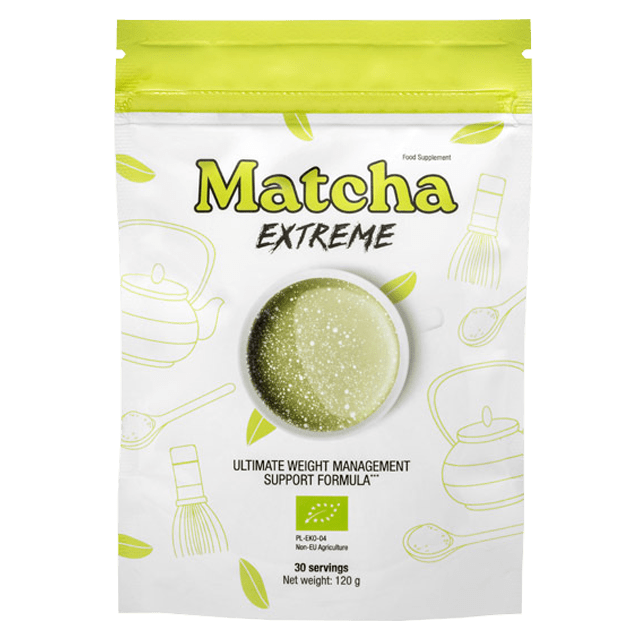
Our Recommendation — Matcha Extreme
Score: 4.8/10 · Best for: tea drinkers who would swap a caloric drink for an unsweetened matcha-style tea and want a fully declared panel, not a proprietary blend. Main caution: no money-back guarantee is published, the pouch lasts 15 days at the maker's full dose, and caffeine is never declared. Fair trial: two months at one serving a day — the three-pouch pack at $35.99 a pouch covers it.
The Two Mechanisms, Honestly Sized
Two mechanisms explain almost every matcha weight-loss claim. The first involves catechins, especially EGCG. The second involves caffeine. Neither mechanism is magic, and neither was ever shown to override energy balance in human trials.
The catechin story centres on an enzyme called COMT. COMT breaks down noradrenaline, a signal involved in thermogenesis and fat oxidation. Laboratory work suggests catechins can inhibit COMT, prolonging that signal slightly in test systems.
That laboratory mechanism is often presented as settled human physiology. It is not. Reviewers of the green-tea literature note the COMT explanation rests mainly on in-vitro evidence, with direct human confirmation still limited.
Caffeine's mechanism is better understood. Caffeine stimulates the nervous system, raises alertness, and can increase energy expenditure for a few hours. It also promotes fat oxidation acutely, especially when combined with activity.
The classic anchor is an extract study, and we label it as such. In Dulloo et al. 1999, a green-tea extract raised 24-hour energy expenditure in 10 healthy men compared with placebo.
In that same study, the extract increased 24-hour energy expenditure by 4% in 10 healthy men compared with placebo. Caffeine alone, at the matched dose in those men compared with placebo, did not produce the same effect.
Those numbers came from capsules of concentrated extract taken three times in one day, inside a respiratory chamber. They describe a short-term metabolic nudge in 10 healthy men, not months of weight change in ordinary drinkers.
That distinction matters for matcha tea. A whisked drink delivers catechins and caffeine together, in food-level amounts. An extract capsule can deliver a standardised, concentrated dose that a normal serving of tea may not match.
So the honest sizing is this. The mechanisms are plausible and partly demonstrated acutely. The long-term weight effect they produce, when trials measure it over weeks, is the small pooled figure in the next section.
How Much Weight Can You Actually Lose?
The pooled catechin record is the starting point. Across green-tea trials, catechin preparations produced roughly 0.2 to 1.3 kg of extra body-fat or weight change over 12 weeks in overweight adults compared with placebo.
The Jurgens et al. 2012 Cochrane review reached a cooler conclusion than most marketing. In overweight or obese adults compared with control, green-tea preparations produced a small loss that was not statistically significant outside Japan.
The Cochrane authors also judged that small loss unlikely to be clinically important on its own. That wording is important. Statistically detectable in some poolings is not the same as meaningful for a person's health or appearance.
A useful benchmark helps. Clinicians often treat around 5% of body weight, in an individual patient compared with their starting weight, as a clearly meaningful loss. For an 80 kg adult, that benchmark is about 4 kg.
Against that scale, a pooled advantage near 1.3 kg over roughly 12 weeks in overweight adults compared with placebo is real but modest. It is roughly one-third of that illustrative 4 kg benchmark, not a transformation.
Fat oxidation is the other number quoted everywhere. In the short-term literature, catechin-caffeine mixtures raised fat oxidation by 10 to 16% on average in adults during the measurement period compared with placebo.
Read that sentence carefully. A higher rate of fat oxidation during a walk or a chamber day is not the same as losing that proportion of body fat. It describes which fuel was burned, not the final scale result.
The matcha-specific work fits that pattern. In Willems et al. 2018, four 1 g matcha drinks enhanced fat oxidation in 13 healthy females during brisk walking compared with control.
The authors themselves warned against overstating the finding. Their summary said matcha's composition could provide beneficial metabolic responses during walking, but its effects should not be overstated inside a weight-loss programme built on regular exercise.
There is also a 2022 matcha pilot we describe without linking, because its design limits what it can prove. It was open-label and had no control group, so participants knew they were taking matcha throughout.
Without a control group, that pilot cannot separate matcha from the lifestyle changes participants made alongside it. People who enrol, measure themselves, and change routines often improve for reasons that have nothing to do with the drink.
We therefore treat that pilot as a prompt for a proper trial, not as evidence of effect. A randomised, blinded, controlled matcha trial over months, with weight as the endpoint, remains the missing study in this field.
Put the record together and the answer stabilises. Expect, at best, a kilo-scale advantage over a quarter, inside a deficit, with exercise. Expect nothing visible in a week, and nothing at all without the deficit.
Does Matcha Burn Belly Fat Specifically?
No food or drink selectively burns belly fat. Spot reduction — losing fat from one chosen area because of what you consumed — is a myth that controlled trials of targeted exercise and diet products have repeatedly failed to support.
Fat loss follows whole-body energy balance. Where fat comes off first, and where it lingers longest, is shaped by genetics, sex, age, and hormones. A catechin drink does not receive instructions to work on the abdomen.
Some catechin trials report waist circumference or visceral-fat subgroups. Those findings describe where a small whole-body change was measured, in specific trial participants compared with placebo, not a targeted abdominal action by the ingredient.
Waist measurements also move for ordinary reasons. Bloating, posture, meal timing, and tape placement change a reading by centimetres between mornings. A single waist reading is a weaker endpoint than an averaged trend over weeks.
If matcha helps you sustain a deficit, your waist will likely shrink as part of general fat loss. That is the honest version of the belly-fat claim, and it is a claim about the deficit, not the drink.
Any product page promising matcha will melt belly fat specifically is promising something no trial has shown. The claim should lower your trust in everything else on that page, including its other numbers.
Does It Work Without Exercise?
Minimally, on the current record. The pooled green-tea weight trials were not matcha-alone miracles; they ran alongside diet contexts, and their combined result was still small in overweight adults compared with placebo.
The NCCIH green tea page summarises the position plainly. The catechins and caffeine in green tea may have a modest effect on body weight, and effects may vary with a person's physical activity level.
Exercise pairing is matcha's best-documented feature. The Chichester work tested matcha around brisk walking, not rest. In 13 healthy females, matcha lowered the respiratory exchange ratio during a 30-minute brisk walk compared with control.
A lower respiratory exchange ratio means a larger share of energy came from fat during that walk, in those women compared with control. It does not mean total daily fat loss rose by the same amount afterwards.
Compensation is why. People who exercise often eat a little more, move a little less later, or both. Trial endpoints over weeks capture that compensation; a 30-minute oxidation reading during exercise cannot.
Without exercise, the remaining route is substitution. A plain matcha in water carries very few calories. Replacing a daily sweetened latte or soft drink with it removes calories every day you actually make the swap.
That substitution effect can exceed the catechin effect. Saving 150 calories a day dwarfs a metabolic nudge worth a few dozen. It is also entirely dependent on behaviour, which is why it rarely headlines a product page.
So our answer is narrow. Matcha without exercise, and without substitution, has little trial support. Matcha with walking, and as a replacement drink, has a coherent, if modest, case behind it.
How Long Does It Take?
Three different clocks get confused in matcha marketing. The first is acute thermogenesis: caffeine and catechins act within hours of a dose. That clock tells you nothing about weight change over a season.
The second clock is fat oxidation during activity. The Willems studies measured it during a single walk, or after three weeks of daily intake. Those are metabolic readings, not before-and-after weight results.
The third clock is the one buyers care about: measurable weight change. In the catechin trial record, that window is 8 to 12 weeks of consistent use, judged on weight and waist trends, not daily impressions.
Shorter judgements mislead. Weight fluctuates by a kilogram or more across a day with water, salt, and gut contents. A product judged at day five is being judged on noise, not on its trial endpoint.
The practical rule follows the trials. Give any matcha routine a full 12 weeks beside a stable deficit. Measure weekly averages. If the trend matches your previous deficit-only trend, the drink added nothing measurable for you.
That discipline also protects your money. A pouch bought for a 12-week test is a defined experiment. A subscription renewed on hope, without a checkpoint, is how a small effect becomes a large total spend.
What a Serving of a Real Product Delivers
Theory becomes useful when it meets a label. Matcha Extreme declares 2,250 mg of matcha leaf in each 4 g scoop, alongside 900 mg spirulina, 500 mg Cacti-Nea, and 350 mg acerola.
That leaf amount sits inside the literature's studied serving range. The Willems drinks used 1 g of matcha per cup, several cups around testing. A scoop delivering 2,250 mg of leaf is therefore a substantial single serving, not a dusting.
The panel declares everything except caffeine. Matcha leaf is naturally caffeinated, yet no caffeine figure is printed anywhere on this product. Any per-scoop caffeine number for it is an estimate from leaf weight, never a label fact.
Using a reported range of 19 to 44 mg of caffeine per gram of matcha, 2,250 mg of leaf estimates to roughly 43 to 99 mg per scoop. The next articles in this set work that arithmetic in full.
No trial has tested this product itself. The evidence above belongs to matcha, green-tea preparations, and extracts as classes. Borrowing class evidence for a specific blend is legitimate only when the doses align, and incomplete even then.
Its other ingredients need their own audits, not matcha's halo. Spirulina's pooled record and Cacti-Nea's unpublished maker trial are treated in their own articles in this set, under the spirulina and prickly-pear titles.
The maker's wider claims also need separating from the trial record. The maker claims the product "eliminates toxins and heavy metals" — a detox claim no matcha weight trial tested, and not a conclusion this article adopts.
The maker also claims 96% of users were satisfied, but publishes no surveyed population and no comparator group for that figure. Without who was asked, how many responded, and compared with what, the number cannot be checked.
A third maker claim, that 90,000 packs have been sold, is likewise a sales claim, not evidence. Popularity, even if accurate, does not measure weight loss in the buyers who used those packs.
Value needs the same discipline. A single pouch costs $53.99, three packs cost $107.98, and six packs cost $161.97, each order plus $12 shipping. No money-back guarantee is published behind any of those prices.
The terms give only a 10-day withdrawal for unused goods. That is a returns right for an unopened product, not a satisfaction guarantee after a 12-week trial. Budget for the test as money already spent.
Our score of 4.8/10 reflects that balance. A fully declared panel and a studied-range serving earn credit. Undeclared caffeine, no published guarantee, and untested finished-product claims hold the score down.
Who Matcha Is and Is Not For
Matcha suits adults who already like tea, tolerate caffeine, and will use it daily. The habit is the delivery system. A product used twice and abandoned delivers neither the substitution effect nor the trial-window exposure.
It suits walkers and moderate exercisers best, because that is where its specific evidence lives. A serving before regular brisk activity matches the tested pattern more closely than a serving before a desk-bound afternoon.
It is not for anyone expecting drug-scale results. The pooled advantage, near 1.3 kg over about 12 weeks in overweight adults compared with placebo, is the ceiling the current record supports, not a starting bid.
Caffeine-sensitive readers should be careful. Jitters, anxiety, palpitations, and disturbed sleep scale with caffeine dose, and matcha's dose varies with leaf amount and grade. Start with one small serving, in the morning, if you try it.
Pregnancy changes the calculation entirely. Generic caffeine guidance is one question; a specific product's own panel caution is another, stricter one. The full safety treatment, including this product's panel line, is in our matcha side-effects article.
Children are outside this article's scope for a simple reason: caffeine. Matcha Extreme's panel states it is not suitable for children, pregnant or lactating mothers. For this product, that panel line governs over generic tea guidance.
Anyone taking regular medication should also pause. Tea catechins and caffeine can interact with some medicines and with iron absorption from meals. A pharmacist check costs nothing and answers the question for your actual prescription list.
If none of those cautions apply, the decision becomes ordinary. Do you like the taste enough to drink it daily, at a price you accept, for an effect the trials size at about a kilo over a quarter?
Our Recommendation — Matcha Extreme
Score: 4.8/10 · Best for: tea drinkers who would swap a caloric drink for an unsweetened matcha-style tea and want a fully declared panel, not a proprietary blend. Main caution: no money-back guarantee is published, the pouch lasts 15 days at the maker's full dose, and caffeine is never declared. Fair trial: two months at one serving a day — the three-pouch pack at $35.99 a pouch covers it.
Frequently Asked Questions
Does matcha suppress appetite?
The appetite signal is small and inconsistent. Some green-tea work reports satiety changes alongside weight maintenance, but no matcha trial shows a strong, reliable hunger reduction that would explain weight loss by itself.
In the Hursel et al. 2009 trial, satiety rose in the high-protein groups in overweight subjects compared with the adequate-protein placebo group, not as a clear matcha-alone effect.
Practically, a warm, bitter drink before a meal may help some people pause before eating. That behavioural effect is real for some drinkers, but it is not a pharmacological appetite suppression claim we can score.
How many calories are in a matcha latte?
A plain matcha in water is close to calorie-free for practical purposes. A latte is a different drink: milk adds protein, fat, and sugar, and café sweetening can add as much energy as a small snack.
That change breaks the substitution maths. Swapping a sweetened coffee for a sweetened matcha latte may save little. Swapping either for plain matcha in water is where the calorie saving actually appears.
Is matcha extract the same as drinking matcha tea?
No. Extracts concentrate catechins into capsule doses, and carry a different safety file from whole-leaf tea. Drinking matcha consumes the leaf itself, at food-level exposure, with caffeine and fibre included.
Our article comparing matcha with green tea works through that format difference in full. The short rule: do not transfer extract trial doses, or extract warnings, directly onto a cup of tea.
Last reviewed: October 2026.
