
- Quick Answer
- Timing Is Per-Ingredient, Not Per-Tub
- The 15-Minute Label vs the 60-Minute Evidence
- The Half-Life Maths Behind the Sleep Cut-Off
- Empty Stomach or Fed?
- Who Should Buy on This Schedule — and Who Should Skip
- Two Worked Schedules
- What About Weekends and One-Off Early Sessions?
- Frequently Asked Questions
- How long does pre-workout last?
- I feel it in 10 minutes — is it already working?
- Can I take pre-workout and go straight into the workout?
- Does taking it later in the day but at a half dose fix the sleep problem?
- I train at 8 p.m. and sleep at 2 a.m. — does the rule fit me?
- What is the latest I can take pre-workout and still sleep?
- Read This Next
Disclosure: This article contains affiliate links. If you buy through them, we may earn a commission at no extra cost to you. It never changes our conclusions.
Quick Answer
Take pre-workout 30–60 minutes before training if you want the caffeine at its peak when the hard sets start — that is the window the caffeine research (ISSN: 3–6 mg/kg, ~60 minutes pre-exercise) doses against. The tingling you feel at 10–20 minutes is beta-alanine arriving, not the caffeine peaking. And work backwards from bed, not forwards from the gym: caffeine's half-life averages ~5 hours, so the working rule is no full serving within ~8 hours of bedtime — the exact cut-off table is below. Best for: morning and early-afternoon trainers; evening trainers should read the sleep section before the label.
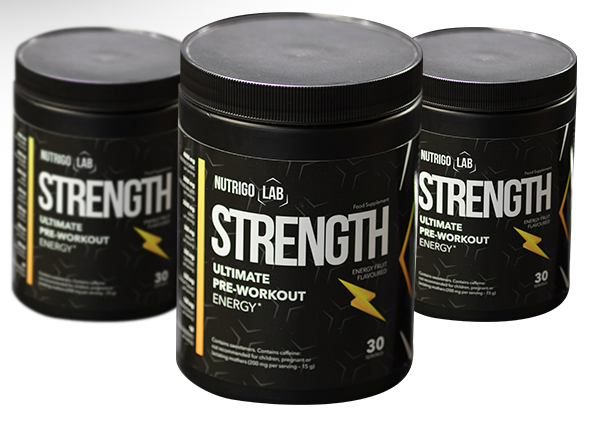
Our Recommendation — Nutrigo Lab Strength
Score: 6.1/10 · Best for: morning and early-afternoon trainers who want the caffeine at its peak for the hard sets — taken 30–60 minutes out, the window the research doses against Main caution: the maker's own direction says about 15 minutes before training, against the 40–60 minute evidence window — and caffeine's roughly five-hour half-life means no full serving within about eight hours of bed; citrulline and beta-alanine also sit under their studied marks Fair trial: one tub at $68.99 (about 30 servings) covers a month of timed sessions — long enough to judge the 30–60 minute window honestly — with no money-back guarantee published.
Timing Is Per-Ingredient, Not Per-Tub
| Ingredient | Peak / relevant window | Timing verdict |
|---|---|---|
| Caffeine | Peak blood levels ~30–60 min after the dose (range 15–120 min by person and stomach contents) | The ingredient that sets the schedule: dose 30–60 min out |
| Citrulline | Blood arginine peaks ~45–90 min; trials dose 40–60 min before training | Also points to ~60 minutes |
| Beta-alanine | Tingle onset 10–20 min — but the benefit is carnosine loaded over weeks | Timing-irrelevant for effect; the tingle is a clock for nothing |
| Creatine | No acute effect — saturation over ~4 weeks of daily intake | Timing-irrelevant, full stop |
| Beetroot nitrate | Blood nitrite peaks 2–3 hours after the dose | A different clock entirely — our beetroot timing article owns this topic |
The 15-Minute Label vs the 60-Minute Evidence
Nutrigo Lab Strength's maker directs 2 scoops in 200 ml of water ~15 minutes before training. The research window for its two acute ingredients is 40–60 minutes. Both can be defended, and the gap is worth understanding rather than papering over. Fifteen minutes is calibrated to the felt onset — early caffeine rise plus the beta-alanine tingle gives a convincing "it's working" signal as you walk into the gym — and for a session that lasts 60–90 minutes, a dose taken 15 minutes out still reaches its caffeine peak mid-workout, in time for the heavy top sets. Sixty minutes is calibrated to the measured peak, and is the better default if your hardest work comes first (a max-effort opener, a time trial). Our practical ruling: 30 minutes is the honest compromise for most lifters on this formula; take it as you leave for the gym, not as you rack the first bar. The maker prints 15; the studies used 60; your session structure arbitrates.
The Half-Life Maths Behind the Sleep Cut-Off
Caffeine's average half-life is ~5 hours (individual range roughly 2.5–10 hours — genetics, medication and pregnancy move it a lot). Run Nutrigo's 200 mg through it: after ~5 hours ~100 mg remains; after ~10 hours ~50 mg. Drake et al. (2013) showed why the residue matters: 400 mg of caffeine taken even 6 hours before bed still cost participants more than an hour of objectively measured sleep. Halve the dose and the lesson shrinks but doesn't vanish — 200 mg is not a trivial evening residue. Hence the working rule of ~8 hours between a full serving and bedtime, earlier if you know you clear caffeine slowly:
| Your bedtime | Last full serving by | If you are caffeine-sensitive |
|---|---|---|
| 10 p.m. | 2 p.m. | Noon |
| 11 p.m. | 3 p.m. | 1 p.m. |
| Midnight | 4 p.m. | 2 p.m. |
| 1 a.m. | 5 p.m. | 3 p.m. |
The maker's own instruction — do not take before bedtime — is the same rule with the maths removed. Training at 6 p.m. for an 11 p.m. bedtime? A full 200 mg serving breaks the rule; a half serving (100 mg) at 5–6 hours out is the compromise most evening trainers land on, and a stimulant-free product is the clean answer. Our side-effects article covers what the residue does to sleep quality when you ignore this.
Empty Stomach or Fed?
| Empty stomach | With / after food | |
|---|---|---|
| Onset | Faster — towards the 15–30 min end | Slower, smoother rise |
| Peak | Higher, sharper | Blunted slightly |
| Side effects | Nausea, jitters and stomach urgency more likely | Best tolerated |
| Suits | Early-morning trainers who tolerate it | Most people, most days |
A large meal immediately before also competes with training itself; the standard practice — a normal meal 1–2 hours out, the pre-workout 30 minutes out — threads both needles.
Who Should Buy on This Schedule — and Who Should Skip
Buy it if your training sits comfortably 8+ hours before bed and you can dose 30 minutes out — on that schedule Nutrigo Lab Strength's 200 mg caffeine and printed panel do exactly what the evidence supports, and our review scores the formula 6.1/10. Skip it (or halve it) if you train in the evening for a normal bedtime, if you are a slow caffeine clearer who already guards sleep, or if you are stacking it on top of afternoon coffee — the cut-off counts all caffeine, not just the scoop. A pre-workout you cannot time is a sleep product you didn't mean to buy.
Two Worked Schedules
The 7 a.m. trainer: dose at 6:30, hard work peaks 7:00–7:30 inside the caffeine window, and by an 11 p.m. bedtime roughly three half-lives have passed — ~25 mg of caffeine remains, a rounding error. Every rule in this article is satisfied without trying. The 6 p.m. trainer: dose at 5:30 for a 6:00 session, peak lands beautifully — and at an 11 p.m. bedtime, only 5.5 hours have passed, leaving ~90–100 mg aboard, inside the territory Drake et al. showed costs sleep even at six hours. This trainer's honest options are the half serving at 5:30 (~100 mg, ~45–50 mg at bed), the full serving moved to a weekend morning session, or a stimulant-free product on weeknights. The schedule, not the scoop, is the decision.
What About Weekends and One-Off Early Sessions?
Timing rules are built for your typical day; the exceptions are worth a sentence each. A one-off 5 a.m. session before a normal-bedtime day asks nothing special — dose 30 minutes out and the caffeine clears long before bed. The trap is the second dose: a morning pre-workout plus a "top-up" coffee at 3 p.m. restarts the half-life clock at the worst point in it. And if a competition or event forces a late session, spend the caffeine deliberately that once and protect the following night rather than pretending the maths suspended itself for the occasion.
Our Recommendation — Nutrigo Lab Strength
Score: 6.1/10 · Best for: morning and early-afternoon trainers who want the caffeine at its peak for the hard sets — taken 30–60 minutes out, the window the research doses against Main caution: the maker's own direction says about 15 minutes before training, against the 40–60 minute evidence window — and caffeine's roughly five-hour half-life means no full serving within about eight hours of bed; citrulline and beta-alanine also sit under their studied marks Fair trial: one tub at $68.99 (about 30 servings) covers a month of timed sessions — long enough to judge the 30–60 minute window honestly — with no money-back guarantee published.
Frequently Asked Questions
How long does pre-workout last?
The felt effect runs about 3–5 hours for most people, tracking caffeine's decline; the stimulant is still measurably present well beyond the feeling, which is the sleep problem in disguise.
I feel it in 10 minutes — is it already working?
You feel the beta-alanine tingle and the early caffeine rise. Peak caffeine — the ergogenic part — arrives around 30–60 minutes. The tingle is a starting pistol for a race that begins later.
Can I take pre-workout and go straight into the workout?
Yes, with the expectation adjusted: the first 15–20 minutes of the session run on warm-up physiology, and the caffeine peak lands mid-workout. For long sessions that is fine; for a session that opens with your heaviest lift, dose earlier.
Does taking it later in the day but at a half dose fix the sleep problem?
Halfway. A 100 mg dose at 5 p.m. leaves ~50 mg at 10 p.m. and ~35 mg by midnight — a real reduction in exposure versus the full serving, and the compromise most evening trainers settle on. It is not zero, and slow caffeine clearers will still feel it; our side-effects article explains why individual clearance varies so much.
I train at 8 p.m. and sleep at 2 a.m. — does the rule fit me?
Better than most evening schedules: six hours from dose to bed puts a full serving's residue near ~95–100 mg at bedtime, at the edge of the Drake territory rather than deep inside it. Many people sleep acceptably there; your own sleep tracking, not this table, is the referee — and a half dose buys margin if it isn't.
What is the latest I can take pre-workout and still sleep?
Work back ~8 hours from bedtime for a full 200 mg serving (see the table), ~10 hours if you are caffeine-sensitive. Drake et al. showed even 6 hours is not enough at 400 mg.
Last reviewed: October 2026. This article is educational and is not medical advice.
