
- Quick Answer
- Cycle These, Never Cycle Those: the Ingredient Table
- Why It Stops Working: Adenosine Receptors, Not Willpower
- The 400 mg Worked Example: Your Day, Audited
- Why Your Training Partner Never Tolerates: the Sensitivity Lottery
- The Other Ingredients Across Months
- Seven Days a Week: the Verdict
- Signs It Has Stopped Working
- The Reset: 7–14 Days, Day by Day
- Reset vs Reduce: Choosing Your Maintenance Pattern
- Who Should Buy for Daily Training — and Who Should Skip
- Frequently Asked Questions
- Is once a week too little to bother with pre-workout?
- How long until pre-workout stops working?
- Should I cycle creatine too?
- How long should a caffeine break be?
- Can I just switch to a stronger pre-workout instead of resetting?
- Will a break make my first serving back feel too strong?
- Is it safe to take pre-workout on rest days for energy at work?
- Read This Next
Disclosure: This article contains affiliate links. If you buy through them, we may earn a commission at no extra cost to you. It never changes our conclusions.
Quick Answer
You can take a pre-workout every day in the narrow sense that its label ingredients are dosed for daily use — but the stimulant half of the tub will quietly stop working, because daily caffeine trains your brain to ignore it. The honest answer splits the label in two: cycle the stimulants (caffeine, and the synephrine stacked beside it) and never cycle the saturation ingredients (creatine and beta-alanine only work because you take them daily — stopping them drains the stores you built). The practical pattern most daily users land on: pre-workout on training days only, plain creatine every day, and a 7–14 day caffeine reset when the scoop stops feeling like anything. Best for: lifters who train 3–5 days a week and treat caffeine as a tool with a maintenance schedule — not a daily entitlement.
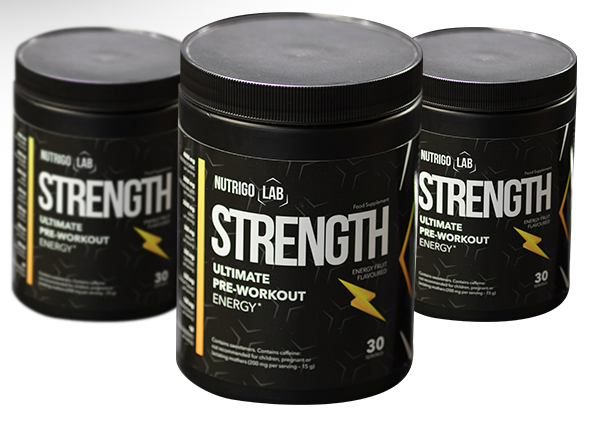
Our Recommendation — Nutrigo Lab Strength
Score: 6.1/10 · Best for: daily trainers who want a formula whose stimulant half and saturation half can be managed separately — every dose on the label, and creatine and beta-alanine that never need cycling Main caution: the 200 mg of caffeine blunts with daily use over about two to three weeks, the citrulline malate is 3 g — only about 2 g of actual citrulline against the 6–8 g studied — and no money-back guarantee is published Fair trial: one tub at $68.99 (450 g, about 30 servings) covers a month of training days — judge the cycle plan across that month, not week one.
Cycle These, Never Cycle Those: the Ingredient Table
| Ingredient (in Nutrigo Lab Strength) | Daily use pattern | Cycle it? |
|---|---|---|
| Caffeine, 200 mg | Tolerance builds with daily use; effect blunts over ~2–3 weeks | Yes — training days only, plus periodic resets |
| Synephrine (bitter orange, ~6 mg) | Rides with the caffeine stack; no daily-use evidence base of its own | Yes — it cycles when the caffeine does |
| Creatine, 3,012 mg actual | Works by saturating muscle stores over ~4 weeks | No — stopping unwinds saturation; take daily, from any source |
| Beta-alanine, 1 g | Works by raising muscle carnosine over weeks of daily dosing | No — daily is the mechanism; stores wash out over 2–3 months if stopped |
| Citrulline malate, 3 g | Acute, session-timed ingredient | Neither — use it on training days; nothing accumulates |
No competitor prints this table, and its absence causes the category's most common self-own: the lifter who "cycles off everything" for two weeks, returns with restored caffeine sensitivity and half-drained creatine stores, and concludes the break "didn't work." The break worked on the ingredient that needed it and vandalised the ones that didn't.
Why It Stops Working: Adenosine Receptors, Not Willpower
Caffeine works by occupying adenosine receptors without activating them — it borrows alertness by muting the brain's tiredness signal. A brain dosed daily defends itself: it upregulates, growing more adenosine receptors, so the same 200 mg blocks a smaller fraction of a larger system. The timelines, stated honestly because the internet compresses them: the pressor (blood-pressure) response to caffeine tolerises within days (Robertson et al. 1981 is the classic demonstration); the ergogenic and felt effects fade progressively over roughly 2–3 weeks of daily intake — a slope, not a cliff. The "1–2 weeks" figure quoted across the category is a usable rule of thumb, not a biological deadline. You may also see the fade blamed on "adrenal fatigue" — that is not a recognised medical diagnosis, and no gland is tired; a receptor count changed, and it changes back. That reversibility is the whole basis of the reset below.
The 400 mg Worked Example: Your Day, Audited
The FDA's ~400 mg/day figure is general-population caffeine guidance — from all sources, and a ceiling, not a target. Watch how fast a "reasonable" day spends it:
| Source | Caffeine | Running total |
|---|---|---|
| Morning coffee (8 oz brewed) | ~95 mg | 95 mg |
| Nutrigo Lab Strength, full serving | 200 mg | 295 mg |
| Afternoon tea or cola | ~35–50 mg | ~330–345 mg |
| Second coffee, or an energy drink | ~80–95 mg | ~410–440 mg — over |
This is why "I only take one scoop" and "my caffeine is fine" are different statements. The formula itself — 200 mg, printed, exactly half the guidance ceiling — is one of the more disciplined in its category (our review scores it 6.1/10, dragged down by dose gaps elsewhere, not by stimulant excess). The excess, when it happens, is assembled by the user's day around it.
Why Your Training Partner Never Tolerates: the Sensitivity Lottery
Tolerance timelines are averages draped over wide individual variation. Caffeine clearance runs through the liver enzyme CYP1A2, whose speed varies genetically — slow clearers can carry a morning dose's residue into the evening, while fast clearers (smokers, on average, clear caffeine notably faster) shrug off doses that flatten others. Hormonal contraception roughly doubles caffeine's half-life in many users; pregnancy stretches it further still, which compounds the pregnancy exclusion rather than merely accompanying it. Baseline receptor genetics vary too. The practical consequence is that no article — including this one — can set your personal reset length or cut-off; the ranges given here (fading over ~2–3 weeks, a 7–14 day reset, an ~8-hour pre-bed rule) are population instruments, and your training log is the calibration. If your reset takes three weeks, you are not broken; you are a slow-clearing data point, and your maintenance schedule should be written accordingly.
The Other Ingredients Across Months
Caffeine dominates the daily-use conversation, but the stack deserves a sentence each. Synephrine has no daily-use evidence base of its own at all — it cycles with the caffeine by default, which is the conservative reading of an absent file. enXtra™ is marketed partly on the claim of not driving tolerance the way caffeine does; its file is young and maker-adjacent, so treat the claim as a hypothesis the reset doesn't depend on. Creatine and beta-alanine, covered above, are not merely safe to run daily — daily is their mechanism, and the decades-long creatine literature in particular has not produced a cycling rationale. The B-vitamins and minerals in a daily serving are nutritional rounding. So the complete daily-use picture is a pyramid: a proven daily base (creatine), a loading partner (beta-alanine), acute ingredients used on the day (citrulline), and a stimulant top that requires active management. Most "can I take this every day" anxiety is the top of the pyramid being mistaken for the whole structure.
Seven Days a Week: the Verdict
Training seven days a week is its own questionable plan — adaptation happens during recovery — but the supplement question separates cleanly. Seven days of the saturation ingredients: correct, indeed required; that is what they are for, and plain monohydrate does it cheaper on rest days. Seven days of the full stimulant serving: you will be tolerant within the month, sleeping worse (the ~5-hour half-life makes a daily evening residue a near-certainty for after-work trainers — the cut-off maths live in our timing article), and escalating dose to chase the original feeling, which is the on-ramp to double-scooping. The maker's own directions quietly agree with the split: Nutrigo Lab Strength is directed before training — a training-day product by its own label. Rest days are for creatine and food.
Signs It Has Stopped Working
- The serving you once felt in 15 minutes now registers as "nothing."
- You are contemplating a second scoop — the tolerance signature, verbatim.
- Your non-training-day mood and focus feel below your old baseline (that is the enlarged adenosine system, unblocked).
- Headaches appear on days you skip it — withdrawal, typically starting 12–24 hours after the missed dose.
- Sleep has thinned out even though your last dose "wears off" by evening.
The Reset: 7–14 Days, Day by Day
Two routes work. Cold turkey is faster and rougher; a taper trades a few days for comfort. For a daily 200 mg user, the taper looks like: days 1–3, half servings (100 mg) or one coffee instead of the scoop; days 4–7, a single coffee or tea only (~50–95 mg), taken before noon; days 8–14, caffeine-free. Cold-turkey users simply start at the last step. What to expect either way: withdrawal headache and fatigue peak around days 1–2 and resolve within roughly a week; training feels flat for several sessions (train anyway — the saturation ingredients, which you are still taking daily, carry the long game); sleep usually deepens noticeably in week one, which is itself diagnostic. By day 7–14, receptor counts have largely normalised and a normal serving feels like a serving again. Then protect the reset: training days only, the lowest effective dose, no casual second coffees "because I'm reset now." Most lifters need this two to four times a year — treat it as scheduled maintenance, not failure.
Reset vs Reduce: Choosing Your Maintenance Pattern
A full reset is not the only sustainable pattern, and for many lifters it is not the best one. Reduce — the standing pattern of training-day-only dosing at the lowest effective serving — prevents deep tolerance from forming in the first place, and suits people whose caffeine intake is otherwise low. Reset — the 7–14 day break — is the repair tool for tolerance already established, and works best scheduled around a deload week, when flat sessions cost nothing. The failure mode to avoid is the unplanned middle: daily full servings, creeping top-up coffees, and a vague intention to "take a break soon," which assembles every downside (blunted effect, thin sleep, withdrawal headaches on accidental off-days) with none of the benefits of either discipline. Pick the pattern the way you pick a training split — in advance, in writing, and with the calendar doing the willpower's work.
Who Should Buy for Daily Training — and Who Should Skip
Buy it if you train 3–5 days a week, will use it on training days only, keep plain creatine for the off days, and accept caffeine's maintenance schedule — on those terms Nutrigo Lab Strength's transparent 200 mg serving is an honest daily-training tool. Skip it if you want a seven-day stimulant habit (no formula survives that expectation), if you are already at the top of the day's caffeine budget from coffee, or if your plan for fading effects is a bigger scoop rather than a reset. And skip the daily pattern entirely if you are pregnant, under 18, or cardiac-flagged — the exclusions in our side-effects article are not suspended by habit.
Our Recommendation — Nutrigo Lab Strength
Score: 6.1/10 · Best for: daily trainers who want a formula whose stimulant half and saturation half can be managed separately — every dose on the label, and creatine and beta-alanine that never need cycling Main caution: the 200 mg of caffeine blunts with daily use over about two to three weeks, the citrulline malate is 3 g — only about 2 g of actual citrulline against the 6–8 g studied — and no money-back guarantee is published Fair trial: one tub at $68.99 (450 g, about 30 servings) covers a month of training days — judge the cycle plan across that month, not week one.
Frequently Asked Questions
Is once a week too little to bother with pre-workout?
For the acute caffeine effect, no — a single weekly session is actually the use pattern tolerance never touches, and the dose will feel full-strength every time. The loaders in the tub, creatine especially, are a different matter — those belong in a daily routine of their own, as this article's table explains.
How long until pre-workout stops working?
The felt caffeine effect fades progressively over roughly 2–3 weeks of daily use as adenosine receptors upregulate. "1–2 weeks" is the common rule of thumb; the honest answer is a slope that varies by dose and person.
Should I cycle creatine too?
No. Creatine has no tolerance mechanism — it works by keeping muscle stores saturated, and cycling off simply drains them over the following weeks. The same applies to beta-alanine and muscle carnosine. Only the stimulants cycle.
How long should a caffeine break be?
Seven to fourteen days is the practical range: long enough for withdrawal to resolve (about a week) and sensitivity to substantially return. Shorter "weekend off" breaks help marginally; they do not reset.
Can I just switch to a stronger pre-workout instead of resetting?
That treats tolerance by raising the dose — it works briefly, costs more, imports new side effects, and leaves the enlarged receptor system untouched. You are renting back your own baseline at a higher price.
Will a break make my first serving back feel too strong?
Expect it to feel like your early servings did — that is the reset working, not a problem. Drop back to a half serving for the first session or two after a 7–14 day break; your receptor count has genuinely changed, and the old full dose is no longer calibrated to the new system.
Is it safe to take pre-workout on rest days for energy at work?
It is caffeine with extra steps and a worse price. If the goal is workplace alertness, coffee delivers the same molecule with precise dosing — our pre-workout vs coffee comparison does that maths. Save the tub for training.
Last reviewed: October 2026. This article is educational and is not medical advice.
