
- Quick Answer
- The Equivalence: 200 mg Is Two Cups
- The Central Comparison Table
- What the Blend Adds Beyond Caffeine — at Label Doses
- What Coffee Genuinely Adds — and What It Cannot
- Cost Per Session: the Worked Maths
- The Endurance Corner: Where Coffee's Case Gets Stronger
- Tested Athletes: the Contamination Asymmetry
- The Hybrid Builds: How People Actually Solve This
- Side Effects and the Late-Day Problem
- The Other Vehicles: Espresso, Energy Drinks, Caffeine Tablets
- The Habit Ledger: Taste, Tolerance and the Kitchen Counter
- The One Scenario Where the Tub Clearly Wins: the Disorganised Morning
- Low-Stim and Decaf Hybrids
- The Segmented Verdict
- Frequently Asked Questions
- What if I don't like coffee?
- Which is healthier, coffee or pre-workout?
- How much coffee equals a pre-workout?
- Is coffee a good pre-workout by itself?
- Can I take pre-workout and coffee on the same day?
- What does pre-workout have that coffee doesn't?
- Is pre-workout stronger than coffee?
- Which is better for running?
- Read This Next
Disclosure: This article contains affiliate links. If you buy through them, we may earn a commission at no extra cost to you. It never changes our conclusions.
Quick Answer
For the one effect with strong evidence behind it — caffeine's — coffee and pre-workout are the same intervention at the same dose. A full serving of the pre-workout audited here, Nutrigo Lab Strength, carries 200 mg of caffeine: about two standard cups of brewed coffee. What the tub adds beyond that is a supporting cast that must be judged at its label doses, not its studied ones — and at label doses, most of the extras are present at half strength or less. What coffee adds is price (a home-brewed double-cup costs a fraction of a serving), dose control, and nothing you have to audit. The verdict is therefore segmented, and it is below: pre-workout wins on convenience and ritual for serious lifters who will also fix its creatine calendar; coffee wins for everyone whose honest need is caffeine before training. Best for: coffee drinkers who train — you already own the active ingredient.
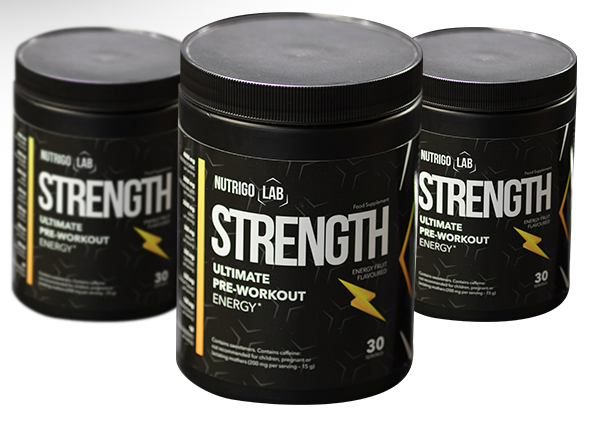
Our Recommendation — Nutrigo Lab Strength
Score: 6.1/10 · Best for: serious lifters who want caffeine's proven effect in a measured, convenient serving — and who will fix the tub's creatine calendar with rest-day monohydrate Main caution: the caffeine is the same molecule as coffee's — 200 mg is about two cups — and most of the supporting cast sits at half its studied strength or less, at $2.30 a session on a single tub against roughly $0.50–$1.00 for home-brewed coffee Fair trial: one tub at $68.99 (30 servings) is the honest test unit — the 3-tub pack drops it to about $1.53 a session — and with no guarantee published, judge it against your coffee at the same caffeine dose.
The Equivalence: 200 mg Is Two Cups
The standard reference figure for brewed coffee is ~95 mg of caffeine per 8 oz cup, with a real-world range of roughly 80–200+ mg depending on size, bean and brew strength. Run the comparison as a range, the way honest numbers demand: one 200 mg pre-workout serving equals about two standard cups, or one large, strong café coffee at the top of the range. Every consequence in this article flows from that equivalence. The caffeine in the tub is not stronger, purer or more "targeted" than the caffeine in the mug — it is the same molecule, adenosine receptors cannot tell them apart, and the ISSN's evidence range (3–6 mg/kg, ~60 minutes before exercise) applies to both identically. Any comparison that credits pre-workout with a performance effect and coffee with none — and such pages exist — is comparing a dose against its own twin and hoping you don't notice.
The Central Comparison Table
| Factor | Pre-workout (Nutrigo Lab Strength, 1 serving) | Coffee (brewed, ~2 cups) |
|---|---|---|
| Caffeine | 200 mg, printed and exact | ~190 mg at the standard 95 mg/cup; real range ~160–400 mg by brew |
| Time to effect | Peak ~30–60 min | Peak ~30–60 min — identical molecule, identical clock |
| Extra ingredients at label dose | Citrulline malate 3 g (studied 6–8 g) · beta-alanine 1 g (studied 3.2–6.4 g/day) · creatine 3,012 mg (in range, training days only) · synephrine ~6 mg, enXtra™, RedNite™ (thin files) | None — which is also the audit result: nothing underdosed, nothing hidden |
| Cost per session | $2.30 (single tub) down to $1.15 (6-tub pack), plus shipping — worked below | ~$0.50–$1.00 home-brewed for two cups (estimate); $3–5+ bought out, where coffee becomes the expensive option |
| Calories / sugar | Negligible; sweetened powder, no sugar load | Negligible black; entirely your choice with milk/sugar |
| Sleep impact | 200 mg on the ~5 h half-life clock, plus a stimulant stack | The same caffeine clock — dose for dose, no difference |
| Best for | Lifters who value the all-in-one ritual and will manage the extras honestly | Everyone whose goal is caffeine before training |
What the Blend Adds Beyond Caffeine — at Label Doses
Take the extras one at a time, at the doses printed on this label (the transparency to print them is why this formula can star in an honest comparison — our review scores it 6.1/10). Creatine, 3,012 mg: the one extra that is fully dosed per serving — but it is a daily-saturation ingredient riding in a training-day product, so coffee plus a daily 3 g monohydrate habit (you can stir it straight into the coffee; it dissolves and the evidence doesn't care about the vehicle) replicates and actually completes this benefit. Citrulline malate, 3 g: half the low end of the 6–8 g studied range, delivering ~2 g of citrulline — a contribution toward the reps-to-failure effect, not the protocol; our citrulline article does the full maths and the top-up fix. Beta-alanine, 1 g: a third of the lowest studied daily dose, delivering the tingle at threshold and carnosine-loading at a discount — the sensation is fully dosed; the benefit is not. Synephrine, enXtra™, RedNite™ beetroot: thinner evidence files at small doses — the beetroot extract carries ~4–7 mg of nitrate against ~300–500 mg studied (our beetroot article has that file). Sum the column honestly: beyond caffeine, a full serving buys you one complete ingredient with a calendar problem, two half-to-third-dose ingredients with real-but-small effects at full dose, and garnish. That is more than coffee offers. It is less than the tub's front panel implies.
What Coffee Genuinely Adds — and What It Cannot
Coffee's column is not empty beyond price. It carries its own studied cargo — chlorogenic acids and the broader antioxidant profile of a whole food — with a long observational literature behind moderate consumption that no powder can cite. It offers dose artistry: half-caf, a single shot, a stronger brew — a titration range of 50–300 mg that pre-workout serves in fixed 200 mg units (or awkward half-scoops). It has a ritual, a taste people actually love, and zero label risk: no proprietary blends, no spiked-batch lottery, no unauditable extras. And it cannot be banned-substance contaminated, a non-trivial point for tested athletes, whose risk from supplements is documented and from coffee is nil. What coffee cannot do: deliver creatine, beta-alanine or citrulline (though, as noted, you can add the first to the cup and the others as cheap standalone powders — assembling the honest version of a pre-workout around coffee is entirely possible, and for dose-purists it is arguably the correct build). Nor can coffee give you the pre-workout ritual — the scoop, the flavour, the tingle as a starting gun — which sounds like a joke until you price adherence: the best pre-training routine is the one that reliably gets a tired person to the gym, and if the tub's theatre does that for you, it has earned something real.
Cost Per Session: the Worked Maths
| Option | Price basis | Cost per session |
|---|---|---|
| Nutrigo, single tub | $68.99 / 30 servings | $2.30 (+ ~$0.40 shipping per serving on a one-tub order) |
| Nutrigo, 3-tub pack | $137.98 / 90 servings | ~$1.53 |
| Nutrigo, 6-tub pack | $206.97 / 180 servings | ~$1.15 |
| Home-brewed coffee, 2 cups | Beans, water, energy — estimate | ~$0.50–$1.00 |
| Coffee + daily creatine monohydrate | The honest-build comparison | ~$0.70–$1.30 |
| Café coffee before the gym | Retail cup × 1–2 | $3–5+ — now the tub is the bargain |
Competitors quote "10–20× the cost" for pre-workout as a vibe; the actual ratio against home-brewed coffee is roughly 2–4× for equivalent caffeine — a real premium, honestly sized — and it inverts entirely against café prices. At five sessions a week, the single-tub habit costs roughly $575 a year in product; bulk buying brings it near $300; the coffee-and-creatine build, roughly $180–340. What the premium buys, per the audit above, is convenience and partial extras — decide if that invoice matches that delivery.
The Endurance Corner: Where Coffee's Case Gets Stronger
Everything above was written from the lifting side, where the pre-workout at least has a plausible extras column. Rotate to endurance and the comparison tilts further. Caffeine's endurance evidence is the strongest part of its file — the position-stand range was built substantially on endurance trials — while the blend extras are lifting-oriented almost by definition: beta-alanine's window (30 seconds to 10 minutes of glycolytic work) touches only the surges of a long event, citrulline's reps-to-failure data has no endurance translation, and creatine's saturation model serves repeated maximal efforts, not steady-state output. Specialist endurance publishers land exactly here — coffee usually wins for runners — and on the evidence they are right. The endurance athlete's honest pre-race shopping list is caffeine (vehicle optional), carbohydrate, and — at real nitrate doses — the beetroot protocol from our linked article. A lifting pre-workout is a detour past all three.
Tested Athletes: the Contamination Asymmetry
One column of the comparison table deserves expansion because it is decisive for a specific reader. Supplement contamination and mislabelling are documented realities — analyses of products in this category have repeatedly found undeclared stimulants and banned substances, which is why third-party certification programmes exist. Coffee has no equivalent failure mode: it is a food, its contents are what agriculture made them, and no anti-doping case begins with a cappuccino. For a drug-tested athlete, then, the comparison is not coffee vs pre-workout on effect — the caffeine is identical — but coffee's zero contamination risk against a powder's small, real, career-shaped one. If the powder is chosen anyway, certified-tested batches are the minimum standard, a standard Nutrigo's maker does not advertise meeting — one more honest line in its file, and a genuine argument for the mug at this level of sport.
The Hybrid Builds: How People Actually Solve This
Real lifters rarely live at either pole; they assemble hybrids, and the three stable patterns are worth naming because each concedes what the other side got right. The purist build: coffee an hour out, creatine monohydrate stirred into it or taken any time daily, nothing else — the full proven core for the lowest price, missing only the citrulline/beta-alanine margins. The completed tub: the pre-workout as the caffeine-and-ritual base, plus a citrulline top-up to reach trial dose and rest-day creatine — the blend made whole at a higher price and more moving parts. The evening build: coffee for morning sessions, a stimulant-free pump formula for weeknight training — caffeine discipline preserved, ritual partially kept. Notice that each hybrid keeps caffeine and creatine at full dose and treats the rest as negotiable; that is the ISSN-shaped skeleton of pre-training nutrition, and any product — tub or mug — is best judged by how cheaply and honestly it fills it.
Side Effects and the Late-Day Problem
Dose for dose, the caffeine side effects are shared — jitters, stomach urgency, the crash — because the molecule is shared. The pre-workout adds its stack: synephrine and enXtra™ ride along, with the maker's own cardiovascular and hypersensitivity warnings attached (its sales page simultaneously claims "no recorded side effects"; our side-effects article reads that contradiction so you don't have to). Coffee adds its own smaller print — acidity on an empty stomach, and the dose variability that cuts both ways. For evening trainers both options hit the same wall: 200 mg of caffeine within ~8 hours of bedtime is a sleep tax in either vehicle (our timing article has the cut-off table), and the honest evening answer in both worlds is decaf, a stim-free formula, or nothing.
The Other Vehicles: Espresso, Energy Drinks, Caffeine Tablets
The comparison is really caffeine's vehicle against caffeine's vehicle, so complete the field. Espresso: roughly 60–80 mg per shot — two shots are a half-serving of the tub, four are a double — with the same brew-variability as coffee in miniature. Energy drinks: typically ~80 mg per small can, ~160–200 mg in the large gym-fridge cans, which makes the big can a pre-workout serving with worse extras (sugar or sweeteners, taurine garnish) and no creatine — the worst of both columns at a café-adjacent price. Caffeine tablets: the comparison's uncomfortable winner on pure function — exact 100–200 mg doses, pennies per serving, zero audit surface — losing only on ritual, taste and the social acceptability of pills before training. The tub sits among these as the premium ritual vehicle with a genuine extras column. Naming the tablet matters because it sets the floor of the market: caffeine itself, delivered exactly, costs almost nothing — so every dollar above that floor is buying the extras, the experience, or the brand, and this article has priced each.
The Habit Ledger: Taste, Tolerance and the Kitchen Counter
Two soft variables decide real-world outcomes more than any table. Tolerance management: coffee drinkers titrate unconsciously — a stronger pot during a hard week, decaf in the evening — while tub users inherit a fixed 200 mg unit that invites the daily-use creep our cycling article dissects; the mug's flexibility is a genuine pharmacological advantage in the long game. Adherence and place: the tub lives by the gym bag and fires a single behavioural starting gun; coffee lives in the kitchen, already entangled with mornings, work and other people's schedules. Whichever vehicle attaches the caffeine habit to the training habit more reliably is, for that person, the better ergogenic system — a conclusion no position stand can reach for you, and the legitimate residue of personal preference left after every hard number in this article has had its say.
The One Scenario Where the Tub Clearly Wins: the Disorganised Morning
Every comparison has a home fixture, and pre-workout's is the chaotic early session. The 5:30 a.m. lifter — training before work, before the household wakes, on a decision made the night before — is not running an artisanal coffee ritual; they are counting minutes in the dark. For that reader the tub's virtues concentrate: a measured 200 mg dose with no brewing, no variability, no washing up worth the name, the flavour and tingle acting as a conditioned starting gun, and the whole thing consumed in the time a kettle takes to boil. The cost-per-session table prices this convenience at roughly $1.15–$2.30 against coffee's coins, and for the disorganised-morning use case that premium is not obviously wasted money — adherence research in every corner of training says the frictionless routine is the one that survives February. The honest comparison honours this: coffee wins the pharmacology and the economics; the tub can still win the morning.
Low-Stim and Decaf Hybrids
One more option deserves a place in the verdict, because the binary hides it: the field is not exhausted by 200 mg tubs and double espressos. Half-caf coffee, a single espresso, a half serving of the tub, stimulant-free "pump" formulas paired with a small coffee — the titration space between 0 and 200 mg is densely populated once you stop treating serving sizes as laws. Evening trainers and the caffeine-sensitive live in this space permanently, and the beginner protocol in our starter guide is built on the same principle. The mature position in this whole comparison is not coffee or pre-workout; it is a chosen caffeine dose, from a vehicle you enjoy, with the extras audited or omitted on their merits.
The Segmented Verdict
You should just drink coffee if your goal is energy and focus for the session (caffeine is the proven effect, and you already own it); if you train in the evening and need precise, low dosing; if budget matters (the premium buys partial extras); if you are a tested athlete minimising contamination risk; or if you dislike sweetened powders on principle. Add a daily creatine habit to the coffee and the blend's strongest honest advantage disappears. Choose the pre-workout if the all-in-one ritual is what gets you to the gym consistently; if you value a printed, exact 200 mg dose over brew variability; if you will top up citrulline and run rest-day creatine to complete the formula's honest gaps; or if your alternative was café coffee, against which the tub is suddenly the economical option. Buy Nutrigo Lab Strength specifically if you want the version of pre-workout whose label survives this article's audit — every amount printed, the creatine content figure stated by the maker itself. Skip it if the extras at label doses are your reason for paying: at 3 g and 1 g, citrulline and beta-alanine are garnish with good references, and the studied versions are cheaper bought standalone next to a coffee.
Our Recommendation — Nutrigo Lab Strength
Score: 6.1/10 · Best for: serious lifters who want caffeine's proven effect in a measured, convenient serving — and who will fix the tub's creatine calendar with rest-day monohydrate Main caution: the caffeine is the same molecule as coffee's — 200 mg is about two cups — and most of the supporting cast sits at half its studied strength or less, at $2.30 a session on a single tub against roughly $0.50–$1.00 for home-brewed coffee Fair trial: one tub at $68.99 (30 servings) is the honest test unit — the 3-tub pack drops it to about $1.53 a session — and with no guarantee published, judge it against your coffee at the same caffeine dose.
Frequently Asked Questions
What if I don't like coffee?
Then the equivalence table works in reverse for you: tea (roughly 50 mg a cup, four cups to a serving — impractical mid-routine), caffeine tablets at exact doses for pennies, or the tub itself, honestly chosen as a flavour-and-ritual purchase rather than a pharmacological upgrade. The molecule does not require a beverage you dislike.
Which is healthier, coffee or pre-workout?
At matched caffeine doses, the health comparison favours the whole food: coffee's moderate consumption carries a long, broadly reassuring observational record and no label risk, while a pre-workout's health profile is the sum of parts you must audit one by one — including a stimulant stack and the maker's own cardiovascular warnings. Neither is "unhealthy" at sensible doses in healthy adults; only one of them asks you to do homework first.
How much coffee equals a pre-workout?
For caffeine — the main event — a 200 mg serving equals about two standard 8 oz cups (~95 mg each), or one large strong café coffee. Brew strength swings the real number widely; treat "two cups" as the centre of a range.
Is coffee a good pre-workout by itself?
Yes — it is the original one. Caffeine at 3–6 mg/kg about an hour before exercise is the best-evidenced legal ergogenic in this entire comparison, and coffee delivers it in a titratable, inexpensive form.
Can I take pre-workout and coffee on the same day?
With arithmetic, yes — total caffeine is the budget (general guidance ~400 mg/day). A 200 mg serving plus two coffees is ~390 mg: legal by that yardstick, jittery for many. Stacking them close together is the side-effect express; our daily-use article covers the pattern.
What does pre-workout have that coffee doesn't?
Creatine (fully dosed here, but daily-use by nature), citrulline and beta-alanine (real ingredients at below-study doses), and a fixed measured caffeine unit. Plus the ritual. That is the complete list, honestly priced in the table above.
Is pre-workout stronger than coffee?
Only if its caffeine dose is larger than your coffee's — a 200 mg serving vs one weak cup, yes; vs two proper cups, no. "Strength" in this category is a caffeine number wearing a flavour name.
Which is better for running?
Coffee, for most runners: the endurance evidence is caffeine's, the blend extras are lifting-oriented and underdosed anyway, and Marathon Handbook-style coaching verdicts land the same way. Lifters who love the ritual are pre-workout's best case.
Last reviewed: October 2026. This article is educational and is not medical advice.
