
- Quick Answer
- First, the Caffeine Maths for Your Body
- The Ramp: Sessions One to Six
- Reading a Label Line by Line (With a Real Panel)
- Caffeine Is Not the Only Stimulant in the Tub
- The Tingle, Scaled to Your Dose
- Your Whole Day's Caffeine, Not Just the Scoop
- Timing, Food and Sleep for First-Timers
- Troubleshooting: Six Beginner Problems
- Your First Week, on One Page
- Label Tricks Aimed at Beginners
- Who Should Not Start
- Who Should Buy This One — and Who Should Skip
- Frequently Asked Questions
- How much pre-workout should a beginner take?
- What does the tingle mean? Should I worry?
- Can I take pre-workout if I drink coffee?
- What time should I take it?
- What if I feel sick during the first session?
- How much water should I mix it in?
- Should I take it on an empty stomach?
- Do I need to cycle it from the start?
- What if I feel nothing at half a serving?
- Is pre-workout safe for teenagers?
- Read This Next
Disclosure: This article contains affiliate links. If you buy through them, we may earn a commission at no extra cost to you. It never changes our conclusions.
Quick Answer
Beginners should start pre-workout the way you would start anything dose-dependent: at half a serving, on a day that doesn't matter, with food in reach. For the formula used as this guide's worked example — Nutrigo Lab Strength, chosen because its label prints every amount — half a serving is one scoop, delivering 100 mg of caffeine, a sensible beginner ceiling for your first sessions. Read the caffeine number before anything else on any label, distrust any product that hides its amounts inside a "proprietary blend," and remember that caffeine is rarely the only stimulant in the tub. Best for: healthy adult beginners who will follow the ramp below instead of copying the full-serving habits of experienced (and tolerant) lifters.
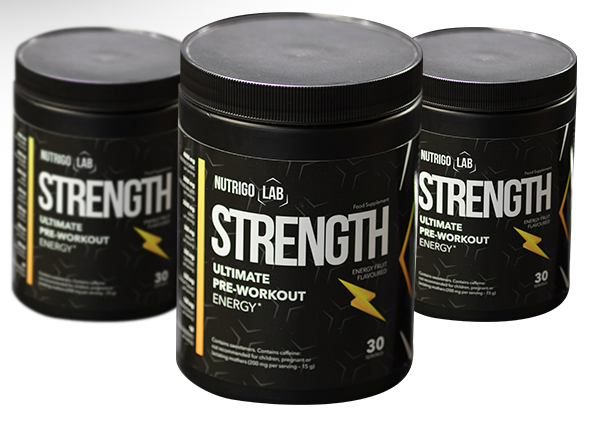
Our Recommendation — Nutrigo Lab Strength
Score: 6.1/10 · Best for: healthy adult beginners who will start at half a serving — one scoop is 100 mg of caffeine — on a label that prints every amount, instead of copying experienced lifters' full-serving habits Main caution: caffeine is rarely the only stimulant in the tub — this one stacks its 200 mg full serving with synephrine — and a full serving is a genuinely mid-range dose for a smaller, caffeine-naive lifter Fair trial: one tub at $68.99 is the purchase unit, and the maker publishes no money-back guarantee — so the half-serving ramp in this guide is also your refund policy: buy the small tub, earn the dose, then decide.
First, the Caffeine Maths for Your Body
Caffeine is dosed in the research by body weight — 3–6 mg per kilogram (ISSN position stand) — while tubs dose by the scoop. Convert once and the whole category gets clearer:
| Body weight | 3 mg/kg | 6 mg/kg | One full Nutrigo serving (200 mg) |
|---|---|---|---|
| 55 kg | 165 mg | 330 mg | ~3.6 mg/kg — mid-range |
| 70 kg | 210 mg | 420 mg | ~2.9 mg/kg — bottom edge |
| 85 kg | 255 mg | 510 mg | ~2.4 mg/kg — below range |
| 100 kg | 300 mg | 600 mg | ~2.0 mg/kg — below range |
Two anchors frame the table: regulators treat a single caffeine dose of ~200 mg and a daily total of ~400 mg (from all sources) as the general-population reference levels for healthy adults. A beginner's insight hides in the first row: a smaller, caffeine-naive lifter gets a genuinely mid-range ergogenic dose from a standard serving — and the full side-effect playlist that can come with it. Your friend's "barely felt it" serving and your "heart was hammering" serving are the same scoop at different body weights and habits.
The Ramp: Sessions One to Six
| Sessions | Dose | Caffeine | What you're testing |
|---|---|---|---|
| 1–3 | ½ serving (1 scoop) | 100 mg | Stomach tolerance, jitters, sleep that night |
| 4–6 | ¾ serving (1½ scoops) | 150 mg | Whether the effect scales or only the side effects do |
| 7+ | Full serving (2 scoops / 15 g) | 200 mg | The label dose — only if the ramp earned it |
Rules of the ramp: never debut a new dose on a max-effort or competition day; keep every other variable (food, timing, your day's coffee) constant so the dose is the only experiment; and treat "the half dose did everything I wanted" as a result, not a waypoint — plenty of beginners should live at one scoop permanently. Each step also scales the other ingredients: at half serving, beta-alanine is 0.5 g (below the ~800 mg tingle threshold for most people, so early sessions may not tingle at all — normal), creatine is ~1.5 g, citrulline malate 1.5 g. The full serving is a package deal; titrate it like one.
Reading a Label Line by Line (With a Real Panel)
Here is the skill that protects every future purchase, demonstrated on Nutrigo Lab Strength's published panel — every amount printed, which is exactly what you want to see:
| Label line | Amount | Beginner's reading |
|---|---|---|
| Caffeine | 200 mg | The dose that matters most; ~2 cups of coffee |
| Citrulline malate | 3,000 mg | A real ingredient at ~half its 6–8 g studied dose |
| Creatine compounds | 4,000 mg → 3,012 mg actual creatine | The panel itself prints the true figure — headline vs content, resolved honestly |
| Beta-alanine | 1,000 mg | Expect a mild tingle; the studied daily dose is 3.2–6.4 g |
| Bitter orange (synephrine) | 100 mg extract, ~6 mg synephrine | A second stimulant — small dose, but it means caffeine is not acting alone |
| enXtra™, taurine, tyrosine… | 300 / 750 / 750 mg | Supporting cast; thinner evidence than the names above |
| RedNite™ beetroot extract | 250 mg | ~4–7 mg of nitrate vs ~300–500 mg studied — label decoration, priced in our review |
Now imagine the proprietary-blend version: "Performance Blend — 8,450 mg" followed by the same ingredient names and no amounts at all. You could not know whether the caffeine is 100 mg or 350 mg, whether the citrulline is 6 g or 600 mg, or whether the beta-alanine exists to work or to tingle. A blend does not always mean a bad product; it always means an unauditable one, and a beginner — who cannot yet calibrate by feel — is the last person who should buy unauditable stimulants. This transparency is why Nutrigo scores 6.1/10 in our review despite genuine dose gaps: it shows its work.
Caffeine Is Not the Only Stimulant in the Tub
Beginners fixate on the caffeine line and miss the stack. Nutrigo pairs its 200 mg with synephrine (~6 mg, low-dose but present) and enXtra™, a galangal extract marketed for alertness without caffeine's profile — a much thinner evidence file. Neither is a reason to panic; together they are a reason the ramp exists and why "I drink coffee fine" doesn't fully predict your first serving. It is also why the maker's warnings matter: its label bars users with cardiovascular disease or caffeine hypersensitivity, and its directions say not to combine with other caffeine products and not to take before bedtime. One honest note that belongs in every beginner guide and appears in few: this maker publishes no money-back guarantee, so your ramp is also your refund policy — buy the small tub, earn the dose, then decide.
The Tingle, Scaled to Your Dose
At a full serving's 1 g of beta-alanine, expect mild tingling in the face, ears or hands starting 10–20 minutes in and fading within the hour; at your half-serving start (0.5 g), likely nothing at all. It is a harmless nerve effect, not the product "working" and not an allergy — our beta-alanine article gives the full mechanism and the studied-dose reality (your 1 g is a third of the lowest trial dose, so treat the ingredient as ambience, not engine).
Your Whole Day's Caffeine, Not Just the Scoop
Approximate caffeine: brewed coffee ~95 mg per cup, tea ~50 mg, cola ~35 mg per can, energy drinks ~80 mg per small can. The beginner's classic first-session disaster is the full scoop poured on top of a two-coffee morning: 200 + 190 = ~390 mg before lunch, at the ceiling of the ~400 mg/day general guidance, in a nervous system with no tolerance. On ramp days, cut the morning coffee — let the experiment have one variable.
Timing, Food and Sleep for First-Timers
Take the dose ~30 minutes before training (the maker's direction is ~15 minutes; the caffeine peak the studies use is 30–60). A little food beforehand trades a slightly slower onset for a much calmer stomach. And guard the exit: caffeine's ~5-hour half-life means a 5 p.m. full serving still has ~100 mg aboard at 10 p.m. — beginners should train before mid-afternoon during the ramp and learn their personal cut-off honestly (our timing article has the bedtime table). A first week of ruined sleep is the most common reason beginners quit a product that was otherwise fine.
Troubleshooting: Six Beginner Problems
| Problem | Likely cause | Fix |
|---|---|---|
| Jitters and shaky hands | Dose above your current tolerance | Back to the previous ramp step; eat something |
| Nausea | Fasted dosing, concentrated drink | Small snack first; more water in the mix |
| No tingle at all | Half serving = 0.5 g beta-alanine, under threshold | Nothing — the tingle is optional; see the beta-alanine article |
| Wide awake at midnight | Session too close to bedtime | Earlier session, half dose, or stim-free on weeknights |
| "It did nothing" | High body weight, existing coffee tolerance, or expectations set by marketing | Complete the ramp before judging; check the mg/kg table |
| Headache on rest days | Caffeine withdrawal rhythm | Keep a modest coffee on rest days; don't let the scoop be your only caffeine source pattern |
Your First Week, on One Page
Day 1 (a low-stakes session): skip the morning coffee, eat normally, half serving 30 minutes out, train moderately, note how you feel at 1 hour, 3 hours, and bedtime. Sessions 2–3: repeat the half dose exactly; consistency is what makes the data readable. Sessions 4–6: step to ¾ only if every note from week one is boring. End of week two: decide your working dose — which may be the half dose forever — and write it on the tub. Beginners who run this protocol learn their stimulant response more reliably in six sessions than influencers learn in a year of full-send scoops, and they arrive at the full serving, if they ever need it, as a decision rather than an accident.
Label Tricks Aimed at Beginners
Beginners are the category's favourite customers precisely because they cannot yet audit, so close with the four tricks aimed at them. The fairy-dusted famous ingredient: a studied name (citrulline, beta-alanine) at a tenth of its dose — visible in the walkthrough above at half and third strength even on an honest label, and invisible inside blends. The stimulant pile-up: five stimulant-family ingredients at small doses, summed by the marketing as "extreme energy matrix," summed by your cardiovascular system less poetically. The borrowed study: "clinically dosed" claims citing trials of a different dose, form or population — the citrulline literature's 8 g borrowed by 3 g labels is the genre's type specimen. The cartoon tub: skulls, warning stripes and "not for the faint-hearted" copy are dosage information of a kind — they announce that side effects are the brand. A beginner's defence is the whole method of this article: find the caffeine number, convert your body weight, ramp from half, and let any product that resists those three steps disqualify itself.
Who Should Not Start
Under-18s (paediatric guidance is against stimulant sports products for adolescents); anyone pregnant or breastfeeding (a full serving alone meets the ~200 mg/day pregnancy guidance from all sources); anyone with cardiovascular disease, arrhythmia, uncontrolled blood pressure or caffeine hypersensitivity — the maker's own exclusions; anyone with an anxiety disorder that stimulants reliably worsen; and anyone on medication they haven't checked for caffeine interactions. If that list is not you, the remaining fallback if pre-workout simply doesn't suit: stimulant-free "pump" formulas exist, and coffee plus a creatine habit covers most of the honest benefit anyway.
Who Should Buy This One — and Who Should Skip
Buy it if you are a healthy adult beginner who wants to learn pre-workout on a label you can actually read — every amount printed, a mid-category 200 mg caffeine dose to ramp into, and a real (if discounted) supporting cast. Skip it if you want a gentle first step and nothing else matters (a stim-free formula or plain coffee is gentler), if the who-should-not list describes you, or if you intended to full-send two scoops on day one — in which case skip the category until the plan changes.
Our Recommendation — Nutrigo Lab Strength
Score: 6.1/10 · Best for: healthy adult beginners who will start at half a serving — one scoop is 100 mg of caffeine — on a label that prints every amount, instead of copying experienced lifters' full-serving habits Main caution: caffeine is rarely the only stimulant in the tub — this one stacks its 200 mg full serving with synephrine — and a full serving is a genuinely mid-range dose for a smaller, caffeine-naive lifter Fair trial: one tub at $68.99 is the purchase unit, and the maker publishes no money-back guarantee — so the half-serving ramp in this guide is also your refund policy: buy the small tub, earn the dose, then decide.
Frequently Asked Questions
How much pre-workout should a beginner take?
Half a serving for at least your first three sessions. On this formula that is one scoop — 100 mg of caffeine. Increase only when you know exactly what the current dose does to your training and your sleep.
What does the tingle mean? Should I worry?
It is beta-alanine activating skin nerves; harmless, temporary (under ~90 minutes), and unrelated to whether the product is working. Hives, swelling or breathing difficulty would be an allergy — different event, stop and seek care.
Can I take pre-workout if I drink coffee?
Yes, with arithmetic: your day's total caffeine is what matters. On training days, most beginners do best dropping the pre-workout-time coffee and keeping the scoop as the main dose.
What time should I take it?
About 30 minutes before training, and not within roughly 8 hours of bedtime at a full serving. Evening trainers: half servings or stim-free products.
What if I feel sick during the first session?
Slow down or stop, hydrate, and let it pass — the usual cause is a fasted, full-strength debut. Your next session goes back a ramp step, with food. Chest pain, a racing or irregular heartbeat, or breathing trouble are not "first-session nerves": stop and seek care, per the triage in our side-effects article.
How much water should I mix it in?
What the maker directs — for this formula, 200 ml, which makes a concentrated but drinkable serving. More water is fine and gentler on the stomach; dramatically less recreates the bolus problem this article warns about in liquid form.
Should I take it on an empty stomach?
You can, but beginners usually shouldn't — nausea and jitters are more likely fasted. A small snack first is the calmer debut.
Do I need to cycle it from the start?
Not formally — but build the habit early: training days only, lowest effective dose. Caffeine tolerance builds over ~2–3 weeks of daily use; our cycling article explains the reset when you need it.
What if I feel nothing at half a serving?
That is data, not failure: you may clear caffeine fast, weigh more than the dose assumes, or already carry tolerance from coffee. Move up the ramp one step; do not leap to double scoops.
Is pre-workout safe for teenagers?
No — paediatric guidance advises against stimulant-containing sports supplements for under-18s. Food, hydration and sleep are the teen protocol, full stop.
Last reviewed: October 2026. This article is educational and is not medical advice.
