
- Quick Answer
- What the Tingle Actually Is: the MrgprD Mechanism
- The Timeline: Threshold, Onset, Fade
- What Beta-Alanine Actually Does (When the Tingle Is Long Gone)
- Loader, Not Stimulant: the Part the Category Buries
- The Dose Audit: 1 Gram Against the Evidence
- The Myth: "If It Tingles, It's Working"
- Paresthesia vs Allergy vs Niacin Flush: Telling Them Apart
- How to Reduce the Tingle (If You Don't Enjoy It)
- Carnosine, Explained Slowly: pH, Buffers and the Burn
- Who Actually Benefits: Sport by Sport
- Split Doses and Sustained Release: the Evidence in Detail
- Name Confusions Worth Clearing
- How the Trials Were Run — and Why Your Mileage Varies
- Beta-Alanine in Food: the Baseline You Start From
- The Other Buffer: Sodium Bicarbonate, and the Stacking Question
- Powder, Capsules and the Dose in Practice
- Who Should Be Cautious
- The Washout: What Happens When You Stop
- The Sensation Inventory: What People Actually Report
- The Verdict for This Formula
- Frequently Asked Questions
- Why do some people's faces tingle and others feel nothing on the same product?
- Does the tingle mean my dose was too high?
- Is the pre-workout tingle dangerous?
- Does tingling mean the pre-workout is working?
- How can I make the tingling stop or lessen?
- How much beta-alanine do I actually need?
- Does the tingle go away with regular use?
- Can beta-alanine help a one-rep max?
- Is it safe to take beta-alanine every day?
- Read This Next
Disclosure: This article contains affiliate links. If you buy through them, we may earn a commission at no extra cost to you. It never changes our conclusions.
Quick Answer
The tingle is paresthesia from beta-alanine — a harmless, temporary firing of sensory nerves in the skin, triggered through a receptor called MrgprD. It is not an allergic reaction, not a sign of skin or nerve damage, and — this is the part the marketing skips — not a sign the product is working. The tingle starts at single doses around 800 mg–1 g, arrives within 10–20 minutes and fades inside 60–90 minutes. Beta-alanine's actual benefit has nothing to do with the sensation: it slowly raises muscle carnosine over weeks of daily dosing at 3.2–6.4 g/day, buffering acid in hard efforts lasting about 30 seconds to 10 minutes. That is the set's dose problem in one line — Nutrigo Lab Strength, whose fully printed panel makes this audit possible, contains 1 g per serving: enough to tingle, roughly a third of the lowest studied daily dose. Best for: lifters in high-rep, glycolytic training who will dose beta-alanine properly every day — the tingle itself is for nobody; it is a side effect with good PR.
One sentence of orientation before the detail: everything in this article hangs on a distinction between the peak of a single dose, which governs the tingle, and the total of daily doses across weeks, which governs the benefit. Keep those two curves separate in your mind and the folklore, the marketing and most of the confusion in this category fall away at once.
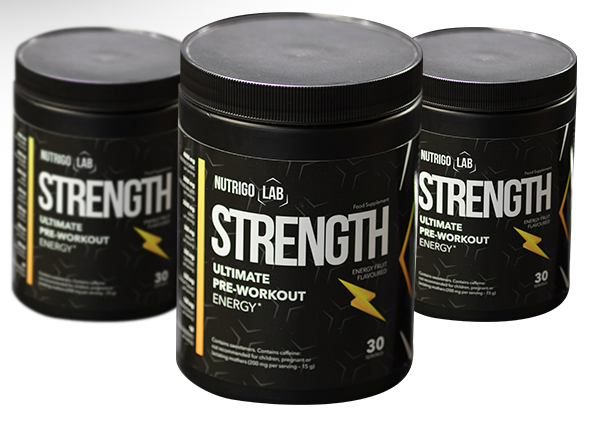
Our Recommendation — Nutrigo Lab Strength
Score: 6.1/10 · Best for: lifters in high-rep, glycolytic training who will dose beta-alanine properly every day — and who want a printed panel that lets them see the tingle maths for themselves Main caution: the tingle is a side effect, not a sign anything is working — and this tub's 1 g of beta-alanine is enough to tingle at roughly a third of the lowest studied daily dose (3.2–6.4 g a day) Fair trial: one tub at $68.99 (about 30 servings) covers a month of training days — judge it on the weeks-long carnosine question, not the day-one tingle — with no guarantee published, that month is bought outright.
What the Tingle Actually Is: the MrgprD Mechanism
Beta-alanine is an amino acid, and in the skin it activates a receptor on sensory nerve endings called MrgprD (mas-related G-protein-coupled receptor D), identified in work by Liu et al. (2012) as the pathway behind the sensation. These nerve endings exist to report on the skin's surface — touch, itch, irritation — and beta-alanine, arriving in the bloodstream after a dose, switches them on chemically. The result is the familiar pattern: pins and needles, prickling, flushing warmth, most often in the face, ears, neck, scalp, hands and forearms, the regions where these receptors are densest. Three properties of the mechanism explain everything users report. First, it is dose-dependent: more beta-alanine in one hit, more nerve firing — which is why a full serving tingles and a half serving often doesn't. Second, it is histamine-independent: unlike an allergic itch, it involves no immune response, produces no wheal, rash or swelling, and antihistamines are not the relevant tool — it is a nerve signal, not inflammation. Third, it is self-limiting: as blood levels fall, the firing stops. In the entire beta-alanine trial literature — Dolan et al. (2019) reviewed 101 human studies — paresthesia is the only consistent side effect, with no pattern of harm attached to it. Uncomfortable for some, funny for others, medically boring throughout.
The Timeline: Threshold, Onset, Fade
| Stage | What happens | Typical timing / dose |
|---|---|---|
| Trigger dose | Single (non-sustained-release) dose that sets off paresthesia in most people | ~800 mg–1 g or more at once |
| Onset | First prickling, usually face/ears/hands | 10–20 minutes after the dose |
| Peak | Strongest tingling and flushing | ~20–40 minutes |
| Fade | Sensation dies away completely | 60–90 minutes total |
| Below-threshold dose | Little or no sensation | Single doses under ~800 mg, or split doses ≤1.6 g spaced out |
Note where a typical pre-workout serving sits on this table. A formula with 1 g of beta-alanine — Nutrigo's dose — lands just above the tingle threshold: expect a definite but short-lived prickle, stronger on an empty stomach (faster absorption, higher peak), weaker with food. Formulas running 3.2 g in a single serving are dosing for maximum sensation, which their marketing then rebrands as potency. The threshold also explains the most common beginner experience: a half serving (0.5 g here) usually produces no tingle at all, which tells you something important — the sensation tracks the peak blood level of one ingredient, not the product "kicking in."
What Beta-Alanine Actually Does (When the Tingle Is Long Gone)
Beta-alanine's real job starts after the sensation ends. It is the rate-limiting building block of carnosine, a dipeptide stored in muscle that buffers hydrogen ions — the acid that accumulates during hard, burning efforts and progressively shuts contraction down. Raise muscle carnosine and you raise the buffer, which is why the benefit concentrates in a specific window: the ISSN position stand on beta-alanine (Trexler et al. 2015) and the Hobson et al. (2012) meta-analysis converge on efforts lasting about 30 seconds to 10 minutes — Hobson found a median improvement around 2.85% in that window — with Saunders et al. (2017) putting the standardised effect at roughly 0.18–0.19, a small effect by any measure. Translation for the gym: high-rep sets, hard intervals, combat-sport rounds, rowing and middle-distance work — the burn-and-hold-on efforts. A one-rep max barely taxes the buffer and shows no benefit; a marathon is too long and too aerobic for it to matter. Beta-alanine is a narrow tool, honestly graded: real, replicated and small, inside its window; absent outside it.
Loader, Not Stimulant: the Part the Category Buries
Here is the structural fact that reorganises how you should buy beta-alanine: it is a loading ingredient, like creatine — not an acute one, like caffeine. Muscle carnosine does not rise meaningfully after one dose. The position stand's protocol is 4–6 g/day (the wider trial range is 3.2–6.4 g/day) taken every day for at least 2–4 weeks; Harris-lineage data put the carnosine rise at roughly +42% after four weeks at 3.2 g/day and +64% at 6.4 g/day. Timing within the day is irrelevant — carnosine stores don't care about your workout window — and once loaded, stores wash out slowly over 2–3 months after you stop. Two consequences follow for pre-workout users. First, the acute ritual (take powder, feel tingle, train) is theatre layered over a chronic process; the dose that matters is your daily total across weeks, rest days included. Second, a pre-workout alone is a poor delivery vehicle: it is taken only on training days, and at 1 g a serving it cannot reach the studied daily totals anyway. Anyone who actually wants beta-alanine's benefit should treat it like creatine — a cheap standalone powder dosed daily — and regard the pre-workout's gram as a small contribution, not the protocol.
The Dose Audit: 1 Gram Against the Evidence
| Reference point | Beta-alanine dose | Context |
|---|---|---|
| ISSN position stand (Trexler 2015) | 4–6 g/day | Daily, ≥2–4 weeks, to significantly raise muscle carnosine |
| Wider trial range | 3.2–6.4 g/day | Produced the +2.85% median effect in the 30 s–10 min window (Hobson 2012) |
| Paresthesia threshold | ~800 mg–1 g single dose | The tingle switches on well below any effective daily total |
| Nutrigo Lab Strength | 1 g/serving, training days only | ~⅓ of the lowest studied daily dose, taken intermittently |
Our review of Nutrigo Lab Strength scores it 6.1/10 and this row is one of the reasons: the formula's beta-alanine is dosed for sensation rather than saturation. To the maker's credit — and this is the pattern across its panel — the amount is printed, so you can do this sum yourself; most rival labels bury beta-alanine inside a proprietary blend precisely so you can't. But a printed shortfall is still a shortfall: if carnosine loading is your goal, this tub contributes flavour and a tingle, and the serious dosing has to happen elsewhere, daily, at three to six times the amount.
The Myth: "If It Tingles, It's Working"
This is the category's most successful piece of folklore, and it inverts the truth twice over. First inversion: the tingle is a side effect of one ingredient hitting sensory nerves in your skin; the ingredient's benefit is a slow chemical change in your muscle that you cannot feel at all. The sensation and the effect share a molecule and nothing else — like judging a savings account by the noise the ATM makes. Second inversion: because the threshold (~800 mg–1 g) sits far below the effective daily dose (3.2–6.4 g), a strong tingle can certify a badly dosed product (all sensation, no saturation), while a properly loaded athlete taking split doses or a sustained-release form may feel no tingle at all — Décombaz et al. (2012) showed a 1.6 g sustained-release dose cut peak blood levels from 248 to 82 µmol/L and made tingling indistinguishable from placebo, with the same total delivered. Brands dose for the tingle because it is the only "effect" a first-time buyer can perceive in the shop-to-gym window. Perceiving it proves the powder contained beta-alanine. It proves nothing else.
Paresthesia vs Allergy vs Niacin Flush: Telling Them Apart
| Feature | Beta-alanine paresthesia | Allergic reaction | Niacin flush |
|---|---|---|---|
| Cause | MrgprD sensory-nerve activation | Immune response to an ingredient | High-dose niacin (vitamin B3) dilating skin blood vessels |
| Sensation | Pins and needles, prickling | Itching with hives/rash, swelling | Hot, red, burning flush, mainly face/neck |
| Visible signs | None — no rash, no swelling | Hives, swelling of lips/tongue possible | Obvious redness |
| Breathing | Unaffected | Can be affected — emergency | Unaffected |
| Course | Fades in 60–90 min | Escalates without treatment | Fades in ~30–60 min |
| Action | None needed | Stop; urgent care if breathing/swelling involved | None needed; lower the dose |
The practical rule: tingling with no visible skin change and no breathing involvement is beta-alanine being beta-alanine. The moment there is swelling, hives or any airway symptom, you are in a different event entirely — stop and treat it as the emergency it is, as our side-effects triage sets out. (For the record, Nutrigo's niacin dose is 16 mg — far below flushing territory; its tingle is the beta-alanine row of this table.)
How to Reduce the Tingle (If You Don't Enjoy It)
Split the dose. Paresthesia tracks peak blood level, so dividing the day's beta-alanine into doses of ≤1.6 g, spaced a few hours apart, keeps the total while muting the sensation — the strategy the trial literature itself uses. Choose sustained-release forms where available; the Décombaz data above is the proof of concept. Take it with food — a meal slows absorption and lowers the peak. Halve the pre-workout serving: with a 1 g formula, one scoop instead of two puts you at 0.5 g, under the threshold for most people, at the cost of halving everything else too — which is itself an admission of how the product is built. Or simply wait: the sensation fades within 60–90 minutes regardless, and many users habituate to a familiar dose over the first week or two. What not to do: chase a stronger tingle with extra scoops — you would be scaling a side effect while the ingredient that matters (caffeine) scales into genuinely unpleasant territory alongside it.
Carnosine, Explained Slowly: pH, Buffers and the Burn
It is worth slowing down on the mechanism, because beta-alanine is one of the few supplement ingredients whose story is complete from molecule to muscle. When you work hard enough that energy demand outruns oxygen delivery — the final reps of a set, the last 200 metres of a row — your muscles lean on glycolysis, which produces hydrogen ions as a by-product. Those ions lower the pH inside the muscle fibre, and falling pH interferes with the machinery of contraction itself: calcium handling blunts, enzymes slow, force leaks away. That chemical squeeze is a major part of what "the burn" actually is. Carnosine — built from beta-alanine and histidine, and stored in muscle at high concentration precisely in the fast-twitch fibres that do this work — is a buffer: it soaks up hydrogen ions and slows the pH fall. More carnosine, slower acidification, a few more reps before the squeeze wins. Every element of the evidence pattern follows from this paragraph. The benefit window (30 seconds to 10 minutes) is the window where acid accumulation is the limiter — too short and phosphocreatine rules, too long and oxygen delivery rules. The loading requirement exists because carnosine stores turn over slowly. And the ceiling on the effect (~2–3%) is honest chemistry: a buffer buys time, it does not repeal fatigue.
Who Actually Benefits: Sport by Sport
| Effort type | Duration | Beta-alanine fit |
|---|---|---|
| High-rep lifting sets, drop sets, circuits | 30 s – 3 min per set | Core territory — the buffering window, set after set |
| Combat-sport rounds, CrossFit-style workouts | 2–10 min bouts | Strong fit — repeated glycolytic efforts |
| Rowing, swimming, cycling time trials (short) | 1–10 min | Supported — much of the trial literature lives here |
| Sprint finishes in longer events | ~1 min at the end | Plausible — the loaded buffer is present when the kick comes |
| Maximal strength (1–3 reps) | Under 10 s | No established benefit — acid is not the limiter |
| Marathon / long steady endurance | Hours | No meaningful benefit — oxygen delivery is the limiter |
This table is also a buying filter. A powerlifter whose training is triples and singles is shopping in the wrong aisle entirely; a hypertrophy trainer living in the 8–20 rep range, or a CrossFit athlete, is standing in the exact aisle the trials were run in — and for them the gap between a 1 g label dose and a 3.2–6.4 g protocol is worth real money to close with a standalone.
Split Doses and Sustained Release: the Evidence in Detail
The standard advice — split your daily beta-alanine into smaller doses — rests on the pharmacokinetics the tingle taught us: paresthesia tracks the peak blood level, while carnosine loading tracks the daily total. Anything that flattens the peak and preserves the total is a free win, and two methods are evidenced. Splitting: single doses of ~1.6 g or less sit at or under most people's tingle threshold, so 4–6 g/day becomes three or four small doses — the pattern many trials used, with meals, across the day. Sustained-release: Décombaz et al. (2012) compared formulations directly and found a 1.6 g sustained-release dose cut peak blood concentration from 248 to 82 µmol/L, with tingling indistinguishable from placebo — the total delivered, the signal gone. Both methods refute the same marketing syllogism once more: the best-documented ways to take beta-alanine for its benefit are specifically the ways that eliminate its famous sensation.
Name Confusions Worth Clearing
Three near-namesakes cause real shopping errors. Betaine (trimethylglycine) is a different compound entirely — an osmolyte from beetroot with its own, separate file — and shares nothing with beta-alanine but four letters. L-alanine is a standard protein amino acid; the "beta" in beta-alanine denotes a different chemical structure and is the entire reason the molecule feeds carnosine synthesis instead of being built into protein. And niacin is not an alternative name for the tingle: its flush is vascular (blood vessels dilating, skin visibly red), beta-alanine's is neural (nerves firing, skin visibly normal) — the differentiation table above exists because the two are confused constantly, including on product-review sites that should know better. Reading the exact ingredient name on the panel, rather than the front-of-tub shorthand, is the beginner skill our label-reading article teaches; beta-alanine rewards it more than most.
How the Trials Were Run — and Why Your Mileage Varies
A last depth point, because it explains most conflicting anecdotes. The trials behind the position stand were run in laboratories, on daily-dosed subjects, with carnosine verified by muscle biopsy or spectroscopy in the foundational work — and the effect they found is an average across people whose baseline carnosine varied considerably. Vegetarians start with lower muscle carnosine (no dietary meat source) and may have more headroom; heavy meat eaters start fuller. Training status matters too, as it does across this category. So two lifters can run the same honest protocol and land at "clearly helps my finishers" and "did nothing I could detect" — both telling the truth about a ~2–3% average effect with individual spread around it. The correct personal instrument is the boring one: a fixed high-rep test set, logged before loading and after four weeks of proper daily dosing, as our self-test approach in the pre-workout overview describes. Anything shorter, or dosed at 1 g on training days, is not a trial of beta-alanine; it is a trial of a tingle.
Beta-Alanine in Food: the Baseline You Start From
Your muscles did not meet carnosine in a supplement shop. Dietary beta-alanine arrives from meat and poultry — largely as the dipeptides carnosine and anserine in the food itself, broken down on digestion — and a meat-eater's ordinary diet supplies it in modest daily amounts, alongside histidine, the synthesis partner that is rarely limiting. This is why vegetarian athletes run lower baseline muscle carnosine and why the loading literature treats them as the highest-headroom group: their stores start emptier, so the same 3.2–6.4 g/day protocol fills a bigger gap. It is also why the "you already eat it" reassurance and the "you need to supplement it" pitch are both half-true: food maintains a baseline built for ordinary life, and the trial protocols raise stores 40–80% above it — a level no plausible amount of chicken reaches, because the doses involved (several grams of the isolated amino acid, daily) exceed what meals deliver. Diet sets the floor; only deliberate dosing sets the trial-level ceiling.
The Other Buffer: Sodium Bicarbonate, and the Stacking Question
Beta-alanine is not the only legal buffer in sport, and the comparison sharpens it. Sodium bicarbonate buffers from the blood side rather than the muscle side, works acutely (a single pre-event dose, unlike beta-alanine's weeks), and carries a gastrointestinal side-effect profile notorious enough that its literature reads partly as a dosing-survival guide. The two are sometimes stacked by serious middle-distance athletes on the theory that buffering both compartments adds up; the combined evidence is suggestive rather than settled, and the GI cost is additive too. For the reader of this article the comparison's value is diagnostic: bicarbonate proves the buffering concept from an independent direction — acid management genuinely is a performance variable in the 30-second-to-10-minute window — while underlining beta-alanine's one decisive advantage, which is that its loading happens quietly at breakfast for a month instead of violently ninety minutes before a start line.
Powder, Capsules and the Dose in Practice
A final practical audit, because beta-alanine's effective dose is physically large. At 3.2–6.4 g/day, powder is the only sane vehicle — it is cheap, nearly tasteless in a drink, and doses by the scoop. Capsule products force arithmetic nobody does: five to ten large capsules a day to reach the protocol, which is why capsule-based beta-alanine supplements so often serve a gram and let the tingle testify for the rest. Pre-workouts sit in between — the dose is visible but the vehicle only visits on training days. So the practitioner hierarchy is simple: if you want beta-alanine's evidence, buy the plain powder and dose it daily with food, in split amounts; if you enjoy it as part of a pre-workout ritual, enjoy it as that. Purchasing it in any vehicle that cannot plausibly deliver 3.2 g a day is purchasing the sensation alone, and the sensation, as this article has taken some length to establish, is the one part of beta-alanine that does nothing for performance at all.
Who Should Be Cautious
Beta-alanine's safety file is clean at studied doses in healthy adults, with paresthesia the only consistent side effect across 101 reviewed studies. The cautions are the category's standard ones rather than beta-alanine-specific alarm: pregnancy and breastfeeding (no adequate data — the standard exclusion), under-18s (pre-workouts as a class are not for adolescents), and anyone whose "tingling" comes with the allergy-column symptoms above. People with existing nerve conditions who find new paresthesia sensations distressing should treat the experience, not the molecule, as the problem — a stim-free, beta-alanine-free formula removes the issue entirely. And if tingling ever persists for hours after a dose, appears without a dose, or comes with weakness, that is no longer a supplement side effect; it is a symptom to have examined.
The Washout: What Happens When You Stop
The loading story has a mirror image that completes the picture and calms a common fear. Carnosine stores, once raised, do not crash when supplementation ends — they decline gradually, with washout measured over roughly 2–3 months back toward baseline. There is no withdrawal syndrome, no rebound below baseline, and no dependency mechanism: beta-alanine is a dietary amino acid, and the stores are a buffer, not a drug reservoir. Practically, this means an athlete who loads for a training block carries the benefit through a competition taper even if the powder runs out, and a user who quits loses the effect on the same slow schedule they built it. Contrast that with caffeine, whose effects evaporate within a day and bill you a headache for the transition — the two ingredients sharing your scoop run on opposite clocks in both directions, which is precisely why the loader/acute distinction organises this entire set of articles.
The Sensation Inventory: What People Actually Report
Because "tingle" undersells the variety, a field inventory helps new users calibrate. The classic presentation is facial: a prickling flush across the cheeks, ears and scalp, often described as sunburn-adjacent or as the feeling before a sneeze that never arrives. Hands and forearms are the second territory — a pins-and-needles that can briefly mimic the sensation of a limb waking up — and a minority report it in the legs, back or across the whole skin surface at high single doses. Accompanying reports include warmth, mild itching without anything to scratch, and a restlessness that is probably the caffeine sharing the timestamp. Intensity scales with dose, speed of intake and stomach emptiness; duration with dose alone. What is not in the honest inventory: pain, rash, swelling, hives, breathing changes or anything lasting beyond about ninety minutes. The moment a report leaves the inventory, it has left beta-alanine too — back to the differentiation table, and to medical advice if the allergy column matches.
The Verdict for This Formula
Buy Nutrigo Lab Strength if you like the pre-training ritual, want a fully printed label, and treat its beta-alanine honestly — as a mild tingle and a partial contribution you will top up separately if carnosine loading is a real goal. Skip it if the tingle is the thing you are paying for (buy caffeine and save the premium), if the sensation genuinely bothers you (choose a beta-alanine-free or stim-free product), or if you expect 1 g on training days to reproduce trials that used 3.2–6.4 g every day — it cannot, and no honest label should let you believe otherwise. The formula's transparency is its virtue: it shows you the 1 g and lets you decide. Decide with the trial doses in view.
Our Recommendation — Nutrigo Lab Strength
Score: 6.1/10 · Best for: lifters in high-rep, glycolytic training who will dose beta-alanine properly every day — and who want a printed panel that lets them see the tingle maths for themselves Main caution: the tingle is a side effect, not a sign anything is working — and this tub's 1 g of beta-alanine is enough to tingle at roughly a third of the lowest studied daily dose (3.2–6.4 g a day) Fair trial: one tub at $68.99 (about 30 servings) covers a month of training days — judge it on the weeks-long carnosine question, not the day-one tingle — with no guarantee published, that month is bought outright.
Frequently Asked Questions
Why do some people's faces tingle and others feel nothing on the same product?
Three variables stack: the dose per kilogram of body weight, stomach contents (a fed dose peaks lower), and individual nerve sensitivity, which varies like every other sensory trait. A 100 kg lifter taking 1 g after lunch and a 55 kg lifter taking it fasted are not having the same exposure, and their reports shouldn't be averaged into a product review.
Does the tingle mean my dose was too high?
Too high for comfort, perhaps; not too high for the ingredient's actual protocol — remember the effective daily dose is three to six times the amount that triggers the sensation. The tingle marks the peak of a single dose, so splitting the same total across the day keeps the loading and drops the fireworks. If the sensation arrives with any allergy-column symptoms, though, "dose" stops being the explanation that matters.
Is the pre-workout tingle dangerous?
No. It is beta-alanine activating skin sensory nerves (MrgprD), a histamine-independent effect with no tissue damage, and across 101 human studies paresthesia is the only consistent side effect of the ingredient. It fades within 60–90 minutes, every time, and requires no treatment beyond patience.
Does tingling mean the pre-workout is working?
No. The tingle certifies that a dose of beta-alanine around 800 mg–1 g or more reached your skin nerves. Beta-alanine's benefit — raised muscle carnosine — is silent, slow and built over weeks of daily dosing. Sustained-release users feel no tingle and get the full effect.
How can I make the tingling stop or lessen?
Split doses to ≤1.6 g at a time, take it with food, use a sustained-release form, or halve the serving. All four lower the peak blood level that triggers the nerves, without changing the daily total that actually matters.
How much beta-alanine do I actually need?
For the studied benefit: 3.2–6.4 g per day, every day, for at least 2–4 weeks (ISSN range 4–6 g/day). A 1 g pre-workout serving on training days contributes roughly a third of the lowest effective daily dose, intermittently — a top-up, not a protocol.
Does the tingle go away with regular use?
Often, partly — many users report the sensation softening at a familiar dose, and split or fed dosing reduces it further. The carnosine benefit, meanwhile, persists for months; stores wash out over roughly 2–3 months after stopping.
Can beta-alanine help a one-rep max?
The evidence says no — its window is efforts of roughly 30 seconds to 10 minutes, where acid buffering is the limiter. Maximal single efforts and long steady endurance sit outside the window where trials find the ~2.85% median benefit.
Is it safe to take beta-alanine every day?
Daily dosing is the studied pattern, not a risk — the trials that built its evidence base dosed daily for weeks. The daily question that deserves scrutiny is your pre-workout's caffeine, which is a tolerance and sleep issue, covered in our daily-use article.
Last reviewed: October 2026. This article is educational and is not medical advice.
