
- Quick Answer
- Compounds vs Content: the 4,000 mg Headline, Converted
- How Creatine Works: Saturation, Not Timing
- The Loading Myth: Faster, Not Further
- The Rest-Day Maths, Worked in Numbers
- The Fix: Top Up Like You Mean It
- Does Caffeine Blunt Creatine? The Evidence, Tiered
- Forms Compared: Why the Top-Up Is Monohydrate
- The Responder Question: Who Starts With Room to Gain
- Myths the ISSN Stand Already Answered
- Pre-Workout vs Post-Workout: the Timing Myth
- If You Fix the Calendar Today: the Saturation Timeline
- Why "Just Take More of the Pre-Workout" Fails as a Fix
- A Label-Reading Checklist for Creatine in Blends
- Who Should Buy — and Who Should Skip
- Frequently Asked Questions
- Is 3 g of creatine a day enough?
- Will creatine make me gain weight?
- Does creatine in a pre-workout count on the days I skip the gym?
- How much does the rest-day top-up cost?
- Do I need to load creatine?
- Should I take creatine on rest days?
- Can I mix extra creatine into my pre-workout?
- Does the caffeine in pre-workout cancel the creatine?
- When is the best time to take creatine?
- Read This Next
Disclosure: This article contains affiliate links. If you buy through them, we may earn a commission at no extra cost to you. It never changes our conclusions.
Quick Answer
Unusually for this category, the dose itself is not the problem — the calendar is. Nutrigo Lab Strength delivers 3,012 mg of actual creatine per serving, which sits inside the ISSN's 3–5 g/day maintenance band. But creatine works by keeping muscle stores saturated every day, and a pre-workout is taken only on training days — at four sessions a week, the average drops to ~1.7 g/day, well under maintenance. So: enough creatine on the days you take it; not enough across the week unless you top up on rest days with plain monohydrate. The second catch is the label: the "4,000 mg of creatine" headline counts compounds, and this article shows the maths that converts it. Best for: lifters who train most days or who will run a 3 g rest-day top-up — a five-second daily habit that closes the only real gap.
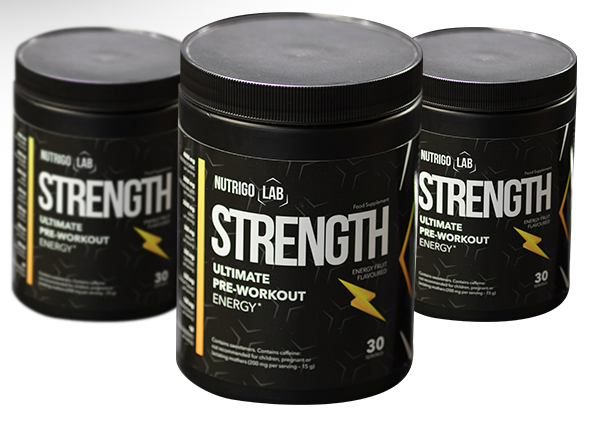
Our Recommendation — Nutrigo Lab Strength
Score: 6.1/10 · Best for: lifters who train most days, or who will run the five-second rest-day top-up — the label's 3,012 mg of actual creatine sits inside the 3–5 g maintenance band on the days you take it Main caution: the calendar is the gap — at four sessions a week the weekly average drops to about 1.7 g a day, well under maintenance — and the “4,000 mg creatine” headline counts compounds, not creatine Fair trial: one tub at $68.99 (about 30 servings) plus cheap plain monohydrate on rest days is the full fair trial — judge saturation over roughly four weeks of daily dosing, with no money-back guarantee published.
Compounds vs Content: the 4,000 mg Headline, Converted
Creatine is sold in chemical partnerships — monohydrate, hydrochloride, malate — and the partner has weight. A label can truthfully print the weight of the compounds while the creatine itself is a fraction of that figure. Nutrigo's panel is the cleanest worked example in the category because the maker prints both numbers: per serving, 3,000 mg of tri-creatine malate plus 1,000 mg of creatine hydrochloride = 4,000 mg of creatine compounds, delivering 3,012.12 mg of actual creatine — about 75% of the headline. To the maker's credit, it prints the 3,012 mg figure itself rather than leaving the conversion to us; our review notes that as a credibility point in its 6.1/10. Two shopper rules follow. First, never compare a compound weight against the 3–5 g evidence range — convert, or find the maker's printed content figure, before judging. Second, refuse generic "elemental percentage" charts circulating online for specific salts: they are unverified for individual products, and the only creatine number with evidentiary standing for a given tub is the one its own panel prints. Where no content figure is printed at all, the honest assumption is that the compounds weigh noticeably more than the creatine inside them.
How Creatine Works: Saturation, Not Timing
Creatine's mechanism is storage. Muscles hold creatine as phosphocreatine, a rapid-access phosphate reserve for regenerating ATP during maximal efforts; supplementing raises those stores by roughly 20% in most people, and the performance benefits — more reps at a given load, more total training volume, strength and lean-mass gains alongside training over months — all flow from fuller stores, in the deepest evidence base of any sports supplement (the ISSN position stand, Kreider et al. 2017, is the reference summary). Two consequences organise everything below. Creatine has no acute effect: the serving in today's pre-workout does nothing for today's session, because the stores it tops up were built by the last few weeks of servings. And creatine has no timing effect: stores don't care whether the dose arrives before training, after it, or with breakfast — the daily total is the entire game.
The Loading Myth: Faster, Not Further
| Protocol (Hultman et al. 1996, behind the ISSN stand) | Muscle creatine result | Time to get there |
|---|---|---|
| Loading: ~20 g/day for 6 days | ~+20% — saturated | ~1 week |
| No loading: 3 g/day | ~+20% — the same endpoint | ~28 days |
| Maintenance thereafter | 3–5 g/day holds saturation | Ongoing, daily |
Loading is a scheduling preference, not a requirement: it reaches the same stores about three weeks sooner, at the cost of a week of 20 g days (and the stomach complaints that often accompany them). If you are starting creatine from zero and impatient, load; if you are simply maintaining, the 3–5 g/day line of the table is your whole protocol — and it is the line a training-days-only routine keeps breaking.
The Rest-Day Maths, Worked in Numbers
| Training days per week | Creatine from this pre-workout alone | Weekly average per day | Against 3–5 g/day maintenance (21–35 g/week) |
|---|---|---|---|
| 4 | 4 × 3.012 g = ~12.0 g/week | ~1.7 g/day | Short by ~9 g/week |
| 5 | ~15.1 g/week | ~2.2 g/day | Short by ~6 g/week |
| 6 | ~18.1 g/week | ~2.6 g/day | Still short of the band's floor |
| 7 (daily use) | ~21.1 g/week | ~3.0 g/day | Just reaches the floor — via a stimulant product taken daily, which our cycling article advises against for other reasons |
Note what the table is and isn't saying. The per-serving dose is genuinely adequate — that distinguishes this formula from the 1–2 g garnish-doses typical of pre-workouts, and our review credits it. The shortfall is structural: saturation is a daily-total game being played with a training-day tool. Stores don't crash on a missed day — they drain gradually — but a permanent ~1.7 g/day average will not hold the ~20% elevation the evidence is built on.
The Fix: Top Up Like You Mean It
The repair is the cheapest in sports nutrition. On each rest day, take ~3 g of plain creatine monohydrate — any time, with any drink or meal. The arithmetic for the four-day trainer closes neatly: 12.0 g from pre-workout days + 3 × 3 g on rest days = ~21 g/week = 3 g/day average, the floor of the maintenance band. Monohydrate is the right form for the job precisely because it is the studied one: a century of the evidence base, the full 3 g is creatine content at monohydrate's near-complete delivery, and it costs a fraction of the salts in the tub. You can also simply take 3 g of monohydrate every day and treat the pre-workout's creatine as a bonus — the totals land around 4–6 g/day on training days, harmless territory for healthy adults, since excess creatine is excreted rather than stored. What not to do: buy a second premium "creatine blend" to fill a gap that the cheapest powder in the category fills best.
Does Caffeine Blunt Creatine? The Evidence, Tiered
The genre's favourite scare — "caffeine cancels creatine" — flattens three tiers of evidence into a slogan. Tier one: Vandenberghe et al. (1996) found, in nine subjects, that caffeine taken during a creatine loading phase eliminated the torque improvement creatine alone produced — even though muscle phosphocreatine still rose 4–6%. A real finding, a tiny sample, a loading-phase design. Tier two: follow-up work in the Hespel/Harris lineage conflicted — some interaction signals, some none. Tier three, the weight-bearing tier: the Elosegui et al. 2022 systematic review of ten studies concludes the question is unproven at normal use and unsettled in either direction — acute caffeine after loading did not impair caffeine's own effect; chronic co-ingestion during loading interfered in two studies, showed nothing in three, and synergy in one. Our house position follows the review: if you load, you may prudently separate the caffeine habit for that week; for ordinary maintenance use — including the creatine inside a caffeinated pre-workout — no consumer decision should be built on this evidence as it stands. Anyone who tells you the matter is settled, in either direction, is selling certainty the literature doesn't contain.
Forms Compared: Why the Top-Up Is Monohydrate
| Form | What the evidence says | Our use for it |
|---|---|---|
| Monohydrate | The form in essentially the entire research base; full, known content per gram | The top-up and the default — cheapest route to a true 3 g |
| Hydrochloride (HCl) | More soluble, marketed on absorption; no demonstrated superiority in outcomes | Fine inside a blend; not worth a premium standalone |
| Tri-creatine malate | Less creatine per gram of compound — this product's 3,000 mg delivers part of its 3,012 mg total | Counts once converted; never compare its raw weight to monohydrate grams |
| Buffered / "Kre-Alkalyn", ethyl ester, and other exotics | Claims of superior stability/uptake not borne out in comparative work | Skip the premium |
Nutrigo's choice to split its creatine across malate and HCl forms is not a defect — the panel converts honestly to 3,012 mg — but it does illustrate the category's habit of dressing a solved problem in new chemistry. Creatine monohydrate's evidence base is the standard every salt is quietly measured against, and no salt has beaten it in a fair comparison.
The Responder Question: Who Starts With Room to Gain
Saturation arithmetic has a human footnote. Baseline muscle creatine varies: people who eat little meat or fish start with lower stores, and the ~20% average rise from supplementation is larger for them — vegetarians are the classic high-responders in this literature. At the other end, a minority of people begin with stores already near the ceiling and gain little; the genre calls them "non-responders," though "already saturated" is the more accurate label. This matters for the pre-workout question because it stratifies expectations: a vegetarian lifter running the rest-day fix properly may feel this ingredient more than any other in the tub, while a heavy meat eater may be maintaining a ceiling they were born near. Neither outcome changes the protocol — you cannot see your stores without a biopsy — but it should soften both the evangelism and the disappointment the category trades in.
Myths the ISSN Stand Already Answered
Three durable myths deserve burial in any complete creatine article, because they still steer purchases. Kidney damage: in healthy adults at studied doses, decades of work — including long-term studies — have not produced a kidney-harm signal; the caution applies to people with existing kidney disease, who should supplement under medical supervision, as with much else. (Blood-test caveat: creatine raises creatinine readings, a marker, without indicating kidney damage — worth telling your doctor you take it.) Cramping and dehydration: the controlled evidence does not support the locker-room claim; some studies find creatine users cramp less, plausibly via better cellular hydration. Bloating: the water creatine draws is intracellular — into the muscle, which is the point — not the subcutaneous puffiness of the imagination; early scale weight changes are that water arriving where you want it. None of these myths survives the position stand, and a brand that still trades on "side-effect-free alternatives" to monohydrate is selling relief from problems the evidence doesn't record.
Pre-Workout vs Post-Workout: the Timing Myth
Because creatine rides inside a pre-workout, a timing mythology has grown around it: that creatine must be taken before training, or (in the rival camp) immediately after, with a narrow anabolic window policed in minutes. The evidence supports neither anxiety. A small early study hinted at a post-workout edge; the broader literature and the position stand converge on the storage logic this article opened with — saturation is indifferent to timing because the store, not the session, is the site of action. The pre-workout placement is convenience packaging: the tub is a daily-contact product for its maker, and the creatine inside inherits the ritual. Practically, this frees the top-up completely — rest-day monohydrate at breakfast is pharmacologically identical to rest-day monohydrate at 5 p.m., and the best time is whichever one survives your actual routine for a year.
If You Fix the Calendar Today: the Saturation Timeline
Suppose you have trained four days a week on this pre-workout for months — stores sitting wherever ~1.7 g/day left them, plausibly well short of saturation — and today you add the 3 g rest-day dose, bringing the average to 3 g/day. What happens next is the Hultman table running in your own legs: stores climb toward the ~20% elevation over roughly four weeks at that intake, after which the maintenance you are now actually practising holds them there. Nothing dramatic announces the change; the reps on your third and fourth sets quietly stop falling away at the old rate, which is why creatine's evidence had to be built by trials rather than testimonials. The symmetric warning applies if you stop the top-up: stores drain over a similar multi-week slope, not overnight — creatine forgives a chaotic week; it does not forgive a chaotic calendar.
Why "Just Take More of the Pre-Workout" Fails as a Fix
The instinctive repair for a half-dose creatine is a bigger scoop, and the label's geometry forbids it. Doubling this serving doubles everything: the creatine reaches ~6 g, yes — and the caffeine reaches 400 mg, the synephrine doubles, and the session acquires the entire side-effect table of our companion article. Even a half-scoop top-up (total 1.5 servings: ~4.5 g creatine, 300 mg caffeine) misprices the fix, paying stimulant costs for a storage ingredient. Saturation ingredients must be topped up separately because they are the only ingredients whose correct dose is independent of the session. That single structural insight — separate the daily base from the acute stack — is the difference between a supplementation routine and a scoop habit, and it is the line our whole muscle-fitness cluster keeps arriving at from different doors.
A Label-Reading Checklist for Creatine in Blends
- Find the content figure, not the compound figure. If the panel prints only "creatine blend 5,000 mg," assume the creatine inside is materially less.
- Check the dose against 3–5 g/day. Below ~3 g of actual content, the pre-workout is a garnish, and a standalone becomes mandatory rather than a top-up.
- Check the calendar, not the clock. Training-days-only is the default flaw; plan the rest-day source before judging the product.
- Ignore loading language on the tub. Loading is optional and one week long; it is not a reason to buy or reject a formula.
- Don't pay salt premiums for the top-up. Monohydrate is the studied, cheapest, full-content form.
Who Should Buy — and Who Should Skip
Buy it if you want your pre-workout to carry a genuinely maintenance-grade creatine dose on training days, you value the rare honesty of a panel that prints its own content figure, and you'll run the 3 g rest-day monohydrate habit. Skip relying on it if you train three or fewer days a week and refuse top-ups (buy standalone monohydrate and a coffee instead — the creatine job will actually get done), or if a 4,000 mg headline is the reason you're buying, when the content is 3,012 mg and your current tub already prints something similar. The formula earns its 6.1/10 with this ingredient as a strength; the strength still needs a calendar to work.
Our Recommendation — Nutrigo Lab Strength
Score: 6.1/10 · Best for: lifters who train most days, or who will run the five-second rest-day top-up — the label's 3,012 mg of actual creatine sits inside the 3–5 g maintenance band on the days you take it Main caution: the calendar is the gap — at four sessions a week the weekly average drops to about 1.7 g a day, well under maintenance — and the “4,000 mg creatine” headline counts compounds, not creatine Fair trial: one tub at $68.99 (about 30 servings) plus cheap plain monohydrate on rest days is the full fair trial — judge saturation over roughly four weeks of daily dosing, with no money-back guarantee published.
Frequently Asked Questions
Is 3 g of creatine a day enough?
Yes — 3 g/day is the floor of the ISSN maintenance range (3–5 g/day) and, given daily, reaches and holds full saturation in about four weeks. The problem is never the 3 g; it is the days that deliver 0 g.
Will creatine make me gain weight?
Scale weight, slightly and honestly: saturating muscle stores draws water into the muscle and adds training-driven lean mass over time — a kilogram or two across the loading month is typical reporting. That is intracellular water and eventually contractile tissue, not fat, and it reverses on the same multi-week slope if you stop. Judge it by the mirror and the logbook, not the scale's first fortnight.
Does creatine in a pre-workout count on the days I skip the gym?
No — and that is the article in one question. A dose not taken is not a smaller dose; it is zero, and the weekly average in the rest-day table is exactly the arithmetic of those zeros. The saturation your muscles hold is built from every day's intake, including the unglamorous rest-day glass of water with 3 g of powder in it.
How much does the rest-day top-up cost?
Very little, by the standards of this category: plain monohydrate is the cheapest studied supplement per day on the market, and 3 g on three rest days is under ten grams a week — a basic tub lasts months. As a rough estimate, the habit runs to a small fraction of the price of one pre-workout serving per week, which is why "buy a second premium blend to fill the gap" is never the right answer.
Do I need to load creatine?
No. Loading (~20 g/day for 5–7 days) saturates stores in about a week instead of about four — the same endpoint, sooner. It is optional, and skipping it costs you nothing but time.
Should I take creatine on rest days?
Yes — that is precisely the gap this article is about. Saturation is a daily-total game; a 3 g monohydrate dose on rest days is what turns a training-days-only pre-workout into a complete creatine protocol.
Can I mix extra creatine into my pre-workout?
Yes, safely and simply. On training days the pre-workout's 3,012 mg already meets the maintenance floor, so extra is unnecessary; on rest days, 3 g of plain monohydrate in any drink does the job.
Does the caffeine in pre-workout cancel the creatine?
Unproven. One nine-person loading study found an interaction; the 2022 systematic review of ten studies calls it unsettled at normal use. Don't reorganise your supplementation around it.
When is the best time to take creatine?
Whenever you will actually take it daily. It has no acute or timing effect; consistency is the entire variable.
Last reviewed: October 2026. This article is educational and is not medical advice.
