
- Quick Answer
- The Triage Table: Normal, Too Much, Dangerous
- The Heart and Blood-Pressure Question, at the Correct Evidence Tier
- The Stack Audit: What Is Actually in the Worked Example
- The Second Tier: Crash, Headache and Gut
- Interactions: What Else Is in Your System
- Pregnancy, Teens and the Household Problem
- Who Should Not Take Pre-Workout At All
- When to Stop Training — and When to Seek Care
- How to Make Side Effects Less Likely
- Who This Product Suits — and Who Should Skip It
- How Long Do Side Effects Last?
- Frequently Asked Questions
- Can pre-workout make you fail a drug test?
- Is tingling skin a sign of an allergic reaction?
- Can pre-workout raise your blood pressure?
- Is 200 mg of caffeine a lot?
- What should I do if my heart races after pre-workout?
- Can pre-workout damage your kidneys or liver?
- Can pre-workout cause a panic attack?
- Can pre-workout affect your mood or anxiety the next day?
- Why do I crash a few hours after taking it?
- Read This Next
Disclosure: This article contains affiliate links. If you buy through them, we may earn a commission at no extra cost to you. It never changes our conclusions.
Quick Answer
Most pre-workout side effects are the stimulants working as advertised, at doses your body finds loud: tingling skin, a racing feeling, jitters, an urgent stomach, a hard time sleeping. Those are normal-but-dose-dependent — they shrink with a smaller serving. A short list is not normal: chest pain or pressure, a racing or irregular heartbeat that doesn't settle, severe breathlessness, fainting, or signs of an allergic reaction — those mean stop training and get medical help. The ingredient most responsible for both lists is caffeine; the second is whatever stimulant is stacked beside it. In Nutrigo Lab Strength, the formula this article audits, that stack is 200 mg of caffeine plus bitter orange extract (synephrine) — moderate by category standards, but a real stack, and the maker's own cardiovascular warning should be treated as binding. Best for: healthy adults who dose conservatively and read their body's signals; nobody with a cardiac or blood-pressure condition should be improvising here.
Keep the frame tight: the effects in the first two bands of the table are the product's pharmacology announcing itself, and they are managed by dose, food and timing. The third band is your body filing a formal complaint — and the correct response to a formal complaint is never a slightly smaller scoop next time.
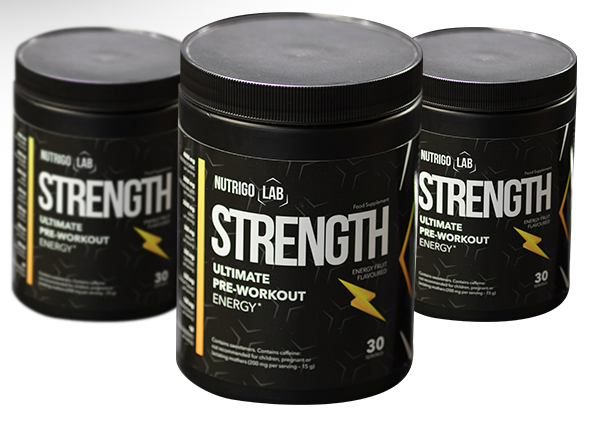
Our Recommendation — Nutrigo Lab Strength
Score: 6.1/10 · Best for: healthy adults who dose conservatively and read their body's signals — a fully printed panel makes the safety audit possible, every amount visible, including the stimulant stack Main caution: the stack is 200 mg of caffeine plus bitter orange (synephrine) — moderate by category standards, but the maker's own cardiovascular warning is binding, and chest pain, a racing heart that won't settle or fainting are never a “smaller scoop next time” problem Fair trial: one tub at $68.99 (about 30 servings) is enough to learn your dose response at half servings first — with no money-back guarantee published, start small rather than stocking up.
The Triage Table: Normal, Too Much, Dangerous
| Effect | Usual driver | Category | What to do |
|---|---|---|---|
| Skin tingling / pins and needles, 10–60 min | Beta-alanine | Normal | Nothing — it fades. Our beta-alanine article explains the mechanism |
| Warmth, alertness, urge to train | Caffeine | Normal | This is the product working |
| Mild stomach urgency, looser stool | Caffeine, taken fasted | Normal | Take with a small amount of food |
| Jitters, anxiety, shaky hands | Caffeine dose too high for you | Dose too high | Halve the serving next time; audit your day's other caffeine |
| Headache, especially next day | Caffeine, dehydration | Dose too high / context | Hydrate; reduce dose; note withdrawal pattern if daily |
| Heart pounding hard, feels "wrong" | Caffeine + synephrine stack | Dose too high — caution | Stop the session. If it doesn't settle promptly, treat as dangerous |
| Can't sleep hours later | Caffeine half-life (~5 h) | Dose/timing | Move the cut-off earlier — see our timing article |
| Chest pain, pressure or tightness | Stimulant stack, exertion | Dangerous | Stop. Seek urgent medical care |
| Irregular, fluttering or very rapid heartbeat that persists | Stimulant stack | Dangerous | Stop. Seek urgent medical care |
| Fainting, severe breathlessness, confusion | Various | Dangerous | Stop. Emergency care |
| Swelling of lips/tongue, hives, wheeze | Allergic reaction to an ingredient | Dangerous | Stop. Emergency care — this is not beta-alanine tingling |
The Heart and Blood-Pressure Question, at the Correct Evidence Tier
Caffeine raises heart rate and blood pressure acutely — modestly in habitual users (whose pressor response blunts within days of regular intake), more noticeably in the caffeine-naive and at higher doses. That is physiology, not scandal. The stack question is more specific: many pre-workouts pair caffeine with p-synephrine from bitter orange, and animal and regulatory assessments have long treated the combination as the thing to watch, because two pressor stimulants plus hard exercise is a plausible risk multiplier. The human data, read fairly, is more reassuring than the warnings and less reassuring than the marketing: a 2023 meta-analysis of roughly 50 studies found no cardiovascular signal for p-synephrine alone or combined with caffeine at studied doses — but "studied doses" were controlled, the participants were screened, and that is not the same as a guarantee for an unscreened user stacking products at the gym. We print no invented blood-pressure figure here because the literature doesn't support a single one for a stack like this; what it supports is tiered caution: healthy adults at label doses sit in the low-risk tier the trials describe; anyone with a cardiac history, arrhythmia, hypertension or stimulant sensitivity sits outside the trial populations entirely, and for them the maker's warning — not this article — governs.
The Stack Audit: What Is Actually in the Worked Example
Nutrigo Lab Strength's stimulant system, from its printed panel: 200 mg caffeine (about two standard cups of coffee, bottom edge of the ISSN 3–6 mg/kg evidence range for a 70 kg lifter), 100 mg bitter orange extract at 6% synephrine ≈ 6 mg synephrine (low against the 10–50 mg in synephrine studies), 300 mg enXtra™ galangal extract (a caffeine-adjacent alertness ingredient with a much thinner evidence file), plus small amounts of cocoa extract (theobromine) and cayenne. Category context matters: many rival tubs run 300–350 mg of caffeine with additional stimulants, so this stack is mid-category, not extreme. But mid-category is still a stack — three stimulant-family ingredients aimed at the same system — and the maker's own materials contain the contradiction we flagged in our product review: its sales page claims "no recorded side effects" while its store FAQ bars people with cardiovascular disease or caffeine hypersensitivity from using it. Both statements are the maker's; the warning is the one to obey. The formula scores 6.1/10 in our review partly because its panel is printed and auditable — the side-effect profile you can read in advance is the safest kind.
The Second Tier: Crash, Headache and Gut
Beneath the triage table sits a band of effects too mild for the red list and too common to omit. The post-workout crash is masked fatigue reasserting itself as caffeine clears, sharpened by the blood-sugar dip of a hard session — unpleasant, not dangerous, and largely preventable with food. The next-day headache is usually caffeine withdrawal arriving on schedule in daily users (it begins 12–24 hours after the last dose) or simple dehydration; both are information about your habit, not your health. Digestive effects — urgency, cramping, loose stool — track caffeine's stimulation of gut motility, worsened by fasted dosing and by the sugar alcohols and concentrated minerals in many powders; the fed, half-dose protocol in the reduction section is aimed at exactly this band. And niacin flushing — a hot, red face at high niacin doses — belongs to other formulas; at 16 mg, this one is nowhere near flushing territory. None of these effects is a reason to fear the category; all of them are reasons to respect that "side effects" is a dose-management conversation long before it is a danger conversation.
Interactions: What Else Is in Your System
Side-effect risk is rarely about the tub alone. Alcohol is the worst common pairing: caffeine masks intoxication without reducing it, and a stimulant stack before a drinking session is a documented route to overconfidence and overexertion. Energy drinks and coffee stack arithmetically, not mysteriously — your body's ledger is in total daily caffeine, as the worked example in our daily-use article shows. Medication cuts both ways: some drugs slow caffeine clearance (certain antibiotics and antidepressants among them), stretching a 5-hour half-life much longer; others add stimulant load (including some ADHD and decongestant medicines), compounding the stack. Exercise itself is an interaction — maximal exertion plus stimulants plus heat and dehydration is the context in nearly every serious case report, which is why the same dose that was fine in a cool morning session can feel dangerous in a hot afternoon one. The audit habit is simple: the tub's label is one page of your file, not the whole file.
Pregnancy, Teens and the Household Problem
Two groups deserve more than a line in the exclusions list because exposure in both is usually casual rather than chosen. Pregnancy: the ~200 mg/day caffeine guidance counts every source, caffeine clearance slows substantially as pregnancy progresses (stretching the half-life and therefore every effect in this article), and the supporting cast — synephrine included — has no pregnancy safety file at all. A full serving is not a grey area here; it is the whole budget spent on an unstudied stack. Teenagers: adolescents encounter pre-workout through gym culture and social feeds (our dry-scooping article covers the trend mechanics), often sharing tubs whose labels they never read, at body weights that push a 200–350 mg serving far up the mg/kg scale, sometimes with unscreened cardiac conditions — the precise combination the serious case reports keep assembling. Parents should know the caffeine number of anything in the house the way they know the alcohol content: it is printed, it is the active ingredient, and "it's just a workout drink" is a marketing sentence, not a description.
Who Should Not Take Pre-Workout At All
- Under-18s. Paediatric guidance (the AAP) advises against stimulant sports products for adolescents; developing bodies and unscreened hearts are not the trial population.
- Pregnancy and breastfeeding. Obstetric guidance caps caffeine around 200 mg/day in pregnancy from all sources — a single full serving of this formula consumes the entire allowance before food and drink.
- Cardiovascular disease, arrhythmia, or a family history of sudden cardiac events. The maker's own exclusion — stimulant stacks plus maximal exertion is precisely the scenario to avoid unscreened.
- Hypertension, especially uncontrolled. Acute pressor effects are the last thing an already-elevated baseline needs.
- Anxiety disorders and stimulant sensitivity. The "side effect" and the condition are the same sensation; dose discipline rarely fixes this pairing.
- Anyone on interacting medication — including some ADHD stimulants, certain antibiotics that slow caffeine clearance, and blood-pressure medication. A pharmacist can audit your specific list; a label cannot.
When to Stop Training — and When to Seek Care
Stop the session, without finishing the set or "seeing how it goes," if you notice: a heartbeat that feels irregular or won't slow as you rest; unusual breathlessness out of proportion to the effort; dizziness or a feeling of fading; nausea that escalates rather than settles; or any pain in the chest, jaw or arm. Seek urgent care for chest pain or pressure, a persistent racing or irregular pulse, fainting, severe breathlessness, or any sign of allergy with breathing involvement. The dry-scooping case reports in our article on that trend — including a heart attack in a healthy 25-year-old and a self-reported one in a 20-year-old first-time user — are the extreme end of what stimulant misuse plus exertion has produced; ordinary label use is not that scenario, but it is why the red-flag list is short, absolute and non-negotiable.
How to Make Side Effects Less Likely
Start at half a serving — for Nutrigo that is one scoop, 100 mg of caffeine — and earn the full dose over several sessions. Take it with a small amount of food if your stomach objects; the onset cost is minor. Respect the sleep cut-off: caffeine's ~5-hour half-life means a 6 p.m. serving still has ~100 mg aboard at 11 p.m.; our timing article sets the ~8-hours-before-bed rule. Audit the whole day's caffeine — the FDA's ~400 mg/day general guidance counts coffee, tea, cola and energy drinks alongside the scoop; most "pre-workout side effects" are actually total-caffeine side effects. Never stack two stimulant products, and never dry-scoop. Hydrate — several effects blamed on pre-workout are dehydration wearing a costume.
Who This Product Suits — and Who Should Skip It
Buy it if you are a healthy adult, your blood pressure is normal, you are not caffeine-sensitive, and you want a measurable, printed stimulant dose rather than a proprietary blend's mystery. Used at label dose, with the reductions above, its side-effect profile is the category's ordinary one. Skip it if anything in the who-should-not list describes you — cardiovascular disease and caffeine hypersensitivity are the maker's own exclusions, not our invention — if you are pregnant, under 18, or on interacting medication without a pharmacist's clearance, or if a 200 mg caffeine serving has previously given you palpitations or panic at rest. A supplement that requires you to ignore your own history is mispriced at any cost.
How Long Do Side Effects Last?
By ingredient: the beta-alanine tingle resolves in 60–90 minutes; caffeine's arc runs 3–5 hours at felt intensity with a tail set by the ~5-hour half-life (which is why "I feel fine" and "my sleep was shallow" can both be true of the same serving); niacin flushes, in formulas that carry flushing doses, burn out within the hour; gastrointestinal effects track the meal you should have eaten. Anything outside those clocks — tingling that persists for hours, a headache pattern that is new and severe, palpitations recurring at rest days after the last dose — has left the territory of expected side effects and entered the territory of symptoms, and should be discussed with a clinician rather than troubleshooted with a smaller scoop.
Our Recommendation — Nutrigo Lab Strength
Score: 6.1/10 · Best for: healthy adults who dose conservatively and read their body's signals — a fully printed panel makes the safety audit possible, every amount visible, including the stimulant stack Main caution: the stack is 200 mg of caffeine plus bitter orange (synephrine) — moderate by category standards, but the maker's own cardiovascular warning is binding, and chest pain, a racing heart that won't settle or fainting are never a “smaller scoop next time” problem Fair trial: one tub at $68.99 (about 30 servings) is enough to learn your dose response at half servings first — with no money-back guarantee published, start small rather than stocking up.
Frequently Asked Questions
Can pre-workout make you fail a drug test?
Caffeine won't. The documented risk is product quality: independent analyses of sports supplements have found undeclared stimulants and banned substances in a minority of products, which is why competitive athletes are advised to use third-party-certified batches. A transparent panel like this formula's is necessary for trust, but certification is the stronger guarantee.
Is tingling skin a sign of an allergic reaction?
No — beta-alanine tingling (paresthesia) is a harmless nerve effect that starts 10–20 minutes after a dose around 800 mg–1 g or more and fades within about an hour. Allergy looks different: hives, swelling, wheeze, breathing difficulty. Those are emergency signs, not tingling.
Can pre-workout raise your blood pressure?
Acutely and modestly, yes — caffeine does, and stimulant stacks add to it. Habitual users blunt the response within days; people with hypertension are outside the safe-use frame regardless.
Is 200 mg of caffeine a lot?
It is about two standard cups of coffee, and half the FDA's ~400 mg/day general-population guidance. For a caffeine-naive or smaller lifter it is a full-strength dose; for a heavy coffee drinker it is mild. Body weight and habit decide which.
What should I do if my heart races after pre-workout?
Stop training and sit down. If the racing is irregular, comes with chest pain, breathlessness or dizziness, or simply doesn't settle as you rest, get urgent medical care rather than waiting it out.
Can pre-workout damage your kidneys or liver?
At label doses in healthy adults, the mainstream ingredients (caffeine, creatine, beta-alanine) have no established organ-damage signal; creatine has been studied for decades without one in healthy users. The documented harms cluster around misuse — mega-dosing, stacking, contaminated or spiked products — which is why transparent labels and third-party-tested brands matter.
Can pre-workout cause a panic attack?
It can produce the physical ingredients of one — racing heart, breathlessness, a sense of alarm — in stimulant-sensitive people or at excessive doses, and that sensation can trigger genuine panic in someone prone to it. If stimulants reliably do this to you, the category is not for you at any dose; if it happens once at a high dose, treat it as dose information and as a stop signal for that session.
Can pre-workout affect your mood or anxiety the next day?
Indirectly and commonly: a serving that thins the night's sleep exports irritability, low mood and blunted focus into the following day, where they are usually blamed on everything except yesterday's scoop. If a pattern of rough mornings tracks your training days, the timing cut-off — not the formula — is the first variable to audit.
Why do I crash a few hours after taking it?
As caffeine clears, the adenosine it was blocking reasserts itself — the tiredness was masked, not removed. Poor sleep the night before a morning session (often caused by yesterday's late dose) compounds it.
Last reviewed: October 2026. This article is educational and is not medical advice.
