
- Quick Answer
- The Gonzales Trials: Desire Up, Hormones Flat
- The Cyclist Pilot: Stone 2009, Read Correctly
- The Timeline: What Happens at 8–12 Weeks, and What Never Happens
- Black, Red, Yellow: the Colour Guide With Evidence Tiers
- The Sperm Numbers, With the Caveats Left On
- Maca vs Ashwagandha vs Tongkat Ali: Three Different Bets
- Dose, Form, Safety — and the Blend Problem
- Energy, Mood and Focus Claims: Where the Animal Boundary Sits
- Gelatinised vs Raw: What the Processing Actually Changes
- A Stronger Alternative in This Category
- Frequently Asked Questions
- Does maca raise testosterone?
- How long does maca take to work for libido?
- Which colour of maca is best for men?
- Does maca increase sperm count?
- How much maca should I take?
- Can I stack maca with ashwagandha or tongkat ali?
- Does maca help erectile function?
- Is maca safe if I have a thyroid condition?
- Read This Next
Disclosure: This article contains affiliate links. If you buy through them, we may earn a commission at no extra cost to you. It never changes our conclusions.
Quick Answer
Maca is the rare supplement whose honest verdict is more interesting than its marketing: it does not raise testosterone — that has been tested directly, twice, and the hormones did not move — and it does appear to raise sexual desire, from about week 8, by a route that has nothing to do with hormones. In the Gonzales trials, men taking 1,500–3,000 mg/day of gelatinised maca reported improved desire while testosterone, LH, FSH, prolactin and estradiol stayed statistically identical to placebo, and the desire effect was formally independent of every hormone and mood score measured. If you want a testosterone effect, maca is the wrong plant and no dose fixes that. If low desire is the problem and your hormones are normal, maca is one of the few botanicals with a real, replicated, honestly-null-on-hormones dataset — at grams per day, which is the catch for blends: Testomore contains 100 mg of maca extract, a fifteenth of the lowest trial dose, where maca is a supporting line in a formula sold on other ingredients. Best for: men with normal testosterone and flagging desire who want the ingredient whose evidence is a libido effect — and who want the sperm and colour claims with their caveats still attached.
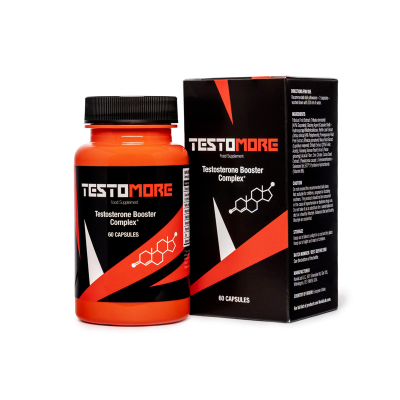
Our Recommendation — Testomore
Score: 6.0/10 · Best for: men who want maca inside a fully printed panel built on a human-trialled branded blend — every amount on the label, so the dose maths can be checked before spending Main caution: maca works in grams in the trials and Testomore carries 100 mg of it — nothing at 100 mg inherits the 1,500 mg evidence — the Tesnor™ also sits at half its 400 mg trial dose, and no money-back guarantee is published Fair trial: two bottles at $53.99 ($107.98, plus $12 shipping) cover the blend's 56-day trial window — with no money-back guarantee, a negative result is not refundable.
The Gonzales Trials: Desire Up, Hormones Flat
The core evidence is two trials from the same Peruvian research group, and they are worth reading as a pair because the second exists to interrogate the first.
| Trial | Design | Finding |
|---|---|---|
| Gonzales et al. 2002 (Andrologia) | 57 men, aged 21–56; gelatinised maca 1,500 or 3,000 mg/day, 12 weeks, placebo-controlled | Sexual desire improved from week 8 — and the improvement was statistically independent of testosterone, estradiol and mood scores, none of which differed from placebo |
| Gonzales et al. 2003 (J Endocrinol) | Randomised trial measuring the full hormone panel at 2, 4, 8 and 12 weeks | No effect on LH, FSH, prolactin, 17-OHP, testosterone or estradiol at any time point. The cleanest "desire without hormones" dataset in the category |
| Zenico et al. 2009 | Men with mild erectile dysfunction | IIEF-5 rose +2.3 points in the maca arm — but the between-group difference was not significant; quote only with that rider |
Most supplement ingredients have a fog of small positive trials and no decisive test. Maca has the opposite: a decisive test of the testosterone claim, run by the very researchers who documented the desire effect, returning a flat line across six hormones at four time points. That is why this site treats maca's continued presence in "testosterone boosters" — including formulas we otherwise score respectably — as a category error rather than a judgement call. The discoverers of the libido effect disproved the hormone claim in 2003; every label implying otherwise since is trading on a correction it hopes you never read. For the full category picture, see our ingredients evidence review, where maca's null sits alongside the ashwagandha and fenugreek small-print.
The Cyclist Pilot: Stone 2009, Read Correctly
The athletic claim attached to maca comes from Stone et al. 2009 — a pilot study of 8 trained cyclists in a crossover design over 14 days. It is quoted in circulation as "black maca improved 40 km time-trial performance in elite athletes", and almost every word of that needs qualifying. What Stone actually found: sexual desire improved versus placebo (P=0.03) — a genuine, if tiny-sample, placebo-controlled libido result, consistent with Gonzales. The 40 km performance improved against the men's own baseline (P=0.01) but not against placebo (P>0.05) — which in trial language means the performance effect is unproven, the classic signature of a pilot too small to separate supplement from expectation. Eight men, two weeks, a null against placebo: that is the entire human performance file. Pages presenting Stone as evidence maca makes athletes faster have read the abstract's first finding and stopped before the second. (The colour attribution often bolted onto Stone is also not established by the paper — the human trials generally did not run colour-vs-colour comparisons, a point the next section needs.)
The Timeline: What Happens at 8–12 Weeks, and What Never Happens
| Outcome | Earliest trial signal | Honest status |
|---|---|---|
| Sexual desire | Week 8 (Gonzales 2002), continuing to week 12 | Replicated direction across trials; the one real effect — allow two months before judging |
| Sperm parameters | 12-week trials | Pilot trends non-significant; one later RCT null — see the sperm section before believing any number |
| Testosterone / hormones | Never — measured at 2, 4, 8, 12 weeks | Flat at every time point in the definitive panel study |
| Athletic performance | 14 days (pilot) | Unproven — improved vs baseline, not vs placebo, n=8 |
The timeline has a commercial consequence: desire is an 8-week outcome, so a one-month trial of maca is an unfair test of the one thing it does. Any maca purchase is implicitly a two-to-three-month purchase — a fact worth knowing before the first bottle, and one that interacts badly with formulas (like most in this category) that publish no money-back guarantee over exactly that judgement window.
Black, Red, Yellow: the Colour Guide With Evidence Tiers
| Colour | The claim | Evidence tier |
|---|---|---|
| Black | Best for men: sperm, libido, energy | Sperm and libido advantages shown in rats; the human trials mostly used colour-unspecified maca. No human colour-vs-colour trial exists |
| Red | Prostate health | Rat-only — reduced prostate size in rodent models; no human prostate trial |
| Yellow | The everyday/default variety | Most common and least differentiated; the default in much of the human research that doesn't specify |
The colour system is real horticulture — maca roots genuinely grow in colour ecotypes with somewhat different chemistry — dressed as proven human pharmacology. What the human record supports is "maca" (gelatinised, grams per day) for desire. It does not support colour prescriptions, because nobody has randomised men to black versus red versus yellow and measured anything. One chemical survey even found black maca lowest in macamides — the compounds most often invoked as the actives — among the colours analysed, which does not disprove black's claims but does illustrate how confidently the hierarchy is asserted relative to its data. Practical reading: if you buy maca, buy it as gelatinised maca at a trial-shaped dose from a maker who states the amount; treat colour as preference, not evidence. And if a blended formula does not state the colour or a meaningful dose — Testomore lists "maca root extract, 100 mg", no colour — then colour marketing is unavailable to it in both directions: it cannot claim black maca's reputation, and you cannot grant it.
The Sperm Numbers, With the Caveats Left On
Fertility is where maca's numbers get quoted with the most confidence and the least justification, so here is the entire file, in order. Melnikovova et al. 2015, the modern pilot: double-blind, 20 men enrolled (18 analysed), 1.75 g/day for 12 weeks. Reported within the maca group: total sperm count up about 20%, concentration up about 14%, motile sperm up about 14%, semen volume up about 9%. Those trends are real as far as they go — and the study found no statistically significant difference versus placebo, on any measure, while the placebo group's total count also rose about 20%. A pilot in which both arms rise by the headline figure is a study of regression and noise, not of maca. Gonzales et al. 2001 supplies the bigger circulating figures — total sperm up 84%, motile sperm up 109% — from an uncontrolled study of 9 men over four months, not black-maca-specific and with no placebo arm at all. And the most rigorous entry is the least quoted: Alcalde & Rabasa 2020, a double-blind randomised trial over 12 weeks, found maca null for sperm quality. The systematic-review verdict (Lee et al. 2016) is that the evidence is insufficient. Men with fertility concerns deserve the unvarnished version: maca for sperm is an open question with weak pilot signals and one null RCT — not a treatment, and no substitute for a semen analysis and a clinician.
Maca vs Ashwagandha vs Tongkat Ali: Three Different Bets
| Maca | Ashwagandha | Tongkat ali | |
|---|---|---|---|
| Route | Non-hormonal — desire effect independent of every hormone measured | Hormonal-adjacent — stress-axis route; small testosterone rises in stressed/older/overweight men in industry-linked trials | Marketed as hormonal; evidence remains small-trial grade |
| Testosterone verdict | Proven null — full panel, four time points | Small positive signals in specific populations (see our Set I reviews) | Unproven at category standard; nothing replicated at scale |
| Best-supported use | Desire, at 1.5–3 g/day, judged at 8–12 weeks | Stress/fatigue contexts | — |
| On this site | 100 mg in Testomore — supporting dose only | Covered across the stress and testosterone clusters | VigRX Tongkat Ali reviewed as a standalone |
The comparison clarifies what kind of purchase maca is. Ashwagandha is a bet that a small hormonal nudge exists in men whose testosterone stress suppresses; tongkat is a bet on an unproven file; maca is not a hormone bet at all — it is the one ingredient in the aisle whose value proposition survives its hormones being measured. That is exactly why it is mis-sold: "testosterone booster" is the shelf it is stocked on, and the shelf is the lie. The mechanism proposed for the desire effect — macamides interacting with the endocannabinoid system (FAAH inhibition) — is genuinely interesting and should be labelled precisely: an emerging, unproven hypothesis from laboratory work, not an established pathway.
Dose, Form, Safety — and the Blend Problem
The trials used gelatinised maca at 1,500–3,000 mg/day. Gelatinisation (a heat process that removes much of the starch) is the studied form and the easier one on digestion; raw maca powder is the traditional food form, harder on some stomachs. On safety, maca's record at food-like doses is benign — it is a cultivated food in the Andes — with two notes worth printing: maca contains glucosinolates (the goitrogen family found across crucifers), so men with thyroid conditions are commonly advised to prefer gelatinised forms, moderate doses and a clinician conversation; and the desire timeline means judging any product at 8–12 weeks. Now the blend arithmetic that ends most maca purchases honestly: Testomore provides 100 mg of maca extract a day — one fifteenth of the lowest Gonzales dose, colour unspecified. Nothing at 100 mg inherits the 1,500 mg evidence; the line is there as support in a formula whose audited headline is its Tesnor™ blend, and our review (6.0/10) treats it on exactly those terms — transparent amount, sub-trial dose, no guarantee published.
Buy maca — as a standalone gelatinised product at 1.5–3 g/day — if your testosterone is normal, desire is the complaint, and you will give it eight weeks. Buy Testomore if you want its overall audited formula and regard the maca as a minor supporting line. Skip both if what you actually want is a testosterone increase: maca's own discoverers measured that door and found it locked, in 2003, at four time points. Men with low desire and low measured testosterone have a medical workup ahead of them, not a root powder — start with the diagnosis route in our category verdict.
Energy, Mood and Focus Claims: Where the Animal Boundary Sits
Maca is also sold for energy, mood and cognition, and this is where its file thins to animal thickness. The human desire data above is the whole of the replicated human story; the energy and cognitive claims rest predominantly on rodent work — fatigue models, memory tasks in ovariectomised animals — translated into label language with the species quietly removed. One human result does usefully bound the hormonal story from the other side: Brooks et al. (2008) gave maca to postmenopausal women and found no estrogen or androgen activity, in the trial or in vitro — the same conclusion as Gonzales in men, in the opposite sex: maca does not behave like a hormone in humans, full stop. If a man feels more energetic on maca, the placebo-sensitive nature of energy as an outcome, the nutritional content of a root powder eaten in gram quantities, and the desire effect itself are all candidate explanations ahead of any demonstrated pharmacology. None of that makes the feeling fake. It makes the mechanism unproven, which is the distinction this site exists to print. Buy maca for the measured effect (desire), at the measured dose (grams), on the measured timeline (8–12 weeks) — and treat energy and focus language as the marketing garnish it currently is.
Gelatinised vs Raw: What the Processing Actually Changes
Every positive human trial in this article used gelatinised maca — root that has been heated and pressurised to gelatinise its starches, concentrating the powder and making it substantially easier to digest. Raw maca powder, the cheaper and more "traditional"-marketed form, retains its full starch load and is the form most associated with digestive complaints; it is also, per gram, less concentrated in everything else. The distinction matters for two practical judgements. First, dose translation: the 1,500–3,000 mg trial figures are gelatinised milligrams — a raw-powder product at the same weight is not the same exposure. Second, the thyroid note: maca's glucosinolates (the compound family common to cruciferous vegetables) are reduced by the cooking/gelatinisation process, which is why the standard caution for men with thyroid conditions pairs "prefer gelatinised" with "moderate dose, clinician conversation" rather than blanket avoidance. When a blend lists only "maca root extract" with no form and no colour — as Testomore's 100 mg line does — none of these distinctions can even be applied, which is itself the finding: at that dose and that level of specification, the ingredient is a panel decoration, and the honest review treats it as one while crediting the maker for printing the amount at all.
A Stronger Alternative in This Category
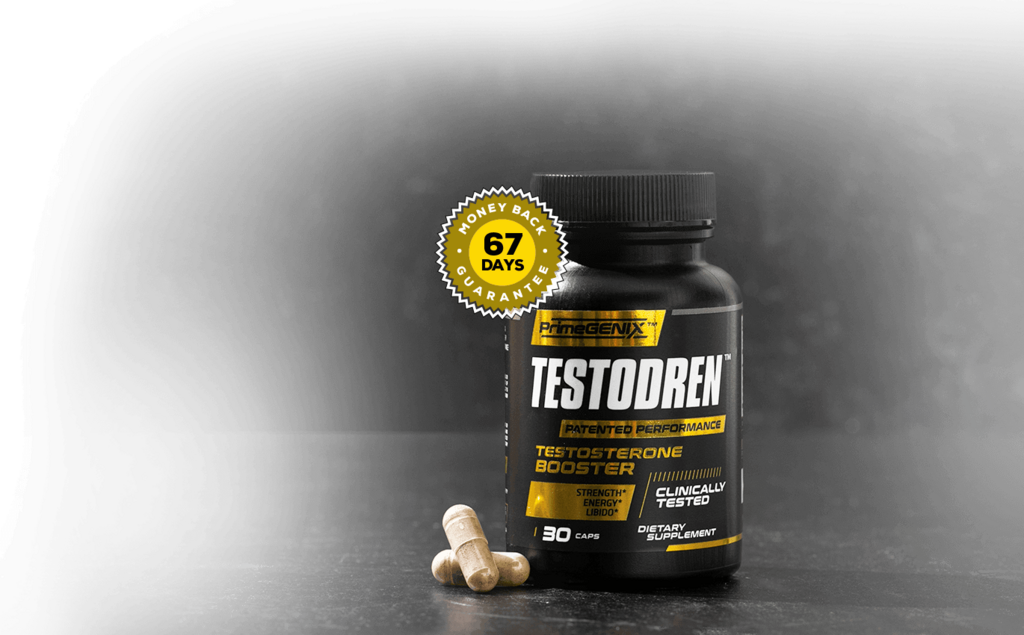
The stronger alternative: Testodren · 8.5/10One ingredient at a published 500 mg dose, with human studies behind the ingredient itself: Testodren is the testosterone formula we score highest in this catalogue.
Our Recommendation — Testomore
Score: 6.0/10 · Best for: men who want maca inside a fully printed panel built on a human-trialled branded blend — every amount on the label, so the dose maths can be checked before spending Main caution: maca works in grams in the trials and Testomore carries 100 mg of it — nothing at 100 mg inherits the 1,500 mg evidence — the Tesnor™ also sits at half its 400 mg trial dose, and no money-back guarantee is published Fair trial: two bottles at $53.99 ($107.98, plus $12 shipping) cover the blend's 56-day trial window — with no money-back guarantee, a negative result is not refundable.
Frequently Asked Questions
Does maca raise testosterone?
No — this has been tested directly. Gonzales et al. (2003) measured LH, FSH, prolactin, 17-OHP, testosterone and estradiol at 2, 4, 8 and 12 weeks on maca and found no change in any of them, even as desire improved in the companion trial. Maca in a "testosterone booster" is a libido ingredient on the wrong shelf.
How long does maca take to work for libido?
Desire improved from week 8 in the Gonzales 2002 trial and was assessed through week 12. Plan on two to three months at 1,500–3,000 mg/day before judging — a single month is not a fair test of the one effect maca has.
Which colour of maca is best for men?
Unproven in humans. Black maca's sperm and libido reputation is animal data plus human trials that mostly didn't specify colour; red maca's prostate effect is rat-only; no head-to-head human colour trial exists. Buy gelatinised maca at a stated, trial-shaped dose and treat colour as preference.
Does maca increase sperm count?
The honest answer is "insufficient evidence". A 2015 pilot reported within-group trends (total count ~+20%) that were not significant versus placebo — whose count also rose ~20%; the famous +84%/+109% figures are from an uncontrolled 9-man study in 2001; and a 2020 double-blind RCT found no sperm-quality benefit. A 2016 systematic review calls the evidence insufficient.
How much maca should I take?
The trial range is 1,500–3,000 mg/day of gelatinised maca. Be aware that blends typically contain far less — Testomore, for instance, has 100 mg — and sub-trial doses do not inherit trial results. If maca is the ingredient you want, buy maca at a maca dose.
Can I stack maca with ashwagandha or tongkat ali?
They are different bets, not duplicates: maca is non-hormonal (desire), ashwagandha has small hormonal signals in stressed/older men, tongkat's file is small-trial grade. Stacking is common and not specifically studied; the more useful discipline is judging one change at a time, over its own timeline, so you know what did what.
Does maca help erectile function?
Weakly at best, on current data. Zenico et al. (2009) saw IIEF-5 rise 2.3 points in the maca arm in men with mild ED — but the difference versus placebo was not statistically significant, which is why we quote the number only with that rider attached. The desire effect is the documented one; erections are a maybe borrowed from it.
Is maca safe if I have a thyroid condition?
Maca contains glucosinolates, the crucifer-family compounds that can affect thyroid iodine handling at high intakes. The standard cautious pattern is gelatinised (processed) forms at trial-range doses and a conversation with your clinician — not raw powder in unlimited quantities, and not alarm either: maca is a food with a long consumption history at these doses.
Last reviewed: October 2026. This article is educational and is not medical advice.
