
- Quick Answer
- The 24% Headline, Taken Apart
- Juice Is Not Extract: the Distinction the Whole Topic Turns On
- A Short Note on Saliva Versus Serum, Because the Whole Myth Lives There
- The Cocoa Half of Tesnor™: a Theobromine Reality Check
- The Tesnor™ Trials: All Three, With Their Funding Attached
- The Testomore Dose Audit: 200 mg Against a 400 mg Headline
- So, Does Pomegranate Increase Testosterone?
- What Pomegranate Is Actually Good For
- Why the Myth Persists
- The Sugar Maths of the Juice Protocol
- If You Buy a Pomegranate Product Anyway: a Four-Line Checklist
- A Stronger Alternative in This Category
- Frequently Asked Questions
- How much pomegranate juice should I drink for testosterone?
- Is pomegranate extract the same as drinking the juice?
- Does Tesnor™ work at 200 mg?
- How long were the Tesnor™ trials?
- Did pomegranate really raise testosterone 24%?
- Is the cocoa in Tesnor™ a meaningful dose of theobromine?
- Can pomegranate interact with medicines?
- Does pomegranate help with erectile function?
- Read This Next
Disclosure: This article contains affiliate links. If you buy through them, we may earn a commission at no extra cost to you. It never changes our conclusions.
Quick Answer
It depends entirely on which "pomegranate" you mean — and the two products sharing the name have almost nothing in common. Pomegranate juice: there is no validated testosterone dose and no controlled evidence that juice raises testosterone in blood; the famous "+24%" figure comes from a single small, uncontrolled study that measured saliva, and the one controlled juice trial found testosterone slightly lower. Tesnor™, a standardised pomegranate fruit-rind plus cocoa seed extract, is a different ingredient with three real randomised trials behind it — all funded by its developer, none independently replicated — in which 400 mg/day raised free and total testosterone in middle-aged men, while the 200 mg dose produced narrower results. Testomore, the formula this article audits, contains the 200 mg dose. Its winning angle is transparency: the branded ingredient and its amount are printed on the label, so the gap between the studied dose and the capsule can be stated exactly — which is what we do below. Best for: men comparing pomegranate products who want to know which claims belong to juice, which belong to the extract, and what the extract's own trials actually found at each dose.
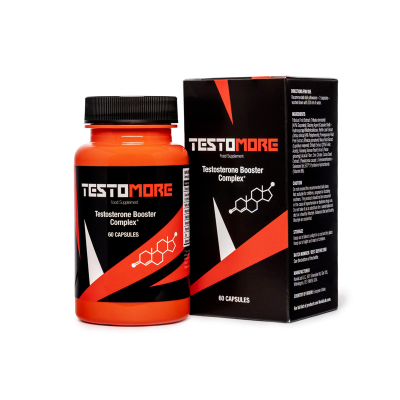
Our Recommendation — Testomore
Score: 6.0/10 · Best for: men who want a fully labelled formula built on a branded, human-trialled blend — every amount printed, so the dose maths can be checked before spending Main caution: Testomore ships Tesnor™ at 200 mg — half the 400 mg dose that raised testosterone in the trials — pomegranate juice studies are not Tesnor™ studies, and the maker publishes no money-back guarantee Fair trial: two bottles at $53.99 ($107.98, plus $12 shipping) cover the blend’s 56-day trial window — with no money-back guarantee, a negative result is not refundable
The 24% Headline, Taken Apart
Search this topic and you will meet the same number everywhere: pomegranate raises testosterone by about 24%. It appears on affiliate guides, clinic blogs and supplement pages, often with confident detail attached. Trace it back and the whole structure rests on one study: Al-Dujaili and Smail, Queen Margaret University, 2012.
Here is what that study actually was. Sixty volunteers — 22 men and 38 women, average age about 39 — drank 500 mL of pomegranate juice a day for two weeks. In the men, salivary testosterone rose from 242 to 298 pg/mL, roughly +24%. And that is all the study was: no placebo group, no control arm, a repeated-measures design presented at conference-abstract level, measuring a saliva hormone fraction that is not the serum total testosterone clinicians use — and in the decade since, no blood-based study has replicated it. An uncontrolled two-week saliva measurement in 22 men is a pilot signal, the kind of result that justifies a proper trial. What it cannot justify is a percentage printed as fact on a thousand pages.
The number has also been re-dressed along the way. A widely ranked guide currently attributes the +24% to a trial in kickboxers drinking 330 mL a day for 60 days, with cortisol falling 32%. No such trial exists in the record we could verify — the population, dose and duration have been swapped while the percentage survived, which tells you the percentage was the point. The same guide's second "human study" — men over 45, 1,000 mg of extract, testosterone up 22% — traces to Mansour et al., a study of 32 adult male Wistar rats given pomegranate extract for six weeks, in which the testosterone rise was not even statistically significant. A non-significant rat result, re-costumed as a human trial, is load-bearing in the current search results for this topic. When the two studies holding up a conclusion both collapse on checking, the conclusion goes with them.
What does the controlled juice evidence say? The one properly designed trial we have runs the other way: in a double-blind crossover study of trained weightlifters drinking roughly 500 mL a day of polyphenol-rich pomegranate juice, plasma testosterone measured about 10% lower after exercise compared with placebo/baseline. One trial does not prove juice lowers testosterone either — post-exercise hormone readings are noisy — but it completes the honest picture: for juice, the uncontrolled study says +24% (in saliva), the controlled study says slightly negative (in blood), and no validated dose exists. If you drink pomegranate juice, drink it because you like it or for its general polyphenol content. As a testosterone intervention, it is a myth built on a conference abstract.
Juice Is Not Extract: the Distinction the Whole Topic Turns On
| Pomegranate juice | Tesnor™ (pomegranate rind + cocoa extract) | |
|---|---|---|
| Part of the fruit | Pressed arils (the juicy seeds) | Fruit rind/peel extract plus cocoa seed extract — the part you throw away |
| Standardisation | None — polyphenol content varies by fruit, brand and season | Standardised: ≥3.5% punicalagins, ≥0.5% theobromine (ingredient code LN18178) |
| Sugar | Roughly 30–35 g per 8 oz glass — a real metabolic cost at trial volumes | Negligible (milligrams of extract in a capsule) |
| Human testosterone evidence | One uncontrolled salivary study; one controlled trial slightly negative | Three randomised trials (developer-funded, unreplicated) — see below |
| Studied "dose" | 500 mL/day in both juice studies — never validated against a control for testosterone | 200 and 400 mg/day, 56 days; 400 mg/day, 84 days |
Two further wrinkles belong in any honest comparison. First, urolithins: pomegranate's ellagitannins are converted by gut bacteria into compounds called urolithins, and people differ sharply in whether their microbiome performs that conversion at all — "producers" and "non-producers" can drink the same juice and absorb different chemistry. (The urolithin research that exists is mostly prostate-context, including anti-androgen-receptor findings in laboratory models — a reminder that "pomegranate compounds interact with androgen pathways" cuts in more than one direction and is not a testosterone claim.) Second, the mechanism stories attached to pomegranate — antioxidant protection of Leydig cells, aromatase inhibition — come from animal and cell work. The "aromatase inhibited by over 50%" line in circulation is animal fat-cell data with no human translation shown. Mechanisms are hypotheses; the trial table below is the evidence.
A Short Note on Saliva Versus Serum, Because the Whole Myth Lives There
The QMU result deserves one more dissection, because the measurement choice is doing quiet work. Clinical testosterone assessment uses serum total testosterone — a blood draw, morning-timed, repeated on a second day before anyone says the words "low T". Salivary measurement tracks the small free fraction that diffuses into saliva; it is cheaper and needle-free, which is why small exploratory studies use it, but it is noisier, more sensitive to collection conditions, and not the number any treatment decision in this field is based on. A +24% salivary change in an uncontrolled two-week study therefore sits three removes from a clinical claim: wrong fluid, no control, no replication in blood. When a page cites the figure as "testosterone increased 24%", each of those removes has been silently crossed. This is also why our trial table specifies the measurement wherever it matters — and why the Tesnor™ trials, whatever their funding caveats, are a different class of object: randomised, placebo-controlled, and measuring the blood outcomes the field actually uses.
The Cocoa Half of Tesnor™: a Theobromine Reality Check
Tesnor™ is not pomegranate alone — it is a 4:1-style pairing of pomegranate rind extract with cocoa seed extract, and the cocoa is doing standardisation work rather than heavy pharmacological lifting. The ingredient is standardised to at least 0.5% theobromine, cocoa's signature alkaloid. Run the arithmetic the marketing skips: at the 400 mg trial dose, that guarantees at least 2 mg of theobromine; at the 200 mg dose in Testomore, at least 1 mg. A single serving of cocoa or a square of dark chocolate delivers many times that. This does not make the pairing pointless — the blend is what was actually trialled, and the punicalagin fraction (≥3.5%) is the rind's contribution — but anyone imagining the cocoa half supplies a meaningful stimulant or theobromine effect should recalibrate: it is a standardisation partner in a blend, present at flavouring-level doses of its famous compound.
The Tesnor™ Trials: All Three, With Their Funding Attached
| Trial | Population & design | Doses & duration | What actually changed |
|---|---|---|---|
| Sreeramaneni et al. 2023 | 120 healthy men, aged 21–35; randomised, placebo-controlled | 200 vs 400 mg/day, 56 days | Both doses raised free testosterone vs placebo; only 400 mg raised total testosterone and LH. Grip strength and arm circumference improved at 400 mg. DHT, cortisol, estradiol unchanged |
| Pandit et al. 2022 | 120 men, aged 36–55; randomised, placebo-controlled | 200 vs 400 mg/day, 56 days | Both doses raised free and total testosterone; Aging Males' Symptoms scores improved |
| Srivastava et al. 2025 (Int J Med Sci) | 120 men, aged 40–70, low desire / mild–moderate ED; testosterone ≥300 ng/dL required to enter | 400 mg/day only, 84 days | Sexual-function scores (DISF-SR-M, IIEF, erectile hardness) improved. Testosterone was a screening criterion, not an outcome — it was not measured as a result |
Read carefully, the trial record is more interesting than either the hype or the dismissal. In younger men (21–35), the 200 mg dose moved free testosterone only; total testosterone and LH moved at 400 mg. In middle-aged men (36–55), both doses moved both free and total testosterone, and symptom scores improved. So the common shorthand "200 mg raises free T only" is true of the young-men trial, not a universal law — at 200 mg in the older group, total testosterone rose too. The 2025 trial is the one most often misquoted: it studied sexual function in older men, used testosterone only to decide who could enrol, and measured none as an outcome. Trade coverage quoting the developer's "clinically proven to boost testosterone" in connection with that trial is conflating two different studies — a conflation we flag because it is already propagating.
Now the part that must travel with every figure above: all three trials were funded by the ingredient's developer (the Laila Nutraceuticals / Gencor ecosystem), and there has been zero independent replication. Industry funding does not make results false — the trials are randomised and placebo-controlled — but across supplement research it reliably predicts friendlier outcomes, and an unreplicated, single-sponsor trial family is provisional evidence, not settled science. The ingredient database NutraSmarts rates Tesnor™ "Limited, 2/5", which strikes us as the fair external calibration: real trials, real design quality, real funding caveat, no confirmation from anyone without a stake. That is also exactly how our Testomore review treats it — the reason its Evidence score is 5.0 rather than either extreme.
The Testomore Dose Audit: 200 mg Against a 400 mg Headline
Everything above lands on one practical question: what dose is in the capsule you can actually buy? Testomore contains 200 mg of Tesnor™ per daily serving — the lower of the two studied doses, and half the 400 mg behind the headline results and the maker's quoted percentages. At 200 mg, the most precise summary of the evidence is: free testosterone rose in both trial populations; total testosterone rose in the middle-aged trial but not in the young-men trial; the strength and arm-size findings belong to 400 mg. A buyer in his twenties expecting the total-testosterone result is, on the trial record, buying the wrong dose for that outcome. A buyer in his forties is closer to the population in which 200 mg performed best — a nuance no advertisement will draw for you, and the reason this article exists.
This is also where Testomore earns its qualified defence. The dose gap is visible because the maker prints the dose: many formulas hide behind proprietary blends where no audit is possible at all. Our review documents the gap in a dedicated section and scores the product 6.0/10 — credit for a branded, human-trialled ingredient and a fully transparent panel (tribulus, nettle leaf, maca, shilajit, ginseng, zinc and selenium all carry printed amounts), discounted because the headline ingredient is underdosed relative to its own headline trial and because no money-back guarantee is published: a 56-day judgement at full price is the buyer's risk. The maker is also unusually candid in the other direction — its label warns the product "should not be consumed in the case of hypertension or diabetes drugs use." Transparency about who should not take a product is the rarest feature in this category, and it counts.
Buy it if you are in (or near) the 36–55 bracket the 200 mg evidence best matches, you value a fully labelled, stimulant-free formula, and you accept the developer-funded, unreplicated state of the Tesnor™ evidence as a fair price for an experiment — judged over the trials' own 56-day window, ideally with a blood test. Skip it if you take hypertension or diabetes medication (the maker's own warning), if you are buying on the juice myth this article just dismantled, or if the specific outcome you want is the 400 mg trial result — no wording on any page changes what 200 mg showed. The whole-formula verdict, price table and safety file are in our Testomore review; the category context is in Do Testosterone Boosters Actually Work?
So, Does Pomegranate Increase Testosterone?
The accurate answer, assembled: Juice — no reliable evidence, one uncontrolled salivary study contradicted by the only controlled trial, and no validated dose. The fruit itself — a nutritious food with interesting polyphenols and person-dependent gut metabolism, not a hormone intervention. Tesnor™ rind-and-cocoa extract — a real, provisional yes at 400 mg/day in developer-funded trials, a partial yes at 200 mg, strongest in middle-aged men, awaiting independent replication. Three different answers for three different things sold under one fruit's name. The category survives by blending them into a single "+24%"; the reader's defence is to refuse the blend — ask which form, which dose, which trial, whose money. Those four questions, applied to any page on this topic including ours, will sort the evidence from the costume jewellery every time. For the wider pattern across all booster ingredients, see our ingredients evidence review.
What Pomegranate Is Actually Good For
Debunking the testosterone claim does not make pomegranate worthless — it relocates its value to where evidence actually exists. The fruit and its juice are legitimately polyphenol-rich, and the cardiovascular literature (blood-pressure and endothelial outcomes) is where pomegranate research is deepest, though it is outside this article's question and we do not grade it here. On fertility, the human signal most often cited is a trial of a pomegranate-plus-galangal combination in which motile sperm rose about 62% versus 20% on placebo over three months — a combination product, so the credit cannot be assigned to pomegranate alone, and it says nothing about testosterone in any case. One further data point keeps the picture honest in both directions: a trial of a synbiotic pomegranate juice in women with PCOS saw testosterone decrease — a different population and a different product, but a reminder that "pomegranate raises androgens" is not even the consistent direction of the human data. The pattern is familiar from our ingredients review: a real food with real chemistry acquires one hormonal headline it never earned, and the headline eats the food.
Why the Myth Persists
If the evidence is this thin, why is the claim this durable? Four mechanics keep it alive. Percentages without bases: "+24%" survives because it is a number, and numbers feel like findings; the salivary, uncontrolled, 22-man basis requires a paragraph, and paragraphs do not fit on labels. The saliva–serum swap: almost no reader knows salivary testosterone is not the blood measure clinicians use, so the study sounds stronger than it is. Costume changes: as this article documented, the claim is re-dressed — kickboxers instead of mixed-sex volunteers, a rat study promoted to a human trial — faster than corrections propagate, because each new page copies the last page rather than the papers. Incentives: a page that concludes "juice doesn't work, the extract is provisional, check the dose" converts worse than a page that concludes "+24%", and the ranking ecosystem rewards conversion copy with the traffic that funds more of it. None of this requires a conspiracy; it requires only that accuracy be slower than copying. The reader's countermeasure is the four-question habit from the section above: which form, which dose, which trial, whose money.
The Sugar Maths of the Juice Protocol
One cost of the juice route is never printed next to the +24%: the protocol itself. The QMU study's dose was 500 mL a day — about two large glasses — sustained daily. At roughly 30–35 g of sugar per 8 oz glass, that is on the order of 60–70 g of sugar a day, every day, as a health intervention aimed largely at middle-aged men. The irony is structural: excess weight and poor metabolic health are among the best-documented suppressors of testosterone in exactly that demographic — the mechanism our category verdict quantifies — so a daily two-glass juice habit pursued for testosterone works against the goal through the sugar door while failing to work through the hormone door. The extract exists precisely to escape that trade (milligrams, no sugar), which is the one genuinely sensible sentence in the pomegranate marketing canon — and it belongs to the rind, not the juice.
If You Buy a Pomegranate Product Anyway: a Four-Line Checklist
Some readers will buy the extract with open eyes — the Tesnor™ file is provisional, not empty — so here is the audit in its shortest form. Form: rind extract, standardised — not juice powder riding the juice myth. Dose: 400 mg/day is the dose with the full trial result; 200 mg/day is the partial-evidence dose — price them differently in your head. Funding: developer-run trials, zero independent replication — expect the truth, if the effect is real, to be smaller than the sponsor's numbers. Exit terms: is there a published money-back guarantee covering the 56-day trial window? For Testomore the answer is no — which does not disqualify it, but does mean the experiment is funded entirely by you, and our review scores it in that light. A product passing all four lines of scrutiny with its eyes open is a reasonable experiment; a product bought on "+24%" is a donation.
A Stronger Alternative in This Category
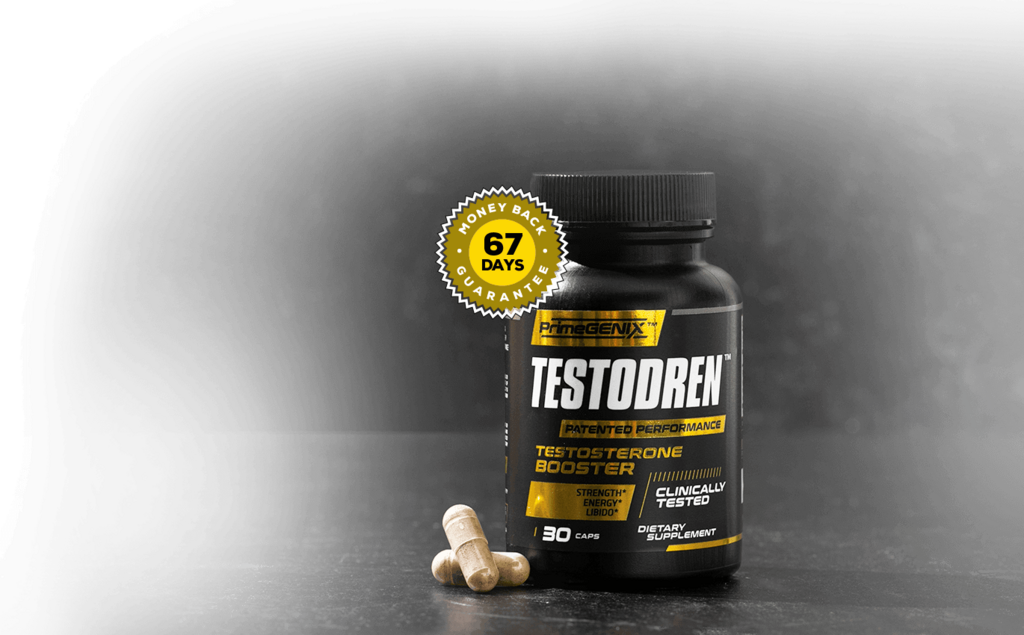
The stronger alternative: Testodren · 8.5/10One ingredient at a published 500 mg dose, with human studies behind the ingredient itself: Testodren is the testosterone formula we score highest in this catalogue.
Our Recommendation — Testomore
Score: 6.0/10 · Best for: men who want a fully labelled formula built on a branded, human-trialled blend — every amount printed, so the dose maths can be checked before spending Main caution: Testomore ships Tesnor™ at 200 mg — half the 400 mg dose that raised testosterone in the trials — pomegranate juice studies are not Tesnor™ studies, and the maker publishes no money-back guarantee Fair trial: two bottles at $53.99 ($107.98, plus $12 shipping) cover the blend’s 56-day trial window — with no money-back guarantee, a negative result is not refundable
Frequently Asked Questions
How much pomegranate juice should I drink for testosterone?
There is no validated dose. The claim traces to 500 mL/day for two weeks in an uncontrolled study measuring salivary testosterone, and the one controlled juice trial found testosterone slightly lower, not higher. Drink juice for pleasure or general nutrition if you like it — not as a testosterone strategy, and mind the roughly 30–35 g of sugar per glass at those volumes.
Is pomegranate extract the same as drinking the juice?
No. Juice is pressed from the arils; Tesnor™ is an extract of the fruit rind — the part discarded when juicing — blended with cocoa seed extract and standardised to ≥3.5% punicalagins and ≥0.5% theobromine. Different plant part, different chemistry, different evidence. Juice studies say nothing about the extract and vice versa.
Does Tesnor™ work at 200 mg?
Partially, on its own trial record. At 200 mg/day, free testosterone rose in both the young-men (21–35) and middle-aged (36–55) trials; total testosterone rose at 200 mg in the middle-aged trial but not in the young-men trial, where the total-T and LH results required 400 mg. All trials were developer-funded and unreplicated.
How long were the Tesnor™ trials?
56 days for the two testosterone trials (200 and 400 mg), and 84 days for the 2025 sexual-function trial (400 mg only). There is no published data beyond 12 weeks, and the 2025 trial did not measure testosterone as an outcome at all — it was an entry requirement (≥300 ng/dL).
Did pomegranate really raise testosterone 24%?
That figure is a salivary testosterone change (242→298 pg/mL) in 22 men within a 60-person mixed-sex, uncontrolled two-week juice study from 2012. It was never replicated in blood, and the controlled juice trial pointed the other way. Versions attributing it to kickboxers, or pairing it with a "22% in men over 45" extract study, are worse: the kickboxer trial does not exist as described, and the over-45 study was conducted in rats and was not statistically significant.
Is the cocoa in Tesnor™ a meaningful dose of theobromine?
No. Tesnor™ is standardised to ≥0.5% theobromine, which works out to at least 2 mg per 400 mg dose and 1 mg per 200 mg dose — a small fraction of the theobromine in an ordinary serving of cocoa. The cocoa is a standardisation partner in the blend, not a functional theobromine dose.
Can pomegranate interact with medicines?
Pomegranate can affect drug-metabolising enzymes (CYP3A4 and CYP2C9 are the ones usually cited), which is a reason to check with a pharmacist if you take prescription medication — particularly blood-pressure or diabetes medicines. Testomore's maker separately warns against using the product alongside hypertension or diabetes drugs.
Does pomegranate help with erectile function?
For the extract, there is a trial: Srivastava et al. (2025) gave 400 mg/day of Tesnor™ for 84 days to men aged 40–70 with low desire and mild–moderate erectile dysfunction, and sexual-function scores — desire, IIEF and erectile hardness measures — improved versus placebo. It was developer-funded, it is a single trial, and it is an extract result: it lends no support to juice, which has no comparable ED trial behind it.
Last reviewed: October 2026. This article is educational and is not medical advice.
