
- Quick Answer
- The Common Effects: Unpleasant, Not Dangerous
- The Liver and Kidney Case Reports, With the Numbers In
- The Medication Interactions That Actually Matter
- Who Should Avoid Tribulus
- The Long-Term Honesty Paragraph
- Frequently Asked Questions
- What are the most common tribulus side effects?
- Can tribulus damage your liver?
- Can tribulus damage your kidneys?
- Is tribulus safe long-term?
- Does tribulus interact with blood thinners?
- Can I take tribulus with a statin?
- Can I take tribulus with diabetes or blood-pressure medication?
- Is tribulus safe during pregnancy?
- Should I stop tribulus before surgery?
- What dose did the injury cases involve?
- Read This Next
Disclosure: This article contains affiliate links. If you buy through them, we may earn a commission at no extra cost to you. It never changes our conclusions.
Quick Answer
At the doses used in human trials (roughly 450–1,500 mg/day for up to 12 weeks), tribulus has generally been well tolerated — the common effects are digestive: nausea, stomach cramps, reflux, diarrhoea. The serious end of the file is made of case reports, not trials: a small number of liver-and-kidney injuries, typically at very high doses, over months, or tangled with other substances — detailed with their numbers below so you can judge them yourself. The honest long-term answer is that there is no long-term answer: human trials run 8–12 weeks, and beyond roughly 90 days the safety data simply runs out. Avoid tribulus if you are pregnant, have liver or kidney disease, take clopidogrel or a statin without telling your clinician, or use hypertension or diabetes medication — the warning one maker in this category actually prints, on the Testomore label, and which this article treats as the floor for the whole category. Best for: anyone weighing a tribulus product who wants the case reports with their doses and confounders attached, not the phrase "generally safe" and a shrug.
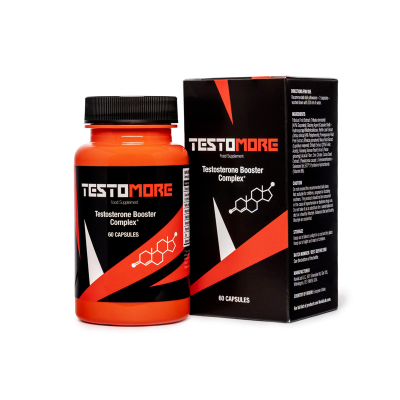
Our Recommendation — Testomore
Score: 6.0/10 · Best for: men who read the safety file first — this is the one label in the category that prints the hypertension-and-diabetes-medication warning itself, inside a fully printed panel Main caution: that warning is real fine print, not boilerplate — and the Tesnor™ still sits at half its trial dose, with no money-back guarantee published Fair trial: $53.99 a bottle (bundles lower) for the two-month judging frame — with the guarantee that isn't published, a negative result is not refundable.
The Common Effects: Unpleasant, Not Dangerous
Across the trial literature, the effects people actually report are gastrointestinal — nausea, stomach discomfort and cramps, acid reflux, loose stools — plus occasional headache, sleep disturbance and restlessness in the retailer-level reports. These are the ordinary frictions of a concentrated botanical extract, they cluster early, and they are the reason trial protocols typically take tribulus with food in split doses (the dosage pattern is covered in our tribulus dosage guide in this series). If a tribulus product upsets your stomach persistently, that is a stop signal, not a phase to push through. The rest of this article is about the rarer reports — rare enough that each one is a published case study, which is precisely why they can be examined in detail.
The Liver and Kidney Case Reports, With the Numbers In
Ryan et al. 2015 (Clinical Nephrology). A man taking tribulus — reported as one tablet a day over a few months — developed severe liver and kidney injury: total bilirubin reached 36 mg/dL (deeply jaundiced; normal is under ~1.2) and creatinine rose to 3.1 mg/dL, with a kidney biopsy showing bile casts — liver failure backing up into the kidney. He recovered. The confounders matter as much as the headline: he was also taking naproxen at 1,000–1,500 mg/day (a kidney-toxic dose of an NSAID in its own right) plus protein supplements. Tribulus is the suspect the case report names, but it did not act alone, and any page quoting this case without the naproxen is quoting half a case.
ACG Case Reports Journal, 2024. A 46-year-old man, two months of tribulus use, presented with liver injury severe enough that bilirubin peaked at 48 mg/dL and creatinine at 7.1 mg/dL — kidney failure territory — and he was treated with plasmapheresis. This is the strongest of the case reports against the ingredient: a cleaner timeline and a very sick patient. It remains what it is — a single case, in a literature where millions of doses are sold — and its correct use is not "tribulus destroys livers" but "severe reactions appear possible, idiosyncratic, and worth knowing about before you start".
Talasaz et al. 2010. A 27-year-old man self-escalated his dose to 7.5 grams a day — five to fifteen times the studied range — and developed acute kidney injury with neurotoxicity signs. He recovered fully on stopping. This case belongs in a different mental box from the other two: it is a dose-abuse report, and its lesson is about ceilings, not about the ingredient at label doses.
Set against these: the LiverTox database — the US reference that grades herbs for liver injury — rates tribulus likelihood E*: unproven, but a possible rare cause of liver injury, at high doses or in people with pre-existing liver disease, and explicitly not convincingly linked at typical doses in humans. (The mechanistic footnote is veterinary: sheep grazing tribulus develop a condition called geeldikkop, driven by steroidal-saponin crystals forming in bile ducts and kidney tubules — the reason toxicologists keep watch on the plant at all.) The European Medicines Agency's herbal committee, for its part, gives tribulus traditional-use status with clinical safety data insufficient — regulators on two continents land in the same place: no proven harm at ordinary doses, no clean bill either.
The Medication Interactions That Actually Matter
Clopidogrel. You will find this summarised elsewhere as "tribulus causes blood clots" or "tribulus thins the blood" — both are distortions of the same file. What the literature actually contains is a set of stent-thrombosis reports (Turkish cardiology literature) in patients taking clopidogrel after stent placement who were also using herbal combinations containing tribulus — the clots formed despite the anti-clotting drug, which points suspicion at the herb combination interfering with clopidogrel's activation (it is a prodrug, switched on by liver enzymes including CYP pathways tribulus may inhibit — that mechanism is theoretical, not demonstrated). A 2024 case report (Dinçer et al.) describes a 78-year-old woman who formed a clot while on clopidogrel after three months of tribulus tea/supplement use — again a case-report-tier signal with the interaction unproven. The defensible bottom line: if you take clopidogrel, especially with a stent, do not add tribulus without your cardiologist — and treat any page claiming tribulus directly causes bleeding as having misread the file.
Statins. A published case report (American Journal of Case Reports) describes a 71-year-old man on long-term atorvastatin who developed rhabdomyolysis — serious muscle breakdown — after adding tribulus, peaking days after both were stopped. The suspected route is CYP3A4: atorvastatin is metabolised through that enzyme, and tribulus extracts inhibit it in laboratory work. One case is not proof, but the combination is common enough — older men are both the statin population and the booster-buying population — that it earns its place on the check-with-your-doctor list.
Blood-pressure and diabetes medicines. Here the theory has a factual leg: in a trial in women with diabetes (Samani 2016), tribulus measurably lowered blood glucose and cholesterol. A glucose-lowering herb added to glucose-lowering medication is an additive-effect risk, and the same logic applies to blood pressure. This is not hypothetical fine print — it is why the maker of Testomore prints on its own label that the product "should not be consumed in the case of hypertension or diabetes drugs use." That warning is, in our reviewing experience, unusually candid for this category, and one of the reasons the product's maker-credibility score holds up despite its other gaps (including no published money-back guarantee). If a tribulus product you are considering carries no such warning, that tells you something about the maker, not about the interaction.
Who Should Avoid Tribulus
| Group | Why |
|---|---|
| Pregnant or breastfeeding women | No human safety data; traditional and animal signals argue for avoidance. Not a product for pregnancy, full stop |
| Prostate or hormone-sensitive conditions | Tribulus is marketed on androgen claims it cannot support — men managing prostate conditions or hormone-sensitive disease should not take an androgen-marketed botanical without their clinician |
| Diabetes (on medication) | Demonstrated glucose-lowering in a diabetic population (Samani 2016) — additive hypoglycaemia risk; Testomore's maker excludes this group explicitly |
| Hypertension (on medication) | Possible blood-pressure effects; the same maker warning applies |
| Statin users | One published rhabdomyolysis case with atorvastatin; CYP3A4 interaction suspected — clinician conversation first |
| Clopidogrel / stent patients | Stent-thrombosis case reports with tribulus-containing combinations; possible prodrug-activation interference |
| Liver or kidney disease | The case-report injuries landed on these organs; LiverTox's caution names pre-existing liver disease specifically |
| Lithium users | Tribulus may act as a diuretic; diuretics can raise lithium levels — a check-with-your-clinician item, not a proven interaction |
| Before surgery | Standard practice: stop non-essential supplements, tribulus included, ahead of surgery and tell the surgical team |
| Tested athletes | Tribulus itself did not move the T:E ratio in elite players — but supplement adulteration is documented in this market, so only certified products (see our tribulus-and-testosterone article in this series) |
The Long-Term Honesty Paragraph
Every claim above comes with an expiry date, and it is short. The human trials behind tribulus run 8–12 weeks; monograph-level safety descriptions cover use up to about 90 days at studied doses (750–1,500 mg/day). Nobody has published multi-year human safety data, because nobody has run the study. That gap does not make long-term use dangerous — it makes it unstudied, which is a different and more uncomfortable thing for a product many men take indefinitely. The sensible pattern, if you use tribulus at all, is the one the trials themselves used: a defined course of 8–12 weeks at a studied dose, then a break and a decision — not an open-ended subscription to an unmeasured exposure. And products like Testomore should be judged inside that frame: its tribulus line (400 mg, below the common trial doses) inherits both the category's mild short-term record and its total long-term silence, which is one reason our review scores the formula a middling 6.0/10 rather than pretending certainty in either direction. The category-wide safety picture, including adulteration, is in our testosterone-booster safety guide.
Our Recommendation — Testomore
Score: 6.0/10 · Best for: men who read the safety file first — this is the one label in the category that prints the hypertension-and-diabetes-medication warning itself, inside a fully printed panel Main caution: that warning is real fine print, not boilerplate — and the Tesnor™ still sits at half its trial dose, with no money-back guarantee published Fair trial: $53.99 a bottle (bundles lower) for the two-month judging frame — with the guarantee that isn't published, a negative result is not refundable.
Frequently Asked Questions
What are the most common tribulus side effects?
Digestive ones: nausea, stomach cramps, reflux and diarrhoea are the recurring trial reports, with headache and sleep disturbance mentioned at retailer level. They are usually early and dose-related, and taking it with food in split doses is the standard mitigation.
Can tribulus damage your liver?
Rare case reports describe severe liver injury in tribulus users — the 2024 ACG case peaked at a bilirubin of 48 mg/dL — but LiverTox rates tribulus E*: unproven, a possible rare cause at high doses or with pre-existing liver disease, and not convincingly linked at typical doses. "Rare and unproven" is the accurate summary in both directions.
Can tribulus damage your kidneys?
The kidney cases mirror the liver ones: a confounded 2015 case (with high-dose naproxen), the 2024 combined liver-kidney case, and a 2010 case at 7.5 g/day — five to fifteen times studied doses — with full recovery on stopping. At label doses there is no trial signal of kidney harm; there is also no long-term data.
Is tribulus safe long-term?
Unknown. Human data covers about 8–12 weeks of use, and monograph safety descriptions reach roughly 90 days at 750–1,500 mg/day. Beyond that there are no studies — long-term daily use is an unmeasured exposure, and cycling off is the cautious pattern.
Does tribulus interact with blood thinners?
The documented concern is specific: stent-thrombosis reports in clopidogrel patients using tribulus-containing herbal combinations, plus one 2024 clot case on clopidogrel — suggesting possible interference with clopidogrel's activation, not a direct bleeding effect. On clopidogrel, treat tribulus as a cardiologist conversation, not a purchase.
Can I take tribulus with a statin?
Tell your clinician first. A published case report describes rhabdomyolysis in a 71-year-old on long-term atorvastatin after adding tribulus, with a CYP3A4 interaction suspected. One case is not proof, but the overlap between statin users and booster buyers makes it a real-world question.
Can I take tribulus with diabetes or blood-pressure medication?
Not without medical advice — tribulus lowered blood glucose in a diabetic trial population, so additive effects are plausible. Testomore's maker states it outright: the product "should not be consumed in the case of hypertension or diabetes drugs use." We treat that as the category standard.
Is tribulus safe during pregnancy?
No — avoid it. There is no human safety data in pregnancy, and the traditional-use and animal record argues against it. This applies to "women's" tribulus products as much as men's.
Should I stop tribulus before surgery?
Yes, as with non-essential supplements generally — and disclose it to the surgical team, particularly given the clopidogrel and blood-pressure questions above.
What dose did the injury cases involve?
Mostly not label doses: 7.5 g/day in the clearest kidney case, months of use in the liver cases, and heavy confounding medication in one. That pattern is genuinely reassuring about studied doses (450–1,500 mg/day) — and genuinely uninformative about years of use, which is the actual gap.
Last reviewed: October 2026. This article is educational and is not medical advice.
